
SENSIT GOLD 100: The GOLD With the Percentage-of-Gas Scale
The SENSIT GOLD 100 is the GOLD family's purging and inerting specialist: the same pumped, intrinsically safe platform displaying up to four gases — LEL, oxygen, carbon monoxide, hydrogen sulfide, HCN optional — plus the scale the original GOLD does not have, a percentage-of-gas measurement reading 5–100% gas for pipeline purging (NFPA 54) and inert-gas operations. Configured, it runs $2,175.80–$4,430.60 at CPS Calibrations across 9 builds, with roughly 18 hours of continuous alkaline runtime.
Percent LEL and percent gas answer different questions, and confusing them on a purge job is how pipes get opened at the wrong moment. %LEL tells you how close an atmosphere is to igniting — the safety question. Percent gas tells you what fraction of the volume is fuel gas — the process question a purge crew actually works to: pushing a main from air to gas, or from gas back to air, and proving where in that sweep the mixture stands. The GOLD 100 exists for crews who must answer the second question with the same instrument that answers the first. This spotlight covers what the 100 adds, the rest of its measurement set, and where it sits beside the original SENSIT GOLD and the newer generation in SENSIT GOLD G2 & G3 leak investigation. The instrument itself is the SENSIT GOLD 100.
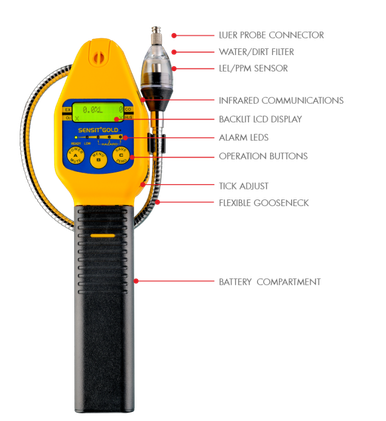
SENSIT GOLD 100
Pumped GOLD-platform investigator with a 5–100% gas scale for purging and inert-gas work.
$2,175.80–$4,430.60 configured
See the GOLD 100What Does the Percentage-of-Gas Scale Actually Do?
The GOLD 100's % NAT GAS channel reads 5–100% gas at 0.1% resolution (±5%), with the gas type selectable between methane (natural gas) and propane. Think about what a purge looks like without it: LEL instruments peg at 100% LEL — a few percent gas by volume — and then tell you nothing more, while the pipe may be anywhere from barely flammable to fully gassed. The % gas scale keeps reading through the whole sweep, so the crew can watch the mixture climb through the flammable range and out the top of it, confirm a fully gassed main before tie-in, or verify an inerted line is truly inert rather than merely below an alarm. That is why the application list names pipeline purging (NFPA 54 compliant) and inert gas operations explicitly — those procedures are written in percent gas, not percent LEL.
What Else Does the GOLD 100 Measure?
Everything the original GOLD measures, on the same pumped platform:
- Leak channel, 10–50,000 ppm (UL) — the survey and pinpoint scale, with an optional ppm sensor scale of 0–2,000 ppm at 1 or 10 ppm resolution.
- LEL, 0–100% at 0.1% resolution (±10%) — the flammability channel for excavation and entry decisions.
- Oxygen, 0–25% at 0.1%; carbon monoxide, 0–2,000 ppm at 1 ppm; hydrogen sulfide, 0–100 ppm at 1 ppm; hydrogen cyanide, 0–30 ppm optional — up to four gases displayed simultaneously.
- The sensed-gas list — methane, natural gas, propane, butane, gasoline vapor, hydrogen sulfide, carbon monoxide — the everyday fuel-gas world of utility work.
The platform carries over intact: internal pump with water/dust filter, intrinsically safe certified design, field calibration with due-date alert, calibration and operation memory, infrared download, bright LCD, programmable auto shut-off. The dimensions are the GOLD's — 11.5 × 3 × 2.32 in., 1.2 lb — but the alkaline runtime stretches to approximately 18 hours continuous, and the standard kit adds a working choice: a 2-piece barhole probe or a confined-space probe, plus a T10 Allen wrench, alongside the hard case, C cells, sensor cap, wrist strap, and manual.
Where Does the GOLD 100 Sit in the GOLD Family?
The original GOLD is the entry pumped multi-gas investigator — survey, pinpoint, CO investigations, confined-space protection — from $1,314.88 configured. The GOLD 100 starts at $2,175.80 and earns the step with the % gas scale, the longer runtime, and the probe-inclusive kit: it is the one specified when purging and inerting are regular work rather than occasional favors. The G2 and G3, covered in the G2 & G3 leak investigation post, are the newer generation of the line.
The buying rule is procedural: if your written procedures say percent gas anywhere — purge verification, inerting checks, gas-freeing — you need an instrument that reads percent gas, and in this family that is the 100. If your procedures never leave the LEL/ppm world, the original GOLD covers them for less. Buying the 100 'just in case' for a scale your procedures never call is shelf money; skipping it when they do call is a compliance hole.
How Does a GOLD 100 Working Day Actually Run?
Take the application list in order and the 100's design choices explain themselves. Morning leak survey and underground pinpointing run on the leak channel and the barhole probe from the standard kit — the probe is not an accessory purchase because SENSIT knows the survey is the base job. A CO investigation at a customer's premises uses the protection display the platform is built around. The afternoon purge job is where the 100 separates from its sibling: the % gas scale verifies the sweep, the selectable methane/propane gas type matches the product in the main, and the inerting check at the end is a reading, not an estimate. Through all of it the pump draws through its water/dust filter, the ~18-hour alkaline runtime outlasts the shift, and the day's calibrations and events sit in memory for infrared download. One instrument, four job types, no box-swapping in the truck — that continuity is what the GOLD 100's price buys over the original.
Frequently Asked Questions
How much does the SENSIT GOLD 100 cost?
Configured, $2,175.80–$4,430.60 at CPS Calibrations across 9 builds — sensor complement and accessories set where a given build lands. The live configurations are on the SENSIT GOLD 100 product page.
What is the difference between the SENSIT GOLD 100 and the SENSIT GOLD?
The GOLD 100 adds a percentage-of-gas scale (5–100% gas) for pipeline purging and inert-gas work, selectable methane/propane gas type, roughly 18 hours of alkaline runtime against the GOLD's ~12, and a standard kit that includes a barhole or confined-space probe. The original GOLD covers leak survey, pinpointing, CO investigations, and confined-space protection at a lower starting price. Both display up to four gases and share the 10–50,000 ppm leak channel.
Why would I need a percentage-of-gas reading?
Because purging and inerting are specified in percent gas. An LEL instrument saturates at 100% LEL — only a few percent gas by volume — and reads nothing beyond it, while a purge sweep runs from 0% to 100% gas. The GOLD 100's % gas channel (5–100%, 0.1% resolution) reads through the entire sweep, so a crew can verify a main is fully gassed before tie-in or truly inert before opening.
What gases does the SENSIT GOLD 100 detect?
Up to four simultaneously: combustible gas (LEL, plus the % gas scale), oxygen (0–25%), carbon monoxide (0–2,000 ppm), and hydrogen sulfide (0–100 ppm), with hydrogen cyanide (0–30 ppm) optional. Its leak channel reads 10–50,000 ppm, and it senses methane, natural gas, propane, butane, gasoline vapor, and the toxic channels listed.
Does the SENSIT GOLD 100 have a pump?
Yes — an internal pump with a water/dust filter draws samples from bar holes, vaults, and confined spaces. Pumped sampling is what makes underground pinpointing and purge-point sampling practical rather than approximate.
How long does the SENSIT GOLD 100 battery last?
Approximately 18 hours of continuous operation on three alkaline C cells — a long survey or purge day on one set. A recharger kit is available as an option for daily-use crews.
Is the SENSIT GOLD 100 intrinsically safe?
Yes — it is a certified intrinsically safe design, built for use in the classified atmospheres where fuel-gas work happens, in the same 11.5 × 3 × 2.32 in., 1.2 lb housing as the GOLD platform.
What comes in the SENSIT GOLD 100 standard kit?
A hard carrying case, three C batteries, an extra sensor cap, your choice of a 2-piece barhole probe or a confined-space probe, a wrist strap, a T10 Allen wrench, and the instruction manual. Optional accessories include a recharger kit, printer, PC interface, hot-air probe, and calibration kit.
How much does it cost to calibrate a SENSIT GOLD 100?
A multi-gas configuration calibrates at CPS's published in-house rate of $90 for 4- and 5-gas instruments — a bench rate at our Rockwood, Tennessee shop, never an on-site price. Every channel is calibrated as configured, the certificate carries as-found and as-left readings with the calibration gas's CoA link, and the instrument joins the CPS Calibration Program. Details are on the calibration services page.
Should I buy the GOLD 100 or the GOLD G2/G3?
Different questions. The GOLD 100 is the GOLD-platform instrument with the % gas scale — the purge/inerting choice. The G2 and G3 are the newer generation of the leak-investigation line, covered in CPS's G2 & G3 post. If your procedures require percent-gas verification, that requirement decides first; generation preference decides second. Call 865-900-8844 and we will walk your job list against both.
The Bottom Line
The GOLD 100 is the GOLD with the process scale: percent gas, 5–100%, on a pumped four-gas investigator — the instrument purge and inerting procedures are written around. At $2,175.80–$4,430.60 configured it costs more than the original GOLD because it does a job the original cannot. Match the instrument to your procedures and the choice makes itself.
Purge procedures on your job list and unsure which scale they require? Call CPS Calibrations at 865-900-8844 — read us the procedure and we will tell you which instrument it names in effect.
--- CPS Calibrations · 109 S. Front Street, Rockwood, TN 37854 · SENSIT GOLD 100 · SENSIT GOLD · Calibration Services
Need a calibration you can file?
In-house calibration at CPS in Rockwood, Tennessee — $55 for single-gas instruments, $90 for 4- and 5-gas — every channel, as-found and as-left data, full certificate.
See Calibration Servicesor call 865-900-8844
Recent Posts
-

What Is Remote Monitoring for Fixed Gas Detection?
Remote monitoring for fixed gas detection means a fixed system's live readings, trends, and alarm hi …Nov 23rd 2026 -

What Are the Key Differences Between the GX-6000 and GX-6100?
The RKI GX-6100 is the current replacement for the discontinued GX-6000: both are pumped 6-gas monit …Nov 22nd 2026 -

How to Read a PID Correction Factor Chart
To read a PID correction factor chart, find your vapor’s row, take the factor under your own lamp en …Nov 21st 2026