
SENSIT GOLD G2 and G3: The Leak Investigation Instruments Utilities Actually Carry
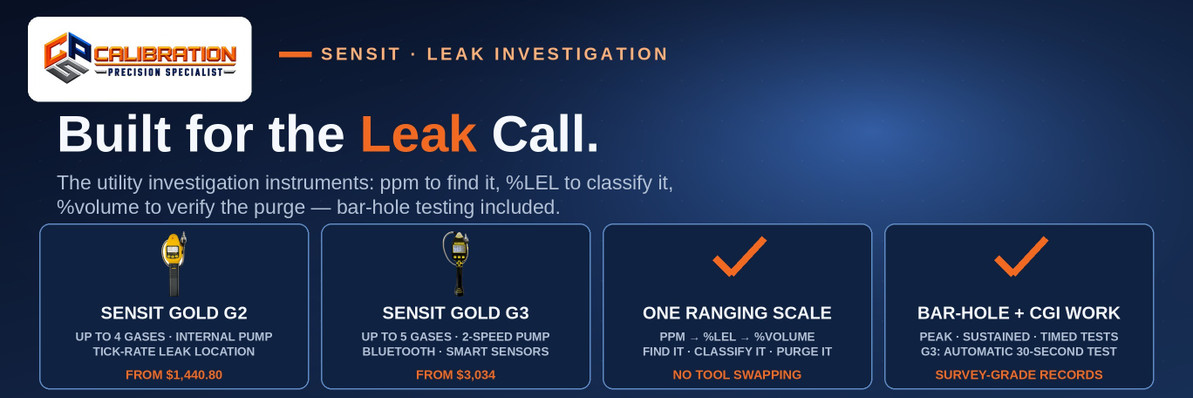
The SENSIT GOLD G2 and GOLD G3 are combustible gas investigation instruments built for utility leak work: each one ranges from parts per million (ppm) for finding a leak, through %LEL for classifying it, to %volume for purging and inert-gas work — with an internal pump, bar-hole testing, and toxic-gas and oxygen channels alongside. The G2 (from $1,440.80 at CPS) displays up to 4 gases at once; the G3 (from $3,034) displays up to 5, and adds a 2-speed pump, smart sensors, Bluetooth, and optional GPS.
A personal 4-gas monitor answers one question: is the air around this worker safe right now? A leak investigation instrument answers a different set: Is there gas here? Where exactly is it coming from? How strong is it at the source? And is this line actually purged? The SENSIT GOLD G2 and SENSIT GOLD G3 are built for the second set of questions — they are the modern form of the combustible gas indicator (CGI) that utility crews have carried for decades, extended with pumped sampling, ppm sensitivity, and toxic channels.
SENSIT GOLD G2
The SENSIT GOLD G2 (from $1,440.80) and GOLD G3 (from $3,034) are the combustible leak investigation instruments built for utility work: ppm, %LEL, and %volume ranging on one instrument, an internal pump, bar-hole testing, and CGI readings — what each model does, what the configurations cost, and which jobs each one fits.
$1,440.80–$3,002.20 configured
See the GOLD G2What Does a Leak Investigation Instrument Do That a Safety Monitor Doesn't?
Three things, mainly. It reads far lower — down in parts per million, where a leak is a trace long before it is a hazard. It reads far higher — all the way to 100% gas by volume, where a %LEL sensor has long since saturated. And it samples actively, pulling gas through a probe with an internal pump, so the technician can interrogate a bar hole, a meter set, or a vault without putting his face in it. The comparison below is about jobs, not brands:
| Job | Leak investigation instrument (GOLD G2 / G3) | Personal safety monitor |
|---|---|---|
| Find a leak | ppm readings plus an audible tick that speeds up as gas gets stronger | Reads %LEL only — too coarse to follow a trace to its source |
| Classify what you found | %LEL range, 0–100% | %LEL range, 0–100% — this is its home scale |
| Purge / inert work | %volume range — 5–100% gas on both GOLD models | %LEL sensor saturates; cannot read rich gas |
| Bar-hole testing | Timed bar-hole test modes with peak and sustained readings | No bar-hole test function |
| Worker protection during the call | Toxic (CO, H2S, HCN) and O2 channels on configured units | Its primary job — alarms worn in the breathing zone |
Plenty of crews carry both, for the same reason a mechanic owns a wrench set and a torque wrench: related tools, different measurements. This post is about the investigation side of the kit.
How Does ppm → %LEL → %Volume Ranging Actually Work?
A gas reading changes scale as you get closer to the source, and each scale answers a different question:
- ppm (parts per million) — the search scale. The G2 reads 0–10,000 ppm combustible (ppm sensor optional); the G3 reads 0–50,000 ppm. At these levels you are following a gradient — the tick rate and the rising number walk you to the leak.
- %LEL — the hazard scale. 0–100% of the lower explosive limit, at 0.1% resolution on both models. This is where you decide how urgent the find is and how the response gets classified.
- %volume — the rich-gas scale. The G2 reads natural gas from 5–100% volume; the G3 measures 5–100% methane by thermal conductivity. Percent-volume is the only honest scale inside a purged main, a meter set full of gas, or an inerted space where there is no oxygen for a catalytic sensor to work with.
One instrument walking all three scales is the whole point of the GOLD format: the technician who pinpoints a leak in ppm can classify it in %LEL and verify the purge in %volume without going back to the truck.
What Is Bar-Hole Testing, and How Do the GOLD Models Handle It?
When a leak is suspected underground, the crew drills small holes along the line's path and samples the gas that has migrated into the soil at each one. The pattern of readings — which holes are hot, and how the readings rise and fall over a timed test — grades the leak and points at the segment to dig. Both GOLD models are built around this work: the G2 ships with your choice of a 2-piece bar-hole probe or a confined space probe in the standard kit, and logs peak readings, sustained readings, and timed tests. The G3 adds a 30-second automatic bar-hole test with automatic purge, and saves the test data to memory — the difference between a number you remember and a survey you can hand over.
GOLD G2 vs. GOLD G3: What's Actually Different?
| SENSIT GOLD G2 | SENSIT GOLD G3 | |
|---|---|---|
| Price at CPS | $1,440.80–$3,002.20 by configuration | $3,034–$4,659.40 by configuration and GPS |
| Gases displayed | Up to 4 simultaneously | Up to 5 simultaneously |
| ppm range | 0–10,000 ppm (optional) | 0–50,000 ppm (optional) |
| Pump | Internal pump | 2-speed internal pump, with pump performance monitoring |
| Power | 3 C alkaline, approximately 18 hours continuous | Rechargeable, approximately 20 hours continuous |
| Weight | 1.2 lb | 2.3 lb |
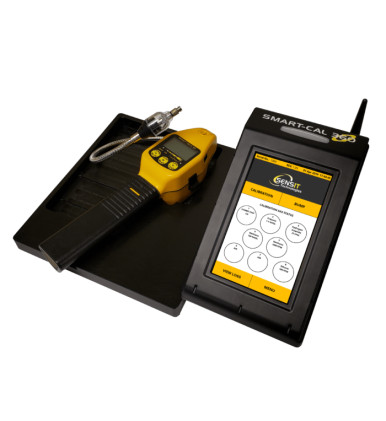
| Data | Internal memory; bar-hole peak/sustained/timed readings | Data logging and mapping; Bluetooth; SMART-CAL 360 compatible; optional GPS (3 m accuracy) |
| Protection | Intrinsically safe; ATEX and UL certified | Intrinsically safe; IP64; UL certified |
Read the table as a workload question, not a better/worse question. A crew whose work is investigate-and-classify — find it, grade it, write it up — is well served by the G2's lighter body and alkaline simplicity. A crew running documented surveys, where every bar-hole test and its location needs to survive as a record, is who the G3's logging, Bluetooth, GPS option, and automatic test sequence were built for. Configurations matter more than the badge: both models are ordered by sensor build — the G2 runs from an LEL-only unit at $1,440.80 to a four-sensor LEL & CO & O2 & H2S build at $3,002.20, and the G3 from LEL-only at $3,034 to a fully loaded build with GPS at $4,659.40. The exact configuration list is on each product page: GOLD G2 configurations and GOLD G3 configurations.
What Else Do Utilities Use Them For?
The application list on the GOLD G2's own product record covers the working week of a gas utility: gas leak surveys, underground leak pinpointing, carbon monoxide investigations, confined space monitoring, combustible gas measurement, pipeline purging, and inert gas operations — including combustible readings in oxygen-free environments, which is exactly where the %volume scale earns its keep. The G3's record adds emissions testing to the same core list. For the pumped ppm end of leak hunting in a smaller package, see our companion piece on the SENSIT HXG-3P; for checking a space from outside it entirely, the SENSIT GasTrac LZ-30 reads methane from up to 100 feet away.
What Does Calibration Look Like for a GOLD G2 or G3?
An investigation instrument lives or dies on trust in small numbers — a ppm reading that has drifted is a leak you'll walk past. CPS calibrates both models in-house: $90 covers a 4- or 5-gas instrument, we calibrate every channel the unit carries, and the certificate shows as-found and as-left readings for each one. Details are on our calibration services page, and every instrument we calibrate is enrolled in the CPS Calibration Program with a reminder ahead of its next due date. Questions about who is qualified to do that work are answered in who can calibrate my gas detector.
Frequently Asked Questions
What is the SENSIT GOLD G2 used for?
The SENSIT GOLD G2 is a combustible gas investigation instrument for utility work: gas leak surveys, underground leak pinpointing, bar-hole testing, carbon monoxide investigations, confined space monitoring, pipeline purging, and inert gas operations. It reads combustible gas in ppm, %LEL, and %volume with an internal pump, and displays up to 4 gases at once, including oxygen, CO, and H2S on configured units. It costs from $1,440.80 at CPS Calibrations.
What is the difference between the SENSIT GOLD G2 and GOLD G3?
The G3 is the larger, survey-grade model: it displays up to 5 gases instead of 4, reads ppm to 50,000 instead of 10,000, uses a 2-speed pump and rechargeable battery (approximately 20 hours), and adds smart sensors, Bluetooth, data logging and mapping, SMART-CAL 360 compatibility, an automatic 30-second bar-hole test, and an optional GPS. The G2 is lighter (1.2 lb vs. 2.3 lb), runs about 18 hours on 3 C alkaline batteries, and costs less: $1,440.80–$3,002.20 against $3,034–$4,659.40 for the G3.
How much does a SENSIT GOLD G2 cost?
At CPS Calibrations the GOLD G2 runs $1,440.80–$3,002.20 depending on sensor configuration: the LEL-only build is $1,440.80, two-sensor builds (LEL with CO, O2, or H2S) are $1,963.20, three-sensor builds are $2,443.20, and four-sensor builds (LEL & CO & O2 & H2S, or with HCN) are $3,002.20. The standard kit includes a hard case, batteries, and your choice of a 2-piece bar-hole probe or a confined space probe.
How much does a SENSIT GOLD G3 cost?
At CPS Calibrations the GOLD G3 runs $3,034–$4,659.40 depending on sensor configuration and GPS. The LEL-only build without GPS is $3,034; two-sensor builds are $3,386.20; three-sensor builds are $3,738.20; four-sensor builds are $4,090.60; and the fullest build (LEL, CO/H2S, O2, and HCN) is $4,442.60. Adding GPS to any configuration adds $216.60, taking the top configuration to $4,659.40.
What gases can the SENSIT GOLD G2 and G3 measure?
Both center on combustible gas — methane (natural gas) and propane are selectable — read in ppm, %LEL, and %volume. Depending on configuration they add oxygen (0–25%), carbon monoxide (0–2,000 ppm), hydrogen sulfide (0–100 ppm), and hydrogen cyanide (0–30 ppm); the G3 also offers sulfur dioxide (0–20 ppm). The G2 displays up to 4 gases simultaneously and the G3 up to 5, and the exact sensor build is chosen at order on each product page.
What is bar-hole testing in gas leak investigation?
Bar-hole testing is how crews grade and locate an underground leak without digging: small holes are drilled along the pipeline's path, and an instrument with a pump samples the gas that has migrated into the soil at each hole. Timed tests with peak and sustained readings show which holes are hottest and how the gas behaves, which grades the leak and points to the segment to excavate. The GOLD G2 logs peak, sustained, and timed bar-hole readings; the GOLD G3 runs a 30-second automatic bar-hole test with purge and saves the data.
Why does a leak detector need a %volume range?
Because %LEL stops meaning anything once gas gets rich. A %LEL sensor saturates at 100% LEL — roughly 5% methane in air — and inside a purged main, a flooded meter set, or an inerted space the actual concentration is far above that, often with no oxygen present for a catalytic sensor to burn gas against. A %volume scale (5–100% gas on both GOLD models) reads those concentrations directly, which is what purge verification and inert-gas work require.
Can the GOLD G2 measure gas in an oxygen-free environment?
Yes — that is one of its stated applications. The GOLD G2's product record lists inert gas operations and detecting combustible gases in oxygen-free environments, because its %volume measurement does not depend on oxygen the way a catalytic %LEL sensor does. Configured toxic and oxygen channels still apply to the spaces where those gases are the question; the %volume combustible reading is the tool for the oxygen-free ones.
Does the SENSIT GOLD G3 have GPS and Bluetooth?
Bluetooth is standard on the GOLD G3, and GPS is a configuration option that adds $216.60 to any sensor build, with 3 m accuracy listed for the GPS option. The G3 also supports data logging and mapping and works with SMART-CAL 360 for automatic calibration and bump testing and SMART-LINK 360 for downloading logs. The GOLD G2 does not list Bluetooth or GPS in its record — it keeps internal memory for readings and bar-hole tests instead.
Who can calibrate a SENSIT GOLD G2 or G3, and what does it cost?
CPS Calibrations calibrates both models in-house at 109 S. Front Street, Rockwood, TN: $90 for a 4- or 5-gas instrument, with every channel calibrated and as-found and as-left readings on the certificate. Call 865-900-8844 to book a unit in, or see our calibration services page. Every calibrated instrument is enrolled free in the CPS Calibration Program, which sends a reminder before its next due date.
The Bottom Line
The GOLD G2 and GOLD G3 are investigation instruments, not bigger safety monitors: ppm sensitivity and a tick to find the leak, %LEL to classify it, %volume to verify the purge, bar-hole testing to grade what's underground — in one pumped instrument, configured with the toxic and oxygen channels the work calls for. G2 from $1,440.80, G3 from $3,034, every configuration priced on its product page.
Choosing between configurations, or putting a price on a survey package? Call CPS Calibrations at 865-900-8844 — we sell both models, calibrate every channel they carry, and will tell you straight which build fits the work you actually do.
CPS Calibrations · 109 S. Front Street, Rockwood, TN 37854 · Calibration Services · The CPS Calibration Program
Need a calibration you can file?
In-house calibration at CPS in Rockwood, Tennessee — $55 for single-gas instruments, $90 for 4- and 5-gas — every channel, as-found and as-left data, full certificate.
See Calibration Servicesor call 865-900-8844
Recent Posts
-

What Is Remote Monitoring for Fixed Gas Detection?
Remote monitoring for fixed gas detection means a fixed system's live readings, trends, and alarm hi …Nov 23rd 2026 -

What Are the Key Differences Between the GX-6000 and GX-6100?
The RKI GX-6100 is the current replacement for the discontinued GX-6000: both are pumped 6-gas monit …Nov 22nd 2026 -

How to Read a PID Correction Factor Chart
To read a PID correction factor chart, find your vapor’s row, take the factor under your own lamp en …Nov 21st 2026