
SENSIT HXG-3P: Pumped Combustible Leak Hunting Indoors and Out
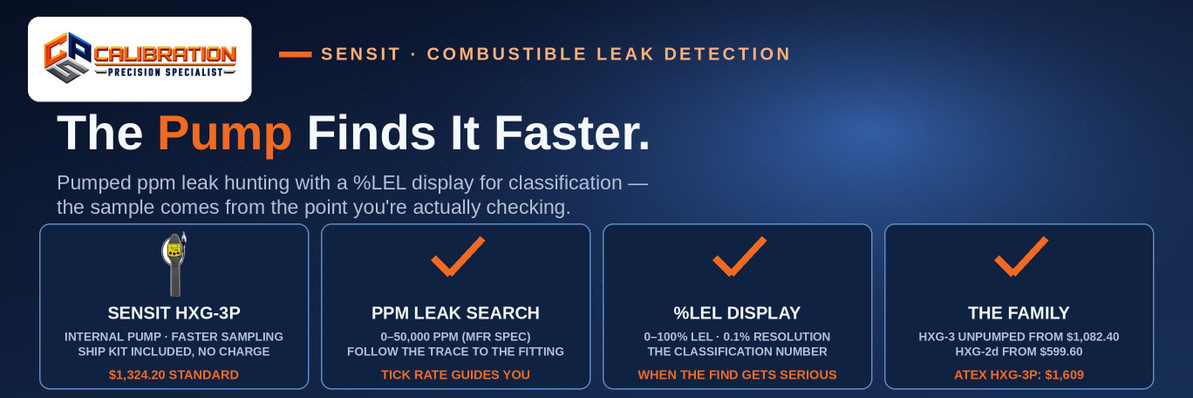
The SENSIT HXG-3P is a pumped combustible gas leak detector: it adds an internal pump to the SENSIT HXG-3, displays ppm and %LEL readings for the same gas, and is built to hunt leaks — following a ppm trace and a tick rate to the source, indoors and out. It costs $1,324.20 with Standard certification or $1,609 with ATEX certification at CPS Calibrations, with a ship kit (hard case or soft pouch) included at no charge.
Most combustible instruments are read one of two ways, and confusing them causes real trouble on leak calls. A safety monitor speaks %LEL: it exists to say whether the air is approaching a flammable mixture. A leak detector speaks ppm: it exists to say where the gas is coming from. The SENSIT HXG-3P is firmly the second kind of tool — with a %LEL display alongside, and a pump doing the sampling work.

SENSIT HXG-3P Combustible Gas Leak Detector (With Pump)
The SENSIT HXG-3P ($1,324.20 Standard, $1,609 ATEX at CPS) adds an internal pump to the HXG-3 combustible leak detector, displaying ppm and %LEL together for leak search: how pumped ppm hunting differs from %LEL safety monitoring, what the pump changes, and how the HXG-3 and HXG-2d compare.
$1,324.20–$1,609 configured
See the HXG-3P CombustibleWhat Does the Pump Actually Change?
The HXG-3P's store record puts it in one sentence: it adds an internal pump to the HXG-3 combustible gas leak detector for faster sampling. Unpack that into field terms:
- You sample the point, not the room. A diffusion instrument reads the air that drifts across its sensor. A pumped instrument pulls gas through its probe from the place you point it — a valve packing, a meter union, the inside of a cabinet, a bar hole — and brings that gas to the sensor.
- The reading comes to you. Instead of leaning the instrument (and yourself) into every suspected pocket, you extend the probe and let the pump do the traveling. On outdoor survey work that means sampling soil gas at the bar hole without kneeling the detector into the hole; indoors it means checking the top of a water heater closet or the back of a manifold from where you stand.
- Response follows the sample. Faster sampling is the record's own phrase: the pump moves gas continuously, so the tick rate and the ppm number track your probe's movement instead of lagging behind diffusion.
ppm vs. %LEL: Why Does a Leak Detector Show Both?
Because a leak search asks two questions in sequence. First, in ppm: is there gas here, and which way does it get stronger? The HXG-3P's ppm scale runs 0–50,000 ppm (manufacturer specification; ppm display optional by build) at 1 or 10 ppm resolution — sensitive enough to follow a trace along a run of pipe and watch it build toward the fitting that's letting go. The audible tick control works the same gradient: faster ticking, stronger gas, closer source.
Then, in %LEL: how serious is what I found? The %LEL scale runs 0–100% LEL at 0.1% resolution. That is the classification number — the one that decides whether this is a repair ticket, an evacuation, or an emergency call. A detector that showed only ppm would leave you converting in your head at the worst moment; a monitor that showed only %LEL would be blind to the trace until it was already a hazard. The HXG-3P's job is to carry you from the first question to the second in one pass. Our GOLD G2 and G3 spotlight covers the same ranging idea on the larger utility investigation instruments.
Is the HXG-3P a Safety Monitor?
No — and the distinction matters enough to state plainly. The HXG-3P is a leak detector: intrinsically safe by design and certified (UL913, Class I, Division 1, Groups C & D with approved alkaline batteries, per SENSIT's brochure), with audible and visual alarms — but its readings are taken at the probe, on a search pattern, by a technician who is hunting. A personal safety monitor is a different contract: it rides in the worker's breathing zone, watches continuously, and alarms on the gases and thresholds the safety program sets, whether or not anyone is hunting that day.
In practice the two ride in the same truck. The safety monitor protects the crew while they work; the HXG-3P is what they pick up when the call is find it. If a reading taken during a search says the area itself is becoming the hazard, that's the safety monitor's alarm doing its job — and the search stops. Checking a space from a distance, before anyone goes in, is yet another tool: the SENSIT GasTrac LZ-30 reads methane from up to 100 feet away.
HXG-3P vs. HXG-3 vs. HXG-2d: Which One Fits?
| Model | Price at CPS | What it is |
|---|---|---|
| SENSIT HXG-3P | $1,324.20 Standard / $1,609 ATEX | The pumped version — internal pump for faster sampling, ppm + %LEL leak search at the probe |
| SENSIT HXG-3 | $1,082.40 Standard / $1,324.20 ATEX | The same leak-detector family without the pump: low-power semiconductor sensor reading in PPM and LEL |
| SENSIT HXG-2d | From $599.60 | The smaller combustible detector — LEL range at 0.1% LEL resolution; the 2dr rechargeable build is $674.40, ATEX $723.80 |
The honest way to choose: if your searches are mostly at arm's length in open air, the diffusion HXG-3 does the same ppm/LEL work for less. If you routinely sample points you can't put the instrument body on — cabinets, vaults, bar holes, appliance interiors — the pump is not a luxury; it's the difference between reading the point and reading near the point. And if the job is combustible checks at %LEL resolution in a compact body, the HXG-2d is the entry point to the family. SENSIT's partial list of gases the HXG-3P senses covers the usual combustible suspects — methane, natural gas, propane, butane, gasoline, hydrogen, refrigerants, and solvents among them.
What Does Calibration Cost for an HXG-3P?
A leak detector you can't trust at 500 ppm will cost you a dry hole or a missed leak. CPS calibrates the HXG-3P in-house at the single-gas rate of $55, with as-found and as-left readings on the certificate; the full picture is on our calibration services page, and calibrated instruments are enrolled in the CPS Calibration Program with a due-date reminder. If you're deciding who should be doing that work at all, who can calibrate my gas detector lays out the standard.
Frequently Asked Questions
What is the SENSIT HXG-3P?
The SENSIT HXG-3P is a combustible gas leak detector with an internal pump. It is the pumped version of the SENSIT HXG-3: the pump draws gas from the point its probe touches — a fitting, a cabinet, a bar hole — to the sensor for faster sampling, and the instrument displays combustible readings in ppm for leak searching and in %LEL for classification. It is intrinsically safe by design, with audible and visual alarms and a tick control for following a leak to its source.
How much does the SENSIT HXG-3P cost?
At CPS Calibrations the HXG-3P is $1,324.20 with Standard certification or $1,609 with ATEX certification. A ship kit — your choice of hard case or soft pouch — is included at no charge with either version. The unpumped HXG-3 is $1,082.40 (Standard) or $1,324.20 (ATEX), and the smaller HXG-2d starts at $599.60.
What is the difference between the HXG-3P and the HXG-3?
The pump. The HXG-3P adds an internal pump to the HXG-3 for faster sampling: it pulls gas from the probe tip to the sensor, so you can sample fittings, cabinets, vaults, and bar holes at the point instead of relying on gas drifting to the instrument. The HXG-3 is a diffusion instrument with a low-power semiconductor sensor reading in PPM and LEL. Both are combustible leak detectors in the same family; the 3P is $241.80 more in Standard certification ($1,324.20 vs. $1,082.40).
What does ppm mean on a leak detector, and how is it different from %LEL?
ppm is parts per million — the search scale. The HXG-3P reads 0–50,000 ppm, which lets you follow a faint trace along a pipe run and watch it build toward the leaking fitting. %LEL is the hazard scale: 0–100% of the lower explosive limit, the scale that classifies how close the air is to a flammable mixture. ppm finds the leak; %LEL tells you how urgent it is. A leak detector shows both so the same instrument can do the hunt and the classification.
Can the HXG-3P be used as a personal safety monitor?
No. The HXG-3P is a leak detector — it samples at its probe while a technician searches, and its job is finding and classifying leaks. A personal safety monitor is worn in the breathing zone, monitors continuously, and alarms on the thresholds in your safety program whether or not a search is under way. The HXG-3P is intrinsically safe and has audible/visual alarms, but it does not replace the personal monitor your crew wears; the two tools do different jobs and normally ride in the same truck.
What gases does the SENSIT HXG-3P detect?
It is a combustible gas detector. SENSIT's partial list of gases sensed includes acetone, alcohol, ammonia, butane, gasoline, halon, hydrogen, jet fuel, ethylene oxide, methane, natural gas, propane, refrigerants, and solvents. Readings are shown in ppm and %LEL. Like all combustible sensors, it responds to flammable gases and vapors as a class — it does not identify which gas it is reading, and it is not a toxic-gas or oxygen monitor.
Why would I choose the ATEX version of the HXG-3P?
ATEX certification is the European hazardous-location certification; the Standard version is the North American configuration. At CPS the ATEX HXG-3P is $1,609 against $1,324.20 for Standard. Choose ATEX if your company's specifications, your insurer, or the sites you work require ATEX-certified equipment; choose Standard if your work is under North American requirements. The instrument and its leak-detection functions are the same either way.
What is tick rate on a leak detector?
The tick is the HXG-3P's audible leak-location signal: a clicking sound whose rate increases as the gas concentration at the probe rises. Walking a pipe run, you listen for the tick to speed up — faster ticking means stronger gas, which means you are closing on the source — while the display gives you the actual ppm or %LEL number. It lets you hunt with your eyes on the fittings instead of glued to the screen.
How is the HXG-2d different from the HXG-3P?
The HXG-2d is the smaller, LEL-focused member of the family: it measures combustible gas in the LEL range at 0.1% LEL resolution, and starts at $599.60 at CPS (the rechargeable 2dr is $674.40; ATEX is $723.80). The HXG-3P adds the ppm leak-search scale and the internal pump. If your work is combustible checks in %LEL, the 2d covers it; if your work is finding small leaks and sampling remote points, the 3P is the tool built for it.
Who can calibrate a SENSIT HXG-3P, and what does it cost?
CPS Calibrations calibrates the HXG-3P in-house at 109 S. Front Street, Rockwood, TN for $55 at the single-gas rate, with as-found and as-left readings on the certificate. Call 865-900-8844 to book it in. Every instrument we calibrate is enrolled free in the CPS Calibration Program, which tracks its due date and sends a reminder before the next calibration is due.
The Bottom Line
A leak search runs on two scales: ppm to find it, %LEL to classify it. The HXG-3P carries both, and its internal pump pulls the sample from the point you're actually checking — the fitting, the cabinet, the bar hole — instead of the air that happens to drift past. $1,324.20 Standard, $1,609 ATEX, ship kit included.
Not sure whether your work needs the pump, or the unpumped HXG-3, or the smaller HXG-2d? Call CPS Calibrations at 865-900-8844 and describe the calls you run — we'll point you at the one that fits, and we calibrate every channel of whichever you choose.
CPS Calibrations · 109 S. Front Street, Rockwood, TN 37854 · Calibration Services · The CPS Calibration Program
Need a calibration you can file?
In-house calibration at CPS in Rockwood, Tennessee — $55 for single-gas instruments, $90 for 4- and 5-gas — every channel, as-found and as-left data, full certificate.
See Calibration Servicesor call 865-900-8844
Recent Posts
-

What Is Remote Monitoring for Fixed Gas Detection?
Remote monitoring for fixed gas detection means a fixed system's live readings, trends, and alarm hi …Nov 23rd 2026 -

What Are the Key Differences Between the GX-6000 and GX-6100?
The RKI GX-6100 is the current replacement for the discontinued GX-6000: both are pumped 6-gas monit …Nov 22nd 2026 -

How to Read a PID Correction Factor Chart
To read a PID correction factor chart, find your vapor’s row, take the factor under your own lamp en …Nov 21st 2026