
SENSIT GasTrac LZ-30: Remote Methane Detection From 100 Feet
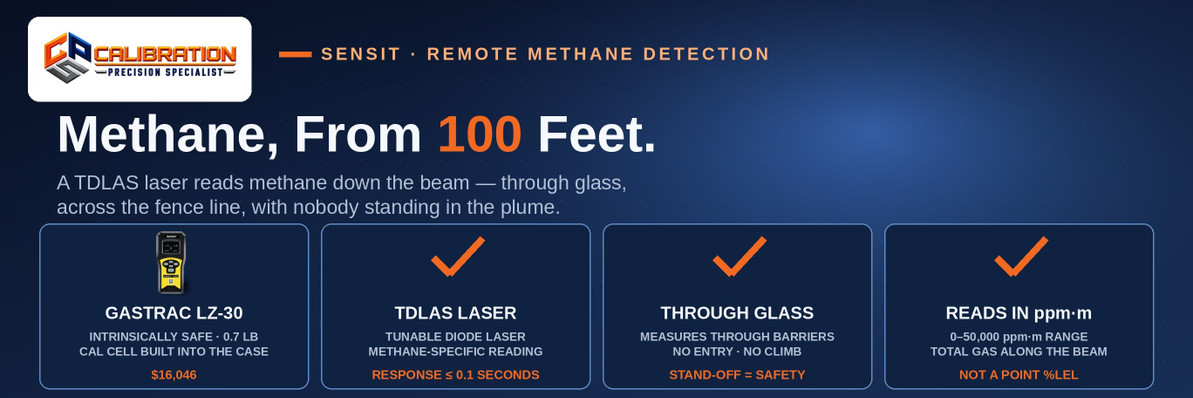
The SENSIT GasTrac LZ-30 is a handheld remote methane detector that uses a tunable laser (TDLAS) to read methane from 0.5 to 30 meters — up to 100 feet — away, including through glass and barriers, and reports it in ppm·m, the total methane along the beam path. The stand-off distance is the safety feature: the operator stays out of the plume, out of the fenced yard, and off the ladder while the instrument answers. It is $16,046 at CPS Calibrations, in an intrinsically safe version with its calibration/bump test cell built into the carrying case.
Every contact leak detector carries an assumption: somebody has to go to the gas. Up the ladder to the fitting, through the gate into the yard, into the vault, across the room where the alarm is sounding. The SENSIT GasTrac LZ-30 inverts that. It is a remote detector — the sensing happens at laser distance, and the person happens somewhere safer.
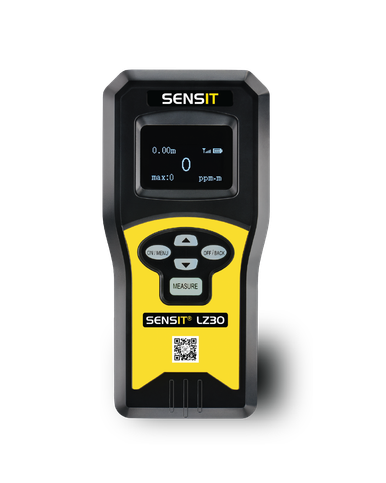
SENSIT GasTrac LZ-30 Remote Gas Leak Detector
The SENSIT GasTrac LZ-30 ($16,046 at CPS) is a handheld laser (TDLAS) remote methane detector that reads methane from 0.5 to 30 m — up to 100 feet — through glass and barriers, in ppm·m: how remote detection works, what a ppm·m reading really says, and when stand-off distance is the safety feature.
$16,046
See the GasTrac LZ-30 RemoteHow Does the LZ-30 Detect Methane From a Distance?
The technology is TDLAS — tunable diode laser absorption spectroscopy. The LZ-30 projects an infrared laser beam tuned to a wavelength that methane absorbs. The beam travels to the target — a wall, a meter set, the ground beyond a plume — reflects back, and the instrument measures how much of that wavelength the methane along the path absorbed. More absorption, more methane in the path. SENSIT's specification gives a detection distance of 0.5 m to 30 m (about 1.5 to 100 feet), a range of 0–50,000 ppm·m, and a response time of a tenth of a second or less — fast enough to sweep: walk the beam across a compressor row, a wellhead, or a row of meter sets and watch the reading react in real time.
Two practical consequences fall out of the physics. First, the LZ-30 is methane-specific — the laser is tuned to methane's absorption, so it is not a general combustible sniffer and it does not respond to other gases the way a semiconductor leak detector does. Second, it needs a surface to reflect from, and the rated sensitivity assumes a decent reflection: SENSIT specifies sensitivity of 5 ppm·m at distances up to 15 m and 10 ppm·m out to the full 30 m. Distance varies with the target's reflectivity — a fact the specification states and any honest operator plans around.
What Does a ppm·m Reading Actually Mean?
This is the part to get right, because ppm·m is not ppm. A contact instrument reads the concentration at its sensor — the gas at one point. The LZ-30 reads the sum of the methane along the whole beam path: concentration multiplied by the thickness of gas the beam crossed, expressed in parts per million × meters. A reading of 500 ppm·m could be a thin layer of strong gas or a deep layer of weak gas — the beam cannot tell you which, and it cannot hand you a %LEL at any point in the plume.
That makes the LZ-30 a finding and screening instrument, and a superb one: is there methane over there, and roughly how much? Pinpointing the fitting and classifying the hazard at the source are contact work — a pumped ppm detector like the SENSIT HXG-3P for the hunt, and an investigation instrument like the GOLD G2 or G3 when the job needs the full ppm → %LEL → %volume picture. The LZ-30's job is to make sure the person doing that work only goes in when there's a reason to, already knowing which corner to go to.
When Is Stand-Off Distance the Safety Feature?
- Through a window, before entry. The LZ-30 measures through glass — the store record says through glass and barriers outright. A crew arriving at a reported odor call can read the room or the meter closet from outside the door glass before deciding how to enter.
- Fenced, locked, or posted property. The beam crosses the fence line legally and physically; the operator doesn't. Survey and first-response screening stop depending on access.
- Elevated fittings. Roof lines, rack piping, and overhead runs get checked from the ground — no ladder, no lift, no climbing toward a suspected leak to confirm it exists.
- The alarm you don't trust yet. When a fixed head or a caller's report says gas, the first question — is there actually methane there? — can be answered from the doorway or the street while the approach is planned.
- Wide-area screening. At 0.7 lb with a 6-hour continuous battery rating and near-instant response, the LZ-30 sweeps a facility or a street segment at walking pace, flagging the spots that deserve a contact instrument.
What Comes With the LZ-30, and What Does It Cost?
At CPS the GasTrac LZ-30 is $16,046 — a single configuration, intrinsically safe version. The store record lists what's in the kit: hard carrying case, wrist strap, instruction manual, protective rubber boot, and charger base with wall transformer. The detail worth pausing on is the case: the calibration/bump test cell is integrated into it, so the instrument's function check and calibration reference travel with it instead of living in a separate kit back at the shop.
How Is a Laser Detector Calibrated?
Through that cell. The LZ-30's case incorporates the calibration/bump test cell, which gives the laser a known methane path to verify against. Beyond the built-in cell checks, CPS calibrates the LZ-30 in-house at the $55 single-gas rate, with the certificate carrying as-found and as-left readings like every instrument we service — see calibration services for the process, and the CPS Calibration Program for due-date tracking. Who should be doing calibration work generally is covered in who can calibrate my gas detector.
Frequently Asked Questions
How far away can the SENSIT GasTrac LZ-30 detect methane?
SENSIT rates the LZ-30's detection distance at 0.5 m to 30 m — about 1.5 to 100 feet — with the distance varying depending on how well the target surface reflects the beam. Specified sensitivity is 5 ppm·m at distances up to 15 m (50 ft) and 10 ppm·m out to the full 30 m (100 ft), over a measurement range of 0–50,000 ppm·m.
How much does the SENSIT GasTrac LZ-30 cost?
The GasTrac LZ-30 is $16,046 at CPS Calibrations — a single configuration in the intrinsically safe version. The kit includes a hard carrying case with the calibration/bump test cell integrated, a protective rubber boot, a wrist strap, an instruction manual, and a charger base with wall transformer. It is a specialized remote-detection instrument, priced accordingly; contact leak detectors for the follow-up work cost far less.
What is ppm·m on the LZ-30?
ppm·m is parts per million times meters — the total methane along the laser's whole beam path. A contact detector reads the concentration at one point; the LZ-30 adds up the methane the beam crossed on its way to the target and back through it, so the same reading can come from a thin layer of strong gas or a deep layer of weak gas. It is the right unit for screening and locating; it is not a point concentration and cannot be converted directly into a %LEL at the source.
Can the LZ-30 detect methane through glass?
Yes. The LZ-30 measures methane at distance through glass and barriers — the laser passes through a window, reflects off the surface beyond it, and reads the methane in the path on the way back. That makes it possible to check a meter set, a room, or an appliance closet from outside before anyone opens the door and goes in.
What gases does the GasTrac LZ-30 detect?
Methane only. The LZ-30's laser is tuned to a wavelength methane absorbs (TDLAS — tunable diode laser absorption spectroscopy), which makes it methane-specific: it does not respond to propane, hydrogen, solvents, or other combustible gases the way a semiconductor leak detector does, and it does not measure toxic gases or oxygen. Crews hunting non-methane combustibles or running a full investigation carry contact instruments alongside it.
Is the SENSIT GasTrac LZ-30 intrinsically safe?
Yes — the version CPS sells is the intrinsically safe (IS) version of the LZ-30. The instrument is a 0.7 lb handheld with an internal lithium-ion battery rated at about 6 hours of continuous operation, and its enclosure is designed to meet IP54. Intrinsic safety is what allows a laser instrument like this to be carried into classified areas as a screening tool.
Can the LZ-30 replace a regular leak detector or survey instrument?
No — it complements them. The LZ-30 tells you from up to 100 feet whether methane is present along a beam path and roughly how much, in ppm·m. It cannot pinpoint the exact fitting (the beam integrates everything along its path) and it cannot give a point %LEL or %volume reading. The working pattern is: screen remotely with the LZ-30, then pinpoint and classify with a contact instrument such as a pumped ppm leak detector or a ppm/%LEL/%volume investigation instrument.
How do you calibrate the GasTrac LZ-30?
The LZ-30's carrying case incorporates a calibration/bump test cell, which gives the laser a known methane reference to check against — the cell travels with the instrument. For a full calibration with a certificate, CPS Calibrations calibrates the LZ-30 in-house at the $55 single-gas rate, with as-found and as-left readings documented. Call 865-900-8844 to book it in.
How fast does the LZ-30 respond?
SENSIT specifies a response time of 0.1 seconds or less — effectively instantaneous for field work. That speed is what makes sweep screening practical: you can walk a beam along a row of fittings, a fence line, or a street segment and see the ppm·m reading react as the beam crosses a plume, instead of waiting for a pumped sample to travel down a hose.
Who uses a remote methane detector like the LZ-30?
Gas utilities screening services and mains before committing a crew, first responders answering odor calls who want to read a structure from outside, and industrial operators checking elevated, fenced, or otherwise hard-to-reach equipment. The common thread is the same: the first question — is there methane there at all? — gets answered from a stand-off distance, and people only close in when the reading says there's a reason to.
The Bottom Line
The LZ-30's specification sheet can be summed up in one sentence: methane, from up to 100 feet, in a tenth of a second, through the window if need be. The stand-off distance isn't a convenience — on the calls where the atmosphere is the question, it's the safety feature. $16,046 at CPS, case and calibration cell included.
If your crews are climbing, entering, or opening doors just to find out whether gas is present, call CPS Calibrations at 865-900-8844. We'll talk through where remote detection fits your workflow — and we calibrate every channel of the contact instruments that do the follow-up work.
CPS Calibrations · 109 S. Front Street, Rockwood, TN 37854 · Calibration Services · The CPS Calibration Program
Need a calibration you can file?
In-house calibration at CPS in Rockwood, Tennessee — $55 for single-gas instruments, $90 for 4- and 5-gas — every channel, as-found and as-left data, full certificate.
See Calibration Servicesor call 865-900-8844
Recent Posts
-

What Is Remote Monitoring for Fixed Gas Detection?
Remote monitoring for fixed gas detection means a fixed system's live readings, trends, and alarm hi …Nov 23rd 2026 -

What Are the Key Differences Between the GX-6000 and GX-6100?
The RKI GX-6100 is the current replacement for the discontinued GX-6000: both are pumped 6-gas monit …Nov 22nd 2026 -

How to Read a PID Correction Factor Chart
To read a PID correction factor chart, find your vapor’s row, take the factor under your own lamp en …Nov 21st 2026