
SENSIT GOLD Combustible Gas Detector: The Original Multi-Gas Leak Investigator
The SENSIT GOLD is the original of the GOLD family: a pumped, intrinsically safe combustible gas detector that displays up to four gases simultaneously — LEL, oxygen, carbon monoxide, and hydrogen sulfide, with hydrogen cyanide optional — and pairs that personal-protection display with a dedicated leak channel reading 10–50,000 ppm for survey and pinpoint work. Configured, it runs $1,314.88–$2,739.92 at CPS Calibrations across 9 builds; a lower headline figure is sometimes shown for this model, but it matches no actual configuration, so the configured range is the number to budget.
Utility leak work has always needed two instruments in one hand. Walking a survey, the investigator needs a sensitive ppm scale that reacts to trace gas long before it is a hazard. Standing over the leak, the same investigator needs %LEL, oxygen, and the toxics read as protection — because the excavation, the vault, and the customer's basement are confined-space problems as much as leak problems. The GOLD was SENSIT's answer: one pumped instrument, a leak channel for finding and a four-gas display for surviving, intrinsically safe and UL/CSA certified for the work. This spotlight covers the original GOLD on its own specs — and then places it honestly in the family it started, beside the SENSIT GOLD 100 and the newer generation covered in SENSIT GOLD G2 & G3 leak investigation. The instrument itself is the SENSIT GOLD.
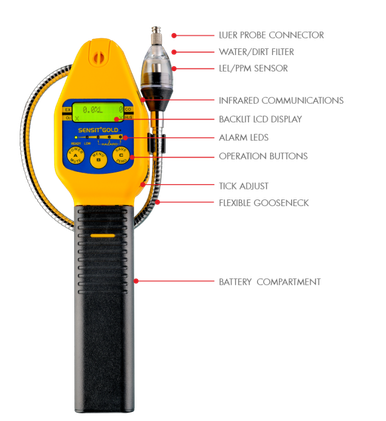
SENSIT GOLD
Pumped leak investigator displaying up to 4 gases — LEL, O2, CO, H2S, with a 10–50,000 ppm leak channel.
$1,314.88–$2,739.92 configured
See the GOLDWhat Does the SENSIT GOLD Measure?
Two scales, one job each. The leak channel reads 10–50,000 ppm (UL listing; 50–50,000 ppm on the CSA listing) — the survey scale, sensitive enough to walk a main or a service line and watch the numbers climb as you near the source. The protection display shows up to four gases simultaneously:
- LEL, 0–100% at 0.1% resolution (±10%) — the flammability reading that governs excavation and entry decisions, with an optional ppm scale of 0–2,000 ppm.
- Oxygen, 0–25% at 0.1% resolution — the channel that catches displaced air in vaults, pits, and basements.
- Carbon monoxide, 0–2,000 ppm at 1 ppm resolution — for the CO investigations utilities run daily, from furnace complaints to ambient checks.
- Hydrogen sulfide, 0–100 ppm at 1 ppm resolution, and hydrogen cyanide, 0–30 ppm as an option — the toxic channels that turn a leak detector into a personal-protection instrument.
Behind those channels sits a partial sensed-gas list that explains the leak channel's reach — methane, natural gas, propane, butane, gasoline vapor, hydrogen sulfide, carbon monoxide — the everyday fuel gases of utility work. The internal pump does the drawing, through a water/dust filter, so the sensor sees gas from bar holes, vaults, and meter sets rather than only the air at the instrument.
How Does the GOLD Fit the Way Leak Crews Actually Work?
The application list on this instrument reads like a utility job board: combustible gas leak detection, gas leak survey, underground leak pinpointing, carbon monoxide investigations, confined space monitoring, combustible gas measurement, pipeline purging, and Method 21 emissions testing. The GOLD was specced for that board — push-button operation with gloves, a bright LCD, audible and visual alarms, field calibration with the due-date alert, calibration and operation memory, and infrared download for the records. At 11.5 × 3 × 2.32 in. and 1.2 lb it is a carried investigator, not a worn monitor — the size buys the pump, the display, and the battery: roughly 12 hours continuous on three alkaline C cells.
The standard kit is a hard carrying case, the C cells, an extra sensor cap, a wrist strap, and the manual; the options list — recharger kit, printer, PC interface, hot-air probe, confined-space probe, calibration kit — is where configurations diverge, which is exactly why the configured price spans $1,314.88–$2,739.92. Sensor complement and accessories, not a discount schedule, move that number.
Where Does the Original GOLD Sit in the GOLD Family?
Three branches, one surname. The GOLD on this page is the original: the straightforward push-button investigator, longest-lived and lowest-cost of the pumped multi-gas GOLDs. The GOLD 100 builds on the same platform and adds the percentage-of-gas scale and purge/inerting work — its own spotlight covers it. The G2 and G3 are the newer generation of the leak-investigation line, covered in depth in the CPS post on SENSIT GOLD G2 & G3 leak investigation.
Read the family this way: the GOLD is the value entry to pumped multi-gas leak investigation, the GOLD 100 is the purge-and-inerting specialist, and the G2/G3 are the current-generation investigators. None of that makes the original obsolete for the crew whose work is survey, pinpoint, and CO calls — it makes it the right-sized tool, provided its channel set (LEL/O2/CO/H2S, HCN optional) covers the hazards on your job list.
What Does the GOLD Cost to Own, Beyond the Purchase?
The predictable costs are small and knowable. Power is three alkaline C cells per roughly 12 hours of continuous running — pocket money, or the optional recharger kit if the instrument works daily. The consumable with a real price is calibration: a multi-gas GOLD configuration calibrates at CPS's published $90 in-house rate, certificate and CoA trail included, and its sensors are specified as low-cost, long-life units — the design point of the platform. The costs that actually hurt GOLD owners are the avoidable ones: a pump or filter neglected until a survey reads wrong, and records scattered until an auditor asks for them. The instrument's own calibration alert, calibration memory, and infrared download exist to prevent exactly those two failures — use them, and the GOLD's ownership story stays as simple as its push-button front panel suggests.
Frequently Asked Questions
How much does the SENSIT GOLD cost?
Configured, $1,314.88–$2,739.92 at CPS Calibrations across 9 builds. A lower headline figure is sometimes displayed, but it matches no actual configuration — sensor complement and kit options set the real price, and the configured range is the number to budget. The live builds are on the SENSIT GOLD product page.
What gases does the SENSIT GOLD detect?
Up to four simultaneously: combustible gas (LEL, with an optional 0–2,000 ppm scale), oxygen (0–25%), carbon monoxide (0–2,000 ppm), and hydrogen sulfide (0–100 ppm), with hydrogen cyanide (0–30 ppm) available as an option. A separate leak channel reads 10–50,000 ppm for survey and pinpointing work.
Does the SENSIT GOLD have a pump?
Yes — an internal pump with a water/dust filter draws the sample, which is what makes bar-hole checks, vault sampling, and underground pinpointing practical. A diffusion instrument can only read the air that reaches it; the GOLD goes and gets the sample.
Is the SENSIT GOLD intrinsically safe?
Yes. The design is certified intrinsically safe, and the instrument carries UL and CSA certification. That is the rating that allows it to be carried into the classified locations and gas-filled atmospheres where leak investigation actually happens.
How long does the SENSIT GOLD battery last?
Approximately 12 hours of continuous operation on three alkaline C cells. A recharger kit is on the options list for crews that run the instrument daily and prefer rechargeables.
What is the difference between the SENSIT GOLD and the GOLD 100?
Same family, different extra scale. The GOLD 100 adds a percentage-of-gas measurement (5–100% gas) suited to pipeline purging under NFPA 54 and inert-gas operations, a longer ~18-hour alkaline runtime, and a probe choice in its standard kit — and it starts at a higher configured price. The original GOLD covers leak survey, pinpointing, CO investigations, and confined-space protection without the % gas scale. The GOLD 100 has its own CPS spotlight.
What is the difference between the SENSIT GOLD and the GOLD G2 or G3?
The G2 and G3 are the newer generation of SENSIT's leak-investigation line; the GOLD is the original platform — push-button, pumped, four-gas display, infrared download. CPS covers the newer instruments in the post on SENSIT GOLD G2 & G3 leak investigation. The GOLD remains the lower-cost way into the same kind of work when its channel set fits your jobs.
How much does it cost to calibrate a SENSIT GOLD?
A multi-gas GOLD configuration calibrates at CPS's published in-house rate of $90 for 4- and 5-gas instruments (a single-gas configuration would take the $55 rate) — bench rates at our Rockwood, Tennessee shop, never on-site prices. The certificate shows as-found and as-left readings for every channel with the calibration gas's CoA link, and the instrument joins the CPS Calibration Program for due-date reminders. See calibration services for the full bench.
Can the SENSIT GOLD be used for confined space monitoring?
Confined space monitoring is one of its listed applications: the pumped sample draw plus simultaneous LEL, O2, CO, and H2S readings are exactly the four channels confined-space work is built around. As with any instrument, it does not replace your entry program — permits, attendants, and ventilation still govern the job — but the measurement set fits the work.
What comes in the SENSIT GOLD standard kit?
A hard carrying case, three C batteries, an extra sensor cap, a wrist strap, and the instruction manual. Optional accessories include a recharger kit, printer, PC interface, hot-air probe, confined-space probe, and calibration kit — the options chosen are a large part of why configured prices span the range they do.
The Bottom Line
The original GOLD earned its place by combining the two halves of leak work — a 10–50,000 ppm survey channel and a four-gas protection display — in one pumped, intrinsically safe instrument, and at $1,314.88–$2,739.92 configured it is still the value door into that combination. If your jobs add purging and inerting, look at the GOLD 100; if you want the current generation, look at the G2/G3 post. If your work is survey, pinpoint, and CO investigations, the original is right-sized.
Not sure which branch of the family fits your job list? Call CPS Calibrations at 865-900-8844 and describe the work — we sell and calibrate all of them, and the advice costs nothing.
--- CPS Calibrations · 109 S. Front Street, Rockwood, TN 37854 · SENSIT GOLD · SENSIT GOLD 100 · Calibration Services
Need a calibration you can file?
In-house calibration at CPS in Rockwood, Tennessee — $55 for single-gas instruments, $90 for 4- and 5-gas — every channel, as-found and as-left data, full certificate.
See Calibration Servicesor call 865-900-8844
Recent Posts
-

What Is Remote Monitoring for Fixed Gas Detection?
Remote monitoring for fixed gas detection means a fixed system's live readings, trends, and alarm hi …Nov 23rd 2026 -

What Are the Key Differences Between the GX-6000 and GX-6100?
The RKI GX-6100 is the current replacement for the discontinued GX-6000: both are pumped 6-gas monit …Nov 22nd 2026 -

How to Read a PID Correction Factor Chart
To read a PID correction factor chart, find your vapor’s row, take the factor under your own lamp en …Nov 21st 2026