
SENSIT HCN Analyzer: Measuring Hydrogen Cyanide Where It Actually Appears
The SENSIT HCN is a hand-held hydrogen cyanide analyzer — a dedicated measuring instrument for the toxic gas that carbon monoxide checks cannot see, produced when nitrogen-bearing synthetics burn and present in a range of industrial processes. It ships with its working kit included — hard carrying case, three C batteries, a hot-air probe, an external filter, and the manual — and runs $1,286.80–$1,608.20 configured at CPS Calibrations.
Every fire-service gas conversation starts with CO, and for good reason — but modern structure fires burn modern contents: foams, plastics, synthetic fabrics and finishes. When those nitrogen-bearing materials burn, they produce hydrogen cyanide alongside the carbon monoxide, and HCN has a property that makes it uniquely dangerous on the fireground: it attacks the body's ability to use oxygen at the cellular level, so it incapacitates in conditions a CO-only picture calls manageable. CPS's background explainer, what is hydrogen cyanide, covers the gas itself in depth. This spotlight covers the instrument: why HCN needs a dedicated analyzer, who measures it and when, and what comes in the box. The instrument itself is the SENSIT HCN.
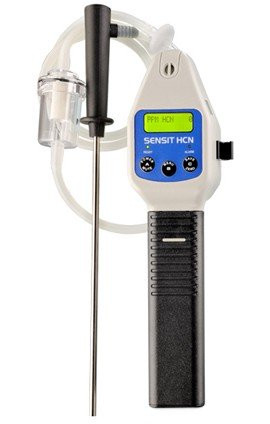
SENSIT HCN Hydrogen Cyanide Analyzer
Hand-held hydrogen cyanide analyzer with hot-air probe and external filter included in the kit.
$1,286.80–$1,608.20 configured
See the SENSIT HCNWhy Does HCN Need Its Own Instrument?
Because no other channel substitutes for it. A CO sensor reads CO; it is silent on cyanide, and the two gases do not rise in a fixed ratio — the fuel package decides the mix, and today's furnishings make that mix HCN-significant. An investigator who measures only CO has measured half the toxic picture of a synthetic-fuel fire and does not know which half. A dedicated HCN analyzer closes that hole with a number: how much cyanide is in this atmosphere, here, now — the figure that overhaul decisions (masks on or masks off), exposure documentation, and industrial process checks actually need. That is the whole argument for a single-purpose instrument, and it is a strong one: the gas is common enough in its settings, dangerous enough in its mechanism, and invisible enough to every other sensor that 'we check CO' is not an HCN program.
Who Measures HCN, and When?
Fire service — overhaul and investigation. Overhaul is the exposure window: the fire is out, the adrenaline is down, respiratory protection comes off, and crews dig through smoldering synthetics that are still off-gassing. A measured HCN reading is what turns 'it smells fine now' into a defensible masks-on or masks-off decision, and it documents the atmosphere the crew actually worked in. Fire investigators use the same measurement when reconstructing what a space held.
Industry — wherever HCN is made, used, or can form. Chemical and plastics processes, fumigation-adjacent work, and any site whose hazard assessment names cyanide need the channel measured by an instrument built for it — for area checks, process verification, and post-incident clearance. The kit's hot-air probe and external filter are the working tells: the probe samples hot gas streams, and the filter protects the measurement in the dirty, particulate-laden air that real HCN settings produce — which is why both are in the box rather than on an options list.
What Ownership Looks Like for a Specialty Analyzer?
Specialty instruments live a particular life: carried less often than a CO analyzer, but relied on completely when they come out — which makes their readiness a discipline problem. The P100-style answer does not apply here; the answer is calibration with documentation. CPS calibrates the SENSIT HCN in-house at the published $55 single-gas rate, and the certificate — as-found and as-left readings, the calibration gas's Certificate of Analysis link — is the record that the analyzer's last reading before your incident was true, and its next one will be. Enrollment in the CPS Calibration Program means the due date is tracked by the program, not by whoever happens to remember the specialty box on the shelf.
The configurations behind the $1,286.80–$1,608.20 range are listed on the product page. However yours is built, the standard kit is the same working set: hard case — specialty instruments travel protected or not at all — batteries, probe, filter, and manual.
How Does an HCN Check Become Routine Instead of Rare?
Specialty measurements fail operationally before they fail technically: the instrument lives in a cabinet, nobody remembers its due date, and on the one night it is needed its calibration is a year stale. The fixes are administrative, and they are the same ones CPS builds its service around. Store it with the CO analyzer, so the toxic pair travels together and the overhaul sweep takes both channels as one habit. Track it in a program, not a memory — an HCN analyzer calibrated at CPS joins the CPS Calibration Program, which watches the due date and reminds you 30 days out, the same as a front-line monitor. Write the decision rule down: the reading at which masks stay on during overhaul should be in the SOP before the incident, not debated on the apparatus floor during it. Do those three things and the HCN channel stops being a specialty event and becomes what it should be — one more number the crew trusts, because it is always ready and always in date.
Frequently Asked Questions
How much does the SENSIT HCN analyzer cost?
Configured, $1,286.80–$1,608.20 at CPS Calibrations. The kit — hard carrying case, three C batteries, hot-air probe, external filter, and instruction manual — is included in the configured price. Live configurations are on the SENSIT HCN product page.
What is hydrogen cyanide, in brief?
A fast-acting toxic gas that interferes with the body's ability to use oxygen at the cellular level. On the fireground it is produced when nitrogen-bearing synthetic materials — foams, plastics, synthetic fabrics — burn, which is why it appears in modern structure-fire smoke alongside carbon monoxide. CPS's explainer what is hydrogen cyanide covers the gas, its sources, and its exposure limits in depth.
Why can't a CO monitor detect HCN?
Sensors are gas-specific: a carbon monoxide sensor measures CO and is silent on cyanide, and the two gases do not occur in a fixed ratio — the burning material sets the mix. A CO-only measurement is therefore not an HCN measurement at any conversion factor. Hydrogen cyanide needs its own sensing channel, which is what a dedicated analyzer provides.
Who uses an HCN analyzer?
Fire departments — for overhaul atmosphere checks and investigation work in synthetic-fuel fires — and industrial sites whose processes make, use, or can generate hydrogen cyanide, for area checks and post-incident clearance. Anywhere a hazard assessment names HCN, a dedicated measuring instrument is how that line gets answered.
What is the external filter for?
Protecting the measurement in dirty air. HCN settings — overhaul debris, industrial atmospheres — carry particulates and contaminants that foul sampling paths; the external filter is part of the working kit so the sample reaching the sensor is the sample you meant to measure. It is included with the instrument.
What comes with the SENSIT HCN?
A hard carrying case, three C batteries, a hot-air (flue) probe, an external filter, and the instruction manual — the full working kit, included in the configured price rather than sold as accessories.
How much does it cost to calibrate a SENSIT HCN?
$55 at CPS Calibrations — the published in-house rate for single-gas instruments, performed at our Rockwood, Tennessee bench and never an on-site price. The certificate carries as-found and as-left readings with the calibration gas's CoA link, and the analyzer joins the CPS Calibration Program so its due date is tracked. See calibration services.
When should firefighters check for HCN?
During overhaul is the textbook moment: the fire is knocked down, crews are digging out smoldering synthetics, and respiratory protection decisions get made. A measured HCN (and CO) reading — not odor, not visibility — is the defensible basis for masks-on or masks-off, and it documents the atmosphere for the exposure record.
Is the SENSIT HCN a personal monitor?
No — it is a hand-held analyzer, carried to the measurement: an overhaul sweep, an area check, a clearance reading. Personal protection is worn and alarming; the analyzer is how a crew quantifies a specific gas in a specific place so decisions and reports rest on numbers.
Can the SENSIT HCN replace our CO analyzer?
No — and it is not meant to. CO and HCN are separate channels answering separate questions; a complete toxic picture in synthetic-fuel smoke needs both measured. The HCN analyzer joins the CO instrument in the kit; fleets that check only one of the pair are seeing half the atmosphere.
The Bottom Line
Hydrogen cyanide is the half of the modern smoke picture that CO instruments cannot see. The SENSIT HCN is the dedicated analyzer for that half — hand-held, probe and filter in the box, $1,286.80–$1,608.20 configured — so overhaul decisions and industrial checks rest on a measured cyanide number. Keep it calibrated at the $55 in-house rate and its number is one you can defend.
Adding an HCN channel to a department or plant gas program? Call CPS Calibrations at 865-900-8844 — we will help you place it in the kit alongside what you already run.
--- CPS Calibrations · 109 S. Front Street, Rockwood, TN 37854 · SENSIT HCN · What Is Hydrogen Cyanide? · Calibration Services
Need a calibration you can file?
In-house calibration at CPS in Rockwood, Tennessee — $55 for single-gas instruments, $90 for 4- and 5-gas — every channel, as-found and as-left data, full certificate.
See Calibration Servicesor call 865-900-8844
Recent Posts
-

What Is Remote Monitoring for Fixed Gas Detection?
Remote monitoring for fixed gas detection means a fixed system's live readings, trends, and alarm hi …Nov 23rd 2026 -

What Are the Key Differences Between the GX-6000 and GX-6100?
The RKI GX-6100 is the current replacement for the discontinued GX-6000: both are pumped 6-gas monit …Nov 22nd 2026 -

How to Read a PID Correction Factor Chart
To read a PID correction factor chart, find your vapor’s row, take the factor under your own lamp en …Nov 21st 2026