
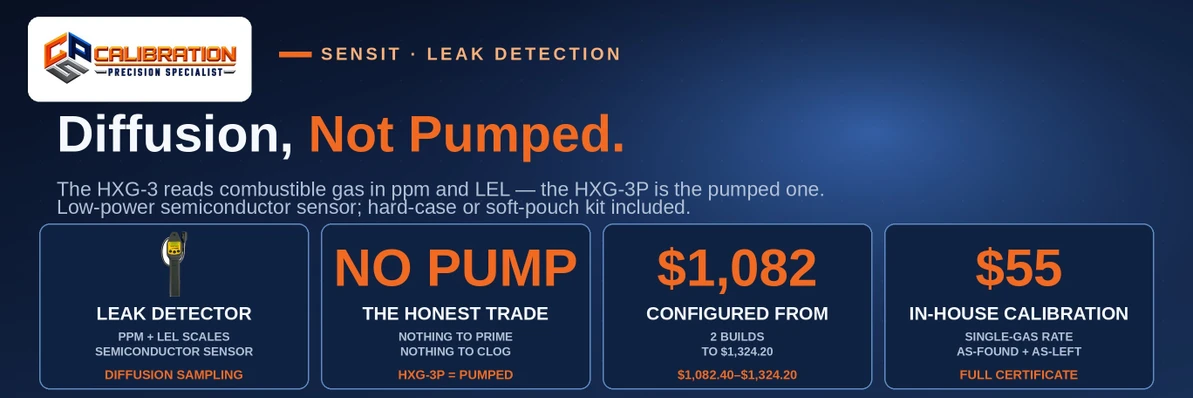
SENSIT HXG-3 Leak Detector: The Diffusion Combustible Leak Detector
The SENSIT HXG-3 is a combustible gas leak detector built around a low-power semiconductor sensor that reads in both ppm and LEL — and it samples by diffusion: there is no pump. Its pumped sibling is the HXG-3P; the HXG-3 on this page is the diffusion model. Configured, it runs $1,082.40–$1,324.20 at CPS Calibrations, with the ship kit — hard case or soft pouch, your choice — included at no charge.
The most common buying mistake in this corner of the catalog is one letter. HXG-3 and HXG-3P look like trim levels; they are actually two sampling methods, and sampling method decides how a leak detector behaves in your hands. A pumped instrument pulls air from bar holes, meter sets, and the far side of a fitting to the sensor. A diffusion instrument reads the air that reaches the sensor — simpler, quieter, nothing to prime or clog, but the sensor has to go where the gas is. This spotlight covers the diffusion model on its own merits and then states the difference plainly, with the pumped model covered in its own CPS post: SENSIT HXG-3P combustible leak detector. The instrument itself is the SENSIT HXG-3.
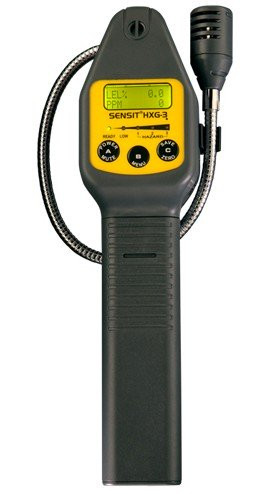
SENSIT HXG-3 Combustible Gas Leak Detector
Diffusion combustible leak detector with a low-power semiconductor sensor reading in ppm and LEL.
$1,082.40–$1,324.20 configured
See the HXG-3What Does the HXG-3 Measure — and How?
Combustible gas, on the two scales leak work uses: ppm for the find — trace concentrations that climb as you approach a source — and LEL for the judgment — how close the atmosphere at the sensor is to flammable. The sensing element is a low-power semiconductor sensor, the technology family leak detectors favor for combustible sniffing: it reacts to combustible gases at the low concentrations a safety LEL channel alone would round away, which is why a leak detector and a personal LEL monitor are different instruments even when both say 'combustible' on the case.
Sampling is diffusion. Gas reaches the sensor by moving through the air on its own — the same principle as a personal monitor — so the working technique is to move the instrument slowly across fittings, joints, meter sets, and appliance connections and let the reading develop. That technique is not a defect to apologize for; on above-ground leak investigation, which is most residential and commercial leak calls, the leaks are where the operator's hands already are.
Which One Has the Pump — HXG-3 or HXG-3P?
Plainly, since the names invite the confusion: the HXG-3P has the pump. The HXG-3 does not. The P is the pump.
Choose the pumped model when the sample has to travel: bar-hole testing over buried lines, drawing from vaults and pits, checking spaces you cannot put your hand — and the instrument — into. Choose the diffusion HXG-3 when the work is at arm's reach: meter sets, regulators, appliance and furnace connections, piping joints, and walk-around leak checks where simplicity, low power draw, and nothing-to-clog matter more than remote draw. Neither is the upgrade of the other; they are two tools sharing a sensor concept, and CPS's spotlight on the HXG-3P covers the pumped technique in the same detail.
What Do the Two Configurations Change?
The HXG-3's two configurations are not sensor packages — they are the ship kit. Choose the hard case or the soft pouch; the kit is included at no charge either way, and that choice is what moves the configured price between $1,082.40 and $1,324.20. Pick the hard case for a truck-box life and shared-crew handling; pick the pouch for a single technician who carries the instrument on the belt or in the tool bag all day. It is a small decision, but it is the honest whole of the price spread — there is no hidden third configuration, and the detector itself is the same instrument in both.
How Do You Work a Diffusion Leak Detector Well?
Technique is the specification diffusion instruments run on. Move slowly. The sensor reads the air that reaches it, and a fast sweep outruns the reading — cross each fitting, union, valve stem, and appliance connection at a pace that lets the display develop, and pause where it stirs. Work the gradient. Leak gas concentrates at the source and thins with distance, so the reading is a map: sweep wide to find the neighborhood, then narrow until the number peaks — the peak is the joint you write up. Mind the air. Wind, ventilation, and even the operator's own movement push a diffusion plume around; re-check a suspect joint from a second approach before condemning it, and re-zero in clean air when the background itself is gassy. None of this requires a pump — it requires patience, which is the real trade the HXG-3 makes: it exchanges drawn-sample reach for simplicity, and rewards a methodical hand with the same answer.
Keeping a Diffusion Detector Honest
A semiconductor leak detector earns trust the same way every gas instrument does: bump it, calibrate it, record it. Because the HXG-3's readings are comparative — gradients and peaks — silent drift is doubly damaging: a desensitized sensor flattens the very gradient the technique reads, and the operator concludes 'no leak' from an instrument that could no longer see one. CPS calibrates the HXG-3 at the published $55 single-gas in-house rate, with as-found readings recorded before adjustment — the as-found figure is the evidence of how the instrument was actually performing on your jobs — and enrollment in the Calibration Program keeps the interval from depending on anyone's memory. Between calibrations, a known-gas function check before a survey day takes a minute and protects the whole day's conclusions.
Frequently Asked Questions
How much does the SENSIT HXG-3 cost?
Configured, $1,082.40–$1,324.20 at CPS Calibrations. The two configurations differ by ship kit — hard case or soft pouch — and the kit is included at no charge; the detector itself is the same instrument. Live configurations are on the SENSIT HXG-3 product page.
Does the SENSIT HXG-3 have a pump?
No. The HXG-3 samples by diffusion — it reads the air at its sensor. The pumped model in this pair is the HXG-3P; the P is the pump. If your work involves bar holes, vaults, or drawing samples from spaces you cannot reach into, you want the pumped sibling, covered in CPS's HXG-3P spotlight.
What does the HXG-3 measure?
Combustible gas, displayed in ppm for leak-finding sensitivity and in LEL for flammability judgment, through a low-power semiconductor sensor. It is a leak detector, not a multi-gas safety monitor — it does not read oxygen or toxic gases.
What is a semiconductor sensor, in plain terms?
A sensing element whose electrical properties change when combustible gas reaches its surface. Leak detectors use the type because it reacts at the low ppm concentrations where leaks announce themselves — well below what a percent-LEL safety reading alone would show. Like every sensor, it needs correct calibration gas and periodic calibration to read true.
Is the HXG-3 a personal safety monitor?
No — it is a leak investigation instrument. It tells you where combustible gas is escaping and how the concentration builds as you approach the source. Personal protection during entry and excavation is the job of a worn multi-gas or LEL monitor with alarms set for that purpose; the two instruments complement each other on a leak crew.
HXG-3 or HXG-3P — which should I buy?
Match the sampling to the work. Arm's-reach leak checks — meter sets, appliances, joints, furnace connections — favor the diffusion HXG-3: simpler, low-power, nothing to prime. Remote sampling — bar holes over buried pipe, vaults, pits — requires the pumped HXG-3P. If your week includes both, the pumped model covers the diffusion model's work less elegantly but completely; the reverse is not true.
What comes with the SENSIT HXG-3?
The detector and your choice of ship kit — a hard carrying case or a soft pouch — included at no charge in the configured price. Choose the case for shared-crew, truck-box service and the pouch for a dedicated carrier.
How much does it cost to calibrate an HXG-3?
$55 at CPS Calibrations — the published in-house rate for single-gas instruments, at our Rockwood, Tennessee bench (never an on-site price). The certificate shows as-found and as-left readings with the calibration gas's Certificate of Analysis link, and the instrument is enrolled in the CPS Calibration Program for due-date reminders. See calibration services.
How often should a leak detector be calibrated?
At the interval in the instrument's manual — and sooner after a failed function check, a hard knock, or readings you do not trust. A leak detector's whole value is a ppm reading you can act on; an instrument that has drifted finds leaks late or invents them, and both errors cost more than a calibration.
Does CPS repair the SENSIT HXG-3?
Yes — CPS sells, calibrates, and repairs the instruments it carries. Anything beyond calibration is quoted in writing before work begins, so a sensor replacement is your decision, made with the price in hand. Call 865-900-8844 or start through the calibration services page.
The Bottom Line
The HXG-3 is the diffusion half of a two-model answer: a low-power semiconductor leak detector reading ppm and LEL, with no pump to prime and the kit included, at $1,082.40–$1,324.20 configured. The HXG-3P is the pumped half. Know which sampling your leak work needs and the one-letter decision makes itself.
Still weighing diffusion against pumped for your crew's work? Call CPS Calibrations at 865-900-8844 and describe the jobs — we will point you at the right letter.
--- CPS Calibrations · 109 S. Front Street, Rockwood, TN 37854 · SENSIT HXG-3 · SENSIT HXG-3P · Calibration Services
Need a calibration you can file?
In-house calibration at CPS in Rockwood, Tennessee — $55 for single-gas instruments, $90 for 4- and 5-gas — every channel, as-found and as-left data, full certificate.
See Calibration Servicesor call 865-900-8844
Recent Posts
-

What Is Remote Monitoring for Fixed Gas Detection?
Remote monitoring for fixed gas detection means a fixed system's live readings, trends, and alarm hi …Nov 23rd 2026 -

What Are the Key Differences Between the GX-6000 and GX-6100?
The RKI GX-6100 is the current replacement for the discontinued GX-6000: both are pumped 6-gas monit …Nov 22nd 2026 -

How to Read a PID Correction Factor Chart
To read a PID correction factor chart, find your vapor’s row, take the factor under your own lamp en …Nov 21st 2026