
SENSIT Trak-It IIIa: The Pumped Combustible Gas Indicator for Leak Survey
The SENSIT Trak-It IIIa is a pumped combustible gas indicator reading in ppm and LEL, built for the utility survey workflow — leak survey, bar-hole testing, and confined-space work — with an internal pump that draws the sample to the sensor instead of waiting for the air to arrive. It is sold in standard and CSA series with a choice of sensor configurations: 18 builds running $1,705.60–$3,407.60 configured at CPS Calibrations, with the ship kit — pouch with shoulder strap, manual, four C batteries, and a confined-space probe — included.
A combustible gas indicator is the surveyor's instrument, and 'indicator' is the operative word: it does not merely alarm, it *indicates* — a graduated reading the operator interprets while moving. The Trak-It IIIa's two scales map to the two halves of a survey. The ppm scale is the search: trace readings over a main, a service line, or a bar-hole pattern, rising as you close on the source. The LEL scale is the judgment: the same atmosphere expressed against flammability, which is the number excavation and entry decisions are made from. The pump is what makes the survey honest — bar holes and probe points are remote samples, and remote samples have to be drawn. This spotlight covers how the IIIa divides that work, the standard-versus-CSA series choice, and what the 18 configurations actually vary. The instrument itself is the SENSIT Trak-It IIIa.
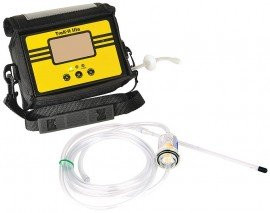
SENSIT Trak-It IIIa Combustible Gas Indicator
Pumped combustible gas indicator (ppm + LEL) for leak survey, bar-hole testing, and confined-space work.
$1,705.60–$3,407.60 configured
See the Trak-It IIIaHow Do the ppm and LEL Scales Divide a Survey?
Walk the job in order. A survey starts on ppm: the crew walks the line or the street with the probe drawing samples, watching small numbers that mean *gas is migrating here*. Bar holes — the drilled pattern over a buried line — get probed one by one, and the ppm readings sort them: the hole that reads highest stands over or nearest the leak, and the pattern of the rest tells you about migration through soil and pavement. None of that works by diffusion; the sample at the bottom of a bar hole must be pulled up to the sensor, which is the internal pump's entire job.
When the source area is found, the scale changes to LEL — because the next questions are safety questions. How close to flammable is the atmosphere at the excavation, in the vault, at the meter set? The Trak-It IIIa's third listed job, confined-space work, lives on this scale too: the pumped draw lets the operator sample a space before entry and read its combustible level in the units entry procedures are written in. One instrument, one pump, two scales — search, then judgment.
What Is the Difference Between the Standard and CSA Series?
The Trak-It IIIa is offered in a standard series and a CSA series — the series choice is about the certification basis the instrument is built and documented to, and it is chosen at configuration time along with the sensor configuration. If your company's specifications or your regulator's expectations name a certification, that naming decides the series; if nothing in your paperwork does, call CPS at 865-900-8844 with your spec sheet in hand and we will match the series to it before you order. What does not change between series is the instrument's work: pumped ppm + LEL indication for survey, bar-hole, and confined-space jobs, in the same ship kit.
The rest of the 18-build spread is sensor configuration and the options that follow from it — which is why the configured price spans $1,705.60 to $3,407.60. That is a wide range, and it is honest: a survey-basic build and a fully configured CSA build are different purchases wearing one model name, and the product page lays out each build so the number you budget is the number you pay.
What Comes With a Trak-It IIIa?
The ship kit is included with purchase: a pouch with shoulder strap — the surveyor's carry, since this instrument works at the end of a walking route, not on a bench — the instruction manual, four C batteries, and a confined-space probe, the sampling reach for the third job on its list. The probe's inclusion matters: a pumped indicator without its probe is a pump with nothing to draw through, and SENSIT puts it in the box rather than on an accessories invoice.
Ownership after the sale is calibration and records. A survey instrument's ppm scale is its credibility — a drifted indicator misranks bar holes and misjudges atmospheres — so the IIIa calibrates at CPS's published single-gas in-house rate with as-found and as-left readings on the certificate and the calibration gas's CoA link behind them, and it joins the Calibration Program so the next due date arrives as a reminder instead of a discovery.
Reading the Ship Kit as a Specification
Utility instruments confess their intended work in their kits, and the IIIa's is unusually legible. The shoulder-strap pouch says route work — this instrument walks mains and easements, it does not ride to one address. The confined-space probe says the survey ends at spaces as often as at pipes. The four C batteries say field-swappable power with no charger infrastructure — a crew can re-power the instrument from a convenience-store shelf at 6 a.m. When a kit reads that coherently, the buying question simplifies: does your week look like the kit? If your combustible work is instead bench-side, indoor, and arm's-reach, SENSIT's smaller detectors fit it better and cost less; the IIIa's money is in the pump, the probe, and the carry — spend it only where those three work.
Frequently Asked Questions
How much does the SENSIT Trak-It IIIa cost?
Configured, $1,705.60–$3,407.60 at CPS Calibrations across 18 builds. Series (standard or CSA) and sensor configuration set the position in that range. The live builds are on the SENSIT Trak-It IIIa product page, and the ship kit is included in the price.
What is a combustible gas indicator?
A survey instrument that indicates — displays a graduated reading — rather than only alarming. The Trak-It IIIa indicates combustible gas in ppm for searching and in LEL for judging flammability, drawing samples with an internal pump. Leak surveyors use indicators to find and rank leaks; personal monitors, by contrast, exist to alarm and protect the wearer.
Does the Trak-It IIIa have a pump?
Yes — an internal pump, and it is central to the instrument's work. Bar-hole testing, probe sampling, and pre-entry confined-space checks all require drawn samples; a diffusion instrument cannot pull gas from the bottom of a bar hole. The confined-space probe is included in the ship kit.
What is the difference between the standard and CSA series?
The series is the certification basis the build is documented to. Choose the CSA series when your company specification or regulator names it; choose standard when nothing in your paperwork requires it. The measurement work — pumped ppm + LEL indication — is the same. If you are unsure which your spec calls for, call 865-900-8844 with the document in hand before ordering.
What is bar-hole testing?
Drilling a pattern of small holes over a buried gas line and probing each one for gas. The readings rank the holes — highest over or nearest the leak — and the pattern reveals how gas is migrating underground, which is how a crew decides where to excavate. It requires a pumped indicator: the sample must be drawn from the bottom of each hole to the sensor.
Can the Trak-It IIIa be used for confined-space work?
Confined-space work is one of its listed uses: the internal pump and probe let the operator draw a sample from the space and read its combustible level in %LEL before entry. It covers the combustible channel of that check; a full entry program still needs its oxygen and toxic measurements and its permits and attendants — the IIIa is the combustible instrument in that kit, not the whole kit.
What comes with the Trak-It IIIa?
The ship kit is included with purchase: pouch with shoulder strap, instruction manual, four C batteries, and a confined-space probe. The pouch-and-strap carry is deliberate — a survey instrument spends its day at the end of a walking route.
Why are there 18 configurations?
Because two independent choices multiply: the series (standard or CSA) and the sensor configuration, with the options that follow from each. That spread is also why the configured price runs from $1,705.60 to $3,407.60 — the builds are genuinely different purchases. The product page enumerates them so you can match a build to your specification rather than guess.
How much does it cost to calibrate a Trak-It IIIa?
$55 at CPS Calibrations — the published in-house rate for single-gas instruments — at our Rockwood, Tennessee bench, never an on-site price. The certificate carries as-found and as-left readings with the calibration gas's CoA link, and the instrument joins the CPS Calibration Program for due-date reminders. The mail-in route is explained in how mail-in gas detector calibration works.
Is the Trak-It IIIa a personal safety monitor?
No — it is a carried survey indicator, worn on a shoulder strap for investigation work. It tells the crew where gas is and how strong it is; personal protection for the individuals working around the excavation is the job of their worn multi-gas monitors. Survey and protection are partner instruments on the same crew, not substitutes.
The Bottom Line
The Trak-It IIIa is the surveyor's pumped indicator: ppm to search, LEL to judge, a pump and probe to reach the sample, in standard and CSA series from $1,705.60 to $3,407.60 configured with the kit included. For crews whose core work is finding buried leaks and ranking them honestly, it is the instrument the workflow was designed around.
Choosing between series or sensor configurations? Call CPS Calibrations at 865-900-8844 with your specification — we will match the build to the document, not to a guess.
--- CPS Calibrations · 109 S. Front Street, Rockwood, TN 37854 · SENSIT Trak-It IIIa · Calibration Services · Mail-In Calibration
Need a calibration you can file?
In-house calibration at CPS in Rockwood, Tennessee — $55 for single-gas instruments, $90 for 4- and 5-gas — every channel, as-found and as-left data, full certificate.
See Calibration Servicesor call 865-900-8844
Recent Posts
-

What Is Remote Monitoring for Fixed Gas Detection?
Remote monitoring for fixed gas detection means a fixed system's live readings, trends, and alarm hi …Nov 23rd 2026 -

What Are the Key Differences Between the GX-6000 and GX-6100?
The RKI GX-6100 is the current replacement for the discontinued GX-6000: both are pumped 6-gas monit …Nov 22nd 2026 -

How to Read a PID Correction Factor Chart
To read a PID correction factor chart, find your vapor’s row, take the factor under your own lamp en …Nov 21st 2026