
Sensor Replacement: Send It In or Do It Yourself?
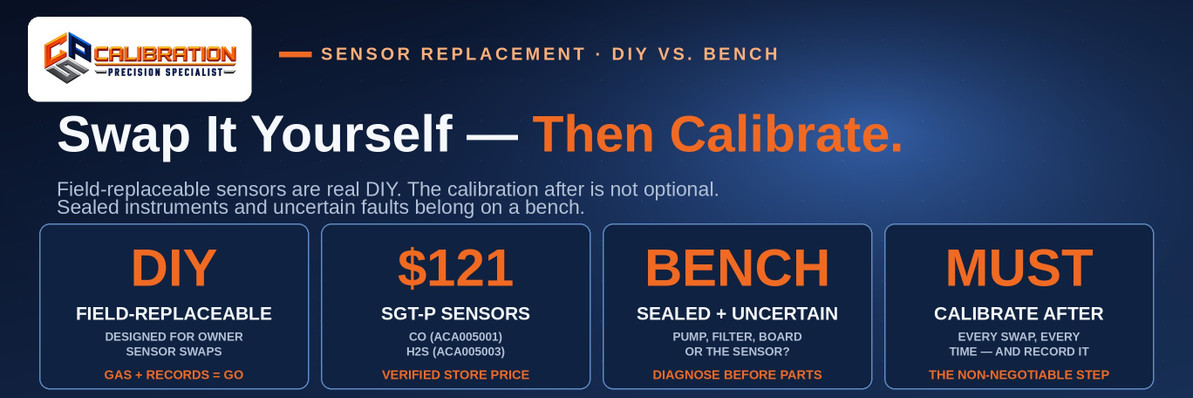
Most sensor swaps on modern portable gas detectors are genuinely do-it-yourself — the instruments are built with field-replaceable sensors for exactly that reason — provided you do the step that is not optional: calibrate the new channel immediately after the swap and record it. Send the instrument in instead when it is a sealed design, when the fault might be the pump, filter, or board behind the sensor rather than the sensor itself, when the swap needs gases you do not own, or when the record has to stand up to an auditor. The sensor itself is often the cheap part — SENKO SGT-P replacement sensors, CO and H₂S, are $121 each — so the real decision is never the part. It is the calibration and the paperwork that follow it.
Sensor replacement sits in an awkward middle ground: mechanically simple, metrologically serious. The swap itself can be a few minutes with a screwdriver on a detector designed for it. But a gas sensor is not a battery — a new one does not arrive knowing anything. Its raw response has to be taught against known gas, and until that happens the channel is displaying numbers with no verified relationship to the air.
This post draws the line honestly — including where the line favors your own workbench over ours. It assumes you have already identified the right sensor; if that step is the problem, start with how to order the right replacement sensor, because the wrong sensor installed perfectly is still the wrong sensor. Two verified listings from our store show the DIY economics: the SENKO CO sensor for SGT-P (part ACA005001, 0–2,000 ppm) and the SENKO H₂S sensor for SGT-P (part ACA005003, 0–500 ppm) are $121 each.
Which Sensor Swaps Are Genuinely DIY?
The genuinely DIY pile shares a design trait: the manufacturer built the instrument to be opened by its owner. Field-replaceable sensors — the pattern across the RKI portable lines and the SENKO SGT-P class — sit behind a cover or in a bay the user is meant to access, with the swap described in the instrument's own documentation. Single-gas and multi-gas electrochemical channels and combustible sensors in this class are owner work, as are the surrounding consumables: filters, batteries, clips, and boots.
Three conditions turn 'can' into 'should,' and all three are about what happens after the cover goes back on:
- You own the right calibration gas, in date. The new channel must be spanned on its documented gas. A toxic channel whose gas you do not stock cannot be finished in-house, however clean the swap was.
- You will calibrate immediately — not at the next scheduled round. An uncalibrated new sensor in service is worse than the tired sensor it replaced, because nobody suspects it. The old one was at least a known quantity with a record.
- You will write it down. Date, instrument serial number, sensor part, and the calibration result. An unrecorded swap breaks the instrument's history: the next calibration's as-found gets read against a sensor nobody knows is new.
Meet all three and the DIY route is not a shortcut — it is the design working as intended, and it keeps the instrument in your building instead of in a shipping box.
Which Swaps Belong on a Bench?
Sealed instruments. Some detectors are built as sealed, replace-the-unit designs where the sensor is not a user part at all. Forcing that case open does not produce a repair; it produces a destroyed instrument and a voided safety story. If the manual does not describe a user swap, there isn't one.
Anything where the sensor might not be the fault. A dead channel can be a spent sensor — or a clogged filter starving it, a weak pump behind it, or a board fault beyond it. Swapping the sensor into a sample-path problem buys a $121 experiment and an instrument that still fails. The bench sequence — as-found record, diagnosis, written quote — exists to identify the actual fault before money goes to parts. That diagnostic value is the strongest argument for sending a questionable failure in rather than parts-swapping at it.
Pumped instruments and multi-channel work, sometimes. A pumped detector's calibration involves the sample path as well as the sensors, and a multi-gas instrument's swap means recalibrating and documenting every channel as configured, not just the new one. Shops with the gases and the discipline do this in-house every week; shops without them are buying risk to save a bench fee. And there is a records line that settles many cases by itself: if the instrument's documentation has to satisfy an auditor, a customer audit, or an incident review, a bench certificate with as-found and as-left data and the gas's CoA trail — the CPS standard, one tier — carries weight a handwritten log entry does not. Finally, warranty: work performed as the manufacturer directs protects the instrument's position; work outside it can complicate a later claim, which is a real cost to weigh against the bench fee.
The Part Everyone Skips: Calibration and Records After the Swap
Whether the swap happened on your bench or ours, the instrument's story must read continuously. The new sensor's first calibration is its baseline: as-found is meaningless for a brand-new channel, but the as-left data, the gas used, and the date are the foundation every later reading gets judged against. Enrolling the instrument — or keeping it enrolled — in the CPS Calibration Program keeps that history by serial number, so a swap done in-house still lands in the same record an auditor will read.
One disposal note, because it is the other skipped step: a spent electrochemical sensor is not ordinary trash. It contains electrolyte and electrode materials and should go out through your site's hazardous or e-waste stream, not the shop bin — and the old sensor should never be kept as a 'spare.' A removed sensor was removed for a reason; putting it back in a drawer labeled spares guarantees it will be reinstalled someday by someone who does not know its history. The honest spare is a new sensor, in its packaging, with its part number legible — $121 in the SGT-P's case — waiting next to the calibration gas that will finish its installation.
Frequently Asked Questions
Can I replace a gas detector sensor myself?
On most modern portables, yes — they are designed for it. Instruments with field-replaceable sensors, including the RKI portable lines and the SENKO SGT-P class, put the sensor behind a user-accessible cover with the swap described in the manufacturer's documentation. The conditions are what follow the swap: calibrate the new channel immediately on its documented gas, and record the swap — date, serial number, sensor part, calibration result. A swap without those two steps is half a repair. Sealed instruments are the exception: if the manual describes no user swap, the instrument goes to a bench or is replaced as a unit.
Do I have to calibrate after replacing a sensor?
Yes — without exception, and immediately. A new sensor's response is unverified by definition; it must be spanned against known gas before its readings mean anything, and the instrument should not return to service until that is done. This is the step that separates a repair from a parts change. It is also the step that decides the DIY question for many shops: if you do not own the documented gas for that channel, in date, the swap cannot be finished in-house no matter how well it went mechanically.
How much does a replacement sensor cost?
It varies by model and gas, and this post only quotes what our store verifies: the SENKO CO sensor for the SGT-P (part ACA005001, 0–2,000 ppm) and the SENKO H₂S sensor for the SGT-P (part ACA005003, 0–500 ppm) are $121 each. For any other instrument, the honest route is how to order the right replacement sensor — identify the exact part for your model and configuration first, because sensor prices and parts are model-specific and a guessed figure helps no one.
What if I replace the sensor and the channel still fails?
Then the sensor was not the fault — or not the only fault. A channel can be starved by a clogged filter, underfed by a weak pump, or silenced by a board problem, and a new sensor installed into any of those still fails. This is the scenario the bench flow exists for: the as-found record and diagnosis come first, and any repair is quoted in writing before work, so parts money is spent on the identified fault. If your own swap lands here, stop swapping parts and send the instrument in with a note describing what was changed — that history genuinely helps the diagnosis.
Does replacing a sensor myself void the warranty?
Work performed the way the manufacturer directs — user-replaceable parts, installed per the instrument's documentation — is the instrument working as designed. Work outside that design, like opening a sealed unit, is where warranty and safety-certification trouble starts. The safe rule is to follow the manual for your exact model: if it describes the swap as a user task, it is one; if it does not, treat the instrument as bench-or-replace. When in doubt, call 865-900-8844 and name the model — a two-minute answer beats a voided claim.
How do I dispose of an old gas sensor?
Through your site's hazardous or e-waste stream, not the ordinary trash — electrochemical sensors contain electrolyte and electrode materials that do not belong in a shop bin. And do not keep the removed sensor as a spare. It was removed because it was spent or failing; in a drawer it becomes a future mistake, reinstalled by someone who never saw its history. A real spare is a new sensor in its packaging with the part number legible, stored with the calibration gas that will be needed the day it is installed.
Is it cheaper to replace sensors myself or send the instrument in?
The sensor part costs the same either way — $121 for the verified SGT-P listings, for example. The honest comparison is everything around the part. DIY costs you the gas, the bench time, and the record-keeping, and saves the shipping and the service visit. Sending it in costs the calibration rate — $55 for a single-gas instrument, $90 for a 4- or 5-gas instrument, in-house — and returns diagnosis if the sensor was not the fault, plus a certificate with as-found and as-left data and the gas's CoA trail. For a confident sensor-only failure in a shop with gas on the shelf, DIY usually wins. For an uncertain failure or an audited fleet, the bench usually does.
Which sensors are not user-replaceable?
Any sensor in a sealed instrument — designs where the manufacturer intends the unit to be serviced as a whole or replaced, with no user access described in the manual. The tell is documentation, not force required: if the manufacturer's own materials never describe opening the instrument, do not improvise a procedure. Specialty channels can also carry bench considerations even in open designs — a PID, for example, needs its own reference gas and response check after any lamp or sensor work, which moves it toward bench work for most shops.
Should I keep a spare sensor on the shelf?
For a fleet's front-line instruments, yes — a new sensor in its packaging is cheap insurance against the week a channel dies, at verified prices like $121 for SGT-P CO and H₂S sensors. Two conditions make it work: the spare must match the exact instrument and gas (use how to order the right replacement sensor to get the part right), and the calibration gas for that channel must be on the shelf beside it, in date. A spare sensor without its gas is a repair that stalls at the last step.
How long does a send-in sensor replacement take?
Call 865-900-8844 and we will confirm the current turnaround for the bench queue. We do not publish a fixed turnaround, because the timeline honestly depends on the queue, on your approval of the written quote if the diagnosis goes beyond the sensor, and on parts if your exact sensor must be ordered. A known sensor failure on a stocked part moves fastest. Transit time in both directions is the carrier's — one more reason a confident, well-equipped in-house swap is sometimes the right call, and this post says so plainly.
The Bottom Line
Do the swap yourself when the instrument is designed for it, you own the channel's gas, you will calibrate immediately, and you will write it down. Send it in when the instrument is sealed, the fault is uncertain, the sample path is involved, or the record has to convince someone besides you. Either way, the swap is not finished when the cover closes — it is finished when the new channel has been calibrated and the instrument's history shows it.
Sensor dead, or not sure the sensor is the problem? Start the ship-in calibration and repair request, or call CPS Calibrations at 865-900-8844. Ship-in address: 109 S. Front Street, Rockwood, TN 37854.
--- CPS Calibrations · 109 S. Front Street, Rockwood, TN 37854 · How to Order the Right Replacement Sensor · SENKO CO Sensor for SGT-P · Calibration Services
Ready to mail in your detector?
Start the ship-in request, pack the meter, and we handle the rest — every channel calibrated as configured, full certificate returned with it.
Start Your Ship-In Requestor call 865-900-8844
Recent Posts
-

What Is Remote Monitoring for Fixed Gas Detection?
Remote monitoring for fixed gas detection means a fixed system's live readings, trends, and alarm hi …Nov 23rd 2026 -

What Are the Key Differences Between the GX-6000 and GX-6100?
The RKI GX-6100 is the current replacement for the discontinued GX-6000: both are pumped 6-gas monit …Nov 22nd 2026 -

How to Read a PID Correction Factor Chart
To read a PID correction factor chart, find your vapor’s row, take the factor under your own lamp en …Nov 21st 2026