
Steel vs. Aluminum Calibration Gas Cylinders: What's the Difference?
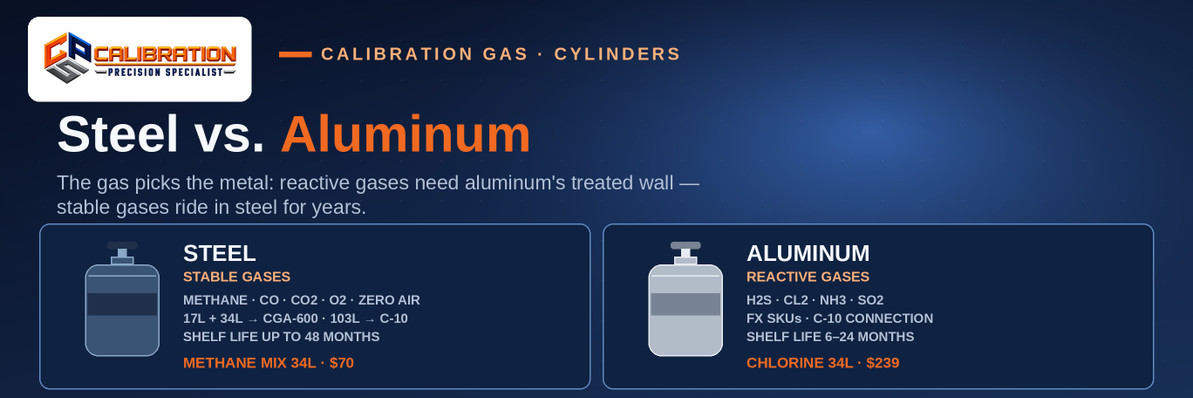
The difference between steel and aluminum calibration gas cylinders is what the gas does to the wall: reactive gases — hydrogen sulfide, chlorine, ammonia, sulfur dioxide — attack and adsorb onto steel, so they ship in aluminum cylinders (at CPS, every chlorine and H2S-bearing mix comes in an FX-prefix aluminum cylinder), while stable gases like methane and carbon monoxide do fine in steel. The material also decides the fitting — CPS steel 17L and 34L cylinders take a CGA-600 regulator, the steel 103L and every aluminum cylinder take a C-10 — and it tracks the shelf life: the stable methane mix on our shelf is certified for 48 months, the H2S quad mix for 24, and chlorine for just 6.
Buyers usually shop calibration gas by size and price, and treat the cylinder as packaging. It isn't. The cylinder is part of the measurement: its wall is in contact with the certified gas for the cylinder's whole life, and whether that wall is inert or reactive decides whether the number on the label is still true when you finally screw on the regulator. That is why the material question is really a chemistry question first, a fittings question second, and a price question third. This post works through all three — which gases go in which metal, why, what each cylinder connects to, and what the difference costs, using the cylinders actually on the CPS shelf as the examples.
Why Do Reactive Gases Ship in Aluminum?
A reactive gas does not sit quietly in its cylinder. Hydrogen sulfide, chlorine, ammonia, sulfur dioxide, nitrogen dioxide, and hydrogen chloride all interact with the surface containing them: they adsorb onto the wall — molecules stick to it and leave the mixture — and the corrosive ones attack the metal itself, especially with any trace of moisture present. In a steel cylinder, both processes run against you. The certified concentration drifts downward as the wall consumes the gas, and corrosion products contaminate what is left.
Aluminum changes that chemistry. Aluminum does not rust, resists the corrosive attack that eats steel, and calibration-gas aluminum cylinders are commonly supplied with specially treated, passivated internal surfaces that give reactive molecules far less to grab onto. The result is not a permanent fix — reactive gases still carry the shortest shelf lives in the cabinet, as our post on calibration gas shelf life works through — but it is the difference between a certified mix that holds its value and one that quietly doesn't.
You can see the rule enforced right on our shelf: there is no steel option for a reactive gas. The chlorine 5 ppm calibration gas exists only in aluminum — 34L through 120L, all C-10 connection, with a 6-month shelf life printed on the listing. The 4-gas RKI-equivalent mix — H₂S 25 ppm / CO 50 / CH₄ 50% LEL / O₂ 12% — is likewise aluminum-only, because the H₂S in the mix makes the material decision for the whole cylinder. One reactive component is enough: the mix inherits the most demanding gas in it.
Why Do Stable Gases Ride in Steel?
Methane, propane, pentane, carbon monoxide, carbon dioxide, oxygen, hydrogen, and nitrogen have no argument with a steel wall. They don't adsorb meaningfully, they don't corrode it, and their certified concentrations hold for years — the stable family typically carries shelf lives around three years, and the methane 2.5% (50% LEL) / oxygen 20.9% mix on our shelf is certified for 48 months. Against that chemistry, steel's virtues are practical: it is the cheaper cylinder to make, it is rugged, and it shrugs off the handling a calibration kit actually gets — truck beds, gang boxes, being set down hard on concrete.
Stable gases are also where you get a genuine choice. That methane mix is sold in steel (17L, 34L, 103L, and larger) and in aluminum (11L trigger-valve up through 120L), because nothing in the gas forces the decision. When both are offered, the tie-breakers are weight, fitting, and price — covered below — not chemistry.
Steel vs. Aluminum, Head to Head
| Steel | Aluminum | |
|---|---|---|
| Which gases | Stable gases: methane, propane, CO, CO₂, O₂, zero air — and stable mixes | Reactive gases: H₂S, Cl₂, NH₃, SO₂, NO₂, HCl — plus any mix containing one; stable gases also offered |
| Why | Wall is inert to stable gases; cheapest, most rugged cylinder | Doesn't rust or feed corrosion; treated/passivated interiors keep reactive concentrations honest |
| CPS sizes | 17L, 34L, 103L (and 221L/680L in some mixes) | 11L (trigger valve), 34L, 44L, 60L, 66L, 120L — SKUs carry the FX prefix |
| Regulator connection | CGA-600 on 17L and 34L; C-10 on 103L | C-10 on every size |
| Shelf-life examples (live listings) | Methane/O₂ mix: 48 months | H₂S quad mix: 24 months · Chlorine 5 ppm: 6 months |
| Price examples (live listings) | Methane mix 34L: $70 · 103L: $145 | Methane mix 60L: $165 · H₂S quad mix 34L: $195 · Chlorine 34L: $239 |
| Weight & handling | Heavier; the cylinder to leave in the shop or the kit box | Noticeably lighter to carry to the instrument; won't rust in damp storage |
The Fitting Follows the Cylinder
Whichever metal you end up with, it brings its regulator connection with it — and on CPS cylinders the pattern is simple enough to read off the SKU. Steel 17L and 34L cylinders take a CGA-600 regulator. The steel 103L steps up to a C-10. Every aluminum cylinder, 11L through 120L, is C-10. Our full guide to CGA-330 vs. CGA-600 regulator fittings works through why those numbers are not interchangeable and what happens when the regulator in the kit doesn't match the cylinder that just arrived.
This is the practical trap in the steel-vs.-aluminum question: a crew that has always bought the steel 34L (CGA-600) and reorders a mix that only ships in aluminum (C-10) discovers the mismatch at the instrument, regulator in hand. When you switch materials — or when a mix forces you to — put the regulator on the same purchase order.
What Does the Difference Cost?
Aluminum costs more, for two stacked reasons: the cylinder itself costs more to produce than a steel one, and the treated interior a reactive gas needs adds process cost on top. The gas itself is the third driver, which is why cross-gas comparisons mislead — the honest comparisons are within one gas. The methane mix: $70 in a steel 34L against $165 in an aluminum 60L (the aluminum line runs 60L and up in that mix, with a 120L also at $165) — you pay for the lighter, rust-proof cylinder even when the gas doesn't require it. The gases that do require it price accordingly: the H₂S quad mix is $195 in its 34L aluminum cylinder, and chlorine 5 ppm is $239 in 34L aluminum — reactive chemistry, short shelf life, and an aluminum bottle are a package deal you cannot unbundle.
Shelf life is the hidden half of the price comparison. A steel cylinder of stable gas gives you years to use it — up to 48 months on the methane mix — so a 103L at $145 can be the cheapest gas you ever buy if your calibration volume spends it in time (our post on how many calibrations you get from a 34L, 58L, or 103L cylinder does that arithmetic). A reactive gas in aluminum starts a 6- to 24-month clock the day it is filled: buy the size your workload will actually finish, because the expensive outcome is not the aluminum — it is half a cylinder of chlorine expiring on the shelf.
Weight, Rust, and Where the Cylinder Lives
The last differences are physical. Aluminum is the lighter cylinder to carry across a plant or up to a rooftop unit, and it does not rust — a real consideration for cylinders stored in damp shops, marine environments, or service trucks. Steel is the heavier, harder-wearing cylinder; for a cylinder that lives in one calibration shop or rides permanently in a kit, its weight never gets a chance to matter and its ruggedness does. Neither consideration ever outranks the chemistry: you do not get to choose steel for a chlorine mix because the cylinder lives outdoors. The gas picks the metal; you pick within what the gas allows.
When either cylinder is empty, the end of the road is the same — both materials are non-refillable disposables in this size class, and our guide to how to dispose of calibration gas cylinders covers how to retire them properly.
Frequently Asked Questions
What is the difference between steel and aluminum calibration gas cylinders? The gas decides. Reactive gases — hydrogen sulfide, chlorine, ammonia, sulfur dioxide — attack and adsorb onto steel, so they ship in aluminum cylinders with treated interiors; stable gases like methane and carbon monoxide are inert against steel and ride in either. The material also sets the regulator connection (CPS steel 17L/34L: CGA-600; steel 103L and all aluminum: C-10), the weight, and the price — aluminum costs more.
Why do reactive gases come in aluminum cylinders instead of steel? Because a reactive gas interacts with its container: it adsorbs onto the wall, pulling the certified concentration down, and corrosive gases attack steel itself. Aluminum does not rust, resists that corrosion, and its cylinders are supplied with treated, passivated internal surfaces that give the gas far less to react with — so the concentration on the label stays true for the cylinder's rated shelf life.
Which calibration gases come in aluminum cylinders? At CPS, every reactive gas and every mix containing one: hydrogen sulfide (single-gas and in the 4-gas quad mix), chlorine, ammonia, and sulfur dioxide mixes are aluminum-only. Stable gases — methane, carbon monoxide, oxygen mixes, zero air — are offered in aluminum as well as steel, in sizes from 11L to 120L. Aluminum cylinders are the ones whose SKUs start with FX.
Can you get hydrogen sulfide calibration gas in a steel cylinder? Not from CPS — and the H₂S is why. H₂S adsorbs onto and reacts with steel, so the concentration would drift out of certification. Every H₂S product we sell, including the 4-gas RKI-equivalent mix (H₂S 25 / CO 50 / CH₄ 50% LEL / O₂ 12%), ships in aluminum with a C-10 connection and a 24-month shelf life. One reactive component decides the material for the whole mix.
Which is better, a steel or aluminum calibration gas cylinder? Neither — they serve different gases. For a stable gas that comes in both, steel is cheaper and more rugged; aluminum is lighter and cannot rust. For a reactive gas there is no contest to judge: aluminum is the only correct container, and a steel cylinder would be a measurement error waiting to happen.
Do steel and aluminum calibration gas cylinders use the same regulator? Sometimes — and the mismatch is the classic trap. CPS steel 17L and 34L cylinders take a CGA-600 regulator; the steel 103L and every aluminum cylinder (11L–120L) take a C-10. So a shop moving from a steel 34L to an aluminum cylinder of the same mix changes fittings too. Check the connection printed on the listing before the cylinder arrives, not at the instrument.
How can you tell if a calibration gas cylinder is steel or aluminum? On a CPS listing, read the SKU and the size: aluminum cylinders carry FX-prefix SKUs (FX34, FX60, FX120) and C-10 connections; steel cylinders carry plain numeric SKUs in 17L, 34L, and 103L sizes. In hand, aluminum is noticeably lighter for its size and has a brushed silver finish that never shows rust; steel calibration cylinders are the heavier, painted ones.
Does cylinder material affect calibration gas shelf life? Indirectly, yes — material follows the gas, and the gas sets the clock. Stable gases in steel carry the longest certified lives (the methane/O₂ mix on our shelf: 48 months). Reactive gases in aluminum run 6 to 24 months (chlorine 5 ppm: 6 months; the H₂S quad mix: 24) — not because aluminum is worse, but because reactive chemistry degrades even in the right container. In the wrong container it would degrade faster and uncertifiably.
Why does aluminum calibration gas cost more than steel? Two costs stack: an aluminum cylinder costs more to produce than a steel one, and the treated, passivated interior a reactive gas requires adds processing. Compare within one gas: the methane mix is $70 in a steel 34L and $165 in an aluminum 60L. Reactive gases carry the full stack — chlorine 5 ppm is $239 in its 34L aluminum cylinder.
Are steel or aluminum calibration gas cylinders refillable? No — in this size class, both are non-refillable disposable cylinders, steel and aluminum alike. When one is empty or expired, it is retired and replaced, not refilled. Venting, puncturing, and disposal have to be done properly — residual reactive gas makes an "empty" cylinder a hazardous-waste question, not scrap metal.
The Bottom Line
Steel vs. aluminum is not a preference; it is a compatibility chart. Reactive gases — H₂S, chlorine, ammonia, SO₂, and any mix containing one — belong in aluminum, where a treated, rust-proof wall keeps the certified concentration honest for its 6- to 24-month life. Stable gases ride happily in steel for years — 48 months on our methane mix — at a lower price, and where a stable gas offers both, weight and fitting break the tie: steel 17L/34L on CGA-600, steel 103L and all aluminum on C-10. Read the gas first, the SKU second (FX means aluminum), and the fitting third — in that order, the cylinder question answers itself.
Not sure which cylinder your instrument's gas comes in — or whether your regulator matches it? Call 865-900-8844 or reach us through Contact Us and we'll match the gas, the cylinder, and the regulator before you order. The full range is in the Calibration Gas category, and the service side lives at Calibration Services.
CPS Calibrations · 109 S. Front Street, Rockwood, TN 37854 · Calibration Gas · Calibration Services · Contact Us
Need a calibration you can file?
In-house calibration at CPS in Rockwood, Tennessee — $55 for single-gas instruments, $90 for 4- and 5-gas — every channel, as-found and as-left data, full certificate.
See Calibration Servicesor call 865-900-8844
Recent Posts
-

What Is Remote Monitoring for Fixed Gas Detection?
Remote monitoring for fixed gas detection means a fixed system's live readings, trends, and alarm hi …Nov 23rd 2026 -

What Are the Key Differences Between the GX-6000 and GX-6100?
The RKI GX-6100 is the current replacement for the discontinued GX-6000: both are pumped 6-gas monit …Nov 22nd 2026 -

How to Read a PID Correction Factor Chart
To read a PID correction factor chart, find your vapor’s row, take the factor under your own lamp en …Nov 21st 2026