
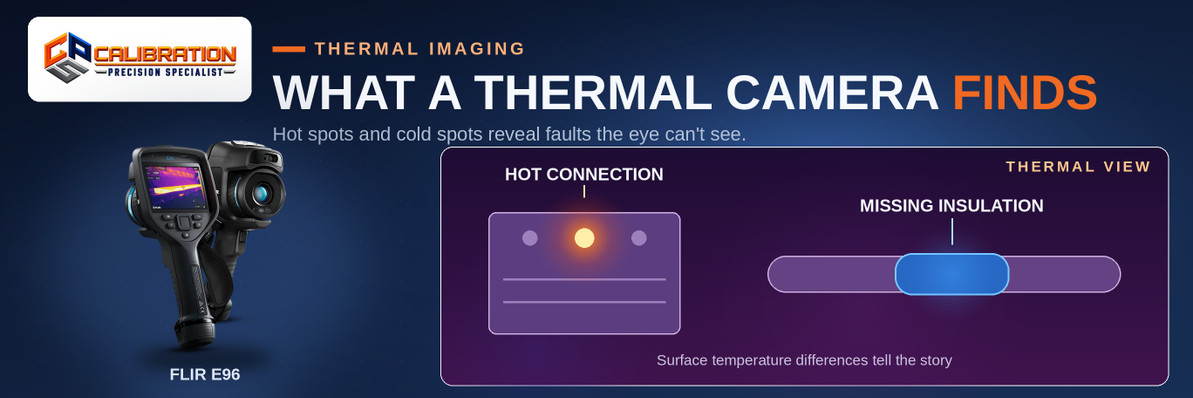
What Can a Thermal Imaging Camera Find in a Plant? Electrical, Steam, and Insulation Faults
A thermal imaging camera finds the plant faults that announce themselves as temperature before they announce themselves as failures: overheating electrical connections, bearings and couplings heating up as they wear, steam traps failed open or closed, and insulation or refractory that is missing, wet, or worn through. FLIR's stated applications for its professional cameras are electrical inspections, mechanical maintenance, building diagnostics, and preventive maintenance — and at CPS the working lineup runs from the pocket FLIR C5 ($699) and E8 Pro ($3,299) for routine rounds to the 640 × 480 FLIR E96 ($15,500) for professional surveys.
A thermal survey is the cheapest look inside a running plant there is: no shutdown, no contact, no opening of equipment that shouldn't be opened. What follows is what the camera actually finds, fault class by fault class — and, at the end, what it honestly cannot do.

FLIR C5 Compact Thermal Camera – 160 × 120 MSX® Pocket Thermal Camera with Wi-Fi
What can a thermal camera find in a plant? Hot electrical connections, failing bearings, dead steam traps, lost insulation. FLIR at CPS: $699 to $15,500.
$699
See the C5 Compact ThermalFirst: What Is the Camera Actually Measuring?
A radiometric thermal camera measures the surface temperature of everything in its field of view — every pixel is a temperature reading. Two specifications decide what you can find with it:
- Resolution is how small and how far away a hot spot can be and still be measured rather than smeared into its surroundings: 160 × 120 on the pocket C5, 320 × 240 on the E8 Pro and E54, 640 × 480 on the E96.
- Thermal sensitivity (NETD) is the smallest temperature difference the camera can distinguish: under 40 mK on the E54, as low as under 30 mK on the E96. Subtle faults — a slightly warm connection, the faint outline of moisture — live in those fractions of a degree.
Everything the camera finds is a surface at the wrong temperature. The skill of a survey is knowing which wrong temperatures matter, and the sections below are the standard hit list.
Electrical Faults: Heat Is Resistance
Current flowing through resistance makes heat, and every electrical fault is unwanted resistance. In a panel, switchgear lineup, or motor control center under normal load, a thermal camera picks out:
- Loose, corroded, or under-torqued connections — the classic finding: one lug, bolt, or breaker stab glowing against its identical neighbors.
- Overloaded circuits and conductors running uniformly hot end to end.
- Unbalanced loads — one phase of three working visibly harder than the others.
- Failing components — breakers, contactors, and fuses whose internal wear shows as heat before it shows as a trip or a fire.
The comparison is built into the equipment: three phases, a row of identical breakers, twin motors. The fault is the one that doesn't match. Two things make electrical thermography work: the equipment must be under load when you look (an idle panel hides its faults), and the finding is comparative — a connection 40 degrees hotter than its twins under the same load is a work order, whatever its absolute temperature.
Mechanical Faults: Friction Announces Itself
Rotating equipment converts its problems into heat with similar honesty:
- Bearings run hotter as lubricant fails, wear progresses, or preload is wrong — compare against the matching bearing on the same machine or its twin across the aisle.
- Couplings and belts show misalignment and slippage as localized heat.
- Motors reveal blocked cooling, failing windings' early stages, and overload as case-temperature patterns.
- Gearboxes and conveyors flag the one idler or gear mesh that is working harder than the rest of the line.
None of this replaces vibration analysis or oil sampling; it triages them. A thermal round tells you which of two hundred bearings deserves the mechanic's next hour.
Steam Traps: The Failure Has a Temperature Signature
A steam trap has exactly two failure modes, and both are visible to a thermal camera:
- Failed closed (or plugged): condensate backs up, the trap and its inlet go cold relative to a working trap, and the equipment it serves waterlogs and loses heat transfer.
- Failed open: live steam blows straight through into the condensate return, so the trap and the downstream line run at steam temperature — energy purchased, boiled, and thrown away continuously.
A trap survey is a comparison exercise: image each trap's inlet, body, and outlet against its neighbors on the same header. The traps that don't match the pattern are the survey's deliverable. No trap has to be opened, isolated, or taken out of service to be judged suspect — the camera reads them in operation, which is the only state that matters.
Insulation, Refractory, and Process Heat Loss
Insulation works by keeping surface temperatures near ambient, so failed insulation draws its own picture:
- Missing, crushed, or wet insulation on steam and process lines shows as bright hot sections in an otherwise uniform run — you can see the exact length that needs re-lagging.
- Refractory loss inside furnaces, kilns, and heaters shows as hot spots on the shell where the lining has thinned or fallen — the finding that schedules the outage repair before the shell itself is damaged. High-temperature range matters here: the E96 measures to 1500 °C, and FLIR's TG298 spot camera ($899) is built as a high-temperature spot instrument.
- Tank levels and process patterns — liquid levels in vessels, blocked or fouled heat-exchange surfaces, and uneven heating all read as temperature patterns on the shell.
Moisture and Building Faults
Water changes how a surface heats and cools, so moisture intrusion — roof leaks, water in walls, wet insulation — appears as a thermal pattern distinct from the dry structure around it, especially as surfaces warm or cool through the day. Building diagnostics is one of FLIR's stated applications for these cameras, and it is the same physics as the plant work: the camera doesn't see the water, it sees the temperature behavior the water causes.
Which Camera Does Your Plant Need?
| Camera | Price | Detector | Built for |
|---|---|---|---|
| FLIR C5 | $699 | 160 × 120 | Pocket camera for quick checks — is it hot, yes or no — and first-pass rounds |
| FLIR Cx5 | $2,149 | 160 × 120 | The C5 concept in a hazardous-location-rated housing |
| FLIR E8 Pro | $3,299 | 320 × 240 | Routine electrical and mechanical survey rounds |
| FLIR E54 | $6,800 | 320 × 240, <40 mK | The professional workhorse: interchangeable lenses, inspection routing, reporting |
| FLIR E96 | $15,500 | 640 × 480, <30 mK, to 1500 °C | Large-area and high-temperature surveys; laser distance meter for documentation |
| FLIR T-Series | from $14,100 | 320 × 240 and up | Professional survey platform with interchangeable optics |
| FLIR AX8 | $1,250 | Fixed-mount sensor | Continuous thermal monitoring of one critical asset, watched around the clock |
The pattern in the table: money buys resolution, sensitivity, temperature range, and optics — the things that decide whether a fault three stories up or a fraction of a degree faint gets measured or missed. Match the camera to the distance and subtlety of your faults, not to the size of your budget alone. The full range is in our thermal imaging category.
The Honest Limits
- It sees surfaces, not interiors. A thermal camera cannot see through walls, steel, or insulation. It reads the surface and infers the rest; the inference is usually right and is still an inference.
- Shiny metal lies. Bare polished metal has low emissivity and reflects the room like a mirror — its apparent temperature may be mostly reflection. Survey technique (emissivity settings, tape or paint reference points, viewing angle) exists because of this, and absolute readings on shiny surfaces deserve suspicion.
- An idle plant hides. Electrical and mechanical faults are load faults. Survey under normal operating load or expect to find nothing and learn nothing.
- It finds anomalies, not causes. The hot lug is a fact; why it is hot — torque, corrosion, overload, harmonics — is the electrician's diagnosis. The camera's job is to put the right component at the top of the work list.
- It does not see gas. That takes an optical gas imaging camera — a different, filtered instrument. Our post on whether a thermal camera can see a gas leak draws that line in full.
The Bottom Line
A thermal imaging camera earns its keep in a plant by finding heat where heat shouldn't be: the connection, bearing, trap, or insulation section that doesn't match its neighbors — found under load, in operation, without a shutdown. At CPS the ladder runs from the $699 FLIR C5 in a shirt pocket to the $15,500 E96 on a professional survey, with the $1,250 AX8 for equipment that should never be unwatched. The faults were always announcing themselves. The camera is just the first tool that listens in the right band.
Not sure which camera matches your survey work — or whether your plant needs a survey before it needs a camera? Call us at 865-900-8844, or reach us through Contact Us, and describe the equipment and the distances involved. We calibrate temperature instruments as well as sell them — see our calibration services.
Frequently Asked Questions
What can a thermal imaging camera find in an electrical panel? The faults that come from unwanted resistance: loose, corroded, or under-torqued lugs and connections running hotter than their neighbors; overloaded conductors hot along their whole length; unbalanced phases, where one of three phases works visibly harder; and failing breakers, contactors, and fuses heating internally before they trip or fail. The survey is comparative — in a row of identical components under the same load, the hot one is the finding — and it must be done under normal load, because an idle panel hides its faults.
Can a thermal imaging camera find a failed steam trap? Yes — a steam trap survey is one of the standard thermal applications. A trap failed closed backs condensate up and runs cold compared with working traps; a trap failed open blows live steam through, so the trap and the downstream return line run at steam temperature. Imaging each trap's inlet, body, and outlet and comparing traps on the same header flags the failures without opening, isolating, or shutting down any trap.
Can a thermal imaging camera see through walls? No. A thermal camera measures surface temperatures only — it cannot see through walls, steel, insulation, or any solid material. What it can do is read the surface patterns those hidden conditions create: moisture in a wall changes how the surface warms and cools, missing insulation lets heat through to the surface, and a hot pipe inside a wall warms the wall over it. The picture is of the surface; the conclusion about what's behind it is an inference — usually a reliable one.
Do you have to shut down equipment for a thermal inspection? No — and you shouldn't. Electrical connections only run hot when current flows through the fault, and bearings only heat up while they turn, so a thermal survey is deliberately done with the plant in normal operation, under normal load. That is the technology's core advantage over inspection methods that need outages. Panel covers and guards are handled under your site's electrical safety rules by qualified people; the camera itself never touches anything.
How much does a thermal imaging camera for plant maintenance cost? At CPS: $699 for the pocket FLIR C5 (160 × 120), $2,149 for the hazardous-location Cx5, $3,299 for the E8 Pro (320 × 240), $6,800 for the professional E54 (320 × 240, sensitivity under 40 mK), and $15,500 for the E96 (640 × 480, under 30 mK, measuring to 1500 °C). The fixed-mount AX8 sensor for continuous monitoring of a critical asset is $1,250. The price ladder buys resolution, sensitivity, lenses, and temperature range — the things that decide which faults get caught.
What is the difference between a $699 and a $15,500 thermal camera? Mostly how small, faint, far away, and hot a fault can be and still get measured. The $699 FLIR C5 resolves 160 × 120 pixels — plenty to answer "is it hot?" at arm's length. The $15,500 E96 resolves 640 × 480 (twelve times the pixels) with thermal sensitivity under 30 mK, interchangeable lenses for distance work, a laser distance meter for documentation, and measurement up to 1500 °C. Between them, the E54 ($6,800) at 320 × 240 and under 40 mK covers most professional survey rounds.
Can a thermal imaging camera find moisture or roof leaks? Yes. Water trapped in a roof, wall, or insulation changes how that surface heats and cools, so wet areas show as distinct thermal patterns against dry structure — FLIR lists building diagnostics among the core applications for these cameras. The camera doesn't image the water itself; it images the temperature behavior the moisture causes, which is why surveys are timed to when the structure is warming or cooling and the contrast is strongest.
Can a thermal imaging camera check bearings? Yes. A bearing that is losing lubricant, wearing, or running misaligned converts the problem into friction heat, and the camera picks it out against its baseline — the matching bearing on the same shaft, its twin on the machine beside it, or its own temperature on the last round. Thermal checks don't replace vibration analysis; they triage it, telling you which of the plant's many bearings deserves detailed attention first.
Can a thermal imaging camera find insulation problems? Yes — it is one of the cleanest applications. Working insulation holds a surface near ambient temperature, so missing, crushed, or wet insulation appears as a bright hot section in an otherwise uniform pipe run, and you can see the exact length to re-lag. The same principle catches refractory loss inside furnaces and kilns as hot spots on the shell, which is where a high-temperature camera range (the E96 measures to 1500 °C) earns its place.
How accurate is a thermal camera's temperature reading? A radiometric camera measures every pixel, but the reading is only as good as the emissivity setting for the surface in front of it. Dull, painted, oxidized, or taped surfaces read true; bare shiny metal reflects the surroundings like a mirror and can read wildly wrong. Practical thermography therefore leans on comparisons — this lug against its twins — and treats absolute readings on reflective surfaces with suspicion. Set emissivity for the target, or put a known-emissivity reference (electrical tape, flat paint) on it.
CPS Calibrations · 109 S. Front Street, Rockwood, TN 37854 · Thermal Imaging · Fixed Systems · Calibration Services · Contact Us
Need a calibration you can file?
In-house calibration at CPS in Rockwood, Tennessee — $55 for single-gas instruments, $90 for 4- and 5-gas — every channel, as-found and as-left data, full certificate.
See Calibration Servicesor call 865-900-8844
Recent Posts
-

What Is Remote Monitoring for Fixed Gas Detection?
Remote monitoring for fixed gas detection means a fixed system's live readings, trends, and alarm hi …Nov 23rd 2026 -

What Are the Key Differences Between the GX-6000 and GX-6100?
The RKI GX-6100 is the current replacement for the discontinued GX-6000: both are pumped 6-gas monit …Nov 22nd 2026 -

How to Read a PID Correction Factor Chart
To read a PID correction factor chart, find your vapor’s row, take the factor under your own lamp en …Nov 21st 2026