
Can a Thermal Imaging Camera See a Gas Leak?
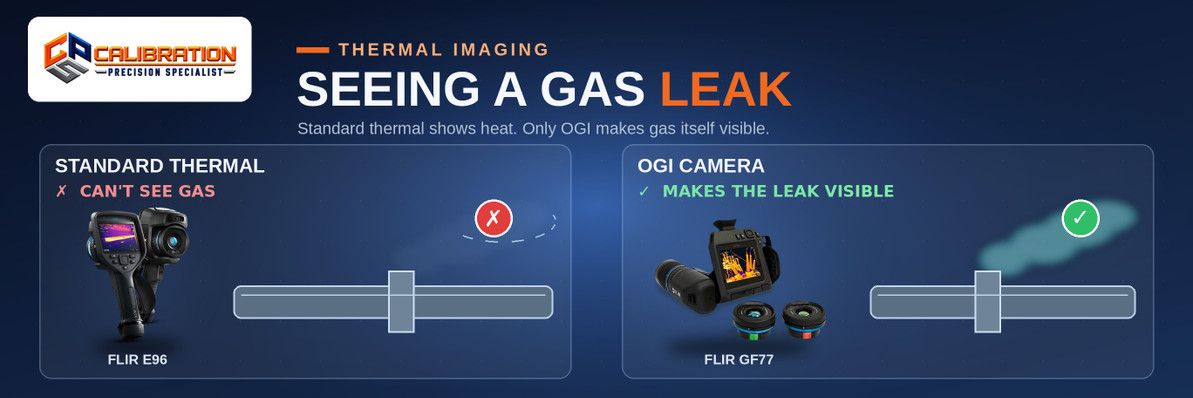
A standard thermal imaging camera cannot see a gas leak — it images surface temperatures, and methane, propane, and most other industrial gases are transparent in the infrared band it uses. The exception is optical gas imaging (OGI): a thermal camera fitted with a spectral filter tuned to the narrow infrared band a specific gas absorbs, which makes the escaping gas visible as a plume. At CPS the OGI cameras are FLIR's uncooled GF77 ($37,950, with interchangeable lenses covering hydrocarbons on one lens and SF₆, ammonia, and ethylene on the other) and the fixed-mount GF77a ($22,950) for continuous monitoring.
This distinction matters because the two tools look identical on a shelf and differ by a factor of ten in price. If you buy a standard thermal camera to find gas leaks, you will find none — not because the camera is broken, but because it was never looking at gas in the first place. Here is how the technology actually divides.
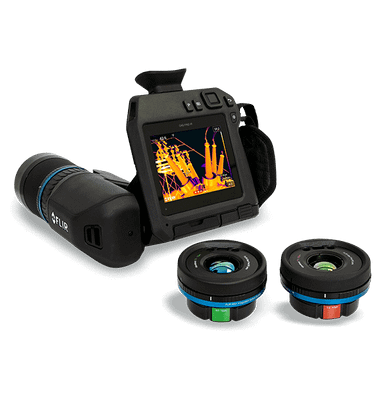
FLIR GF77 Gas Imaging Camera – Uncooled Optical Gas Imaging Camera for Hydrocarbons & VOCs
Can a thermal camera see a gas leak? A standard one can't — it sees temperature, not gas. Optical gas imaging can: FLIR GF77 ($37,950), GF77a ($22,950) at CPS.
$37,950–$62,950 configured
See the GF77Why Can't a Normal Thermal Camera See Gas?
A thermal camera measures infrared radiation coming off surfaces and converts temperature differences into an image. That is all it does, and it does it well: a hot bearing, an overloaded breaker, and a cold spot where insulation is missing all announce themselves because their surfaces are at different temperatures.
A gas leak has no surface. The escaping methane in a pipe flange plume is roughly at ambient temperature, and in the broad long-wave infrared band a standard camera uses, methane simply does not absorb enough radiation to register. FLIR's own explanation of the technology is blunt: most thermal imagers can't directly detect gases. The gas is there; the camera is blind to it. Pointing an E-Series or T-Series camera at a known leak and seeing nothing is the expected result, not a malfunction.
How Does Optical Gas Imaging Work?
OGI starts from a fact of molecular physics: many gas compounds absorb infrared energy, but only within a narrow range of wavelengths — a spectral fingerprint. Most hydrocarbons (methane, propane, butane, benzene) absorb near 3.3 µm; methane also absorbs near 7.7 µm; sulfur hexafluoride absorbs near 10.6 µm.
An OGI camera mounts a spectral filter in front of its detector that passes only that narrow band — the band pass. Now the physics works for you instead of against you:
- Background objects behind the leak emit and reflect infrared through the filter as normal.
- Where a gas cloud sits between the background and the camera, the gas absorbs radiation in the band pass, so less energy reaches the detector.
- The camera renders that deficit as a visible cloud — a plume that looks like smoke drifting from the leak point.
FLIR lists three conditions that must hold for the plume to appear: the gas must absorb infrared in the camera's filtered band; the cloud must have radiant contrast against its background; and the cloud's apparent temperature must differ from the background's. When those hold, an operator can scan a valve row, a compressor seal, or a tank farm and watch leaks reveal themselves in real time — no contact, no shutdown, and no walking the line with a sniffer hoping to stumble into the plume.
One more consequence of the filter: an OGI camera sees only gases that absorb in its band. The filter that makes methane visible makes the camera blind to a gas whose fingerprint lies elsewhere. That is why OGI cameras are sold gas-family by gas-family.
Which Gases Can the FLIR GF77 Actually See?
The FLIR GF77 answers the band problem with interchangeable spectral-filter lenses, chosen at order and swappable in the field (FLIR notes a lens swap can require calibration by FLIR service):
| GF77 lens | Spectral band | Gases it visualizes (per FLIR) |
|---|---|---|
| LR lens | 7–8.5 µm | Methane, nitrous oxide, propane, sulfur dioxide, R-134a, R-152a |
| HR lens | 9.5–12 µm | Sulfur hexafluoride (SF₆), ammonia, ethylene |
The detector behind those lenses is 320 × 240 with thermal sensitivity under 25 mK, and FLIR's High Sensitivity Mode (HSM) accentuates plume movement so small leaks stand out. The GF77 also doubles as a radiometric thermal camera — while you hunt leaks you can check component temperatures with the same instrument — which is more than a convenience: it is one camera doing survey thermography between LDAR rounds.
Its fixed sibling, the FLIR GF77a, comes in the same LR and HR spectral versions, mounts permanently, and watches a well site, compressor station, or process area around the clock, alarming through your control system over GigE/RTSP network connections. FLIR describes it as the first uncooled fixed-mount autonomous OGI camera; it is also radiometrically calibrated, so the same unit monitors tank levels and overheating components.
And the gases no OGI camera can show you, on any lens: hydrogen, oxygen, nitrogen, and helium do not absorb infrared in a usable band and cannot be imaged directly. Carbon dioxide absorbs at a different band (around 4.3 µm) and needs a dedicated CO₂-band camera — neither GF77 lens covers it. If your leak problem is hydrogen, the answer is a point detector, not a camera of any kind.
Cooled vs. Uncooled OGI: Where the GF77 Sits
The classic OGI camera pairs its spectral filter with a cooled infrared detector — FLIR's G-Series is that class of instrument — and cooled cameras remain the high-sensitivity benchmark for formal LDAR (leak detection and repair) survey work. Cooling buys sensitivity; it also buys a cryocooler to maintain and a substantially higher price.
The GF77 and GF77a are uncooled OGI cameras — that word is in both product names on our shelf, and it is the honest headline of what they are. Uncooled means no cryocooler, nothing to service on a detector-cooling schedule, and prices of $37,950 (handheld GF77) and $22,950 (fixed GF77a) at CPS instead of cooled-camera money. The trade is sensitivity headroom on the smallest leaks in the worst contrast conditions. For continuous fixed monitoring, routine leak surveys, and first-pass LDAR screening, uncooled OGI is a working tool; for a compliance survey program, confirm the camera class your regulation and your leak-size targets demand before you buy. Our full thermal imaging range — standard and OGI side by side — is in the category, and the FLIR brand page lists every model we carry.
What OGI Cameras Cannot Do
- They cannot tell you a concentration. An OGI image shows where gas is escaping and roughly how the plume behaves. It does not read ppm. Quantifying the leak still takes a point measurement at the source.
- They cannot see every gas. Only gases that absorb in the camera's filtered band appear. Hydrogen is invisible to OGI, full stop.
- They cannot replace point detectors. A camera surveys when someone points it (or, for the GF77a, watches one fixed field of view). It does not sit at every flange with a 4-20 mA output and a relay. Detection-and-alarm duty still belongs to fixed heads and controllers.
- They need contrast to work. A plume against a background at the same apparent temperature can fade from view; survey technique — angle, background, HSM — is part of the instrument.
OGI Camera vs. Point Gas Detector: Which Do You Need?
| OGI camera (GF77 / GF77a) | Point gas detector | |
|---|---|---|
| What it answers | "Where is gas escaping?" | "How much gas is at this point, right now?" |
| Output | A visible plume on screen | A concentration reading, alarms, relays, 4-20 mA / Modbus |
| Coverage | Everything in the field of view, scanned | One point per detector |
| Gases | Only those absorbing in the fitted lens's band | The sensor fitted — including hydrogen, which OGI cannot see |
| Best at | Leak surveys, LDAR screening, finding the exact source, continuous watch of a high-value area (GF77a) | Continuous alarming and plant integration |
| Price at CPS | $37,950 handheld · $22,950 fixed | Fixed heads from a few hundred dollars per point |
Most facilities that take leaks seriously end up with both, doing different jobs — and our post on how a fixed gas detection system works covers the detector side of that pairing.
So What Is a Standard Thermal Camera For?
Everything temperature-shaped — which in a plant is a long and valuable list: overheating electrical connections, failing bearings, dead steam traps, missing insulation, moisture intrusion. A standard camera like the FLIR E96 ($15,500) is the right instrument for those, at a fraction of OGI money, and telling the two apart before you buy is the entire point of this post. Our companion guide covers that side in full: what a thermal imaging camera can find in a plant.
The Bottom Line
Can a thermal imaging camera see a gas leak? A standard one cannot — it sees temperature, and gas has no temperature signature in its band. An optical gas imaging camera can, because its spectral filter is tuned to a band the gas absorbs, turning the plume into a visible cloud. At CPS that means FLIR's uncooled GF77 ($37,950, LR lens for methane and hydrocarbons, HR lens for SF₆, ammonia, and ethylene) and the fixed-mount GF77a ($22,950) — real OGI, honestly bounded: no ppm readings, no hydrogen, no substitute for point detection and alarms.
Trying to decide between an OGI camera, a standard thermal camera, or point detection for a leak problem? Call us at 865-900-8844 with the gas and the area you need to cover, and we'll spec the tool that can actually see it — or reach us through Contact Us.
Frequently Asked Questions
Can a thermal imaging camera see a gas leak? Only a specialized one can. Standard thermal cameras image surface temperatures and cannot detect gas at all — most gases are transparent in the band they use. Optical gas imaging (OGI) cameras are thermal cameras with a spectral filter tuned to the narrow infrared band a target gas absorbs, so the leak appears as a visible plume. At CPS the OGI models are the FLIR GF77 ($37,950) and the fixed-mount GF77a ($22,950); every other thermal camera we sell is a temperature instrument.
Can a thermal camera see methane? Yes — with the right camera and the right lens. Methane absorbs infrared near 3.3 µm and again near 7.7 µm, so an OGI camera filtered for a methane band renders a methane leak as a visible plume. The FLIR GF77's LR lens (7–8.5 µm) is its methane configuration, also covering propane, nitrous oxide, sulfur dioxide, R-134a, and R-152a. A standard thermal camera, including high-end models like the FLIR E96, cannot see methane at any price.
What is optical gas imaging (OGI)? Optical gas imaging is a thermal imaging technique that visualizes otherwise invisible gas leaks. The camera's detector sits behind a spectral filter that passes only a narrow band of infrared wavelengths — the band where the target gas absorbs radiation. Gas between the camera and the background absorbs energy in that band, so less reaches the detector, and the camera displays the deficit as a smoke-like plume. FLIR, which commercialized the technology, notes three requirements: the gas must absorb in the camera's band, the cloud must have radiant contrast with the background, and the cloud's apparent temperature must differ from the background's.
How much does a gas imaging camera cost? At CPS, the handheld FLIR GF77 is $37,950 and the fixed-mount FLIR GF77a for continuous monitoring is $22,950. Those are uncooled OGI prices — the cooled OGI cameras used for high-end LDAR survey work cost more again. For scale, standard professional thermal cameras run from $699 (FLIR C5) to $15,500 (FLIR E96) on the same shelf, but no standard camera at any price can image gas; the filter, not the budget, is the difference.
Can an OGI camera measure how much gas is leaking? No. An OGI camera visualizes a leak — it shows where gas is escaping and how the plume behaves — but it does not produce a concentration in ppm or a leak rate. Quantifying a leak still requires a point measurement at the source with a detector or sampling instrument. OGI's value in a survey is finding and localizing leaks across a whole area quickly, so the point measurements happen at the right flanges instead of by wandering with a sniffer.
Can a thermal camera see a hydrogen leak? No. Hydrogen does not absorb infrared radiation in a band an OGI camera can filter for, so hydrogen is invisible to optical gas imaging — as are oxygen, nitrogen, and helium. Hydrogen leaks are found with point detection: fixed hydrogen sensors and transmitters, or portable hydrogen instruments. If hydrogen is your gas, spend the money on detectors at the points that matter rather than on any camera.
Can the FLIR GF77 see carbon dioxide? No. Carbon dioxide absorbs infrared around 4.3 µm, and the GF77's two lenses cover 7–8.5 µm (LR) and 9.5–12 µm (HR) — neither band is CO₂'s. CO₂ imaging requires a camera built and filtered specifically for the CO₂ band. What the GF77's lenses do cover, per FLIR: methane, nitrous oxide, propane, sulfur dioxide, R-134a, and R-152a on the LR lens; sulfur hexafluoride, ammonia, and ethylene on the HR lens.
Does an OGI camera replace fixed gas detectors? No. A handheld OGI camera surveys only when an operator points it, and it produces a picture, not an alarm output. Fixed detectors watch their points continuously, read concentration, and drive relays, 4-20 mA loops, and plant alarms — including for hydrogen, which no camera can see. The fixed-mount GF77a narrows the gap by watching one area continuously and alarming through a control system, but it complements point detection rather than replacing it.
Why doesn't my FLIR thermal camera show a leak I know is there? Because it is working as designed. Standard FLIR cameras — the E-Series, T-Series, C-Series, and spot cameras — are broadband temperature instruments with no spectral filter, so gas that absorbs in a narrow band simply doesn't register, even a large leak of it. Seeing nothing on a standard camera is not evidence that no leak exists. Leak visualization takes an OGI camera filtered for that gas; leak alarming takes a point detector.
What can a standard thermal camera find, if not gas? Faults that show up as temperature: overheating electrical connections and unbalanced loads, failing bearings and couplings, steam traps that have failed open or closed, missing or damaged insulation and refractory, and moisture intrusion in roofs and walls. A plant survey with a camera like the FLIR E54 ($6,800) or E96 ($15,500) finds maintenance faults weeks before they fail outright — that is the standard camera's real job, and our companion post walks through each fault type.
CPS Calibrations · 109 S. Front Street, Rockwood, TN 37854 · Thermal Imaging · Fixed Systems · Calibration Services · Contact Us
Need a calibration you can file?
In-house calibration at CPS in Rockwood, Tennessee — $55 for single-gas instruments, $90 for 4- and 5-gas — every channel, as-found and as-left data, full certificate.
See Calibration Servicesor call 865-900-8844
Recent Posts
-

What Is Remote Monitoring for Fixed Gas Detection?
Remote monitoring for fixed gas detection means a fixed system's live readings, trends, and alarm hi …Nov 23rd 2026 -

What Are the Key Differences Between the GX-6000 and GX-6100?
The RKI GX-6100 is the current replacement for the discontinued GX-6000: both are pumped 6-gas monit …Nov 22nd 2026 -

How to Read a PID Correction Factor Chart
To read a PID correction factor chart, find your vapor’s row, take the factor under your own lamp en …Nov 21st 2026