
What Is T90 Response Time — and Why Does It Decide How You Sample and Test?
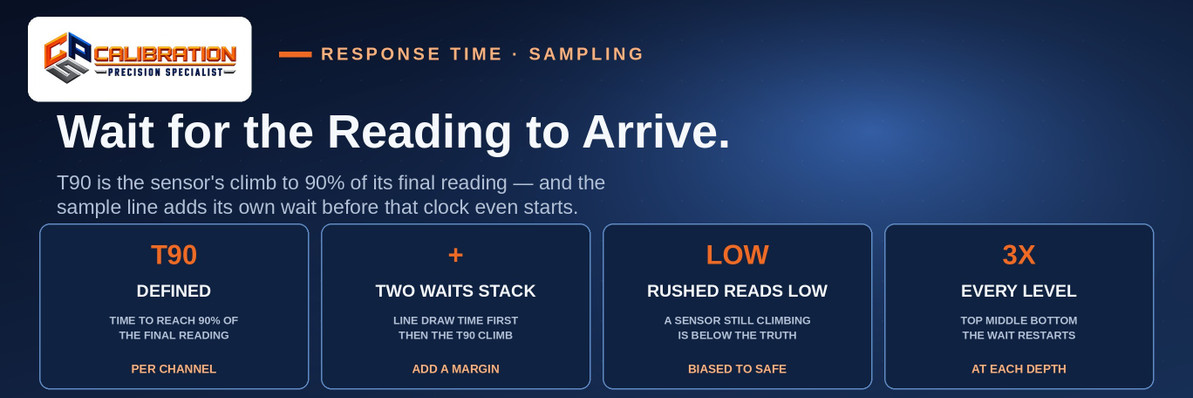
T90 is the time a gas sensor takes to reach 90% of its final reading after the gas sample reaches the sensor — and for remote sampling it is only the second of two waits: the sample must first travel the length of the sample line, and only then does the sensor's T90 clock start, so the minimum trustworthy wait at each test point is draw time plus T90 plus a settling margin. Read the display before that total has run and the reading is still climbing — which means a rushed pre-entry test reads low by construction, in the dangerous direction.
Response time sounds like a spec-sheet footnote, the kind of number compared when two instruments are otherwise tied. In the field it is something else: it is the number that decides how long a tester stands at a manway with a probe in the hole before the number on the screen means anything. Every pre-entry test, every remote sample, every bump test is a negotiation with T90, whether the person holding the instrument knows the term or not. This post defines it precisely, shows how it stacks with sample-line draw time, and explains why it governs both sampling technique and response checks — the companion routine is how to test a confined space before entry, and the timing question from the tester's side is how long do you test a confined space before entry.
What Does T90 Actually Measure?
Picture a sensor sitting in clean air, reading zero. Now put a fixed concentration of gas in front of it, all at once — a step change. The reading does not jump to the true value. It climbs: fast at first, then leveling as it approaches the final, stable reading. T90 is the time that climb takes to reach 90% of the final value. The remaining fraction arrives more slowly as the curve flattens, which is why 90% is the industry's comparison point: it captures how quickly the sensor substantially responds, on the steep part of the curve, without waiting for the last of the settling. Two consequences follow immediately. First, T90 is measured from the moment gas reaches the sensor — not from the moment gas enters a probe, a hose, or a space. Everything upstream of the sensor is somebody else's delay. Second, T90 is a property of each channel separately. A 4-gas instrument carries four sensors responding by different mechanisms, and they do not climb at the same speed; the instrument is only as fast, for a given gas, as that gas's channel. A tester waiting on "the reading" is really waiting on four readings, and the slowest channel of interest sets the wait.
Why Do Sensor Types Respond at Different Speeds?
Because they detect gas by different physics, and physics sets the pace. An electrochemical toxic sensor generates its signal from a chemical reaction with the target gas at an electrode; a catalytic LEL sensor's signal comes from gas burning on a heated element and changing that element's temperature; an infrared channel measures light absorbed by the gas in an optical path. Reaction, combustion, and absorption do not proceed on the same clock, so the channels' response times differ — and the differences do not stay put. Cold slows chemical reactions and can slow a sensor's climb. The flame arrestors, filters, and splash protection fitted over a sensor — necessary protection in real service — are material the gas must pass through, and they add time. An aging or contaminated sensor responds more sluggishly than it did new. The practical rule is not to memorize any instrument's published figures but to treat them as best-case, measured on a bare sensor under controlled conditions: the installed sensor, in the weather, at its age, will be the same or slower. That is also why response is worth observing directly, in bump tests, rather than assumed from a datasheet — covered below.
How Do Sample-Line Draw Time and T90 Stack?
Remote sampling — a pumped instrument drawing air from inside a space through a probe and hose — is where T90 stops being a footnote and becomes the procedure. The timeline has two distinct phases. Phase one is transit: the pump pulls the space's air through the line, and until the sample front has traveled the full length of hose and reached the sensors, the instrument is still reading whatever was in the line before — typically clean surface air. The longer the line, the longer this takes. Phase two is response: with the sample now at the sensors, each channel begins its climb, and T90 runs. Only after transit plus T90 — plus a margin for the curve to settle the rest of the way — is the display showing the space's atmosphere. Skip phase one in your head and you will systematically under-wait: a tester who waits one T90 from dropping the probe has given the sensors a fraction of the time they needed, because much of that wait was spent still drawing yesterday's air up the hose. This is also why the wait restarts at every test level. Confined spaces are tested at multiple depths because atmospheres stratify; moving the probe from the top of the space to the bottom presents the sensors with a new sample and starts a new transit-and-climb. A tester who sweeps the probe down and reads continuously is collecting a smear of half-arrived readings, not a profile of the space.
Why Does Rushing a Pre-Entry Test Read Low?
Follow the curve. A sensor exposed to a step change reports a value below the final value at every moment before it settles — that is what climbing means. A reading taken early is therefore not a random error; it is a biased one, biased low, toward safety, toward clearance. The tester at the manway who drops the probe, counts a few seconds, and reads the screen has measured the sensor's progress, not the space's atmosphere. If the true atmosphere is hazardous, the early reading understates it; if the reading is taken early enough, a dangerous space can present a clean-looking number. The oxygen channel makes the same point in the other direction: a depleted space's O2 reading is still falling toward its true value while the sensor climbs down-scale, so an early read overstates the oxygen — again, the error leans toward "safe." There is no version of an early reading that leans toward caution. Patience at the test point is not thoroughness theater; it is the difference between measuring the space and measuring the sensor. And the failure is invisible afterward: the permit records the number that was written down, with no trace of whether the sensor had finished arriving at it.
What Do Bump Tests and Calibrations Tell You About Response?
A bump test — a brief exposure to known gas that checks the sensors respond and the alarms trigger — is, among other things, a response observation. A channel that climbs promptly and alarms is demonstrating live response behavior; a channel that creeps, stalls, or fails to alarm in the bump window is showing you a response problem — a dying, poisoned, or blocked sensor — before it can hide in a real atmosphere. That is information a calibration record alone does not carry, because calibration answers a different question: it applies certified gas and adjusts the instrument's zero and span so the settled reading is accurate. An instrument can be accurately calibrated at its final value and still respond sluggishly getting there. So the two checks divide the work: calibration makes the destination right, the bump test watches the journey. If a channel's response has degraded — slow to climb, reluctant to clear — that is a service finding, not a setting; the instrument belongs on a bench, where we calibrate every channel and a channel that cannot respond properly is a repair conversation, quoted in writing before work is done. (And the bump and calibration are only meaningful if the gas behind them is right — see can you calibrate with the wrong gas mix.) Questions about a slow channel: 865-900-8844.
A Working Rule for Testers
Build the wait before you start the test, not while you are watching the screen. Know the instrument's response behavior per channel; allow for the line — longer line, longer transit; then allow T90 and settling time on top, at every level, every time the probe moves. When the display has genuinely leveled — not paused, leveled — the reading is the space's. When in doubt, wait longer: the cost of an extra half-minute at a manway is nothing, and the cost of a low-biased reading on a permit is the entry that follows it. Response time is the rare safety specification that is entirely in the tester's hands: the sensor's T90 is fixed by physics, but whether the procedure respects it is a choice made at every single test point.
Frequently Asked Questions
What is T90 response time on a gas detector?
T90 is the time a sensor takes to reach 90% of its final, stable reading after the gas concentration at the sensor changes in a step — for example, when sample gas first reaches a sensor that was sitting in clean air. It is the standard way response speed is specified and compared. The clock starts when gas arrives at the sensor, not when it enters a sample probe or hose, and each channel of a multi-gas instrument has its own response behavior.
Why is response time measured to 90% instead of 100%?
Because a sensor's response curve climbs steeply at first and then flattens as it approaches its final value, so the last fraction takes a disproportionately long time to settle exactly. Measuring to 90% captures the meaningful part of the response — how quickly the sensor substantially registers the gas — on a basis that can be compared consistently between instruments. For field decisions, treat T90 as the minimum response wait and allow a settling margin beyond it.
How long should you wait before trusting a pumped sample reading?
Long enough for both waits to complete: the sample must first travel the full length of the sample line to reach the sensors — longer lines take longer — and then the sensors need their T90 plus a settling margin. Only after draw time plus T90 has run is the display showing the space's atmosphere rather than the air that was in the line. Follow the instrument manufacturer's sampling guidance for your line length, and when in doubt, wait longer.
Why does a gas detector read low if you test too quickly?
Because the reading is still climbing. A sensor exposed to gas rises progressively toward its final value, so at any moment before it settles, the displayed value is below the true concentration — an error biased toward "safe." A pre-entry reading taken a few seconds after the probe goes in measures the sensor's progress, not the space. The same haste overstates oxygen in a depleted space, because that channel is still falling toward its true low value.
Is T90 the same for all four gases on a 4-gas monitor?
No. Each channel is a separate sensor working by its own mechanism — electrochemical for the toxic and oxygen channels, catalytic or infrared for combustibles — and they respond at different speeds. The instrument's effective response for a test is set by the slowest channel you are relying on. T90 is also not a lifetime constant: cold, protective filters and flame arrestors, and sensor age can all slow an installed sensor below its published figure.
What is the difference between a bump test and calibration for response time?
A bump test briefly exposes the sensors to known gas to confirm they respond and the alarms trigger — it adjusts nothing, but it lets you observe response: a channel that climbs sluggishly or fails to alarm is showing a problem. Calibration applies certified gas and adjusts zero and span so the settled reading is accurate; it does not by itself prove the sensor gets there promptly. Calibration makes the final value right; the bump test watches how the channel travels.
Does a longer sample line change T90?
It does not change the sensor's T90 — that clock starts when gas reaches the sensor. What a longer line changes is the transit time before that clock can start, because the pumped sample takes longer to travel a longer hose. Total wait is line transit plus T90 plus settling margin, so lengthening the line lengthens the total wait at the test point even though the sensor itself is unchanged.
Do you need to wait again at every depth when testing a confined space?
Yes. Atmospheres stratify, so spaces are tested at multiple levels, and each new probe position presents the sensors with a new sample: transit and response run again. Reading continuously while sweeping the probe produces a smear of half-arrived values rather than a profile of the space. Stop at each level, let draw time plus T90 plus settling run, record the leveled reading, then move.
Can a sensor's response time get slower as it ages?
Yes. Response depends on the sensor's physical and chemical condition, and aging, contamination, drying, and poisoning all degrade it; protective fittings and cold conditions add their own delays. This is why published T90 figures are best-case values for a new sensor under controlled conditions, and why observed response in routine bump tests matters: a channel that has become noticeably slow is giving you a service warning before it fails outright.
What should you do if a gas detector responds very slowly?
Take it out of service and have it evaluated. Sluggish response — slow to climb on a bump test, slow to clear afterward — points to a sensor that is aged, contaminated, poisoned, or obstructed, and no calibration setting restores physical response speed. At CPS Calibrations the bench calibrates every channel the instrument carries and quotes any sensor or repair work in writing before it is done; call 865-900-8844 to arrange it, or send the instrument to 109 S. Front Street, Rockwood, TN 37854.
The Bottom Line
T90 — the time for a sensor to reach 90% of its final reading once gas reaches it — is the clock inside every gas test you run. Stacked behind sample-line transit time, it sets the minimum wait at every test point and every depth; read earlier and you have measured a sensor mid-climb, which always means a value biased toward safe. Bump tests show you the climb, calibration sets the destination, and the discipline that joins them is simply waiting: draw time, plus T90, plus settling, every time.
Slow channel, failed bump, or an instrument due for calibration? Call CPS Calibrations at 865-900-8844 — 109 S. Front Street, Rockwood, TN 37854.
--- CPS Calibrations · 109 S. Front Street, Rockwood, TN 37854 · How to Test a Confined Space Before Entry · How Long Do You Test a Confined Space Before Entry
Need a calibration you can file?
In-house calibration at CPS in Rockwood, Tennessee — $55 for single-gas instruments, $90 for 4- and 5-gas — every channel, as-found and as-left data, full certificate.
See Calibration Servicesor call 865-900-8844
Recent Posts
-

How Long Do Gas Detector Sensors Last?
Gas detector sensors do not share one lifespan: a traditional galvanic oxygen sensor typically lasts …Nov 16th 2026 -

The 15-Minute Weekly Gas Detection Checklist for Supervisors
A weekly gas detection check takes a supervisor about 15 minutes and covers four things: every instr …Nov 15th 2026 -

Calibration Gas for PID Instruments: Isobutylene and the 100 ppm Standard
A PID is calibrated on 100 ppm isobutylene — not on the gas you are measuring — because the instrume …Nov 14th 2026