
Can You Calibrate With the Wrong Gas Mix? What Actually Goes Wrong
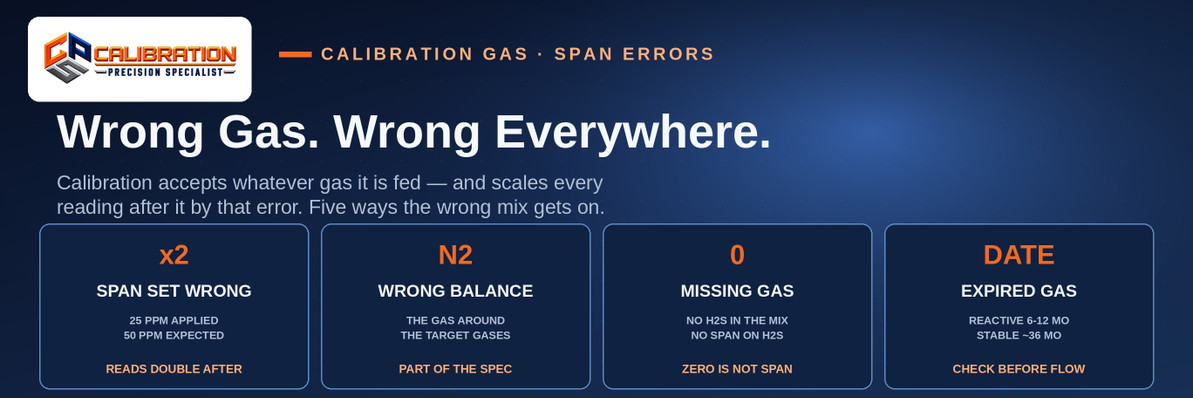
Yes — you can calibrate a gas detector with the wrong gas mix, and the instrument will usually accept it without complaint, which is exactly the problem: calibration sets the instrument's span to whatever gas it was actually fed, so a wrong concentration, the wrong balance gas, or a mix missing one channel's gas produces an instrument that passes calibration and then reads wrong — proportionally, everywhere, until the next calibration. The standard 4-gas mix (H2S 25 ppm, CO 50 ppm, CH4 2.5% vol, O2 12.0%, balance nitrogen) only calibrates correctly when those are the span values the instrument is set to expect.
A detector has no way to know what is in the cylinder. It knows what it was told to expect, and it knows the signal its sensors produced while the gas was flowing. Calibration is the act of forcing those two to agree. Feed it a different gas than it expects and it will still force the agreement — it will just agree on a lie, and then apply that lie to every reading in the field. This post walks the five ways the wrong gas gets onto an instrument and what each one does to the readings, and it sits inside a wider series: what calibration gas is, how to read a calibration gas label, and the calibration gas finder that matches a mix to an instrument before any of this matters.
What Happens When the Span Concentration Is Wrong?
Span calibration teaches the instrument one sentence: "this much signal means this much gas." If the gas in the cylinder and the value the instrument expects disagree, the instrument learns the sentence wrong — and because span is a scale, the error is proportional, not fixed. It reads wrong by a ratio, at every concentration, high and low.
Run the arithmetic on the standard mix. Suppose an H2S channel is set to expect a 50 ppm span value, but the cylinder actually feeding it carries H2S at 25 ppm. The sensor produces a 25 ppm signal; the instrument is told that signal means 50. From then on the channel doubles everything: a real 10 ppm atmosphere reads about 20, a real 25 ppm atmosphere reads about 50. Run it the other way — 50 ppm applied to an instrument expecting 25 — and the channel halves everything, which is the dangerous direction: a real 20 ppm H2S atmosphere displays as roughly 10, under an alarm threshold it should have crossed. Nothing about the calibration screen flags this. The instrument calibrated "successfully" both times. The only place the error existed was on the cylinder label, which is why how to choose calibration gas starts with matching values, not with price or cylinder size. The same proportional logic applies to the oxygen channel: the standard mix carries O2 at 12.0%, and if the instrument expects a different oxygen span value than the mix delivers, the O2 scale is set wrong by that ratio — on the channel every other safety decision leans on.
What Does the Wrong Balance Gas Do?
Everything in the cylinder that is not a target gas is the balance, and it is part of the specification, not filler. The standard 4-gas mix is balanced in nitrogen, which means the gas flowing over the sensors during calibration contains the four target gases and essentially no oxygen beyond the 12.0% the mix deliberately carries. Balance matters for two reasons. First, the oxygen channel is spanned against the mix's stated O2 value in that balance — change the balance and you change the environment the O2 span was set in. Second, a catalytic LEL sensor does not measure gas directly; it burns it, and burning requires oxygen. A catalytic bead starved of oxygen under-responds or cannot respond at all, which is why catalytic sensors read falsely in inert atmospheres. Calibrate an LEL channel in an oxygen-free presentation it was not specified for and the span you set does not describe how that sensor behaves in air. The label discipline is simple: the balance gas printed on the label must be the balance the instrument's specified mix calls for — nitrogen-balanced and air-balanced mixes are different products, not interchangeable packaging. The distinction between the gases themselves is covered in zero gas vs. span gas; the point here is that "close enough" on balance is a calibration error with a clean conscience.
What Is the LEL Correction-Factor Problem?
A catalytic LEL sensor responds differently to different combustible gases — the same percent of LEL of two different gases does not produce the same signal. Instruments handle this with correction factors: calibrate on one gas, apply a factor, and the channel estimates another gas's LEL. The failure mode is a silent mismatch. Calibrate the LEL channel on methane — the standard mix carries CH4 at 2.5% vol, which is 50% LEL because methane's LEL is 5% vol — and then send the instrument to measure a different combustible without the correct factor applied, and the displayed %LEL is a conversion that was never made. Depending on the gas, the channel can read high or read low; the low direction is the one that hurts, because an atmosphere displayed as a fraction of its true %LEL looks safer than it is. No factor table is printed in this post on purpose: factors are instrument- and sensor-specific, they belong to the manufacturer's documentation for the exact model, and a factor borrowed from a chart for a different sensor is itself a wrong-gas error wearing a lab coat. The discipline is to know which gas the channel was spanned on, know which gas it will actually meet, and confirm the instrument is applying that model's specified factor for the target gas — or span it on the target gas.
What Goes Wrong With Expired Gas?
Calibration gas is a promise with a date on it. Reactive gases — the toxic components such as H2S are the classic case — degrade in the cylinder, and their usable shelf life runs roughly 6–12 months; stable gases hold far longer, roughly 36 months. Past the date, the label concentration is no longer a fact; it is a history. Span an instrument on degraded gas and you have run the wrong-concentration failure above with extra steps: if a mix labeled 25 ppm H2S has decayed below 25, the instrument is spanned against a value the gas no longer holds, and every reading scales by an error nobody can compute, because nobody knows what was actually in the cylinder. Expired gas does not announce itself either — the cylinder has pressure, the gas flows, the calibration completes. The date check takes seconds and is the cheapest step in the entire procedure, which is why it belongs in the same breath as reading the concentrations: value, balance, date, every time, before the regulator goes on. CPS's own bench treats the gas as part of the record — each bottle's Certificate of Analysis is tied to the calibrations it was used on — because a calibration is only as traceable as the gas behind it.
What If the Mix Does Not Contain a Channel's Gas?
A 4-gas instrument has four channels, and a mix spans only the channels whose gases it actually contains. Put a mix with no H2S in it on a 4-gas instrument and the H2S channel sees nothing to span on. It may sit at zero, it may be zeroed, it may even be carried through the procedure by software that spans the channels it can — but that channel was never shown a known concentration of its gas, so its scale was never verified or set. Zero is not span: a zero check proves the channel reads nothing when there is nothing, and says nothing about whether it reads 25 when there is 25. This failure hides better than the others because three channels genuinely were calibrated, the instrument genuinely passed what it was given, and the paperwork looks complete. The check is a count, done at the label: four channels, four gases, four concentrations that match the specified span values. If a channel's gas is not in the cylinder, that channel needs its own gas — single-gas cylinders exist for exactly this — and the calibration gas range is organized by mix so the match can be checked before ordering, not discovered at the bench.
The Fix: A Label Discipline, Not a New Procedure
None of the five failures needs new equipment. They need one habit, applied in order, every time: read the label before the regulator goes on. Confirm each concentration against the instrument's specified span values — all of them, not just the first line. Confirm the balance gas. Confirm the date, with reactive mixes held to their shorter lives. Confirm the mix actually contains a gas for every channel on the instrument. And confirm the LEL channel's calibration gas and correction-factor setting match the gas it will measure in service. If any line disagrees, the correct move is to stop with the cylinder still closed: a calibration postponed is an inconvenience, while a calibration performed on the wrong gas is a false record plus an instrument reading wrong in the field — worse than no calibration, because it comes with paperwork saying everything is fine. If a mix was used in error and you know it, the instrument is not "probably close"; its readings are off by a ratio you can work out from the two values, and the remedy is a fresh calibration on the correct gas, which at CPS is bench work where we calibrate every channel the instrument carries. Questions about which mix an instrument specifies are a phone call: 865-900-8844.
Frequently Asked Questions
Can you calibrate a gas detector with the wrong gas mix?
Yes — physically, the instrument will accept it, and that is the hazard. Calibration forces the sensor's signal to match the span value the instrument expects, whatever gas actually produced the signal. Feed it a different concentration than it expects and it sets a proportionally wrong scale, then applies that scale to every field reading until the next calibration. The instrument cannot detect the mismatch; only the person reading the cylinder label can.
What happens if you calibrate with the wrong concentration of gas?
Every reading scales by the ratio between the two values. Apply 25 ppm to a channel expecting a 50 ppm span and the channel doubles its readings afterward — a real 25 ppm atmosphere displays as about 50. Reverse it and the channel halves its readings, so a real 20 ppm atmosphere can display as about 10 and sit under an alarm it should have triggered. The error is proportional, so it grows with the concentration.
Can you calibrate a 4-gas monitor with a mix that is missing one gas?
No — you calibrate only the channels whose gases are in the cylinder. A mix with no H2S in it gives the H2S channel nothing to span on: it can be zeroed, but zero only proves the channel reads nothing in clean gas, not that it reads correctly at concentration. That channel remains unspanned until it is calibrated on a mix or a single-gas cylinder that actually contains its gas at the specified value.
Does the balance gas in a calibration cylinder matter?
Yes. The balance — nitrogen in the standard 4-gas mix — is part of the specification. It sets the environment the oxygen channel is spanned in, and it matters physically for a catalytic LEL sensor, which burns gas and needs oxygen to respond; starved of oxygen, a catalytic sensor under-responds or reads falsely. A nitrogen-balanced mix and an air-balanced mix are different products, and substituting one for the specified other is a calibration error.
What happens if you calibrate with expired calibration gas?
The span is set against a concentration the gas no longer holds. Reactive gases degrade fastest, with shelf lives around 6–12 months, while stable gases run roughly 36 months; past the date, a cylinder labeled 25 ppm may deliver less, and the instrument is scaled to a value that was never in front of its sensors. The calibration completes and passes, and the size of the error is unknowable — which is why the date is checked before the gas flows, not after.
Can you calibrate an LEL sensor on methane and measure a different gas?
Only with the instrument's specified correction factor for that target gas applied. A catalytic LEL sensor responds differently to different combustible gases, so a channel spanned on methane — 2.5% vol in the standard mix, equal to 50% LEL — does not automatically read another gas's %LEL correctly. Factors are specific to the instrument model and sensor; use the manufacturer's factor for the exact model, or span the channel on the target gas itself.
How do you know which calibration gas mix your detector needs?
From the instrument's specified span values — the concentrations its calibration is designed around — matched line by line against a cylinder label: each gas, each concentration, the balance gas, and the expiry date. For a standard 4-gas instrument that is typically H2S 25 ppm, CO 50 ppm, CH4 2.5% vol (50% LEL), O2 12.0%, balance nitrogen. CPS's calibration gas finder walks the match, and if a label and a manual disagree, stop and resolve it before calibrating.
What should you do if you already calibrated with the wrong gas?
Treat every reading since that calibration as off by the ratio between the gas applied and the value expected — and recalibrate on the correct gas before relying on the instrument. Do not average it out or mentally correct field readings; a span error is exactly the thing calibration exists to remove. A fresh calibration on the right mix, with every channel spanned, resets the instrument to a scale you can defend.
Is a zero calibration enough if you do not have span gas?
No. Zeroing sets the channel's reading in clean conditions — it proves the baseline, nothing more. Span is what verifies and sets the scale at concentration, and the wrong-gas failures in this post are all span failures: wrong value, wrong balance, missing gas, degraded gas. An instrument that has only been zeroed has an unverified scale, and an instrument zeroed in contaminated air has a wrong baseline as well.
How does CPS make sure the right gas is used on a calibration?
By treating the gas as part of the calibration record. The mix is matched to the instrument's specified span values before calibration, we calibrate every channel the instrument carries, and each gas bottle's Certificate of Analysis — captured from the supplier code when the bottle enters service — is linked to the certificates of the instruments it was used on. If a mix does not match an instrument's specification, it does not go on the instrument; call 865-900-8844 to confirm the right mix for a model.
The Bottom Line
Calibrating with the wrong gas mix does not produce a failed calibration — it produces a successful-looking one: a span set to the wrong concentration scales every reading by that ratio, the wrong balance undermines the oxygen and LEL channels, a correction-factor mismatch misreads the combustible channel, expired gas spans against a value that no longer exists, and a missing gas leaves a channel zeroed but never spanned. The entire defense is on the label: match every value, the balance, and the date to the instrument's specification before the gas flows.
Not sure the cylinder on your shelf matches the instrument in your hand? Call CPS Calibrations at 865-900-8844 — or send the instrument to 109 S. Front Street, Rockwood, TN 37854 and let the bench match the gas for you.
--- CPS Calibrations · 109 S. Front Street, Rockwood, TN 37854 · Calibration Gas Guide · How to Read a Calibration Gas Label · Calibration Gas
Need a calibration you can file?
In-house calibration at CPS in Rockwood, Tennessee — $55 for single-gas instruments, $90 for 4- and 5-gas — every channel, as-found and as-left data, full certificate.
See Calibration Servicesor call 865-900-8844
Recent Posts
-

How Long Do Gas Detector Sensors Last?
Gas detector sensors do not share one lifespan: a traditional galvanic oxygen sensor typically lasts …Nov 16th 2026 -

The 15-Minute Weekly Gas Detection Checklist for Supervisors
A weekly gas detection check takes a supervisor about 15 minutes and covers four things: every instr …Nov 15th 2026 -

Calibration Gas for PID Instruments: Isobutylene and the 100 ppm Standard
A PID is calibrated on 100 ppm isobutylene — not on the gas you are measuring — because the instrume …Nov 14th 2026