
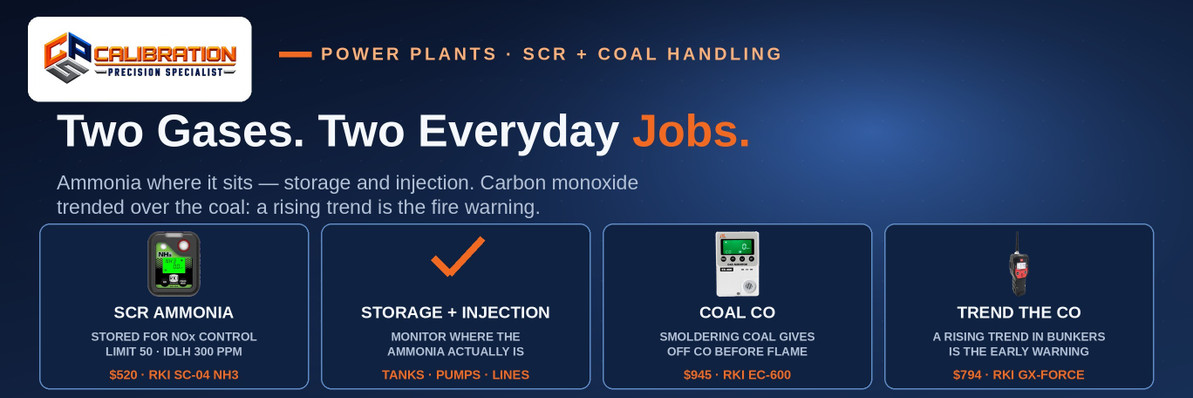
Ammonia at the SCR and CO in Coal Handling: A Power Plant's Two Everyday Gas Jobs
A power plant's two everyday gas jobs are ammonia monitoring at the SCR — where ammonia stored for NOx control (OSHA limit 50 ppm, IDLH 300 ppm) needs detection at its storage and injection areas — and carbon monoxide monitoring in coal handling, where smoldering coal gives off CO and a rising CO trend in bunkers and on tripper floors is the earliest fire warning, against the same 50 ppm worker exposure limit.
The generator's hydrogen gets the attention, but these two systems run every day, hold their hazards in ordinary places, and are worked by ordinary crews on ordinary rounds. That is exactly why they injure people: nobody treats a routine area like a hazardous one until the numbers say otherwise. This post is the detailed companion to the plant-wide map in what gas detection does a power plant need?
Why Does the SCR Store Ammonia in the First Place?
Because selective catalytic reduction is how the plant controls NOx: ammonia is injected into the exhaust stream ahead of a catalyst, and the chemistry converts nitrogen oxides to nitrogen and water. The plant therefore keeps an ammonia supply on site — often aqueous ammonia — with storage, transfer, and injection equipment running whenever the unit runs. The gas job follows directly from the process: wherever ammonia is stored, moved, or injected is where ammonia can be released, and ammonia is not forgiving — an OSHA permissible exposure limit of 50 ppm as an 8-hour average, and 300 ppm immediately dangerous to life or health (IDLH).
Where Do Ammonia Detectors Belong at an SCR?
Where the ammonia is — in two areas:
- The storage area. Tanks, unloading connections, pumps, and valves. Releases here are equipment events: a failed seal, a hose or connection problem during a delivery, a relief event. Detection belongs at the equipment, where a release starts, not at the far wall.
- The injection area. The lines and equipment feeding ammonia to the exhaust stream. This area is worked by people — rounds, maintenance, adjustments — so detection here protects a person standing in the job, not just a tank farm standing alone.
A personal monitor covers the worker's side of both areas: the RKI SC-04 ammonia monitor ($520) rides with the operator doing rounds and unloading work, while fixed points from the stand-alone detectors range watch the areas between rounds. Ammonia announces itself by smell far below dangerous levels — which tempts people to trust their noses. Do not: smell tells you ammonia is present, not how much, and the gap between "strong smell" and the 300 ppm IDLH line is not a gap a nose can measure.
Why Is CO in Coal Handling a Fire Alarm, Not Just an Exposure Monitor?
Because of where the CO comes from. Coal in a bunker, silo, or pile can begin to smolder — a slow, deep, self-heating burn with no flame and often no visible smoke at the surface. Smoldering coal gives off carbon monoxide as it burns incompletely, and that CO rises into the bunker headspace and the tripper floor above it. A CO reading that trends upward over hours and shifts is the coal telling you it is heating — long before a heat detector or a human nose has anything to report.
That makes coal-handling CO a trending job, not just an alarm job:
- A flat CO history is a healthy bunker. The baseline matters as much as any single reading.
- A rising trend is the warning — investigate the coal, not the detector.
- An alarm-only setup wastes the signal. A point that only speaks at a high limit throws away the days of rising readings that were the actual early warning.
A fixed point sized for gallery air — the RKI EC-600, 0–150 ppm, $945 — fits this scale, and its readings belong somewhere they are watched and recorded, because a trend nobody logs is a warning nobody gets.
What About the People Working the Coal Galleries?
The same CO is their exposure too. Gallery and tripper-floor work puts people in the air the bunker breathes into, and CO is colorless and odorless with an OSHA limit of 50 ppm as an 8-hour average — a worker cannot sense a slow build-up across a shift. Fixed gallery points cover the space; a personal 4-gas monitor covers the person wherever the round takes him. The RKI GX-3R ($640) carries CO with LEL, O2, and H2S, and the pumped RKI GX-Force ($794) covers sampling work around bunkers and enclosed coal spaces. We calibrate every channel on all of them — a CO channel reading low fails both jobs at once, the fire warning and the exposure record — through calibration services.
Frequently Asked Questions
Why does a power plant store ammonia?
For emissions control. A selective catalytic reduction (SCR) system injects ammonia into the exhaust stream, where it reacts over a catalyst to convert nitrogen oxides (NOx) into nitrogen and water. Running an SCR means storing ammonia on site — often as aqueous ammonia — with storage tanks, transfer pumps, and injection equipment in daily service whenever the unit runs.
How dangerous is ammonia at an SCR?
Ammonia's OSHA permissible exposure limit is 50 ppm as an 8-hour time-weighted average, and 300 ppm is rated immediately dangerous to life or health (IDLH). Ammonia is irritating enough that people notice it well below those numbers — but smell reports presence, not concentration, and cannot tell a strong-but-legal reading from one approaching the IDLH. Detection with instruments, at the storage and injection areas, is what turns smell into a number a decision can rest on.
Where should ammonia detectors be installed at a power plant?
In the two places the ammonia is: the storage area — at tanks, unloading connections, pumps, and valves, where releases start — and the injection area, where the feed equipment runs and where people work rounds and maintenance. Fixed points watch those areas continuously; a personal ammonia monitor such as the RKI SC-04 ($520) covers the operator during deliveries, rounds, and line work between the fixed points.
Why monitor carbon monoxide in coal bunkers?
Because smoldering coal gives off carbon monoxide before it flames. Coal that self-heats and begins to smolder burns incompletely and releases CO into the bunker headspace and the tripper floor above it, well before smoke or heat announces a fire. A CO point in that air — watched as a trend — is the earliest warning of a bunker fire a plant can get.
What does a rising CO trend in a coal bunker mean?
It means the coal is likely heating. A healthy bunker holds a flat, low CO baseline; readings that climb steadily over hours and shifts mean something in the pile or bunker is smoldering and producing more CO as it grows. The correct response is to investigate the coal — its temperature, its age, its movement — not to assume the detector is drifting. Trending is the whole value: an alarm-only setup discards the rising readings that were the warning.
What is the OSHA limit for carbon monoxide in a power plant?
50 ppm as an 8-hour time-weighted average — the same OSHA permissible exposure limit that applies in general industry. The limit matters twice in coal handling: it caps what gallery and tripper-floor crews may breathe across a shift, and it is separate from the fire-warning job, where a rising trend below the limit can still be telling you a bunker is smoldering.
Can you smell ammonia or carbon monoxide leaks?
Ammonia, yes — and that is a trap. Its sharp smell reports that ammonia is present but not how much, and it cannot distinguish a tolerable reading from one near the 300 ppm IDLH. Carbon monoxide, no — CO is colorless and odorless, and a worker in a coal gallery gets no sensory warning at any concentration. One gas over-reports itself and the other does not report at all; instruments settle both.
What CO detector fits a coal gallery or tripper floor?
A fixed stand-alone CO monitor sized for area air — the RKI EC-600 reads 0–150 ppm and costs $945 — with its readings recorded somewhere they are reviewed, because coal-handling CO only pays as a trend. Crews working the galleries add a personal multi-gas monitor (RKI GX-3R, $640; pumped RKI GX-Force, $794) so the exposure record follows the person, not just the room.
How often do SCR ammonia and coal CO detectors need calibration?
On the interval each detector's manufacturer specifies — ammonia and CO sensors in plant environments do not share one honest number. The stakes of skipping are doubled in coal handling, where a CO channel reading low destroys both the worker-exposure record and the bunker fire trend at the same time. Fixed and personal instruments belong on one written calibration schedule with documented as-found and as-left results.
What do ammonia and CO detection cost a power plant?
At live CPS list prices: a personal ammonia monitor (RKI SC-04) is $520, a fixed stand-alone CO point (RKI EC-600) is $945, and personal 4-gas monitors for gallery crews are $640 (RKI GX-3R) or $794 pumped (RKI GX-Force). Multi-point fixed ammonia systems price by point count and installation. Every point adds recurring calibration, which belongs in the budget alongside the hardware.
The Bottom Line
Ammonia at the SCR is a where-it-sits job — storage and injection, 50 ppm limit, 300 ppm IDLH. CO in coal handling is a which-way-it's-moving job — trend the bunkers and tripper floors, because smoldering coal speaks in carbon monoxide first. Do both, and the plant's two everyday gas jobs stop being surprises.
Putting points on an SCR or a coal system? Start with the plant-wide map in what gas detection does a power plant need? and the CPS Calibration Program, or call CPS Calibrations at 865-900-8844.
CPS Calibrations · 109 S. Front Street, Rockwood, TN 37854 · Calibration Services · The CPS Calibration Program
Need a calibration you can file?
In-house calibration at CPS in Rockwood, Tennessee — $55 for single-gas instruments, $90 for 4- and 5-gas — every channel, as-found and as-left data, full certificate.
See Calibration Servicesor call 865-900-8844
Recent Posts
-

What Is Remote Monitoring for Fixed Gas Detection?
Remote monitoring for fixed gas detection means a fixed system's live readings, trends, and alarm hi …Nov 23rd 2026 -

What Are the Key Differences Between the GX-6000 and GX-6100?
The RKI GX-6100 is the current replacement for the discontinued GX-6000: both are pumped 6-gas monit …Nov 22nd 2026 -

How to Read a PID Correction Factor Chart
To read a PID correction factor chart, find your vapor’s row, take the factor under your own lamp en …Nov 21st 2026