
What Gas Detection Does a Power Plant Need?
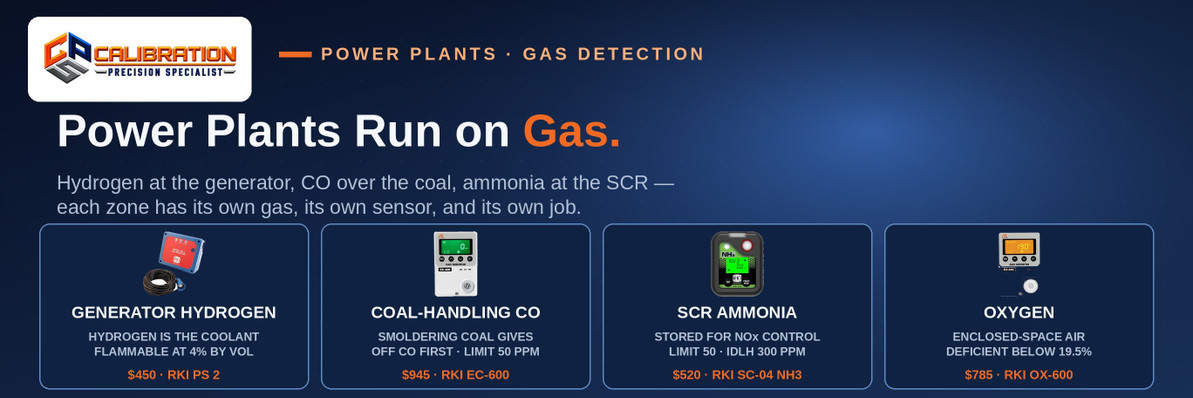
A power plant needs gas detection matched to each system, not one plant-wide monitor: hydrogen leak and purity monitoring at hydrogen-cooled generators (hydrogen is flammable from 4% by volume, rises fast, and burns with a nearly invisible flame), carbon monoxide detection in coal handling and at combustion equipment (OSHA limit 50 ppm), ammonia detection at SCR storage and injection areas (limit 50 ppm, IDLH 300 ppm), and oxygen and personal multi-gas monitors for the people who enter plant spaces.
A power plant is several chemical processes sharing one fence line. The fuel system, the generator, the emissions controls, and the ash and coal yards each create a different gas, send it to a different place, and hurt people a different way. Detection that treats the plant as one hazard misses all four. This post is the map, zone by zone — and CPS serves plants across East Tennessee, in the middle of some of the heaviest power generation country in the region.
What Is the Gas Hazard Map for a Power Plant?
| Zone | Gas to monitor | Why it is there | Where detection goes |
|---|---|---|---|
| Generator (hydrogen-cooled) | Hydrogen (H2) | The generator's cooling gas | Purity monitoring on the machine; leak points around casings and seal-oil areas, mounted high — hydrogen rises |
| Coal handling — bunkers, tripper floors, galleries | Carbon monoxide (CO) | Smoldering coal gives off CO before it flames | In the bunker and gallery air, trended over time, not just alarmed |
| SCR / emissions control | Ammonia (NH3) | Stored (often aqueous) ammonia injected for NOx control | Storage and injection areas |
| Boiler and combustion areas | CO and oxygen (O2) | Combustion exhaust leaks; oxygen displacement in enclosed spaces | Breathing zones and enclosed low areas |
| Confined and enclosed spaces plant-wide | O2, LEL, CO, H2S as the space requires | Whatever the space has held or adjoins | Tested before and during entry, with a personal monitor on the entrant |
Two of those zones earn their own deep dives in this series: hydrogen monitoring at power plant generators, and ammonia at the SCR and CO in coal handling.
Why Is Hydrogen the Generator's Gas Problem?
Because many large generators are cooled with hydrogen — which makes the cooling gas itself the hazard. Hydrogen is flammable from 4% by volume across a wide range to about 75%, it rises fast, and it burns with a nearly invisible flame, so a leak gives a person almost nothing to see, smell, or feel. Generator hydrogen systems run at high purity, and the standard practice is purity monitoring on the machine plus leak monitoring around the places hydrogen can escape — casings and seal-oil areas first. The full treatment is in hydrogen monitoring at power plant generators.
Why Does Coal Handling Need Carbon Monoxide Detection?
Because coal tells you it is in trouble with CO first. A pile or bunker of coal that begins to smolder gives off carbon monoxide well before there is visible smoke or flame, so a rising CO trend in a bunker or on a tripper floor is the earliest warning the plant gets. CO is also a direct exposure hazard to the people working those galleries — colorless, odorless, with an OSHA permissible exposure limit of 50 ppm as an 8-hour average. One gas, two jobs: fire warning and worker protection. The paired post covers both in depth: ammonia at the SCR and CO in coal handling.
Why Does the SCR Need Ammonia Detection?
Because NOx control runs on ammonia. Selective catalytic reduction systems store ammonia — often as aqueous ammonia — and inject it into the exhaust stream. The exposure numbers are tight: an OSHA limit of 50 ppm as an 8-hour average, and 300 ppm rated immediately dangerous to life or health (IDLH). The monitoring points follow the ammonia: the storage area and the injection area, where a flange, pump seal, or unloading connection is the likely source.
Fixed Points, Personal Monitors, or Both?
Both, doing different jobs. Fixed points watch the plant when nobody is there: a stand-alone combustible point such as the RKI PS 2 ($450) at a hydrogen leak area, an RKI EC-600 CO monitor (0–150 ppm, $945) in a coal gallery, an RKI OX-600 oxygen monitor (0–25%, $785) in an enclosed space, and a personal RKI SC-04 ammonia monitor ($520) on the operator working the SCR. Browse the stand-alone detectors and the wider fixed systems ranges for the controller-based versions.
Personal monitors travel with the worker into the spaces fixed points do not cover. A 4-gas instrument such as the RKI GX-3R ($640 — LEL, O2, CO, and H2S) is the standard plant carry, and a pumped instrument such as the RKI GX-Force ($794) draws a sample from a space before and during entry work. We calibrate every channel on both kinds of instrument — fixed points drift silently with nobody wearing them to notice, which is why they belong on the same written schedule as the portables in calibration services.
Frequently Asked Questions
What gas detection does a power plant need?
A power plant needs detection matched zone by zone: hydrogen purity and leak monitoring at hydrogen-cooled generators (hydrogen is flammable from 4% by volume), carbon monoxide detection in coal handling (OSHA limit 50 ppm), ammonia detection at SCR storage and injection areas (limit 50 ppm, IDLH 300 ppm), oxygen monitoring in enclosed spaces (deficient below 19.5%), and personal multi-gas monitors for workers entering plant spaces. No single monitor covers systems this different.
Why do power plant generators need hydrogen monitoring?
Many large generators are cooled with hydrogen, and the cooling gas is itself flammable from 4% by volume across a range to about 75%. Hydrogen rises fast and burns with a nearly invisible flame, so leaks give almost no human warning. Generator systems run hydrogen at high purity, and the standard practice is purity monitoring on the machine plus leak monitoring around casings and seal-oil areas, where escapes happen first.
What gas detection does coal handling need?
Carbon monoxide detection, trended over time. Smoldering coal gives off CO before it produces visible smoke or flame, so a rising CO trend in bunkers and on tripper floors is the earliest fire warning available. CO is also a direct worker exposure — colorless and odorless, with an OSHA permissible exposure limit of 50 ppm as an 8-hour average — so the same points protect the people working the galleries.
Why does an SCR system need ammonia detectors?
Selective catalytic reduction controls NOx by injecting ammonia, which the plant stores on site — often as aqueous ammonia. Ammonia's OSHA exposure limit is 50 ppm as an 8-hour average and 300 ppm is immediately dangerous to life or health. The monitoring points are where the ammonia is: the storage area and the injection area, covering tank connections, pumps, and unloading points.
Where should hydrogen detectors be placed at a generator?
High, and at the leak sources. Hydrogen is far lighter than air and rises fast, so detectors belong above and around the generator casings and the seal-oil area — the places hydrogen escapes first and collects highest. A detector at breathing height can read clean air below a rising leak. Placement follows the gas: hydrogen points go up, just as heavier gases' points go low.
Does a power plant need fixed detectors or portable monitors?
Both. Fixed points watch zones continuously when nobody is present — generator hydrogen areas, coal galleries, SCR storage — and can drive alarms and ventilation. Portable and personal monitors travel with workers into spaces fixed points do not cover, and a pumped portable tests a space before entry. The two layers protect different moments: the fixed layer guards the plant, the personal layer guards the person.
What does gas detection for a power plant cost?
Point by point, at live CPS list prices: a stand-alone combustible point (RKI PS 2) is $450, an oxygen monitor (RKI OX-600) is $785, a CO monitor (RKI EC-600) is $945, and a personal ammonia monitor (RKI SC-04) is $520. Personal 4-gas monitors run $640 for the RKI GX-3R and $794 for the pumped RKI GX-Force. Multi-point plants move to detector heads on a controller, priced by point count and installation — and every point carries a recurring calibration cost that belongs in the budget.
How often do power plant gas detectors need calibration?
On the interval the manufacturer specifies for each detector — there is no single number that honestly covers hydrogen, CO, ammonia, and oxygen sensors in different environments. What is universal is the failure mode: sensors drift, fixed points drift silently, and a point reading low reports a dangerous room as safe. Put every fixed and portable point on a written calibration schedule based on its manual, and keep the records with the plant's safety documentation.
Can one detector monitor hydrogen, CO, and ammonia together?
Not as one point. Hydrogen, carbon monoxide, and ammonia live in different zones of the plant, behave differently in air — hydrogen rises fast; the others mix and travel differently — and use different sensing technologies. A multi-gas portable can carry CO alongside LEL, oxygen, and H2S for a worker, but the generator's hydrogen, the bunker's CO, and the SCR's ammonia each need a point where that gas actually is.
Who calibrates gas detectors for power plants in East Tennessee?
CPS Calibrations in Rockwood, Tennessee calibrates portable and fixed gas detection for plants across East Tennessee — in-house at our shop and on-site for installed fixed systems. In-house calibration is $55 for a single-gas instrument and $90 for a 4- or 5-gas instrument; on-site work at your facility is quoted in writing and costs more than bench work. Every certificate carries as-found and as-left readings on every channel.
The Bottom Line
A power plant's gas detection is a map, not a monitor: hydrogen at the generator, CO trending over the coal, ammonia at the SCR, and oxygen and personal monitors wherever people enter — each gas watched where it actually goes.
Working through that map for an audit, an outage, or a new system? Start with the fixed systems range and the CPS Calibration Program, or call CPS Calibrations at 865-900-8844.
CPS Calibrations · 109 S. Front Street, Rockwood, TN 37854 · Calibration Services · The CPS Calibration Program
Need a calibration you can file?
In-house calibration at CPS in Rockwood, Tennessee — $55 for single-gas instruments, $90 for 4- and 5-gas — every channel, as-found and as-left data, full certificate.
See Calibration Servicesor call 865-900-8844
Recent Posts
-

What Is Remote Monitoring for Fixed Gas Detection?
Remote monitoring for fixed gas detection means a fixed system's live readings, trends, and alarm hi …Nov 23rd 2026 -

What Are the Key Differences Between the GX-6000 and GX-6100?
The RKI GX-6100 is the current replacement for the discontinued GX-6000: both are pumped 6-gas monit …Nov 22nd 2026 -

How to Read a PID Correction Factor Chart
To read a PID correction factor chart, find your vapor’s row, take the factor under your own lamp en …Nov 21st 2026