
Benzene Monitoring in Oil and Gas: When You Need a PID
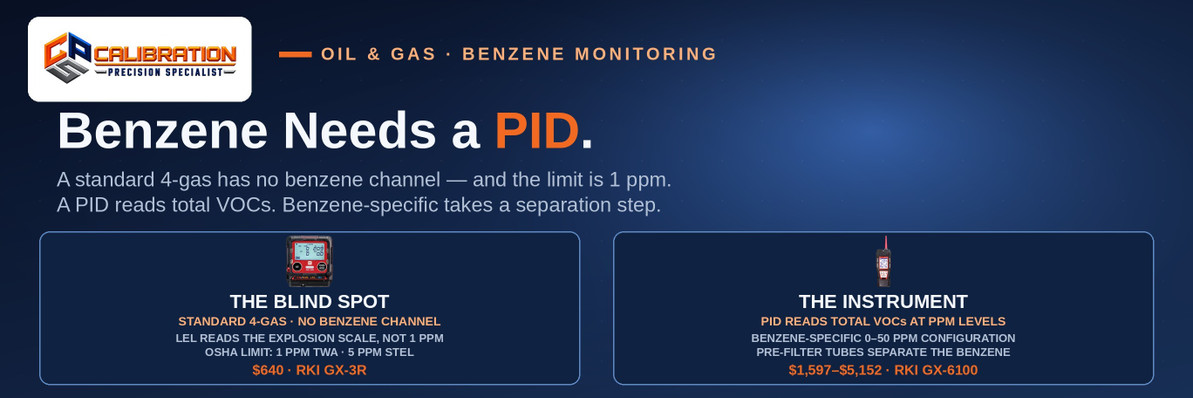
You need a PID for benzene work whenever a job can release benzene at occupational levels — tank gauging, refinery turnarounds, loading racks, and produced-water handling — because benzene's OSHA exposure limit is 1 ppm as an 8-hour average (5 ppm short-term), and no channel on a standard 4-gas monitor can see benzene anywhere near that level. But a standard PID reads total VOCs, not benzene itself: a benzene number you can act on requires a benzene-specific measurement method, such as the pre-filter tube configuration available on PID instruments like the RKI GX-6100.
Everything below is the honest version of that answer: where benzene actually shows up in oil and gas work, why the monitor already on your crew's belts is blind to it, what a PID can legitimately claim, and the exact point where "VOC screening" stops and "benzene measurement" has to start.
Where Does Benzene Actually Show Up in Oil and Gas?
Benzene is a natural component of crude oil and many refined streams, which means it concentrates wherever crude and product vapors concentrate:
- Tank gauging and thief hatches. Opening a hatch on a crude or produced-water tank releases the tank's vapor space directly into the gauger's breathing zone. This is one of the best-documented benzene exposure points in the industry — we cover the hatch hazard itself in tank gauging and thief hatches: the gas hazard nobody sees coming.
- Turnarounds and shutdowns. Vessels, exchangers, and lines that held product get opened, drained, and cleaned. Residual hydrocarbons off-gas into work areas and confined spaces for days, and benzene is part of that vapor mixture.
- Loading racks. Tank trucks and rail cars loading crude or refined product vent displaced vapor at the fill connection — exactly where the operator stands.
- Produced-water handling. Water separated from crude carries dissolved hydrocarbons; tanks, sumps, and treatment equipment handling it release benzene-bearing vapor at openings and vents.
- Sampling, maintenance, and leak work. Any task that opens a product system — pulling a sample, breaking a flange, repairing a pump seal — puts a worker at the point where vapor escapes.
The pattern underneath the list: benzene exposure in oil and gas is a vapor-at-an-opening problem. It happens at hatches, vents, flanges, and drains, at low concentrations that matter over a shift — not as a dramatic release a combustible-gas alarm would ever catch.
Why Can't a Standard 4-Gas Monitor See Benzene?
Because it has no benzene sensor, and its nearest channel works on the wrong scale by four orders of magnitude:
- The standard four are LEL, O₂, CO, and H₂S. There is no benzene channel in a 4-gas monitor. It cannot alarm on a gas it has no sensor for.
- The LEL channel reads the explosion scale. Benzene's flammable range starts at roughly 1.2% by volume — about 12,000 ppm. A combustible-gas sensor is built to warn as vapor approaches that range. Benzene's OSHA limit is 1 ppm. A worker can be over the benzene exposure limit by a wide margin while the LEL channel reads zero, because on the LEL scale 1 ppm of benzene is effectively nothing.
- Smell is not a backup. Odor is not a measurement, it varies by person, and it fatigues. No exposure decision should ever rest on it.
So the 4-gas monitor stays exactly what it is — the right instrument for flammable gas, oxygen, CO, and H₂S, and a necessary part of the same jobs. It is simply blind to the benzene half of the hazard. That blindness is the entire reason benzene monitoring is a separate purchase.
What Does a PID Actually Measure?
A photoionization detector (PID) uses an ultraviolet lamp — most commonly 10.6 eV — to ionize vapor molecules in the sample, and measures the resulting current as a concentration. Three facts define what that number is, and is not:
- It reads total VOCs, not one vapor. Every vapor the lamp can ionize contributes to one combined reading. The display is a total, expressed in isobutylene equivalents — the gas PIDs are conventionally calibrated on. What a reading in equivalents means for a specific vapor is a correction-factor question, and it matters: we work the math in PID correction factors explained.
- It works on the exposure scale. Where an LEL sensor resolves percent-of-flammable-range, a PID resolves parts per million and below — the scale occupational exposure limits actually live on. That sensitivity is the whole point; the head-to-head with LEL sensing is in PID vs. LEL for VOC detection.
- It only sees what its lamp can ionize. A 10.6 eV lamp ionizes benzene and most common solvent and fuel vapors — and cannot ionize methane at all. A PID is not a combustible-gas instrument and never replaces the LEL channel.
Stated as one rule: a standard PID tells you how much ionizable vapor is in the air, in total. It does not tell you which vapors make up the total. For many jobs, the total is enough. For benzene compliance decisions, it is not — and the next section is where that line falls.
When Is Total VOC Enough — and When Do You Need Benzene-Specific?
| The job | Total-VOC PID reading | Benzene-specific measurement |
|---|---|---|
| Screening an area or a leak for vapor presence | ✅ This is the job — fast, sensitive, honest as a total | Unnecessary |
| Deciding whether vapor is present at ppm levels a 4-gas can't see | ✅ Yes | Unnecessary |
| Tracking a known single-vapor source over a shift | ✅ Workable, with the correction factor for that vapor applied | Better if the decision is close to a limit |
| Comparing a worker's exposure against benzene's 1 ppm limit | ❌ A total cannot prove the benzene share of a mixed vapor | ✅ Required — the decision is about benzene specifically |
| Documenting benzene exposure for a record or a regulator | ❌ Same problem — the number isn't a benzene number | ✅ Required |
| Post-control verification that benzene controls worked | ❌ Controls must be judged on benzene itself | ✅ Required |
The logic is simple: the more specific the decision, the more specific the measurement has to be. "Is vapor present, and roughly how much?" is a screening question, and a PID answers it well. "Is this worker's benzene exposure under 1 ppm?" is a benzene question, and only a method that separates benzene from the other vapors in the sample can answer it.
How Does Benzene-Specific Measurement Work on a GX-6100-Class Instrument?
Benzene-specific portable measurement adds a separation step in front of the PID. On the RKI GX-6100 ($1,597–$5,152) — the six-gas instrument in our range — the manufacturer builds it this way, per the instrument's live specification:
- A benzene-specific PID configuration. The GX-6100's specification lists a 10.0 eV PID as benzene-specific, 0–50 ppm (with a 0–100 ppm VOC range), alongside the general-purpose 10.6 eV PID options (0–40,000 ppb low range / 0–4,000 ppm high range) and a PID library of more than 600 VOCs.
- Pre-filter tubes. Benzene pre-filter tubes and a holder are listed among the GX-6100's standard accessories with applicable benzene configurations. The tubes chemically strip the interfering VOCs out of the drawn sample, so what reaches the PID is the benzene fraction — that separation is what turns a total-VOC instrument into a benzene measurement for that reading.
- The rest of the instrument still matters. The GX-6100 monitors up to six gases at once — the standard LEL, O₂, CO, and H₂S set plus two smart-sensor channels — and its internal pump draws a sample from up to 100 feet away. On a tank or turnaround job, that means one instrument can run the 4-gas channels the entry requires and the VOC/benzene channel the exposure decision requires, sampled from where the vapor actually is.
Two honest limits to state plainly. First, the pre-filter tube mode is a sampling mode, not continuous benzene monitoring — a tube is used for a measurement, then the instrument returns to total-VOC duty. Second, the benzene-specific configuration is a configuration: not every GX-6100 build includes it, which is why configuration help matters more on this instrument than on almost any other we sell. Call 865-900-8844 before ordering one for benzene work, and we will spec the build the way this post describes.
Which Benzene Jobs Need Which Setup? Use This When…
- You are gauging or sampling tanks and need to know vapor is present before and during the task → a PID-equipped multi-gas instrument, run in total-VOC mode for screening, with benzene-specific measurements taken at the hatch when exposure is the question.
- You are running a turnaround with opened equipment → PID screening for the work area, benzene-specific spot measurements at vessel openings and drains where crews actually work, and the standard 4-gas channels running throughout for LEL/O₂/CO/H₂S.
- You are loading product at a rack → a PID on the operator for the vapor displaced at the fill connection; benzene-specific checks when you are validating that rack controls keep exposure under the limit.
- You handle produced water → PID screening at tank hatches, sumps, and treatment openings; benzene-specific measurement for any task where a worker's exposure record matters.
- Your only vapor question is "is something there?" → a total-VOC PID alone is an honest answer, and benzene-specific hardware is money spent on a decision you are not making.
Browse the instruments this applies to in portable multi-gas monitors and pumped monitors — pumped sampling is what lets the instrument draw from the hatch, the vessel, or the far end of the rack instead of only reading the air at the wearer's chest.
Keeping a PID Honest: Calibration
A PID is calibrated on isobutylene, bump tested before each day's use like any other channel, and fully calibrated at the manufacturer's interval — and because a PID reading is an equivalents number, a calibration that drifts quietly corrupts every decision built on it. Sent to CPS in-house, calibration runs $55 for a single-gas instrument and $90 for a four- or five-gas — and we calibrate every channel on the instrument, PID included, not a sample of them. The calibration gas behind it carries a QR code on every bottle that pulls up its SDS and certificate of analysis, and CPS charges no hazmat fee on calibration gas — we absorb it. On-site service is quoted in writing; the $55/$90 rates are our in-house rates.
Frequently Asked Questions
Can a 4-gas monitor detect benzene?
No. A standard 4-gas monitor carries sensors for combustible gas (LEL), oxygen, carbon monoxide, and hydrogen sulfide — there is no benzene channel. Its LEL sensor works on the flammable scale, and benzene does not become flammable until roughly 1.2% by volume (about 12,000 ppm), while OSHA's benzene exposure limit is 1 ppm. A worker can be well over the benzene limit while a 4-gas monitor reads zero on every channel.
What is the OSHA exposure limit for benzene?
OSHA's permissible exposure limit for benzene is 1 ppm as an 8-hour time-weighted average, with a short-term exposure limit of 5 ppm over 15 minutes (29 CFR 1910.1028). Those are occupational-exposure levels — low parts-per-million — which is precisely why measuring benzene requires an instrument built for ppm-and-below vapor measurement, not a combustible-gas sensor.
Can a PID measure benzene specifically?
A standard PID cannot. A 10.6 eV PID measures total volatile organic compounds — every ionizable vapor combined into one reading in isobutylene equivalents — so it can show that vapor is present at ppm levels without identifying how much of the total is benzene. Benzene-specific measurement requires a separation step: on the RKI GX-6100, a benzene-specific PID configuration (listed at 0–50 ppm) used with pre-filter tubes that strip interfering VOCs from the sample before it reaches the sensor.
What PID lamp do you need for benzene?
A 10.6 eV lamp — the general-purpose PID lamp — ionizes benzene, so benzene contributes to a total-VOC reading. The GX-6100's benzene-specific configuration, however, is built around a 10.0 eV PID listed at 0–50 ppm for benzene, used together with benzene pre-filter tubes. Lamp choice is part of the configuration, which is why a benzene instrument should be specified for the job rather than bought as a generic PID build.
How much does a benzene-capable gas monitor cost?
The RKI GX-6100 — up to six gases with PID capability and an available benzene-specific configuration — runs $1,597–$5,152 at CPS depending on configuration. The price spread is the configuration itself: which PID, which additional smart sensors, and whether the benzene-specific setup is included. A standard 4-gas monitor like the RKI GX-3R is $640, but it has no VOC or benzene capability at any price — the PID instrument is a different class of tool.
When do I need benzene monitoring at a tank or thief hatch?
Whenever the hatch will be opened and a worker will be at it — gauging, sampling, or checking levels on tanks holding crude or produced water. Opening the hatch releases the tank's vapor space into the worker's breathing zone, and benzene is a documented component of that vapor. Screen with the PID in total-VOC mode; when the question is the worker's benzene exposure against the 1 ppm limit, take a benzene-specific measurement.
Is a PID reading in ppm the same as a benzene reading?
No. A standard PID display is total VOCs in isobutylene equivalents — the sum of every ionizable vapor present, weighted by how the PID responds to each. In a mixed-vapor stream (crude vapor is always mixed), the total can overstate or understate the benzene portion. Applying a correction factor improves an estimate for a known vapor; it does not turn a total into a benzene measurement. Only a separation method — pre-filter tube mode — measures benzene itself.
Can a PID replace a 4-gas monitor for confined space entry?
No. A PID measures VOCs; it does not measure oxygen, and its lamp cannot ionize methane, so it cannot do the combustible-gas job either. Confined-space entry still requires the standard channels — LEL, O₂, CO, and H₂S — tested before and during entry. The PID's role is alongside them: a six-gas instrument like the GX-6100 carries the four standard channels and the PID in one unit, which is the practical way benzene work and entry work end up on the same instrument.
How often does a PID need to be calibrated?
Bump test the PID channel before each day's use, like every other channel, and perform a full calibration at the manufacturer's recommended interval — and sooner after a failed bump test, a high-concentration exposure, or visibly drifting readings. PIDs are calibrated on isobutylene span gas. At CPS, in-house calibration is $55 for a single-gas instrument and $90 for a four- or five-gas, and every channel on the instrument is calibrated, including the PID.
What is a benzene pre-filter tube, and how does it work?
A benzene pre-filter tube is a consumable tube fitted ahead of the PID sensor for a benzene-specific measurement. As the instrument's pump draws the sample through it, the tube's filtering medium removes the interfering VOCs from the stream, so the PID measures the benzene fraction that passes through instead of the total vapor. The RKI GX-6100 lists benzene pre-filter tubes and a holder among its standard accessories with applicable benzene configurations. Tubes are consumed by use — a benzene program budgets for them as an ongoing supply, not a one-time accessory.
The Bottom Line
Benzene monitoring turns on one honest distinction. A standard 4-gas monitor cannot see benzene at all — its world starts around 12,000 ppm and benzene's limit is 1 ppm. A standard PID closes that sensitivity gap but reads total VOCs, which is a screening number, not a benzene number. When the decision is screening — is vapor present, and roughly how much — a PID is the right and sufficient tool. When the decision is benzene — a worker's exposure against 1 ppm, a record, a control that has to be proven — the measurement needs the separation step: a benzene-specific configuration with pre-filter tubes, on an instrument like the GX-6100 ($1,597–$5,152) that still carries the four standard channels the same job requires. Buy for the decision you actually have to make, and be suspicious of any instrument — or any salesperson — that calls a total-VOC reading a benzene reading.
Spec'ing a benzene instrument, or not sure whether your jobs need screening or benzene-specific measurement? Call 865-900-8844 or reach us through Contact Us. We will walk the task list the way this post does — portable multi-gas monitors, pumped monitors, calibration gas, and the calibration services that keep every channel honest.
CPS Calibrations · 109 S. Front Street, Rockwood, TN 37854 · Calibration Gas · Calibration Services · Contact Us
Need a calibration you can file?
In-house calibration at CPS in Rockwood, Tennessee — $55 for single-gas instruments, $90 for 4- and 5-gas — every channel, as-found and as-left data, full certificate.
See Calibration Servicesor call 865-900-8844
Recent Posts
-

What Is Remote Monitoring for Fixed Gas Detection?
Remote monitoring for fixed gas detection means a fixed system's live readings, trends, and alarm hi …Nov 23rd 2026 -

What Are the Key Differences Between the GX-6000 and GX-6100?
The RKI GX-6100 is the current replacement for the discontinued GX-6000: both are pumped 6-gas monit …Nov 22nd 2026 -

How to Read a PID Correction Factor Chart
To read a PID correction factor chart, find your vapor’s row, take the factor under your own lamp en …Nov 21st 2026