
Blog

What Is Remote Monitoring for Fixed Gas Detection?
Remote monitoring for fixed gas detection means a fixed system's live readings, trends, and alarm history can be seen away from the controller panel — and an alarm is sent to a named person by voice call, text, or email — instead of only sounding in the room where it happened. A local horn protects people who are on site; remote monitoring protects the hours when nobody is on site.Most fixed gas detection systems were built for a person standing in the building. The controller displays the readi
…
Nov 23rd 2026

What Are the Key Differences Between the GX-6000 and GX-6100?
The RKI GX-6100 is the current replacement for the discontinued GX-6000: both are pumped 6-gas monitors with two smart sensor slots and the same PID options (10.0, 10.6 and 11.7 eV), but the GX-6100 doubles battery life from 14 to up to 28 hours, adds Bluetooth on top of IrDA, and measures combustibles in ppm, %LEL and % volume where the GX-6000 read %LEL only.RKI published its own short Q&A when the GX-6100 replaced the GX-6000. This post takes those manufacturer facts and answers the quest
…
Nov 22nd 2026

How to Read a PID Correction Factor Chart
To read a PID correction factor chart, find your vapor’s row, take the factor under your own lamp energy — not another lamp and not another maker’s chart — and multiply: true concentration = display × factor, so a 100 ppm isobutylene-equivalent reading is 53 ppm of benzene at a factor of 0.53 (10.6 eV, RAE TN-106), 50 ppm of toluene at 0.50, or 430 ppm of hexane at 4.3; to set an alarm instead, divide the exposure limit by the factor.Our companion post, PID Correcti
…
Nov 21st 2026
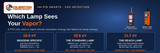
PID Lamp Energies: 10.0 vs. 10.6 vs. 11.7 eV — Which Lamp Sees Your Vapor?
A photoionization detector (PID) can only detect a vapor whose ionization energy is below its lamp energy: a 10.0 eV lamp isolates benzene (9.24 eV) and other aromatics for benzene-specific work, a 10.6 eV lamp covers most everyday VOCs — benzene, toluene, acetone (9.69 eV), and ammonia (10.18 eV) — and an 11.7 eV lamp adds the high-energy vapors the others miss, including methanol (10.84 eV), formaldehyde (10.88 eV), and methylene chloride (11.32 eV).A PID does not have one detection list. It h
…
Nov 20th 2026

Catalytic Bead vs. Infrared vs. Hydrocarbon Sensors: What Can Each LEL Sensor Detect?
A catalytic bead LEL sensor detects almost any combustible gas — including hydrogen — but it needs oxygen (readings fall off below about 10% O₂) and it can be poisoned silently; an infrared LEL sensor detects hydrocarbons with no oxygen and no poisoning, but it cannot detect hydrogen at all; and a semiconductor (MOS) hydrocarbon sensor detects a broad mix of gases cheaply, but it drifts and cross-responds, so it alarms well and measures poorly.Three different sensors can all put a number on a co
…
Nov 19th 2026