
Catalytic Bead vs. Infrared vs. Hydrocarbon Sensors: What Can Each LEL Sensor Detect?
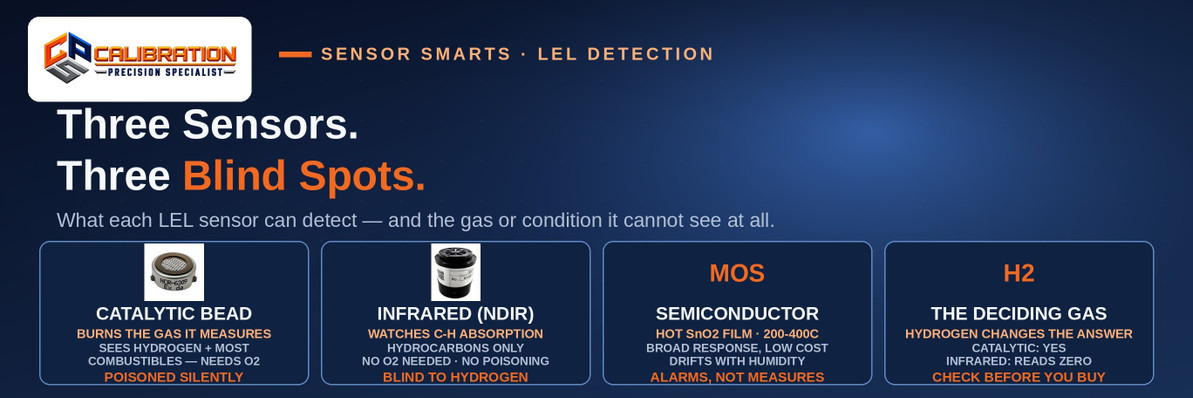
A catalytic bead LEL sensor detects almost any combustible gas — including hydrogen — but it needs oxygen (readings fall off below about 10% O₂) and it can be poisoned silently; an infrared LEL sensor detects hydrocarbons with no oxygen and no poisoning, but it cannot detect hydrogen at all; and a semiconductor (MOS) hydrocarbon sensor detects a broad mix of gases cheaply, but it drifts and cross-responds, so it alarms well and measures poorly.
Three different sensors can all put a number on a combustible-gas display, and they do not see the same world. That is why two instruments standing in the same leak can disagree — and why the right question is never just “which LEL sensor is better?” It is “what can this sensor detect, what can it not detect, and what quietly takes its accuracy away?” This post is the detection-coverage reference for the three LEL technologies CPS sells and calibrates: catalytic bead, infrared (NDIR), and semiconductor hydrocarbon (MOS). For the two-way buying comparison, see catalytic bead vs. infrared LEL sensors: when each wins. For the semiconductor principle in depth, see semiconductor (MOS) gas sensors: where they work and where they lie.
How Does Each LEL Sensor Actually Work?
Catalytic bead: it burns a trace of the gas
A catalytic bead (pellistor) carries a platinum-treated bead heated to several hundred degrees. Combustible gas oxidises on the catalyst, the bead gets hotter, its resistance changes against a matched reference bead, and the instrument converts that change to %LEL. Because the measurement is combustion, the sensor responds to essentially anything that burns — and it cannot work where combustion cannot happen.
Infrared (NDIR): it watches hydrocarbons absorb light
An infrared sensor shines IR light through the sample and measures absorption at the wavelength carbon–hydrogen bonds absorb, around 3.3–3.4 microns. Nothing burns, nothing is consumed, and no catalyst is involved. The sensor is fundamentally a hydrocarbon sensor: if the gas has no C–H bond for that wavelength, the light passes through unchanged.
Semiconductor (MOS): a hot oxide film changes resistance
A semiconductor hydrocarbon sensor holds a metal-oxide film — usually tin dioxide (SnO₂) at roughly 200–400°C. Oxygen adsorbed on the hot film ties up electrons and keeps resistance high; a reducing gas reacts with that oxygen, releases the electrons, and resistance falls. One resistance change is the whole signal — which is why the sensor responds to so many gases, and why it cannot tell you which one it saw.
What Can Each Sensor Detect — and What Can It Not?
| Gas or condition | Catalytic bead | Infrared (NDIR) | Semiconductor (MOS) |
|---|---|---|---|
| Methane, propane, and other hydrocarbons | Yes — the standard %LEL job | Yes — its home ground; response varies by hydrocarbon, so correction factors apply | Responds — broadly, but not as an accurate %LEL measurement |
| Hydrogen (H₂) | Yes — the portable LEL technology that sees it | No — hydrogen does not absorb at the hydrocarbon wavelength; the sensor reads zero | Responds — hydrogen is a reducing gas, so it moves the film; not a quantified hydrogen reading |
| Solvent and fuel vapours | Yes, with correction factors against the calibration gas | Yes for hydrocarbons, with correction factors | Responds strongly — alcohols and solvents are classic MOS cross-responders |
| Carbon monoxide and other non-hydrocarbon gases | Only if combustible and present at %LEL-level concentrations — not a toxic-gas measurement | No on a hydrocarbon LEL channel | Responds — one reason MOS readings cannot be taken as a named-gas concentration |
| Oxygen-deficient or inerted air (below about 10% O₂) | No — without oxygen the bead cannot burn the gas and readings fall low | Yes — no oxygen needed | Responds, but baseline and sensitivity shift with the atmosphere; not a substitute for a rated LEL channel |
| Silicones, sulfur compounds, and lead in the air | Poisoned — sensitivity is lost permanently and silently | Unaffected — an optical measurement cannot be poisoned | Surface can be affected over time; drift is the everyday problem |
| A blast of gas above the range | Can be damaged or burned out by sustained over-range exposure | Survives — recovers when the gas clears | Saturates; recovery and baseline return can be slow |
Read the hydrogen row twice. It is the most consequential line in the table: a facility whose hazard is hydrogen — battery rooms, electrolysis, hydrogen storage and fuelling — gets a confident zero from an infrared LEL sensor while the leak builds. That is not a calibration problem. It is physics, and no span adjustment fixes it.
Why Do the Three Sensors Fail Differently?
Catalytic bead fails silently. Poisoning by silicones (sealants, lubricants, some adhesives), sulfur compounds, and lead compounds destroys catalyst activity without any fault indication. The display still works; the numbers just get smaller than the truth. Low oxygen fails the same quiet way. The only defences are a bump test before use and calibration on schedule.
Infrared fails by blindness, not by drift. An IR sensor does not lose sensitivity to hydrocarbons the way a bead loses catalyst — it is stable, long-lived, and honest inside its coverage. Its failure is categorical: a gas outside its absorption physics is invisible, and a hydrocarbon other than the calibration gas reads through a correction factor that must actually be applied.
Semiconductor fails by vagueness. Humidity and temperature move the baseline, many gases produce the same resistance change, and sensitivity drifts over time. In a leak sniffer, an A2L refrigerant sensor, or the low-ppm combustible channel of an instrument such as the RKI GX-6100, that breadth is useful — it finds the leak and shows small concentrations early. As the sole basis for a %LEL safety decision, it is the wrong witness.
Which LEL Sensor Should You Choose?
| Use this sensor when… | Because |
|---|---|
| Catalytic bead — normal-air confined-space and hot-work monitoring, mixed or unknown combustibles, any hydrogen risk, tight budget | Broadest combustible coverage including hydrogen, at the lowest instrument and sensor cost; the standard channel on 4-gas monitors such as the RKI GX-3R |
| Infrared — inerted or oxygen-deficient spaces, silicone- or sulfur-rich environments, hard-to-reach fixed points, high-concentration areas | No oxygen requirement, no poisoning, survives over-range, and stays stable far longer between services |
| Semiconductor (MOS) — leak searching, refrigerant and low-ppm screening, early-warning alarming where the question is “is something here?” | Cheap, small, sensitive, and long-lived — an excellent alarm and screening tool, as long as nobody treats its output as a precise concentration |
Many crews do not have to pick just one philosophy for the whole plant. The personal monitor in normal air stays catalytic, the fixed point in the inerted or dirty area goes infrared, and the leak-search tool stays semiconductor — each sensor doing the job its physics suits. CPS calibrates every channel of all three types; see calibration services and calibration gas for the span gases each technology needs.
Does Sensor Type Change Calibration?
Yes — in what can go wrong between calibrations. A catalytic channel must be bump-tested because poisoning is silent; an infrared channel must be spanned with the right hydrocarbon (or the correction factor applied) because its response is gas-specific; a semiconductor channel must be treated as a screening device whose baseline moves with humidity and age. All three still need verification against known gas — sensor type changes the failure mode, never the need to prove the reading. Response speed is part of that proof too: see what T90 response time means.
Frequently Asked Questions
Can an infrared LEL sensor detect hydrogen?
No. Hydrogen has no carbon–hydrogen bond to absorb infrared light at the hydrocarbon wavelength (around 3.3–3.4 microns), so an infrared LEL sensor reads zero in hydrogen. For hydrogen — battery rooms, electrolysis, storage, and fuelling — use a catalytic bead channel or a dedicated hydrogen sensor.
Can a catalytic bead sensor detect hydrogen?
Yes. A catalytic bead oxidises any combustible gas that reaches it, including hydrogen, methane, propane, and solvent vapours. That breadth is exactly why catalytic remains the standard LEL channel on portable 4-gas monitors used where hydrogen is possible.
Does a catalytic bead LEL sensor work without oxygen?
No. The bead measures gas by burning it, and below roughly 10% oxygen there is not enough oxygen to burn the sample properly, so readings fall low — potentially showing safe in an unsafe inerted space. Use an infrared sensor for oxygen-deficient or nitrogen-purged atmospheres.
What poisons a catalytic bead sensor?
Silicones from sealants, lubricants, and adhesives are the classic poison, along with sulfur compounds and lead compounds. Poisoning is permanent and silent: the sensor gives no fault, it simply responds less. A bump test before use is how a poisoned bead gets caught.
What is a semiconductor (MOS) hydrocarbon sensor?
It is a heated metal-oxide film — usually tin dioxide held at roughly 200–400°C — whose electrical resistance falls when reducing gases react with oxygen adsorbed on its surface. The design is cheap, small, sensitive, and long-lived, which is why MOS sensors run leak sniffers, refrigerant sensors, and low-ppm combustible channels.
Why is a semiconductor sensor not accurate enough for %LEL safety decisions?
Because one resistance change is produced by many gases at once, and the baseline shifts with humidity, temperature, and age. An MOS sensor can say something combustible or reducing is present, but it cannot reliably say which gas or exactly how much — so it alarms and screens well, and quantifies poorly.
Can an infrared sensor be poisoned like a catalytic bead?
No. Infrared detection is optical — nothing is burned and there is no catalyst to destroy — so silicones, sulfur, and lead do not reduce its sensitivity. It can still be blinded by a gas it cannot absorb, notably hydrogen, and its optics still need periodic verification against span gas.
Which LEL sensor lasts longest?
Infrared, generally. With no catalyst to poison or burn out and no damage from over-range exposure, an IR sensor typically outlasts a catalytic bead, which is a consumable with a life of a few years — shorter in poisoning environments. MOS sensors are also long-lived, but their drift, not their survival, is the limit.
Do all three sensor types need calibration?
Yes. Catalytic beads drift and can be poisoned, infrared sensors must be verified with the correct hydrocarbon or correction factor, and semiconductor baselines move with humidity and age. The interval and the failure you are checking for differ; the need to prove the reading against known gas does not.
Can one instrument contain more than one LEL technology?
Yes. Configurable multi-gas instruments can combine channels — for example a catalytic %LEL channel for broad coverage including hydrogen alongside infrared %volume or low-ppm semiconductor channels for inert or high-range work. The RKI GX-6100 class is built around that idea: match each channel to the atmosphere it will actually sample.
The Bottom Line
Catalytic bead sees the most gases — hydrogen included — and pays for it with an oxygen requirement and silent poisoning. Infrared sees hydrocarbons only, and in return needs no oxygen, cannot be poisoned, and lasts. Semiconductor sees a little of everything cheaply, and pays for it with drift and cross-response. Pick the sensor whose blind spot your facility can live with — and if hydrogen is anywhere in the hazard list, an infrared-only LEL channel is the one blind spot you cannot accept.
Need a calibration you can file?
In-house calibration at CPS in Rockwood, Tennessee — $55 for single-gas instruments, $90 for 4- and 5-gas — every channel, as-found and as-left data, full certificate.
See Calibration Servicesor call 865-900-8844
Recent Posts
-

How to Read a PID Correction Factor Chart
To read a PID correction factor chart, find your vapor’s row, take the factor under your own lamp en …Nov 21st 2026 -
PID Lamp Energies: 10.0 vs. 10.6 vs. 11.7 eV — Which Lamp Sees Your Vapor?
A photoionization detector (PID) can only detect a vapor whose ionization energy is below its lamp e …Nov 20th 2026 -

Catalytic Bead vs. Infrared vs. Hydrocarbon Sensors: What Can Each LEL Sensor Detect?
A catalytic bead LEL sensor detects almost any combustible gas — including hydrogen — but it needs o …Nov 19th 2026