
Blog

Fixed vs. Portable Gas Detection: Which Does Your Facility Actually Need?
Portable gas detectors protect a person — they are worn in the breathing zone and travel wherever the worker goes — while fixed gas detectors protect a place, monitoring the same room or leak source continuously, 24/7, whether anyone is there or not. Most facilities with a continuous gas hazard need both: fixed points at the likely leak sources and portables on the people, because a fixed system cannot perform a confined-space pre-entry test and a portable detector cannot watch an unoccupied roo
…
Oct 25th 2026

How Do You Train a New Hire to Use a Gas Detector in 15 Minutes?
You can train a new hire to use a gas detector safely in 15 minutes by teaching five things in order: what the monitor measures and what normal readings look like (oxygen 20.9%, combustible gas 0% LEL, carbon monoxide 0 ppm, hydrogen sulfide 0 ppm in fresh air), how to power on and fresh-air zero in clean air only, how to run a bump test — the functional check OSHA guidance, following ISEA, calls for before each day's use — the alarm numbers that mean leave (oxygen below 19.5% or above 23.5%, LE
…
Oct 24th 2026

Calibration Gas Cylinder Sizes: What Sizes Does Calibration Gas Come In?
Calibration gas comes in disposable aluminum cylinders of 11L, 34L, 44L, 60L, 66L, and 120L, and steel cylinders of 17L, 34L, 103L, 221L, and 680L — ten volumes in all, from 11L to 680L, with the 34L made in both materials. The 34L is the most common size — it is the standard cylinder for bench calibrations and docking stations — while 11L is the smallest size (sold in minimum quantities of 6) and steel cylinders of 103L and up are made for high-volume calibration programs.
Mos
…
Oct 23rd 2026
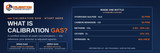
What Is Calibration Gas? Mixtures, Balance Gas, and How to Pick the Right Bottle
Calibration gas is a certified mixture of target gases at exact, known concentrations — a typical 4-gas cylinder carries 25 ppm hydrogen sulfide, 50 ppm carbon monoxide, 2.5% methane (50% LEL), and 12% oxygen in a nitrogen balance — that you flow over a gas detector's sensors so the instrument can be bump tested and adjusted to read accurately. It comes in two working forms: span gas, which contains the target gases at a set concentration, and zero gas, which contains none of them. T
…
Oct 23rd 2026

How to Choose Calibration Gas: A Buyer's Checklist for Concentrations, Sizes, and Fittings
Choosing calibration gas is a matching exercise, not a shopping exercise. The right cylinder is the one whose concentrations match your instrument manual's specified mix exactly, whose balance gas suits the sensor set, whose fitting matches your regulator — steel 34L cylinders take CGA-600, 103L cylinders take C-10 — and whose size you will finish before its shelf life runs out: reactive mixes last 6–12 months, stable gases about 36. Get those matches right and the calibration takes care of itse
…
Oct 23rd 2026