
Calibration Kits: What's in the Case and What to Check Before a Big Job
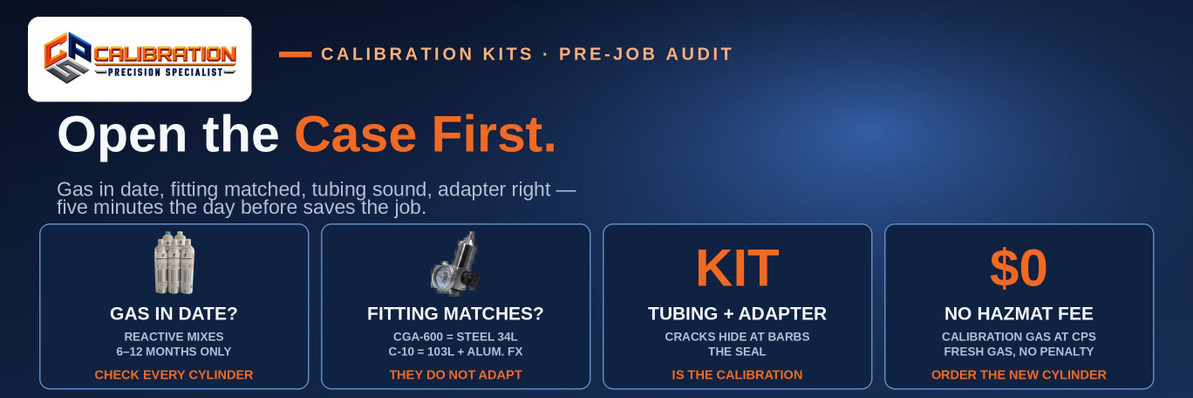
A calibration kit fails a big job in four ordinary ways: gas past its date (reactive mixes keep only 6–12 months, stable mixes about 36), a regulator whose fitting does not match the cylinder in the case (CGA-600 belongs on a steel 34L; C-10 belongs on a steel 103L and on aluminum FX cylinders), tubing cracked at the barb, and an adapter that does not seal on the detector you actually brought. Every one of those is discoverable the day before, in five quiet minutes with the case open — which is the only time discovering them is free.
Nobody's kit fails in the shop. It fails at the gate of a plant, on a turnaround morning, with six detectors to bump and span before a permit can be signed. The audit below is organized the way the gas flows: cylinder first, then the fitting that connects it, then the tubing, then the adapter at the sensor — plus the paperwork that proves any of it counted. For the math on how far a cylinder actually goes — calibrations per bottle, by cylinder size and flow — see how long does a bottle of calibration gas last, and for the fitting question in full, CGA-600 vs. C-10 regulators.
What's Actually in a Working Calibration Kit?
- The gas — the documented mix for the instruments on the job, in date, with enough left in the cylinder to finish (plus a zero-gas cylinder where the work calls for one).
- The regulator — fixed-flow, with the fitting that matches that cylinder, threads clean and undamaged.
- The tubing — flexible, uncracked, long enough to work comfortably, with sound ends at both barbs.
- The adapter or cap — the one made for each detector model on the job, seal intact.
- The paperwork habit — the cylinder's Certificate of Analysis trail and a way to record what was calibrated, with what gas, and what the as-found readings were.
Anything else in the case — spare filters, spare batteries, a second hose — is fleet-specific. The five items above are the kit; the rest is luggage. Audit the five and the job survives.
Check the Gas First: Date, Mix, and Shelf Life
Calibration gas is a perishable with two clocks. Reactive mixes — the ones carrying gases like H₂S that interact with the cylinder and each other — hold their certified values for roughly 6–12 months. Stable mixes keep about 36 months. Past the date, the gas in the cylinder is no longer the gas on the label, and a calibration performed with it is a number built on an assumption. Check the date on every cylinder in the case, and check the mix against the job: the right concentrations for the instruments being spanned, not merely a 4-gas bottle because 4-gas is what is usually in the case.
Then check quantity with honest math. A cylinder that spans two detectors and dies mid-fleet leaves the rest calibrated on hope. The bottle-life post linked above works the arithmetic by cylinder size; the calibration gas cylinder sizes guide covers what the sizes hold. One ordering note that matters to the budget: CPS charges no hazmat fee on calibration gas — the fresh cylinder you should be ordering is not carrying a penalty line for being gas.
Does the Regulator Fit the Cylinder in the Case?
This is the mismatch that cross-threads in the dark. The established pairings: a steel 34L cylinder takes a CGA-600 fitting; a steel 103L takes C-10; aluminum FX cylinders also take C-10. A regulator carried over from a different cylinder size does not adapt — it damages threads, leaks certified gas, or refuses to seat while a crew watches. Our stocked example is the CGA-600 fixed-flow regulator in stainless steel at $205 — the right part, for exactly one of those fittings.
While the regulator is in your hand: threads clean, no crossed or flattened starts; the outlet barb sound; and the flow verified as the fixed flow the calibration procedure assumes. A regulator that free-flows or starves changes the gas delivery your calibration depends on, quietly, in the direction you would not choose.
The Pre-Job Checklist: Tubing, Adapter, and Paper
- Tubing: flex every inch. Cracks hide at the barbs where the hose bends hardest. A leaking span line dilutes gas with room air — the same silent failure as a leaking cap.
- Adapter: confirm it is the cap for the models on this job, and press its seal. Two detector brands on one job can mean two adapters in the case; one is a plan to improvise.
- Zero gas and bump discipline: if the job's procedure calls for zero air, it is in the case and in date too — not assumed.
- Paper: the gas's CoA information recorded or reachable, and a log for as-found/as-left readings. A calibration nobody documented is a calibration you will be re-proving later.
- The night-before rule: open the case the day before, every time. Every failure on this list is a five-minute fix at the shop and a job-delay at the gate.
If the audit finds the kit short — gas out of date, fitting wrong, adapter missing — that is precisely the moment calibration gas and a phone call fix it: 865-900-8844. And for fleets that would rather the bench carried this discipline, CPS calibrates in-house at $55 single-gas and $90 for 4- and 5-gas instruments with the full certificate — see calibration services.
Frequently Asked Questions
What should be in a calibration kit?
Five things, audited as a set: the documented gas for the instruments on the job (in date, with enough left to finish), a fixed-flow regulator whose fitting matches that cylinder, sound tubing, the calibration adapter or cap made for each detector model on the job, and the paperwork habit — the gas's Certificate of Analysis trail plus a log for as-found and as-left readings. Everything else is fleet-specific luggage.
How long does calibration gas stay good?
It depends on the mix. Reactive mixes hold their certified values for roughly 6–12 months; stable mixes for about 36 months. Past the printed date, the gas is no longer certified to be what the label says, and calibrating with it builds readings on an assumption. Check dates the day before a job, not at the gate.
Which regulator fitting does my cylinder need?
By cylinder: a steel 34L takes CGA-600; a steel 103L takes C-10; aluminum FX cylinders take C-10. The fittings do not interchange — forcing one cross-threads the connection and leaks certified gas. Our CGA-600 fixed-flow regulator in stainless steel is $205, for the 34L steel cylinder it belongs on.
Can I use an adapter to run a CGA-600 regulator on a C-10 cylinder?
Do not build a calibration on stacked adapters. Every added joint is a leak path and a thread-damage risk on certified gas delivery. Carry the regulator that matches the cylinder in the case — the pairing is steel 34L/CGA-600, steel 103L/C-10, aluminum FX/C-10 — and treat a mismatch found in the audit as a stop-and-fix, not a workaround.
How do I know if there's enough gas left for the job?
Do the bottle math before the job: calibrations per cylinder depend on cylinder size, regulator flow, and how long each span runs. Our post 'how long does a bottle of calibration gas last' works the arithmetic by size. The field rule follows from it: a cylinder that cannot finish the fleet does not go in the case as the only gas.
Does CPS charge a hazmat fee on calibration gas?
No. CPS charges no hazmat fee on calibration gas — the price of the cylinder is the price. That matters to the pre-job audit: replacing an out-of-date cylinder costs the gas itself, not the gas plus a penalty, so there is no budget excuse for calibrating on expired mix.
What happens if I calibrate with expired gas?
The calibration completes, the meter accepts it, and the readings are anchored to a mixture that is no longer certified — the failure is invisible until an incident or an audit asks what the gas actually was. Reactive components drift first and furthest. It is the most expensive cheap mistake in the kit, which is why the date check is first on the checklist.
Why does the adapter matter if the gas is right?
Because the adapter is the seal between certified gas and the sensor. A cap for the wrong model can sit on the housing and leak at a corner, diluting span gas with room air; the detector then calibrates low and reads low all day. Right gas, right fitting, right adapter — the chain is only as true as its weakest seal.
How often should I audit the kit?
Before every big job, the day before — and as a habit, whenever the case comes back from the field. Gas dates move, tubing cracks at barbs, adapters migrate between cases. Five minutes with the case open at the shop is the whole cost; the same discovery at a plant gate costs the morning.
Can CPS just handle calibration for our fleet?
Yes. CPS calibrates in-house in Rockwood, Tennessee at published rates — $55 for single-gas instruments, $90 for 4- and 5-gas — every channel, as-found and as-left data, full certificate with the gas CoA trail, and enrollment in the CPS Calibration Program so due dates come with reminders. Call 865-900-8844 or see the calibration services page.
The Bottom Line
A calibration kit is a chain — certified gas, the fitting that matches its cylinder, sound tubing, the adapter that seals on your detector — and a big job tests every link at the worst possible moment. Audit it the day before: dates, fitting, tubing, adapter, paper. Five minutes at the shop is the difference between a kit and a story.
Short on gas, a regulator, or an adapter? Call CPS Calibrations at 865-900-8844 — no hazmat fee on calibration gas — or send the fleet in: 109 S. Front Street, Rockwood, TN 37854.
--- CPS Calibrations · 109 S. Front Street, Rockwood, TN 37854 · Calibration Gas · CGA-600 vs. C-10 Regulators · Calibration Services
Need a calibration you can file?
In-house calibration at CPS in Rockwood, Tennessee — $55 for single-gas instruments, $90 for 4- and 5-gas — every channel, as-found and as-left data, full certificate.
See Calibration Servicesor call 865-900-8844
Recent Posts
-

Which GfG Portable Gas Detector Is Best for You?
The right GfG portable is decided by three questions — how many gases, pumped or diffusion, and PID …Nov 24th 2026 -

What GfG Fixed Gas Detection Systems Are There? Every Transmitter and Controller Explained
GfG’s fixed gas detection line at CPS is 39 products in two layers: 23 transmitters and detection sy …Nov 24th 2026 -
What GfG Portable Gas Detectors Are There? Every Model Explained
GfG’s portable line at CPS is 14 products built around six instruments: the Micro IV single-gas dete …Nov 24th 2026