
Chlorine Monitoring in Chemical Plants: Storage, Loading, and the Scrubber
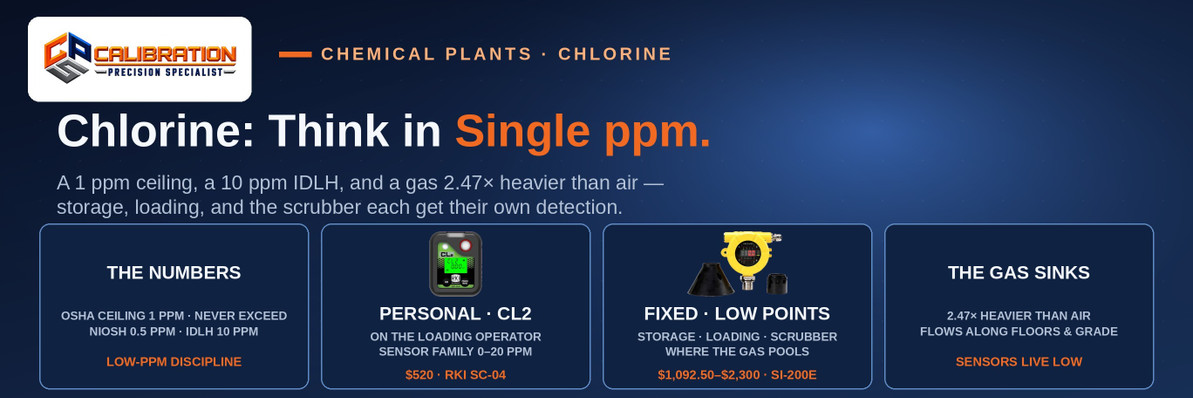
Chlorine monitoring in a chemical plant is a low-ppm discipline built in three places — storage, loading, and the scrubber — because OSHA's chlorine limit is a 1 ppm ceiling that may never be exceeded, NIOSH recommends 0.5 ppm, and 10 ppm is immediately dangerous to life or health. Fixed detectors sit low (chlorine is about 2.5 times heavier than air and pools), and the operator connecting a railcar or ton container wears a personal chlorine monitor ranged 0–20 ppm.
Chlorine punishes vague monitoring. Most plant gases are managed against an 8-hour average, which forgives a brief excursion; chlorine's limit is a ceiling, which forgives nothing. A release that peaks at 8 ppm for two minutes has blown through the legal limit and stands at the edge of the IDLH. The monitoring system therefore has to be accurate in single digits, placed where a heavy gas actually goes, and fast enough to matter. This post walks the three chlorine areas of a chemical plant — the storage yard, the loading connection, and the scrubber — and the detection each one needs. It is the chlorine chapter of our plant-wide map, what gas detection a chemical plant needs. The other industry that lives on chlorine — water treatment — runs the same low-ppm discipline in its chlorine rooms; we mapped those in fixed gas detection for water treatment plants.
What Are the Chlorine Numbers Everything Is Built On?
From the NIOSH Pocket Guide and OSHA's Table Z-1:
| Chlorine level | What it is |
|---|---|
| 0.5 ppm | NIOSH recommended ceiling (15-minute) |
| 1 ppm | OSHA PEL — a ceiling, never to be exceeded |
| 10 ppm | NIOSH IDLH — immediately dangerous to life or health |
| 1,500 lb on site | OSHA PSM threshold quantity for chlorine (29 CFR 1910.119) |
| 2,500 lb on site | EPA Risk Management Program threshold for chlorine |
Now weigh the inventory against those thresholds. Chlorine ships and stores as a liquefied compressed gas in 150-lb cylinders, in ton containers holding 2,000 lb, and in railcars and tank trucks far larger than either. A single ton container is 2,000 lb — past OSHA's 1,500 lb process-safety threshold on its own, and two containers put a site past EPA's 2,500 lb RMP threshold as well. Chlorine areas are regulated areas at very small inventories, and their detection is part of that compliance structure.
The gas itself dictates placement: chlorine's relative density is 2.47 — roughly two and a half times heavier than air. A leak does not rise and dilute; it slumps, flows along the floor and grade, and fills pits, trenches, sumps, and low rooms. Every sensor decision in this post follows from that one number.
Storage: Ton Containers, Cylinders, and Railcars at Rest
Storage is quiet until it isn't: a valve packing, a fusible plug, a corroded pigtail. The leak that starts at 2 a.m. in an empty storage building is the fixed system's whole reason to exist.
- Fixed points low and at the vessels. Chlorine detectors belong near the container valves and connection stubs, and near floor level and low collection points where the gas will arrive first. Explosion-proof fixed detectors in the class of the SENKO SI-200E — configured at $1,092.50–$2,300 by gas and options — and the Crowcon Xgard XG1 at $1,022–$2,016 configured hold this watch continuously, tied to alarms that reach an attended location and, in enclosed chlorine rooms, to ventilation and the scrubber.
- Sample-draw for the worst corners. A chlorine room's atmosphere is corrosive to the very sensors watching it, and some points cannot be reached safely once gas is present. A sample-draw transmitter — the RKI GD-70D, configured at $1,570–$4,460 — pulls air from the monitored point to a sensor mounted where it can be calibrated and serviced, which is why sample-draw is the standard answer for scrubber rooms and enclosed container storage.
- Alarm logic set against the ceiling. With a 1 ppm legal ceiling and a 0.5 ppm recommended ceiling, storage alarms are set in the low single digits — the first alarm is an investigate-now signal, not a nuisance to silence. A chlorine alarm that waits for 10 ppm has waited for the IDLH.
Loading and Unloading: The Connection Is the Hazard
More chlorine releases happen at connections than anywhere else — the flex hose, the gasket, the valve operated a quarter-turn too far — and loading is the one chlorine job where a person is guaranteed to be standing at the leak point. The monitoring follows that fact:
- A fixed point at the rack, watching the connection zone and the low area under it, so a leak during a transfer alarms even if the operator is looking the other way.
- A personal monitor on the operator, in the breathing zone: the RKI SC-04 chlorine monitor, $520, whose sensor family spans 0–20 ppm — a range chosen for exactly this limit structure, reading honestly from below the 0.5 ppm recommended ceiling up through the 10 ppm IDLH. A 0–100 ppm instrument would spend the whole event in its bottom few percent, where accuracy is worst; a 0–20 ppm instrument is built for the numbers chlorine actually uses.
- Detection during the whole transfer, not just the hookup. Connections leak under pressure changes — at startup, at container changeover, at disconnection. The personal monitor stays on from first valve to final purge, and the fixed point stays live for the hours the area is unattended between transfers.
The Scrubber: Monitor the System That Eats the Release
The emergency scrubber is the chlorine area's last line: vented gas and the air from a chlorine room are drawn through a caustic solution that neutralizes the chlorine before discharge. It is easy to treat the scrubber as the end of the monitoring conversation. It is actually a monitored area of its own:
- A detector proves the scrubber is keeping up. A chlorine reading downstream of, or inside, the scrubber room tells operators whether a release is being absorbed or is overwhelming the system — the difference between an incident and an evacuation.
- A detector makes the room enterable. After an event, nobody should have to guess whether the scrubber room, the container room, or the low pit beside them is clear. A fixed point — or a sample drawn from outside the room — turns "it smells better" into a number below the ceiling before anyone goes in.
- The scrubber's own leaks count. Caustic circulation pumps, seals, and piping sit in chlorine service; the low points around the scrubber get the same low-mounted detection as the storage vessels.
Calibration: Chlorine Sensors Are Consumables
An electrochemical chlorine sensor is spent a little by every ppm it measures, and it drifts between exposures — in a gas whose entire legal range is 0 to 1 ppm, a sensor reading 30% low has quietly moved the ceiling to 1.3 ppm. Chlorine points are calibrated on the manufacturer's interval with the correct chlorine calibration gas, and the personal monitors get the same discipline: our published in-house rate for a single-gas instrument like the SC-04 is $55, fixed systems are serviced on-site and quoted in writing, and every serviced instrument's as-found and as-left readings land in the CPS Calibration Program — the record a PSM mechanical-integrity file needs. We calibrate every channel, and repairs are quoted in writing before work is done. The starting point is calibration services or 865-900-8844.
Frequently Asked Questions
What is the OSHA exposure limit for chlorine?
One ppm as a ceiling. OSHA's permissible exposure limit for chlorine (29 CFR 1910.1000, Table Z-1) is a ceiling concentration of 1 ppm that must never be exceeded at any time — it is not an 8-hour average, so a brief excursion over 1 ppm is a violation in itself. NIOSH recommends a stricter 0.5 ppm ceiling over 15 minutes, and rates 10 ppm as immediately dangerous to life or health (IDLH).
Why do chlorine detectors need to measure such low concentrations?
Because chlorine's entire regulatory range fits in ten parts per million: 0.5 ppm is NIOSH's recommended ceiling, 1 ppm is OSHA's legal ceiling, and 10 ppm is the IDLH. A useful chlorine detector must be accurate in single digits, which is why personal chlorine monitors use sensors ranged 0–20 ppm — the instrument spends its working life in the part of the scale where it is most accurate, instead of reading 1 ppm as 1% of a 0–100 ppm scale.
Where should chlorine sensors be mounted?
Low. Chlorine's relative gas density is 2.47 — about two and a half times heavier than air — so leaked chlorine slumps to the floor, flows along grade, and collects in pits, trenches, sumps, and low rooms. Fixed sensors go near the likely leak points (valves, connections, container stubs) and at the low collection points the gas drains into, not at ceiling or thermostat height. Sample-draw systems can pull from the low point to a sensor mounted somewhere serviceable.
How much chlorine triggers OSHA process safety management?
1,500 lb in a process, under Appendix A to 29 CFR 1910.119. Chlorine packaging makes that a small number in practice: one ton container holds 2,000 lb, so a single container in a process already exceeds the threshold, and EPA's Risk Management Program threshold of 2,500 lb is passed with the second container. PSM coverage brings with it the mechanical-integrity and documentation duties that make calibrated, recorded chlorine detection part of the compliance file.
What should a chlorine unloading operator wear?
A dedicated personal chlorine monitor in the breathing zone, for the entire transfer. The RKI SC-04 chlorine monitor ($520) uses a sensor family spanning 0–20 ppm, bracketing the 0.5 ppm recommended ceiling, the 1 ppm OSHA ceiling, and the 10 ppm IDLH. Loading and unloading put the operator at the connection — statistically the most likely leak point — so the personal monitor backs up the fixed point at the rack from first valve to final purge.
How does a chlorine scrubber work, and does it need monitoring?
An emergency scrubber draws chlorine-laden air through a caustic solution that neutralizes the chlorine before the air is discharged. It needs monitoring in two directions: detection that shows whether a release is being absorbed or is overwhelming the scrubber, and detection that proves the scrubber room and connected low areas read below the ceiling before anyone re-enters after an event. The scrubber's pumps and piping are in chlorine service themselves, so its low points get detectors like any other chlorine area.
Can a standard 4-gas monitor detect chlorine?
No. A standard 4-gas instrument reads LEL, oxygen, CO, and H₂S — chlorine is not among its channels, and a catalytic LEL sensor does not respond usefully at chlorine's 1 ppm ceiling. Chlorine requires an electrochemical chlorine sensor: in a dedicated single-gas monitor, as the toxic channel of a 5-gas instrument, in a fixed detector, or in a sample-draw transmitter. Plants running chlorine need that channel deliberately specified, not assumed.
What size chlorine containers does a plant monitor?
The standard packages are 150-lb cylinders, 2,000-lb ton containers, and railcars or tank trucks. All of them store chlorine as a liquefied compressed gas under pressure, all of them connect through valves and flexible connections that are the usual leak points, and the monitoring treats them the same way: fixed low-mounted points at the vessels and connections, a personal monitor on anyone making or breaking a connection, and scrubber coverage where the plant's design provides it.
How often does a chlorine detector need calibration?
On the manufacturer's specified interval — and chlorine service argues for keeping it. Electrochemical chlorine sensors are consumed by exposure and drift over time; against a 1 ppm ceiling, a sensor reading low by even a fraction of a ppm has moved the real alarm point materially. CPS calibrates single-gas chlorine portables in-house for $55 at published rates and services fixed chlorine points on-site, quoted in writing, with as-found/as-left records for every instrument.
What should workers do when a chlorine alarm sounds?
Move upwind and out of the low areas, and let the trained response structure work. Chlorine pools at floor level, so evacuation routes go up and upwind, never through pits or low rooms. Nobody re-enters a chlorine area on the basis of smell — the check is a calibrated instrument reading below the ceiling, ideally a fixed point or a sample drawn from outside the space. That is the operational reason the storage, rack, and scrubber detection exists: it converts an alarm into a verified all-clear.
The Bottom Line
Chlorine leaves no margin: a 1 ppm ceiling, a 10 ppm IDLH, a gas two and a half times heavier than air, and inventories that cross federal process-safety thresholds in a single container. The monitoring that matches it is low-ppm and low-mounted — fixed points at storage and the scrubber, a 0–20 ppm personal monitor on the loading operator, and calibration records that prove every point still reads true. CPS Calibrations sells, calibrates, and repairs chlorine detection from one shop in Rockwood, Tennessee.
Chlorine storage or loading in East Tennessee? Call CPS Calibrations at 865-900-8844 — we'll map the points, the personal monitors, and the calibration plan for your chlorine areas.
CPS Calibrations · 109 S. Front Street, Rockwood, TN 37854 · Calibration Services · The CPS Calibration Program · What Gas Detection Does a Chemical Plant Need?
Need a calibration you can file?
In-house calibration at CPS in Rockwood, Tennessee — $55 for single-gas instruments, $90 for 4- and 5-gas — every channel, as-found and as-left data, full certificate.
See Calibration Servicesor call 865-900-8844
Recent Posts
-

What Is Remote Monitoring for Fixed Gas Detection?
Remote monitoring for fixed gas detection means a fixed system's live readings, trends, and alarm hi …Nov 23rd 2026 -

What Are the Key Differences Between the GX-6000 and GX-6100?
The RKI GX-6100 is the current replacement for the discontinued GX-6000: both are pumped 6-gas monit …Nov 22nd 2026 -

How to Read a PID Correction Factor Chart
To read a PID correction factor chart, find your vapor’s row, take the factor under your own lamp en …Nov 21st 2026