
What Gas Detection Does a Chemical Plant Need?
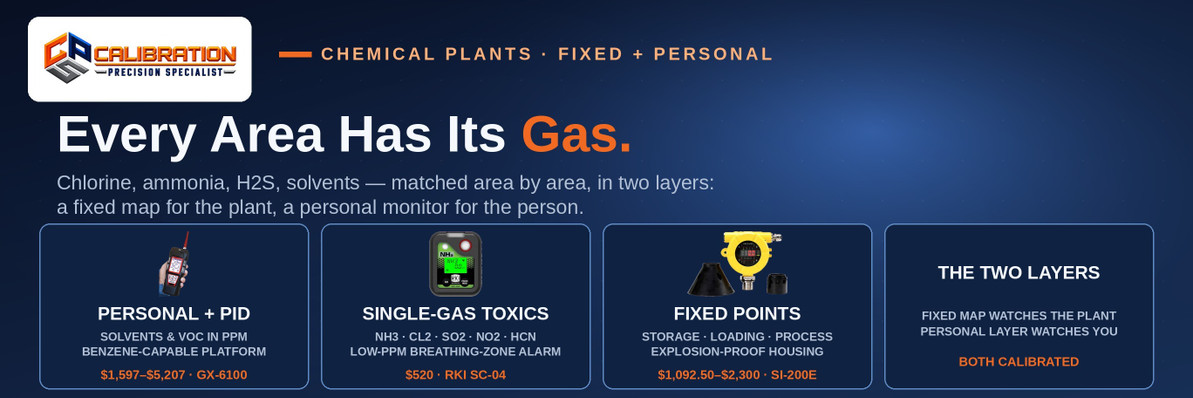
A chemical plant needs gas detection in two layers matched to each area's gases: fixed detectors at storage, loading racks, and process units for the plant's specific toxics — chlorine (OSHA ceiling 1 ppm), ammonia (NIOSH recommended limit 25 ppm), hydrogen sulfide, and flammable gas in %LEL — plus solvent/VOC monitoring on a PID, and a personal multi-gas monitor on every worker, because a wall sensor cannot follow a mechanic into a pipe rack, a sump, or a vessel entry.
There is no single "chemical plant detector," because a chemical plant is not one hazard — it is a dozen different gas hazards sharing a fence line. The chlorine unloading rack, the ammonia system, the tank farm, the wastewater sump, and the solvent blending room each fail differently and each needs its own sensor chemistry. This post maps the plant area by area: the gases, the limits that set the alarm points, and the instruments that cover each job. Chlorine gets its own deep dive in the companion post on chlorine monitoring in chemical plants.
Start With the Limits: The Numbers That Set Every Alarm
Every alarm point in the plant traces back to an exposure limit. The ones that drive chemical-plant detection:
| Gas | OSHA PEL | NIOSH REL | IDLH | Behavior |
|---|---|---|---|---|
| Chlorine (Cl₂) | 1 ppm ceiling | 0.5 ppm ceiling (15-min) | 10 ppm | ~2.5× heavier than air — sinks |
| Ammonia (NH₃) | 50 ppm TWA | 25 ppm TWA · 35 ppm STEL | 300 ppm | Lighter than air (0.60) |
| Hydrogen sulfide (H₂S) | 20 ppm ceiling | 10 ppm ceiling (10-min) | 100 ppm | Heavier than air — pools in sumps |
| Carbon monoxide (CO) | 50 ppm TWA | 35 ppm TWA · 200 ppm ceiling | 1,200 ppm | Mixes freely with air |
| Benzene | 1 ppm TWA | 0.1 ppm TWA · 1 ppm STEL | 500 ppm | PID territory — ppm and below |
Two of these numbers explain most chemical-plant detector purchases. Chlorine's ceiling is 1 ppm — not an average, a never-exceed line, with NIOSH recommending half that — so chlorine detection is a low-ppm discipline: the sensor has to be accurate and honest in single digits, not merely present. And benzene's recommended limit is 0.1 ppm, a tenth of a part per million, which no standard 4-gas sensor can see at all. That is what the PID layer is for.
Scale matters too. Under OSHA's process safety management standard (29 CFR 1910.119, Appendix A), a process holding 1,500 lb of chlorine or 10,000 lb of anhydrous ammonia is a covered process with the full PSM program attached. A chlorine ton container holds 2,000 lb by itself — two containers in one process area is 4,000 lb, comfortably over the threshold — which is why chlorine storage areas carry the detection, alarming, and scrubber infrastructure described in the chlorine deep dive.
Storage and Loading: Where the Big Inventories Sit
Tank farms, cylinder and ton-container storage, and railcar/truck loading racks hold the plant's largest quantities of its worst gases, and they are outdoors or semi-outdoors — wind moves a leak, and nobody is standing there most of the day. This is fixed-detector territory:
- Fixed toxic points at the storage vessels and the connection points. Leaks start at valves, flanges, flex hoses, and unloading connections, so sensors belong at those points and at the low spots a heavy gas like chlorine (relative density 2.47) will drain into. Fixed platforms like the SENKO SI-200E explosion-proof detector, configured at $1,092.50–$2,300 by gas, and the Crowcon Xgard XG1 toxic/oxygen detector at $1,022–$2,016 configured, are built for exactly this duty — continuous watch over a point nobody is standing at.
- Sample-draw where the point sensor can't live. Wet, corrosive, hot, or inaccessible locations get a sample-draw transmitter that pulls the air to the sensor: the RKI GD-70D, configured at $1,570–$4,460 by sensor type, exists for the chlorine and acid-gas points where a diffusion sensor would corrode or a technician cannot safely reach to calibrate.
- Flammable points where the inventory is a solvent or fuel. The combustible side of the fixed map reads in %LEL — the Crowcon Xgard XG3 at $784–$1,162 configured is the flammable-gas counterpart to the toxic points above.
- Personal monitors for the loading crew. The operator making and breaking connections is the closest person to the most likely leak. A dedicated single-gas toxic monitor — the RKI SC-04 series, $520 per gas for chlorine, ammonia, SO₂, NO₂, HCN, or PH₃ versions — puts a low-ppm alarm in the breathing zone of the person doing the work, reading the gas at the concentrations its limits demand (the chlorine sensor family spans 0–20 ppm, bracketing the 1 ppm ceiling and the 10 ppm IDLH).
Process Areas: The Working Plant
Reactors, distillation, blending, and packaging add the mixed-gas picture: CO from combustion and partial oxidation, H₂S anywhere sour streams or sulfur chemistry run, oxygen displacement where nitrogen blanketing is used, and flammables from the process itself.
- The standard personal layer is 4-gas — LEL, O₂, CO, H₂S — in the portable multi-gas family every operator and mechanic already knows.
- The fifth channel is the plant-specific one. The RKI GX-3R Pro, configured at $1,005–$1,575, adds one toxic sensor — ammonia, chlorine, SO₂, NO₂, HCN, PH₃ and others — to the standard four, which is how a unit matches its monitor to its actual chemistry instead of carrying a generic box.
- Fixed points repeat the storage logic at smaller scale: a toxic point at the compressor seals, an LEL point at the solvent day tank, an O₂ point at the nitrogen-blanketed vessel's manway. The map is drawn from the process, not from a catalog.
Solvents and VOCs: The PID Layer
Solvent vapor is where standard sensors go blind. A catalytic LEL sensor reads percent of the explosive range — for most solvents that alarm arrives thousands of ppm above the exposure limit. Benzene makes the point brutally: OSHA's limit is 1 ppm and NIOSH recommends 0.1 ppm, against an LEL of over 10,000 ppm. A worker can be ten times over the benzene limit while an LEL sensor reads zero.
The instrument that sees this range is the photoionization detector (PID), which reads ionizable organic vapors in ppm and fractions of a ppm. Know its one honest limitation: a PID reads a total — it tells you solvent vapor is present and how much, not which solvent it is. For benzene-specific work, PID platforms support benzene-selective measurement with the right lamp and configuration. The RKI GX-6100, configured at $1,597–$5,207, is the pumped 6-gas platform that carries a PID alongside the standard channels — the turnaround, tank-entry, and leak-survey instrument, where one box has to answer LEL, toxics, and VOC questions in the same entry.
Wastewater, Sumps, and the Forgotten Corners
Every chemical plant has a wet end — neutralization sumps, API separators, lift stations, sample pits — and it behaves like a wastewater plant: H₂S generated in the sump (NIOSH ceiling 10 ppm, IDLH 100 ppm, and it deadens the sense of smell, so the "rotten egg" warning disappears exactly when it matters), methane and oxygen displacement in below-grade spaces, and CO near fired equipment. Pumped multi-gas for entries, fixed H₂S points at the sump rim, and the discipline that nobody trusts a nose — the portable gas detection layer covers this with the same instruments the process areas use.
The Layer That Makes It Real: Calibration
A chemical plant's detection map is only as good as its last calibration. Electrochemical toxic sensors drift and are consumed by exposure — the chlorine sensor that sits in low-level chlorine background all year is aging faster than the one in clean air. Fixed points are calibrated where they sit; CPS services installed systems on-site, quoted in writing for the job. Portables come to the bench: published in-house rates are $55 single-gas and $90 for 4- and 5-gas instruments, we calibrate every channel the instrument has, and repairs are quoted in writing before work begins. Every serviced instrument enters the CPS Calibration Program — one record per instrument, certificates with as-found/as-left data, due-date reminders — which is the paperwork a PSM mechanical-integrity audit asks for. Start from calibration services or call 865-900-8844.
Frequently Asked Questions
What gases does a chemical plant need to monitor?
It depends on the plant's chemistry, but the recurring list is: chlorine and ammonia where they are stored or used (ceilings and limits in the low ppm), hydrogen sulfide in sour and wastewater service, carbon monoxide around combustion, flammable gases and vapors in %LEL, oxygen where inert gas blanketing is used, and solvent VOCs — including benzene — measured with a PID. The right list is drawn from the plant's own process chemicals and their exposure limits, area by area.
Why can't a chemical plant just use 4-gas monitors everywhere?
Because a standard 4-gas (LEL, O₂, CO, H₂S) cannot see the plant's defining hazards. It has no chlorine or ammonia channel, and its LEL sensor reads percent of explosive range — for benzene, whose NIOSH recommended limit is 0.1 ppm, the LEL sensor would still read zero at ten times the exposure limit. Chemical plants add toxic-specific sensors (a fifth channel or dedicated single-gas units) and a PID layer for solvents on top of the 4-gas base.
What is the exposure limit for chlorine in a chemical plant?
OSHA's permissible exposure limit for chlorine is a 1 ppm ceiling — a concentration that must never be exceeded, not an 8-hour average. NIOSH recommends a 0.5 ppm ceiling over 15 minutes, and rates 10 ppm as immediately dangerous to life or health. Those numbers are why chlorine detection is a low-ppm discipline: the detector must be accurate in single digits, with sensors ranged in tens of ppm rather than hundreds.
When does a chemical plant fall under OSHA process safety management?
When a process holds a listed highly hazardous chemical at or above its threshold quantity in Appendix A to 29 CFR 1910.119 — 1,500 lb for chlorine and 10,000 lb for anhydrous ammonia, among many others. A single chlorine ton container is 2,000 lb, so chlorine storage crosses its threshold with the second container. PSM coverage brings process hazard analysis, mechanical integrity, and the documentation duties that make calibrated, recorded gas detection part of the compliance system, not an accessory.
Where do fixed gas detectors go in a chemical plant?
At the leak sources and the accumulation points: storage vessels and their valves, loading/unloading connection points, compressor and pump seals, and the low spots where heavy gases like chlorine (about 2.5 times heavier than air) drain and pool — plus flammable (%LEL) points at solvent and fuel inventories. Sample-draw transmitters cover points that are wet, corrosive, hot, or unreachable. The fixed map watches the plant continuously, including the hours nobody is standing there.
What is a PID and why does a chemical plant need one?
A photoionization detector measures organic vapors — solvents — in ppm and fractions of a ppm, the range where their exposure limits live. Benzene's OSHA limit is 1 ppm and NIOSH's recommendation is 0.1 ppm, far below anything an LEL sensor can register. A PID reads total ionizable vapor rather than identifying a specific compound; benzene-selective measurement is available on PID platforms with the right lamp and configuration. Pumped PID multi-gas instruments like the GX-6100 ($1,597–$5,207 configured) are the standard survey and entry tool.
What gas detector should a chlorine loading operator wear?
A dedicated low-ppm chlorine monitor in the breathing zone. The operator making and breaking connections works closest to the most likely leak point, against a 1 ppm OSHA ceiling. A single-gas chlorine unit like the RKI SC-04 Cl₂ ($520, with a sensor family spanning 0–20 ppm) alarms in the range that matters, backed by the fixed points at the rack. The same logic gives ammonia-system operators a dedicated NH₃ monitor ($520 in the same series).
How much does fixed gas detection for a chemical plant cost?
Point by point at CPS list prices: explosion-proof fixed toxic detectors like the SENKO SI-200E configure at $1,092.50–$2,300 by gas; the Crowcon Xgard XG1 toxic/oxygen point runs $1,022–$2,016 and its flammable XG3 counterpart $784–$1,162; sample-draw transmitters like the RKI GD-70D run $1,570–$4,460 by sensor. A plant map is typically a mix — toxic points at storage and loading, LEL points at solvent inventories, sample-draw where the environment is corrosive — quoted from the area list, not a package price.
How often do chemical plant gas detectors need calibration?
On the manufacturer's specified interval for each instrument — and chemical service is the argument for not stretching it. Electrochemical toxic sensors drift with time and are consumed by gas exposure, so a chlorine or H₂S sensor in continuous low-level background ages faster than one in clean air. Fixed points are calibrated in place (CPS on-site service is quoted in writing); portables are calibrated on the bench at $55 single-gas / $90 multi-gas published in-house rates, each with a certificate and a due-date reminder.
Can one vendor handle a chemical plant's fixed and portable detection?
That is the model CPS Calibrations is built on: we sell the fixed points, the sample-draw transmitters, the personal monitors, and the PID instruments; we supply the calibration gas; we calibrate portables on the Rockwood bench and fixed systems on-site (quoted in writing); and we keep every instrument's record — as-found/as-left data and due dates — in one program. One call, 865-900-8844, covers the whole map.
The Bottom Line
A chemical plant's gas detection is a map, not a purchase: fixed low-ppm toxic points where the chlorine and ammonia sit, %LEL points at the flammables, a PID layer for the solvents no other sensor can see at 0.1–1 ppm, and a personal monitor on every worker — all of it calibrated on a record a PSM audit can read. CPS Calibrations sells, calibrates, and repairs every layer of that map from one shop in Rockwood, Tennessee.
Chemical plant in East Tennessee working through its detection map? Call CPS Calibrations at 865-900-8844 — bring us the area list and we'll price the points, the portables, and the calibration plan together.
CPS Calibrations · 109 S. Front Street, Rockwood, TN 37854 · Calibration Services · The CPS Calibration Program · Chlorine Monitoring in Chemical Plants
Need a calibration you can file?
In-house calibration at CPS in Rockwood, Tennessee — $55 for single-gas instruments, $90 for 4- and 5-gas — every channel, as-found and as-left data, full certificate.
See Calibration Servicesor call 865-900-8844
Recent Posts
-

What Is Remote Monitoring for Fixed Gas Detection?
Remote monitoring for fixed gas detection means a fixed system's live readings, trends, and alarm hi …Nov 23rd 2026 -

What Are the Key Differences Between the GX-6000 and GX-6100?
The RKI GX-6100 is the current replacement for the discontinued GX-6000: both are pumped 6-gas monit …Nov 22nd 2026 -

How to Read a PID Correction Factor Chart
To read a PID correction factor chart, find your vapor’s row, take the factor under your own lamp en …Nov 21st 2026