
Contractor Gas Detectors on Your Site: Who Verifies the Calibration?
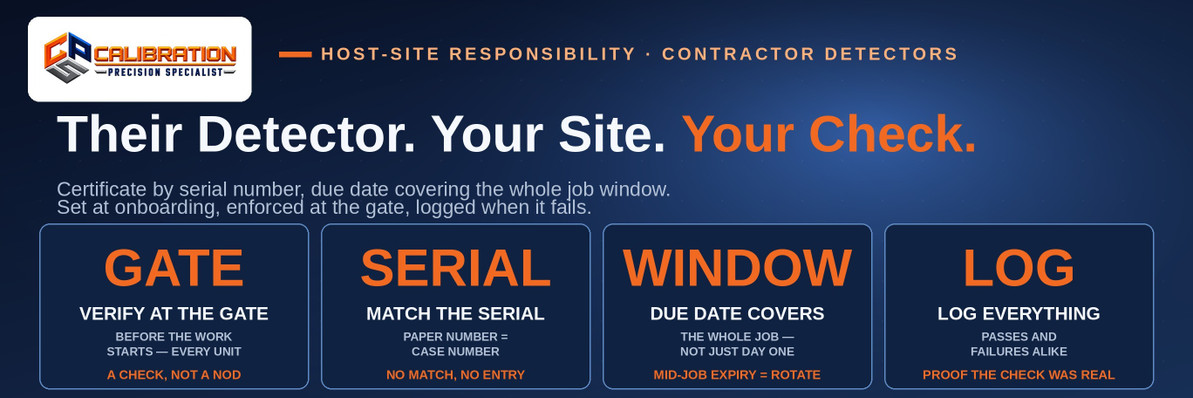
The host site verifies it. A contractor owns their detectors, but the moment those instruments work in your atmosphere, under your permits, the duty to confirm they are in calibration sits with the host — and the confirmation has to be a check, not a courtesy: a current calibration certificate matched to the instrument's serial number, a due date that covers the entire job window rather than just the start date, and bump-test discipline the host can observe during the work. Agreed in writing at onboarding, enforced at the gate, and documented when it fails, that check protects the contractor's crew exactly as much as the host's — because an unverified detector does not care whose logo is on the case.
Every site has watched this scene: a contractor crew arrives for a shutdown, the detectors come out of their cases at the gate, and someone asks the question that should have been settled weeks earlier — 'these are in calibration, right?' A nod comes back. The crew goes to work. That nod is what passes for verification on a remarkable number of sites, and it survives right up until an incident, an audit, or a regulator asks for the paper.
This post builds the version that survives the asking: what the host verifies, when, against which documents, and what happens when an instrument fails the check. It pairs with what an auditor looks for in bump test and calibration records — the auditor's checklist is simply the gate check, read later — and with what's on a CPS calibration certificate.
Why the Host Verifies — and What 'Verify' Actually Means
The logic is structural, not personal. The host controls the site: the permits are the host's, the atmospheric hazards are the host's process, the emergency response is the host's, and the stop-work authority is the host's. A detector is the instrument that decides whether the air a permit authorizes is in fact safe to breathe — and the host is the party relying on that decision dozens of times a day, for the host's own entrants working beside the contractor's. Reliance creates the duty to check, whatever the contract says about who owns the hardware. Reputable contractors understand this and arrive with their documentation in order; the check is not an accusation, it is the site working as designed.
And 'verify' has a specific meaning — it is not accepting an assurance, a sticker, or a due date read over a radio. Verification is documentary and physical, in three parts:
- A certificate that matches the instrument in hand. Serial number on the paper, serial number on the case — the same number. A fleet certificate, a certificate for a different unit, or a certificate with no serial number verifies nothing about the detector standing at your gate.
- A due date that covers the job window. In date on day one and expiring on day six of a ten-day job is an expired detector for the back half of the work. Judge certificates against the whole window, and settle at onboarding what happens mid-job when a date falls — rotation to a calibrated unit, not a waiver.
- Records behind the certificate worth the name. A certificate that shows as-found and as-left readings per channel, with the calibration gas documented, proves a calibration happened. A pass/fail card proves a form was filled in. The host does not need to re-audit the contractor's calibration provider — but the difference between those two documents is visible at a glance, and it is reasonable to require the first kind.
Building the Check: Onboarding, the Gate, and During the Work
Onboarding is where the standard is set. The contractor requirements in your site's onboarding package should name it plainly: personal gas detectors used on site must carry current calibration covering the job window, evidenced by a certificate per instrument identified by serial number, with bump testing performed per the manufacturer's direction during the work. Named early, the requirement is a logistics item — the contractor calibrates what needs calibrating while there is still time, at published rates if they use a bench like ours ($55 single-gas, $90 for 4- and 5-gas in-house), or rotates in compliant units. Named at the gate for the first time, the same requirement is a confrontation with a mobilized crew.
The gate check is where the standard is enforced — briefly, physically, every time. Instruments presented, serial numbers matched against certificates, due dates read against the job window, and the results logged: instrument, serial, due date, checker. Two minutes per instrument inside a check-in the crew already expects. What gets logged gets respected; what gets waved through gets gamed, by the next contractor if not this one. And the check protects the honest contractor — the firm that spent the money to keep its fleet current should never lose a morning to the firm that did not and bluffed.
During the work, the host watches the practice, not the paper. Bump testing before use, instruments worn in the breathing zone rather than riding in a truck cab, alarms answered rather than silenced — the disciplines that show whether the culture behind the certificates is real. The host does not run the contractor's safety program — only notices, and acts on its own stop-work authority when the air is being judged by instruments nobody is minding.
When an Instrument Fails the Gate
It will happen, and the response decided in advance is what keeps it small. The instrument does not go to work — that part is not negotiable, and it is not personal: a detector without verified calibration is not a detector, it is a display. The contractor's options are the ones agreed at onboarding: swap in a compliant unit from their own fleet, calibrate the instrument (a bench turnaround will rarely save a mobilization morning, which is precisely why onboarding names the requirement while there is still time), or have the affected workers use site-issued instruments under the site's own program, where the site's rules allow it.
What the host must not do is the quiet waiver — the verbal 'go ahead this once' that converts the host's check into the host's liability and teaches every watching crew that the standard is weather-dependent. Document the failure and the remedy in the same log as the passes: instrument, serial number, what failed, what was done. That entry is not bureaucracy; it is the record that the system works. If the instrument's owner wants it calibrated and documented properly afterward, that is ordinary bench work — calibration services covers it, and its record can join the CPS Calibration Program like any other instrument's. The gate, the log, and the certificate are one system: verification at the front, evidence at the back, and nobody's crew breathing on a nod.
Frequently Asked Questions
Who is responsible for verifying a contractor's detector calibration?
The host site, in practice — whatever the contract says about ownership. The host issues the permits, owns the atmosphere being entered, and relies on those detectors' readings to protect everyone in the area, including its own people working beside the contractor's crew. Reliance creates the duty to check. The contractor's duty is to arrive compliant: instruments in calibration through the job window, certificates by serial number ready to present. The host's duty is to actually perform the verification — document matched to instrument, dates read against the window — rather than accepting an assurance at the gate.
What exactly should the host check at the gate?
Three things, physically: the instrument itself, its calibration certificate, and the match between them. The certificate's serial number must be the serial number on the instrument in hand; the due date must cover the entire job window, not just the start date; and the certificate should show a real calibration — as-found and as-left readings per channel with the gas documented — rather than a bare pass mark. Log the instrument, serial number, due date, and checker for every unit admitted. Two minutes per instrument, inside a check-in the crew already expects.
Is a calibration sticker on the detector enough?
No. A sticker states that someone, at some point, claimed a date — it cannot be matched to a record, it shows nothing about what the channels read, and it survives transfers between instruments in a way certificates do not. Stickers are useful reminders riding on an instrument; they are not verification. The document that verifies is the certificate, identified by serial number, showing what was done. Hosts that accept stickers as proof discover, at the first audit or incident, that they have accepted a claim in place of evidence. Require the certificate; let the sticker be what it is — a label.
Does a specific regulation require the host to verify?
This post deliberately does not hang the practice on a single cited clause — its verified sources document calibration practice and audit expectations, not a regulation text. What can be said plainly: auditors examine calibration records for everyone who worked in the space, and 'the contractor said they were calibrated' has never functioned as a defense after an incident. The gate check stands on that practical ground; sites needing chapter-and-verse for their jurisdiction should get it from their own EHS counsel.
What if a contractor's certificate expires mid-job?
Settle it at onboarding, because it is a when, not an if, on long jobs. The clean rules are rotation or recalibration: the instrument leaves service at its due date and a compliant unit takes its place, or the instrument is calibrated during the job with its new certificate filed at the gate like the originals. What does not happen is a grace-period waiver invented on the day. A due date that covers the whole window is a mobilization requirement precisely so that mid-job expiries are planned rotations — scheduled, logged, and covered — instead of discoveries.
What should happen when an instrument fails the gate check?
It does not go to work — and everything after that is logistics. The agreed remedies are: the contractor swaps in a compliant unit, the instrument is calibrated and returns with a proper certificate, or the affected workers use site-issued instruments under the site's program where site rules allow. The failure and the remedy go in the gate log beside the passes. What the host must never issue is the one-time verbal waiver: it converts the host's check into the host's liability, and it teaches every crew watching that the standard bends under schedule pressure — the exact condition under which it matters most.
Should the host also verify bump testing?
Yes — as a practice observed during the work rather than a document demanded at the gate. Calibration proves the instrument read correctly on its calibration date; bump testing before use proves the sensors respond and the alarms fire today. The host's onboarding requirements should name bump discipline during the job, and supervision in the field should see evidence of it: bump gas present and in date, checks happening at shift start. What an auditor looks for in bump test and calibration records covers how both records get read after the fact — the gate and the field checks are how a site makes sure that reading goes well.
Can a contractor use the host's calibration records instead?
Only if the contractor's people are actually working under the host's instrument program — issued site instruments, tracked in the site's system. A contractor's own detector cannot borrow the host's records; its calibration lives or dies on its own certificate. Where sites do issue instruments to contractor personnel, the arrangement should be explicit in onboarding: whose instruments, whose program, whose due-date tracking, and what happens at demobilization. Blended arrangements fail in the gap between two programs that each assumed the other was watching — name the owner of every instrument's compliance, in writing, before the job.
What records should the host keep from contractor verification?
The gate log: date, contractor, instrument, serial number, calibration due date, checker's name, and disposition — admitted, swapped, calibrated, or refused — kept with the job's permit documentation, with copies of the certificates presented. That bundle is what an auditor, insurer, or investigator will ask for, and it is what what an auditor looks for in bump test and calibration records describes being examined. A documented refusal in the log is not an embarrassment — it is proof the check was real.
A contractor says their calibration is 'not due yet' but has no certificate — what now?
Treat it as unverified, because it is. 'Not due' is a claim about a date on a document that has not been produced; the entire point of the check is that claims do not admit instruments, evidence does. The remedies are the standard ones — produce the certificate, swap the unit, calibrate it, or issue site instruments per the agreed rules — and they are the contractor's to choose among. Most reputable firms resolve this in minutes with a phone call to their own office for the document. The firm that cannot produce a certificate for an instrument in front of you is telling you how its fleet is managed, and the gate is exactly where that information is cheapest to learn.
The Bottom Line
Their detector, your site, your check — because the atmosphere, the permits, and the consequences belong to the host. Set the standard at onboarding, enforce it at the gate in two documentary minutes per instrument, watch the practice during the work, and log the failures with the passes. Do that, and 'who verifies the calibration?' has an answer with a name and a record attached — which is the only kind of answer that survives the day it is needed.
Need instruments calibrated and documented before a mobilization? See calibration services — $55 single-gas, $90 for 4- and 5-gas, in-house in Rockwood, Tennessee — or call CPS Calibrations at 865-900-8844. 109 S. Front Street, Rockwood, TN 37854.
--- CPS Calibrations · 109 S. Front Street, Rockwood, TN 37854 · What an Auditor Looks For · What's on a CPS Calibration Certificate · Calibration Services
Need a calibration you can file?
In-house calibration at CPS in Rockwood, Tennessee — $55 for single-gas instruments, $90 for 4- and 5-gas — every channel, as-found and as-left data, full certificate.
See Calibration Servicesor call 865-900-8844
Recent Posts
-

What Is Remote Monitoring for Fixed Gas Detection?
Remote monitoring for fixed gas detection means a fixed system's live readings, trends, and alarm hi …Nov 23rd 2026 -

What Are the Key Differences Between the GX-6000 and GX-6100?
The RKI GX-6100 is the current replacement for the discontinued GX-6000: both are pumped 6-gas monit …Nov 22nd 2026 -

How to Read a PID Correction Factor Chart
To read a PID correction factor chart, find your vapor’s row, take the factor under your own lamp en …Nov 21st 2026