
Crowcon Detective+: The Transportable Area Monitor Crews Set Up in Minutes
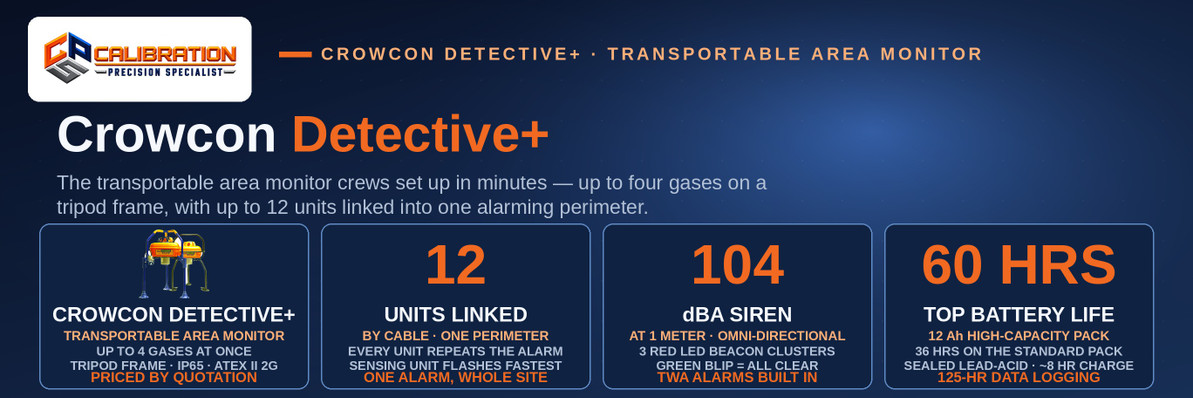
The Crowcon Detective+ is a transportable area monitor that watches up to four gases at once — flammable gas, oxygen, carbon dioxide, and toxics — from a rugged tripod frame a crew can set down and switch on in minutes. Its wailing siren puts out 104 dBA at 1 meter, three red LED beacon clusters ride on top, up to 12 units link by cable into a single perimeter where every unit repeats every alarm, and the sealed lead-acid battery runs up to 36 hours as standard or 60 hours with the high-capacity pack. CPS quotes the Detective+ per configuration rather than listing a shelf price.
Fixed gas detection protects the places you knew about when the plant was designed. Personal monitors protect the chest they're clipped to. Neither one covers the situation a turnaround actually creates: a workface that didn't exist last week, in a spot with no detector within a hundred feet, where a vessel is being opened, a flange broken, or a hot job run next to live process equipment. That gap — temporary work in unmonitored space — is what a transportable area monitor exists to fill, and the Detective+ is Crowcon's established answer to it: a full multi-gas monitor on a tripod, built to be carried in, set down, and trusted. This post covers what it watches, how a linked perimeter works, where it earns its place, and the limits worth knowing before you spec one.
What Is a Transportable Area Monitor?
An area monitor is a gas detector that watches a space rather than a person: it sits in the work area, samples the air around it continuously, and alarms loudly enough for everyone in earshot — not just a wearer — to act. A transportable area monitor adds the deployment model: no installation, no wiring back to a control room, no commissioning visit. It travels to the job, stands on its own frame, runs on its own battery, and leaves when the job does. Our guide to what an area monitor is works through the category and where it sits between personal and fixed detection; the Detective+ is the classic form of it — a self-contained unit, 640 × 455 × 455 mm and 7.5 kg (16.5 lb), that one person can carry and deploy.
Crowcon builds the Detective+ on the lineage of its Triple Plus+ portable platform — a design Crowcon counts at more than 55,000 units sold worldwide — repackaged into a frame-mounted area instrument. The housing is fire-retardant, high-impact, UV-stabilized ABS, sealed to IP65, and the tripod frame (rigid legs, or a folding-leg version for tighter storage and transport) is shaped to protect the instrument: the sensors live on the underside, shielded and raised, and Crowcon rates the unit to keep functioning even if it is overturned.
What It Watches, and Why
The Detective+ carries up to four gas channels at once, and the menu behind those four slots is the widest of any area monitor in its class. Three sensor technologies do the work:
- Catalytic (pellistor) or infrared for flammable gas — 0–100% LEL. Infrared can also be supplied as a dual range, 0–100% LEL / 0–100% volume, for inerted or high-concentration work — but that dual range occupies two display channels, so the unit becomes a three-reading instrument. IR's advantage is immunity to the catalyst poisons (silicones, sulfur compounds) that blind pellistors; the pellistor's advantage is that it sees hydrogen, which IR cannot.
- Infrared for carbon dioxide — 0–5% volume, the range that matters in breweries, wineries, dry-ice and beverage plants, and anywhere CO₂ is stored or generated. Only one infrared sensor can be fitted per unit, and IR channels combine with oxygen and toxic sensors.
- Electrochemical for oxygen and toxics — oxygen 0–25% volume, plus a toxic menu that runs well past the standard H₂S/CO pair.
| Gas | Range |
|---|---|
| Flammable gas (pellistor or IR) | 0–100% LEL (IR dual-range: 0–100% LEL / 0–100% vol) |
| Carbon dioxide (IR) | 0–5% vol |
| Oxygen (O₂) | 0–25% vol |
| Hydrogen sulfide (H₂S) | 0–50 ppm |
| Carbon monoxide (CO) | 0–500 ppm |
| Sulfur dioxide (SO₂) | 0–10 ppm |
| Chlorine (Cl₂) | 0–5 ppm |
| Nitrogen dioxide (NO₂) | 0–10 ppm |
| Phosphine (PH₃) | 0–5 ppm |
| Ammonia (NH₃) | 0–50 ppm or 0–1000 ppm |
| Hydrogen (H₂, non-flammable levels) | 0–2000 ppm |
| Hydrogen cyanide (HCN) | 0–25 ppm |
| Hydrogen chloride (HCl) | 0–10 ppm |
| Chlorine dioxide (ClO₂) | 0–1 ppm |
| Hydrogen fluoride (HF) | 0–10 ppm |
| Ethylene oxide (C₂H₄O) | 0–10 ppm |
| Volatile organics | 1–100 ppm |
Why the breadth matters: temporary work produces temporary hazards. The standard four (LEL, O₂, H₂S, CO) cover most hot work, but the job that opens a chlorine header, a fumigation space, or an ammonia refrigeration line needs the exotic channel — and an area monitor you can configure for Cl₂, PH₃, HCN, HF, or ethylene oxide is one you don't have to rent around. Response is quick for a diffusion-class instrument — typically 20 seconds for methane, 10 seconds for oxygen, 20 seconds for toxics and IR — and the backlit LCD shows all four channels at once, as current readings, TWA, or peak values. Expected sensor lives are honest industrial numbers: flammable 5 years, toxic 3 years, oxygen a minimum of 2 years, IR more than 5 years.
Set It Down, Switch It On: Deployment
Deployment is the product. There is no mounting bracket to bolt, no cable to pull to a junction box, no transmitter to address. The crew carries the unit in, stands it where the hazard assessment says the air needs watching, and switches it on. The frame does the rest of the physical work: it holds the sensors up off the deck and out of washdown water, keeps them underneath the body where they're shielded from dropped tools and direct weather, and keeps the instrument working if the unit gets knocked over — a realistic event on a congested workface.
Two sampling choices cover the placement problems a diffusion-only monitor can't:
- Diffusion (standard) — the unit reads the air at its own position. Right for open workfaces, perimeters, and anywhere the monitor can stand in the air mass it needs to judge.
- Internal pump (option) — a built-in electric sampling pump draws air to the sensors from up to 100 ft (30 m) away, per Crowcon's specification. That puts the monitor at the safe edge of a sump, pit, or vessel opening while the sample comes from inside it. A manual aspirator covers spot checks.
Battery is sized for real shifts, not brochure shifts. The standard 6 V, 7.2 Ah sealed lead-acid pack runs the unit up to 36 hours with a flammable or CO₂ sensor fitted — including, per Crowcon's manual, a 30-minute period in full alarm. The optional 6 V, 12 Ah high-capacity pack extends that to up to 60 hours — two and a half days of continuous cover. Recharging takes about 8 hours, on AC power, in a safe area.
Link Up to 12: The Perimeter Play
One Detective+ covers a workface. Linked Detective+ units cover a site. With interconnecting cables, up to 12 units link together to form a perimeter or area array — around a tank, along a fence line, ringing a turnaround work area — and the array behaves like one instrument with twelve noses:
- Every unit alarms for every unit. When any linked Detective+ senses gas, the alarm repeats across all of them. A release at the far end of the perimeter is announced at the near end, where the crew actually is.
- The sensing unit identifies itself. The unit that is actually detecting the hazard flashes its LED clusters in quick succession; units repeating the alarm flash slower. Nobody has to guess which corner of the site the gas is in — the fast-flashing unit is standing in it.
- One green blip means all clear. In normal operation each unit shows a slow-flashing green confidence LED, so a walking supervisor can read the health of the whole array at a glance — and a rapid green flash flags a low battery before it becomes a gap in coverage.
The alarm itself is built for outdoor industrial noise: a wailing, omni-directional siren at 104 dBA at 1 meter, three large red LED clusters on top of the unit plus a red LED on the control panel, and time-weighted-average alarms on the toxic channels for the 8-hour and 15-minute exposure limits. Everything the array sees is recorded: the Detective+ data-logs all channels (125 hours at a 10-second interval — 45,000 readings) and event-logs 1,000 events — alarms, over-ranges, calibrations, bumps, TWA events — downloadable to a PC via Portables PC software for the job file. How that deployment model plays out across a full outage is the subject of our companion post on area monitors for turnarounds and shutdowns.
Detective+ or DetectiveIQ: The Established Design and the Networked One
The Detective+ now shares Crowcon's area-monitor lineup with the DetectiveIQ, and the two are best understood as different answers to the same problem rather than a replacement and its predecessor. The Detective+ is the established transportable: four gases, cable-linked arrays, lead-acid endurance measured in days, a plain backlit LCD, and a design with a long field history. The DetectiveIQ is the networked generation: up to seven gases on modular sensor trays, wireless alarm-passing between units with no cable runs, battery life Crowcon rates in weeks, a color display, and phone-app visibility of live readings.
Choose on the job, not the brochure. Cable linking is a constraint — someone lays and manages the interconnecting leads — and also a guarantee: no pairing, no network configuration, no wireless survey, and an alarm path that is a physical wire. Fleets that already own Detective+ units, work that repeats in the same plants, and crews who value a known instrument with known service costs are the Detective+'s natural home. Fleets speccing fresh for very large perimeters or multi-week deployments should read the DetectiveIQ post and compare honestly — CPS sells and services both.
The Honest Limits
- Four gases is the ceiling — and a dual-range IR flammable build (LEL + % volume) uses two channels doing it, leaving two. If your hazard assessment names five gases, this is the wrong instrument; that's DetectiveIQ territory.
- Linking is by cable. There is no built-in wireless alarm-passing on the Detective+ and no live remote readout on a phone — readings are read at the unit or downloaded afterward via the RS232 PC link. The Detective+ is also not a Crowcon Connect device.
- Lead-acid endurance has a logistics tail. Thirty-six to sixty hours is generous, but multi-week jobs mean a charging rotation: roughly 8 hours on AC power, in a safe area, per cycle. The pack also makes up much of the unit's 7.5 kg.
- IP65 is weatherproof, not submersible. Rain, washdown splash, and dust are fine; standing water over the unit is not what the rating promises.
- An area monitor is a layer, not the program. It watches the air where it stands. It doesn't clear a confined space for entry, doesn't test a space remotely unless the pump option is fitted and used, and doesn't replace the personal monitor on any worker's chest.
What Does It Cost? Quoted, Not Shelved
There is no shelf price in this post, and that's a fact about the product, not a sales tactic: Crowcon's current price book leaves Detective+ configurations unpriced, because the configuration is the price. Gas selection, infrared versus catalytic flammable sensing, the pump option, standard versus high-capacity battery, rigid versus folding frame, and the interconnecting leads for a linked array all move the number — a two-gas diffusion unit and a four-gas pumped IR build are barely the same purchase. CPS quotes the Detective+ per configuration: tell us the gases, the deployment, and how many units need to link, and the quote comes back in writing. Call 865-900-8844.
Calibration and Service
A transportable monitor earns its keep across many jobs, which means its calibration history has to travel with it. The Detective+ calibrates quickly through its internal menu, through Portables PC software, or on Crowcon's CheckBox IMH management system, and its event log keeps the record — calibrations and bumps are among the 1,000 logged events, which is the paper trail a turnaround safety file needs. CPS handles the full service loop around deployments: bump testing and calibration before the unit goes out, sensor replacement when channels reach end of life (flammable 5 years, toxic 3, oxygen 2-plus), battery-pack replacement, and post-job log downloads for your records. See our calibration services for how fleet service works — and for the personal and fixed instruments the Detective+ works alongside, which still need their own documented attention.
Specifications at a Glance
| Type | Transportable area monitor, tripod-frame |
|---|---|
| Gases | Up to 4 simultaneously |
| Flammable | Pellistor or IR, 0–100% LEL (IR dual-range adds 0–100% vol, using 2 channels) |
| CO₂ | IR, 0–5% vol (one IR sensor max) |
| Toxics / O₂ | Electrochemical, 16 toxic options (see table above) |
| Linking | Up to 12 units, interconnecting cable; all units repeat all alarms |
| Sampling | Diffusion; internal pump option (draw up to 100 ft / 30 m); manual aspiration |
| Audible alarm | Wailing omni-directional siren, 104 dBA at 1 m |
| Visual alarm | 3 top-mounted red LED clusters + panel LED; green confidence / low-battery LED |
| Display | Backlit LCD, up to 4 gases — current, TWA, or peak |
| Battery | 6 V sealed lead-acid: 7.2 Ah standard (up to 36 hrs), 12 Ah optional (up to 60 hrs); ~8 hr recharge, safe area |
| Data logging | 125 hrs at 10 s intervals (45,000 readings); 1,000 events; RS232 / Portables PC |
| Response (typical) | Methane 20 s · oxygen 10 s · toxics 20 s · IR 20 s |
| Sensor life (expected) | Flammable 5 yrs · toxic 3 yrs · oxygen ≥2 yrs · IR >5 yrs |
| Size / weight | 640 × 455 × 455 mm (25.2 × 17.9 × 17.9 in) · 7.5 kg (16.5 lb) |
| Ingress protection | IP65 |
| Operating range | −20 °C to +50 °C (−4 °F to 122 °F) · 0–95% RH non-condensing |
| Approvals | ATEX II 2G Ex ib d IIC T4 · IECEx Ex ib d IIC T4 |
Frequently Asked Questions
What is the Crowcon Detective+?
A transportable multi-gas area monitor. It stands on a rugged tripod frame — rigid or folding legs — and continuously watches up to four gases at once (flammable gas, oxygen, carbon dioxide, and toxics) in a temporary work area, alarming with a 104 dBA siren and three red LED beacon clusters. It runs up to 36 hours on its standard sealed lead-acid battery, or up to 60 hours on the optional high-capacity pack, and up to 12 units can be cable-linked into one alarming perimeter. It's IP65 and ATEX/IECEx certified.
How many gases can the Detective+ detect at the same time?
Four. The channels combine a flammable sensor (catalytic pellistor or infrared, 0–100% LEL), an optional infrared CO₂ sensor (0–5% volume), oxygen (0–25%), and electrochemical toxics from a 16-gas menu — H₂S, CO, SO₂, Cl₂, NO₂, PH₃, NH₃, H₂, HCN, HCl, ClO₂, HF, ethylene oxide, and more. One caveat: only one infrared sensor fits per unit, and the dual-range IR flammable option (LEL plus % volume) occupies two channels, leaving two.
How do linked Detective+ units work?
With interconnecting cables, up to 12 Detective+ units link into a perimeter or area array. When any unit in the array senses gas, every linked unit repeats the alarm — siren and beacons — so the warning reaches the whole site, not just the corner where the gas is. The unit actually sensing the hazard flashes its LED clusters in quick succession while the repeating units flash slower, which tells the crew which unit is standing in the gas. Each unit also shows a slow green confidence flash in normal operation and a rapid green flash for low battery.
How long does the Detective+ battery last?
Up to 36 hours on the standard 6 V, 7.2 Ah sealed lead-acid pack with a flammable or CO₂ sensor fitted — Crowcon's figure includes 30 minutes in full alarm. The optional 6 V, 12 Ah high-capacity pack extends runtime to up to 60 hours. Recharging takes about 8 hours on AC power and must be done in a safe area, so multi-day deployments run best as a rotation: units in service, units on charge.
Does the Detective+ have a built-in pump?
It's an option. The standard Detective+ is a diffusion monitor — it reads the air at its own position. Crowcon offers an internal electric sampling pump that draws a sample from up to 100 ft (30 m) away, which lets the unit stand at the safe edge of a sump, pit, or vessel opening while sampling inside it. A manual aspirator can also be attached for spot sampling. If remote sampling is part of your deployment, spec the pump at order time.
How loud is the Detective+ alarm?
The audible alarm is a wailing, omni-directional siren rated at 104 dBA at 1 meter — loud enough to carry across an outdoor work area over plant noise. Visually, three large red LED clusters on top of the unit flash in alarm, backed by a red LED on the control panel. On linked arrays, every unit sounds and flashes, and the sensing unit flashes fastest. Toxic channels also carry time-weighted-average (TWA) alarms for 8-hour and 15-minute exposure limits.
Is the Detective+ rated for hazardous areas?
Yes. The Detective+ is certified ATEX II 2G Ex ib d IIC T4 for Europe and IECEx Ex ib d IIC T4 internationally — intrinsically safe equipment for gas atmospheres, over an ambient range of −20 °C to +50 °C. The housing is IP65: dust-tight and protected against water jets, so rain and washdown splash are fine, though IP65 is not a submersion rating. The fire-retardant, high-impact ABS body and protective tripod frame are built for industrial sites, and Crowcon rates the unit to keep functioning even if overturned.
What is the difference between the Detective+ and the DetectiveIQ?
Capacity and connectivity. The Detective+ monitors up to 4 gases, links up to 12 units by cable, runs 36–60 hours on a sealed lead-acid pack, and shows readings on a backlit LCD. The DetectiveIQ is Crowcon's networked generation: up to 7 gases on modular sensor trays, wireless alarm-passing with no cable runs, battery life measured in weeks rather than days, a color display, IP66/IP68 sealing, and live readings on a phone app. The Detective+ is the established, wired, known-quantity design; the DetectiveIQ is the connected one. CPS sells and services both.
How much does the Crowcon Detective+ cost?
CPS quotes it per configuration — there is no single shelf price. Crowcon's current price book leaves Detective+ configurations unpriced because the build drives the number: which gases, infrared or catalytic flammable sensing, the pump option, standard or high-capacity battery, rigid or folding frame, and how many units link together. Tell CPS the gases and the deployment and you'll get a written quote for exactly that build. Call 865-900-8844.
How is the Detective+ calibrated?
Three ways: through the unit's internal menu, through Crowcon's Portables PC software (which also sets alarms, clock, and logging interval and downloads the data log), or on Crowcon's CheckBox IMH calibration management system. Calibrations and bump tests are written to the unit's 1,000-event log, which is the record your safety file needs. CPS calibrates and services Detective+ units — including sensor and battery-pack replacement — through our calibration services, and can turn units around between deployments.
The Bottom Line
The Detective+ is the area monitor for the work that moves: turnarounds, hot work, vessel openings, and every temporary job in a place fixed detection doesn't reach. Four gases on one tripod, a 104 dBA siren the whole crew can hear, up to 60 hours between charges, and a cable-linked array of up to 12 units that turns a single monitor into a perimeter — deployed in minutes, with no installation at all. It is wired where its stablemate is wireless, and four-gas where that one is seven; within those honest limits, it's the established, proven form of transportable monitoring, and CPS quotes, calibrates, and services it as a fleet instrument.
Speccing area monitoring for a turnaround or a standing temporary-work program? Call 865-900-8844 or reach us through Contact Us. Tell us the gases and the footprint and we'll quote the Detective+ configuration that fits — and our calibration services keep the fleet documented between jobs.
CPS Calibrations · 109 S. Front Street, Rockwood, TN 37854 · Calibration Gas · Calibration Services · Contact Us
Need a calibration you can file?
In-house calibration at CPS in Rockwood, Tennessee — $55 for single-gas instruments, $90 for 4- and 5-gas — every channel, as-found and as-left data, full certificate.
See Calibration Servicesor call 865-900-8844
Recent Posts
-

What Is Remote Monitoring for Fixed Gas Detection?
Remote monitoring for fixed gas detection means a fixed system's live readings, trends, and alarm hi …Nov 23rd 2026 -

What Are the Key Differences Between the GX-6000 and GX-6100?
The RKI GX-6100 is the current replacement for the discontinued GX-6000: both are pumped 6-gas monit …Nov 22nd 2026 -

How to Read a PID Correction Factor Chart
To read a PID correction factor chart, find your vapor’s row, take the factor under your own lamp en …Nov 21st 2026