
Crowcon DetectiveIQ: The 7-Gas Area Monitor That Networks a Whole Worksite
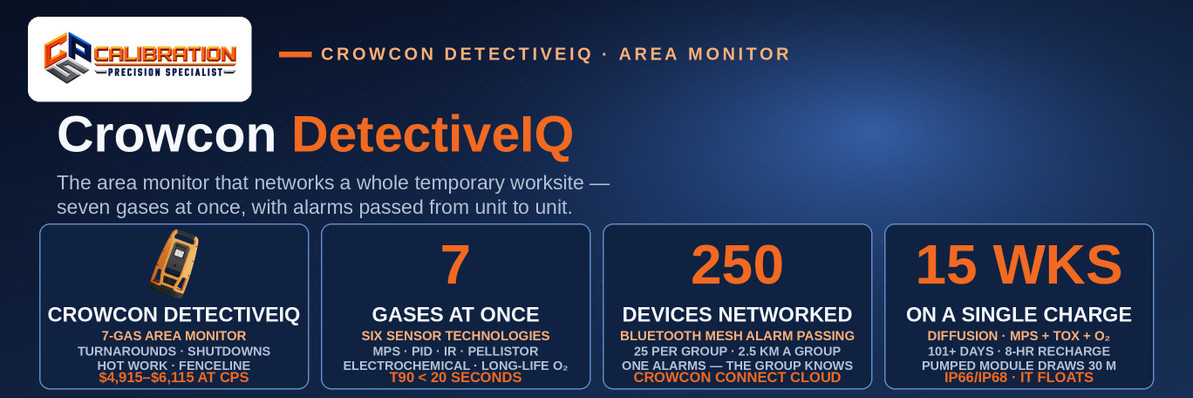
The Crowcon DetectiveIQ is a configurable area monitor that detects up to 7 gases simultaneously, links up to 250 units over Bluetooth Mesh so an alarm on one unit alerts the whole group, and runs up to 15 weeks on a single charge in diffusion mode — built for the temporary worksites, turnarounds, and fence lines where fixed gas detection doesn't exist.
Personal detectors protect the person wearing them. They don't watch the space. An area monitor is the unit you set down at the edge of the work — beside the hot-work job, at the confined-space opening, along the fence line — and it keeps measuring after the crew moves on. If you're new to the category, our guide to what an area monitor is and when you need one covers the basics. The DetectiveIQ is Crowcon's current flagship in that category, and it replaced the long-running Detective+ in Crowcon's line (more on that in the FAQs, and in our Detective+ spotlight).
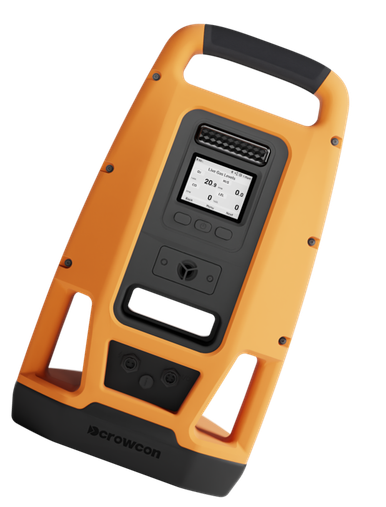
Crowcon DetectiveIQ Area Monitor
Crowcon DetectiveIQ: up to 7 gases, Bluetooth Mesh linking 250 units, up to 15 weeks per charge, IP66/IP68. CPS list $4,915–$6,115 by configuration.
$4,915–$6,115 configured
See the DetectiveIQ AreaSeven Gases at Once — and Why the Sensor Mix Matters
Most area monitors top out at four or five channels. The DetectiveIQ carries up to seven gases simultaneously, and its interchangeable sensor slots accept six different sensor technologies: electrochemical, PID, infrared, MPS, pellistor, and long-life O₂. That mix matters because no single technology reads everything a turnaround can produce:
| Channel | Range | Why it's on the unit |
|---|---|---|
| Oxygen (O₂), long-life sensor | 0–25% vol | Displacement and enrichment — the first check in any space |
| Flammable gas (MPS) | 0–100% LEL | No catalyst bead to poison, and no correction factors when the gas changes |
| Flammable gas (pellistor) | 0–100% LEL (methane/propane) | The conventional catalytic option some sites still specify |
| Carbon monoxide (CO) | 0–500 ppm | Engine exhaust, heaters, and incomplete combustion around hot work |
| Hydrogen sulfide (H₂S) | 0–100 ppm | Sour crude, wastewater, and decaying organics |
| Dual toxic (CO + H₂S in one sensor) | CO 0–500 ppm / H₂S 0–100 ppm | Both toxics without spending two slots |
| Carbon dioxide (CO₂), infrared | 0–5% vol | Heavier than air, pools low, and displaces oxygen silently |
| VOCs (PID) | 0–4,000 ppm | Solvent and hydrocarbon vapor at ppm levels an LEL sensor can't see |
Response is fast for an area unit: T90 under 20 seconds for key gases. The display is a colour LCD that rearranges itself around the active channels (1 to 8 shown) with colour-coded alerts that shift green to red, and alarms are visual plus a 97 dB sounder with low/high, TWA, and STEL alarm types. Three buttons run the whole interface — a deliberate choice for gloved hands and minimal training on a rented-in workforce.
The Battery Is the Headline: Up to 15 Weeks
Area monitors usually live on a charging rotation. The DetectiveIQ mostly doesn't. In diffusion mode at 20 °C, Crowcon rates the MPS + toxics + O₂ configuration at 101+ days — up to 15 weeks — on a single charge, with a full recharge in about 8 hours. Read the configuration fine print, because the number moves with the sensor set:
- Diffusion, MPS | toxics | O₂: 101+ days
- Diffusion, with PID fitted: 20 days
- Pumped, pellistor | toxics | O₂: 15 days
- Pumped, with PID fitted: 9 days
Even the worst case — pumped, with a PID — covers a nine-day turnaround without a charger. For a multi-week shutdown, the practical effect is simple: units go out at the start of the job and stay out, instead of cycling through a charging shelf every few days while coverage gaps open up.
Bluetooth Mesh: One Alarm Becomes Every Alarm
A lone area monitor only warns the people standing near it. The DetectiveIQ's built-in alarm passing uses Bluetooth Mesh to connect up to 250 devices across 10 groups. Each group links up to 25 units spaced up to 100 m apart, covering about 2.5 km — a full fence line. When one unit goes into alarm, the alarm passes across the group, so a leak detected at the far end of a plot warns workers who can't hear the first unit's sounder.
On top of the mesh, the DetectiveIQ is part of Crowcon's IQ platform and talks to Crowcon Connect, Crowcon's cloud-hosted application: real-time alarms, compliance dashboards, location tracking, device configuration, and reporting for the safety office. For a turnaround with dozens of units scattered across a unit, that central view is the difference between managing the fleet and hunting for it. We put the DetectiveIQ in the wider turnaround picture in area monitors for turnarounds and shutdowns.
Four Ways It Gets Deployed
Single-unit hot-work watch. One diffusion unit set beside the job, watching for flammable gas and CO while welding and cutting go on overhead. The 97 dB sounder and red alert lights carry over tool noise better than a personal detector's alarm alone.
Confined-space attendant station. Fit the optional pumped module and the unit stays outside with the attendant while the sample line runs up to 30 m (100 ft) into the space — pre-entry and continuous monitoring without putting the instrument, or a second person, inside.
Fenceline string. Up to 25 linked units around a plot boundary or a neighboring-community fence line. Diffusion units at this spacing run for weeks between charges, and mesh alarm passing means the whole string reports together.
Turnaround grid. Multiple groups — up to 250 devices total — spread across the site, feeding Crowcon Connect. This is the configuration the DetectiveIQ was designed around: temporary, dense, and torn down when the job ends.
Built to Endure — and It Floats
The housing is ASA and Pebax, rated IP66 and IP68, and Crowcon's own line for it is "built to endure — and it floats," which matters on marine work, wastewater sites, and anywhere a unit can end up in water. It operates from −20 °C to +55 °C (−4 °F to +131 °F) at 0–95% RH. At 298 × 536 × 268 mm and 8.1 kg (about 17.9 lb), it's a two-hand carry to the set-down point — this is a worksite unit, not a personal monitor, and it's sized like one.
Approvals: ATEX II 1G Ex ia da IIC T4 Ga and IECEx — Zone 0 certified, the highest gas-zone rating, plus RED/FCC/IC wireless approvals. One honest note: Crowcon's datasheet lists CSA US Class I Division 1 Groups A–D but marks that certification as pending. If your site standard requires the CSA mark specifically, ask us for the current certificate status when you request a quote — we'll confirm it in writing.
Servicing: a Sensor Tray, Not a Screwdriver Job
The DetectiveIQ is built around a pull-in, pull-out modular sensor tray, with minimal parts and screws — the outer casing, boot, and handles are replaceable in the field, which keeps a knocked-around rental or fleet unit in service instead of on a bench. Crowcon specifies 6-monthly calibration, and the unit stores up to 8,640 event logs for the compliance record. Warranty is 2 years on the unit, with sensor warranty separate.
CPS calibrates and services what we sell: send units to us or ask about on-site service for a fleet. Details are on our calibration services page, or call 865-900-8844 — CPS Calibrations, 109 S. Front Street, Rockwood, TN 37854.
The Honest Limits
- It lists at $4,915–$6,115 at CPS. The configuration — gas set, sensor technologies, pumped or diffusion — sets where a unit lands in that range. Every configuration is on the DetectiveIQ product page.
- The 15-week battery is the best case, not every case. It's the diffusion MPS/toxics/O₂ build. Add a PID and you're at 20 days; run the pump and you're at 9–15 days. Plan the charging shelf around your actual configuration.
- The pump is an option, not standard. Base units are diffusion. If your work needs remote sampling, the pumped module has to be in the configuration from the start.
- It's a point monitor. It measures the air where it sits (or where its sample line ends). For very long perimeters, compare the mesh approach with open-path detection before you commit — the right answer depends on the site.
- It's not a personal detector. At 8.1 kg it watches a space; your crew still wears their own monitors.
Frequently Asked Questions
How many gases can the Crowcon DetectiveIQ detect at once?
Up to 7 gases simultaneously. Its interchangeable sensor slots accept electrochemical, PID, infrared, MPS, pellistor, and long-life O₂ sensors, so one unit can cover oxygen, flammables, CO, H₂S, CO₂, and VOCs in the combination your hazard assessment calls for.
How long does the DetectiveIQ battery last?
Up to 15 weeks (101+ days) on a single charge in diffusion mode with the MPS, toxics, and O₂ configuration at 20 °C. A PID-equipped diffusion build runs about 20 days, and pumped configurations run 9–15 days. A full recharge takes about 8 hours.
How much does the Crowcon DetectiveIQ cost?
CPS lists the DetectiveIQ at $4,915–$6,115, priced by configuration — the gas set, sensor types, and pumped module determine where a unit lands in the range. See the configurations and current prices, or call CPS Calibrations at 865-900-8844 and we'll spec your exact configuration in writing.
Can DetectiveIQ units be networked together?
Yes. Built-in alarm passing over Bluetooth Mesh connects up to 250 devices in 10 groups. Each group links up to 25 units spaced up to 100 m apart, covering about 2.5 km, and an alarm on any unit passes across the group. Units also report to the Crowcon Connect cloud platform for real-time alarms and compliance dashboards.
Is the DetectiveIQ intrinsically safe?
It is ATEX II 1G and IECEx certified (Ex ia da IIC T4 Ga) — Zone 0, the highest gas-zone rating. Crowcon's datasheet also lists CSA US Class I Division 1 Groups A–D, marked as certification pending; ask us for current certificate status if your site requires the CSA mark.
Does the DetectiveIQ have a pump?
A pump is an optional module, not standard equipment. Diffusion is the base configuration; the optional pumped module draws a sample from up to 30 m (100 ft) away, which is the setup used for confined-space pre-entry testing from outside the space.
What gases and ranges does the DetectiveIQ cover?
Oxygen 0–25% vol, flammable gas 0–100% LEL (MPS or pellistor), carbon monoxide 0–500 ppm, hydrogen sulfide 0–100 ppm, a dual CO/H₂S sensor, carbon dioxide 0–5% vol by infrared, and VOCs 0–4,000 ppm by PID — up to seven channels fitted at once.
How often does the DetectiveIQ need calibration?
Crowcon specifies calibration every 6 months. CPS Calibrations performs calibration and service on the units we sell — see our calibration services page or call 865-900-8844. The unit also logs up to 8,640 events for your compliance records.
Is the DetectiveIQ waterproof?
Yes — it's rated IP66 and IP68 for water and dust ingress, and the sealed housing floats. It's built for outdoor temporary worksites and operates from −20 °C to +55 °C.
What replaced the Crowcon Detective+?
The DetectiveIQ. Crowcon succeeded the Detective+ with the DetectiveIQ in 2025 (Detective+ last orders closed November 28, 2025), adding the 7-gas capacity, Bluetooth Mesh networking, and the IQ-platform connection the older unit didn't have. Our Detective+ spotlight covers the outgoing model.
The Bottom Line
The DetectiveIQ is the area monitor for jobs that are temporary, spread out, and too big for a single unit: up to 7 gases, a battery that measures in weeks instead of shifts, and a mesh network that turns 25 separate units into one alarm system along a fence line. It's priced by configuration — $4,915–$6,115 at CPS — because the configuration is the product: tell us the gases, the layout, and the job length, and CPS will spec it with you: 865-900-8844, 109 S. Front Street, Rockwood, TN 37854.
Need a calibration you can file?
In-house calibration at CPS in Rockwood, Tennessee — $55 for single-gas instruments, $90 for 4- and 5-gas — every channel, as-found and as-left data, full certificate.
See Calibration Servicesor call 865-900-8844
Recent Posts
-

What Is Remote Monitoring for Fixed Gas Detection?
Remote monitoring for fixed gas detection means a fixed system's live readings, trends, and alarm hi …Nov 23rd 2026 -

What Are the Key Differences Between the GX-6000 and GX-6100?
The RKI GX-6100 is the current replacement for the discontinued GX-6000: both are pumped 6-gas monit …Nov 22nd 2026 -

How to Read a PID Correction Factor Chart
To read a PID correction factor chart, find your vapor’s row, take the factor under your own lamp en …Nov 21st 2026