
Area Monitors for Turnarounds and Shutdowns: How Crowcon's DetectiveIQ Networks a Whole Site
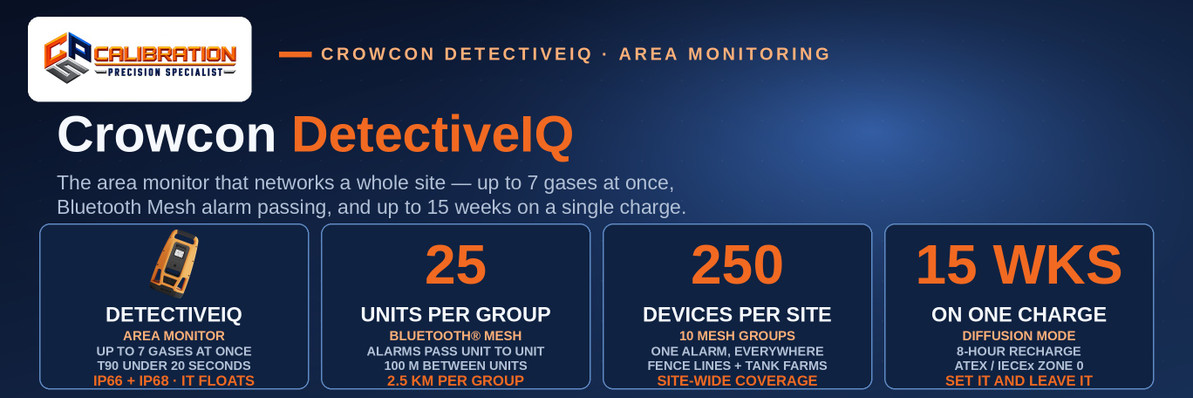
An area monitor watches the ground nobody is standing on: Crowcon's DetectiveIQ detects up to 7 gases simultaneously, links up to 25 units into a single Bluetooth Mesh network that passes alarms from unit to unit, and runs up to 15 weeks on one charge in diffusion mode — built for turnarounds, shutdowns, tank farms, and fence lines where one worker's personal monitor can't cover the site.
If you want the basics of what an area monitor is and how it differs from a personal detector, start with our explainer, What Is an Area Monitor?. This post is about what happens when you put networked area monitors to work on a real outage.
Why do turnarounds and shutdowns need area monitors?
A turnaround concentrates more people, more open equipment, and more simultaneous hot work into a few weeks than the plant sees all year. Lines are broken, vessels are opened, contractors who don't know the unit walk in beside crews who do. Personal monitors still matter — every entrant wears one — but they only sample the air at one chest, one worker at a time. A leak at a flange row fifty feet from the nearest entrant alarms nobody until the cloud reaches somebody.
Area monitors close that gap. Placed at the work face, around opened equipment, and along the routes people walk, they watch the space itself — continuously, including the minutes when nobody is standing there. Crowcon designed the DetectiveIQ for exactly this work: its datasheet names turnaround and shutdown procedures, hot work maintenance, and confined space entry as the jobs it was built for, in the places where fixed detectors are impractical because the hazard is temporary.
Where else does a networked area monitor earn its keep?
Tank farms. The dike, the pump row, and the loading rack are classic unmonitored ground: visited often, occupied rarely. A DetectiveIQ sitting at the low point of a dike or beside a pump seal watches between rounds, and its mesh network means the alarm doesn't stay at the tank — it repeats on every linked unit across the site.
Fence-line and perimeter watch. During outages, emissions events, or work near a property boundary, the question is what is leaving the site. Crowcon rates the DetectiveIQ for fenceline deployment with up to 25 interconnected devices, spaced up to 100 m apart — a picket line of monitors along the boundary, all reporting into one network.
Confined-space support. An area monitor is not the entrant's personal monitor and never replaces it — but a unit positioned at the opening watches the space's surroundings and the attendant's area, and the optional pumped module draws a sample from up to 30 m (100 ft) away, so the point being tested doesn't have to be the point where the instrument sits. (The entry itself still follows the full permit process — see What Is a Confined Space?)
Temporary worksites. Construction spreads, remediation jobs, and utility work share one trait: the site exists for weeks, not decades, so nobody is installing fixed detection. A monitor that runs for weeks on a charge, survives weather at IP66/IP68, and needs no infrastructure beyond its own mesh is the practical answer.
How does the DetectiveIQ network a whole site?
Each DetectiveIQ carries built-in alarm passing over Bluetooth Mesh. Link units together and an alarm raised on one is passed across the network, so the crew at the far end of the pipe rack hears about the leak at the exchanger — from the unit nearest them, not from a radio call that may or may not come.
The numbers, from Crowcon's datasheet:
- Up to 25 devices per group, with up to 100 m spacing between units
- Up to 10 groups — 250 devices on one site network
- Each group covers about 2.5 km, so a fence line or a long unit row fits in a single group
- Alarms also flow to the Crowcon Connect app and cloud dashboard, with real-time alarms, location tracking, and compliance reporting
That networking is the difference between a monitor and a system. Twenty-five stand-alone monitors give you twenty-five separate alarms, each audible only where it stands. Twenty-five networked DetectiveIQs give you one alarm, everywhere, the moment any single unit sees gas.
What gases can a DetectiveIQ watch?
Up to seven gases at once, from interchangeable sensor slots covering six technologies: electrochemical, infrared, PID, MPS™, pellistor, and long-life O₂. The datasheet ranges:
| Gas | Range |
|---|---|
| Oxygen (O₂) | 0–25% vol |
| Methane (CH₄) | 0–100% LEL |
| Propane (C₃H₈) | 0–100% LEL |
| Flammable (MPS™) | 0–100% LEL |
| Carbon monoxide (CO) | 0–500 ppm |
| Hydrogen sulfide (H₂S) | 0–100 ppm |
| Dual toxic (CO + H₂S) | CO 0–500 ppm / H₂S 0–100 ppm |
| Carbon dioxide (CO₂, IR) | 0–5% vol |
| VOCs (PID) | 0–4,000 ppm |
Response is fast for an area instrument — T90 under 20 seconds for key gases — and the colour display shifts its alerts from green to red as channels alarm, so the state of the unit reads at a glance from across the deck. The alarm sounder is 97 dB at 30 cm, with low/high, TWA, and STEL alarms per channel. Every event lands in a log of up to 8,640 events, which is the paper trail an outage review or an incident investigation will ask for.
For the full configuration walk-through — every sensor combination CPS can build — see the companion spotlight: Crowcon DetectiveIQ Area Monitor.
How long does the battery really last?
The headline figure is real, with a configuration attached. In diffusion mode at 20 °C, the MPS + toxic + O₂ build runs 101+ days — the "up to 15 weeks" on the datasheet cover. Change the build and the number changes honestly:
- Diffusion, PID fitted: about 20 days (PID lamps draw power)
- Pumped mode: about 15 days on a pellistor build, about 9 days with PID fitted
- Recharge: 8 hours back to full
Even the shortest of those covers a typical outage without a mid-job battery swap, and the longest covers a whole season of standby watch. The practical point for a turnaround planner: you charge the fleet once, deploy it, and stop thinking about batteries while the work runs.
Is the DetectiveIQ built for hazardous areas?
Yes — it's certified for the areas it's meant to watch. ATEX/IECEx Zone 0 (Ex II 1G Ex ia da IIC T4 Ga). Its CSA US Class I, Division 1, Groups A–D certification is marked pending on Crowcon's datasheet — confirm its status at quote time if your site requires that listing. The housing is IP66 and IP68 against dust and water, operates from −20 °C to +55 °C, weighs 8.1 kg — and it floats, which anyone who has fished equipment out of a dike or a sump will appreciate. A pull-in, pull-out modular sensor tray keeps servicing quick: swap the tray, not the instrument.
DetectiveIQ vs. Detective+: what's the difference?
The Detective+ built this category for Crowcon — a transportable tripod monitor that plants have run for years — and the DetectiveIQ is its successor. Both earn a place; they are not the same tool.
| DetectiveIQ | Detective+ | |
|---|---|---|
| Gases at once | Up to 7 | Up to 4 |
| Networking | Built-in Bluetooth Mesh, 25/group, 250 total | Units interconnect by lead; linked units repeat the alarm |
| Battery | Up to 15 weeks diffusion | Up to 36 hrs (60 hrs, high-capacity pack) |
| Alarm | 97 dB at 30 cm, colour-coded display | 104 dBA siren at 1 m, three LED beacons |
| Sealing | IP66 / IP68 | IP65 |
| Certification | ATEX/IECEx Zone 0; CSA Class 1 Div 1 pending | ATEX II 2G, IECEx |
| Pumped sampling | Optional module, up to 30 m | Optional internal pump, up to 30 m |
| Weight | 8.1 kg | 7.5 kg |
If your fleet already runs Detective+ units, they remain a sound four-gas perimeter tool — interconnected, they form a protective ring around a work area, and CPS calibrates and supports them. The DetectiveIQ is the step up when the job needs more gases, wireless alarm passing instead of leads, or battery life measured in weeks. More on the older unit here: Crowcon Detective+ Area Monitor.
The honest limits of area monitoring
- An area monitor supplements personal monitors; it never replaces them. It reads the air where it sits. The air in a worker's breathing zone, thirty feet away and downwind, can be different. Entrants still wear their own detectors — always.
- Diffusion response depends on placement and airflow. A diffusion unit can only alarm on gas that reaches it. Wind direction, thermal layering, and dead spots behind equipment all decide whether a leak finds the sensor. Placement is an engineering decision — near likely leak points, at the right height for the gas, with the site's airflow in mind — not a drop-it-anywhere decision.
- Battery life follows the build. Fifteen weeks is the best diffusion configuration; PID and pumped builds run days-to-weeks, not months. Spec the runtime against the job length, not the brochure headline.
- Mesh range shrinks around steel. The 100 m unit spacing is the rated figure; dense pipe racks and vessel walls will eat into it. A site walk with the units in hand beats a paper layout.
Calibration and upkeep
Crowcon specifies calibration every six months, and an area monitor that sits in storage between outages deserves a bump check before it deploys — a detector that has slept for a year should prove it can still see gas before it guards a crew. CPS calibrates and services Crowcon area monitors along with the personal monitors in the same fleet, so the whole site's detection arrives at the turnaround ready: calibration services. We calibrate every channel — if a sensor won't hold calibration, we'll tell you before the outage does.
Frequently Asked Questions
What is an area monitor used for?
An area monitor watches a space rather than a person: it sits at a work face, tank dike, fence line, or vessel opening and alarms on gas in that area, including when nobody is standing there. Crowcon's DetectiveIQ, for example, detects up to 7 gases at once and is built for turnarounds, shutdowns, hot work, confined-space support, and temporary worksites where fixed detectors are impractical.
How many gases can the Crowcon DetectiveIQ detect?
Up to 7 gases simultaneously, from interchangeable sensor slots covering electrochemical, infrared, PID, MPS, pellistor, and long-life O₂ sensors. Published ranges include O₂ 0–25% vol, methane and propane 0–100% LEL, CO 0–500 ppm, H₂S 0–100 ppm, CO₂ 0–5% vol, and PID VOCs 0–4,000 ppm.
How long does the DetectiveIQ battery last?
Up to 15 weeks on a single charge in diffusion mode — 101+ days for the MPS, toxic, and O₂ configuration at 20 °C. A PID-equipped build runs about 20 days in diffusion, and pumped builds run about 9 to 15 days depending on sensors. Recharge takes 8 hours.
How many DetectiveIQ units can be linked together?
Up to 25 devices in one Bluetooth Mesh group, spaced up to 100 m apart and covering about 2.5 km, and up to 10 groups — 250 devices — across a site. An alarm on any unit passes across the network, so every linked unit warns its own area at the same time.
Can an area monitor replace personal gas detectors?
No. An area monitor reads the air where the unit sits, which is not the same as the air in a worker's breathing zone. Area monitors supplement personal monitors — they watch spaces, perimeters, and unoccupied ground — while every worker in the hazard area still wears their own detector.
What is the difference between DetectiveIQ and Detective+?
The Detective+ monitors up to 4 gases, interconnects with other units by lead, and runs up to 36 hours (60 with the high-capacity pack) behind a 104 dBA siren. The DetectiveIQ is its successor: up to 7 gases, built-in Bluetooth Mesh networking for up to 250 devices, battery life up to 15 weeks, and IP66/IP68 sealing versus the Detective+'s IP65.
How far can a DetectiveIQ draw a sample from?
Up to 30 m (100 ft) with the optional pumped module. That lets the instrument sit outside a space, a dike, or a sump while the sample point is at the hazard — useful for pre-entry checks and for monitoring spots that are hard to reach or unsafe to stand at.
Is the Crowcon DetectiveIQ intrinsically safe?
It is certified for hazardous areas: ATEX/IECEx Zone 0 (Ex II 1G Ex ia da IIC T4 Ga); its CSA US Class I, Division 1, Groups A, B, C, and D listing is marked pending on Crowcon's datasheet. Zone 0 is the most demanding ATEX category — the unit is rated for areas where an explosive atmosphere is present continuously or for long periods.
How much does a Crowcon DetectiveIQ cost?
DetectiveIQ and Detective+ are priced by quotation — neither is listed in Crowcon's FY27 price book, because the price depends on the sensor build. Tell CPS which gases you need to watch and we'll quote the configuration, along with the calibration plan to keep it in service.
How often does an area monitor need calibration?
Crowcon specifies calibration every six months for the DetectiveIQ. A unit coming out of storage should also be bump-tested before deployment to prove every channel responds, and CPS can calibrate all channels and document the results before your outage starts.
The Bottom Line
Turnarounds and shutdowns put the most people next to the most open equipment a plant ever sees, and personal monitors alone leave most of that ground unwatched. A networked area monitor — up to 7 gases, alarms passed across up to 250 devices, weeks of battery, certified for Zone 0 (CSA Class 1 Div 1 still pending) — turns scattered instruments into one site-wide warning system. Place it thoughtfully, keep every worker's personal monitor on their chest where it belongs, and calibrate the fleet before the outage, not during it.
Planning detection coverage for an outage or a temporary site? Call CPS Calibrations at 865-900-8844 or visit us at 109 S. Front Street, Rockwood, TN 37854 — we'll help you spec the DetectiveIQ build and the calibration plan to go with it.
Need a calibration you can file?
In-house calibration at CPS in Rockwood, Tennessee — $55 for single-gas instruments, $90 for 4- and 5-gas — every channel, as-found and as-left data, full certificate.
See Calibration Servicesor call 865-900-8844
Recent Posts
-

What Is Remote Monitoring for Fixed Gas Detection?
Remote monitoring for fixed gas detection means a fixed system's live readings, trends, and alarm hi …Nov 23rd 2026 -

What Are the Key Differences Between the GX-6000 and GX-6100?
The RKI GX-6100 is the current replacement for the discontinued GX-6000: both are pumped 6-gas monit …Nov 22nd 2026 -

How to Read a PID Correction Factor Chart
To read a PID correction factor chart, find your vapor’s row, take the factor under your own lamp en …Nov 21st 2026