
Crowcon Gas-Pro: The 5-Gas Pumped Monitor — Configurations, Prices, and Who Needs One
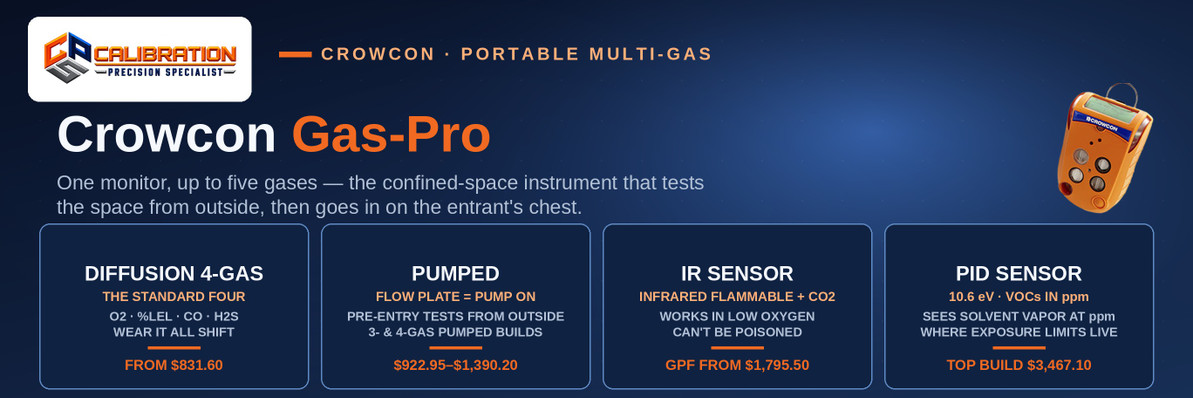
The Crowcon Gas-Pro is a portable multi-gas detector that monitors up to five gases at once: the standard four — oxygen, flammable gas in %LEL, carbon monoxide, and hydrogen sulfide — plus a fifth channel that can be an infrared sensor for flammables or CO₂, or a PID that reads volatile organic compounds in ppm. It runs in diffusion mode or with an internal pump that switches on when you clip on its flow plate, which is what makes it a confined-space instrument: test the space from outside, then wear the same monitor in. At CPS, Gas-Pro configurations run from $831.60 for a 4-gas diffusion unit to $3,467.10 for the 5-gas IR and PID builds.
Crowcon designed the Gas-Pro for industrial environments and fleet managers, and it shows in the decisions they made: a top-mount display you read at a glance while it's clipped to your chest, a single button, and a housing that is independently tested to IP65 and IP67. It is bigger than a personal 4-gas monitor — 309 g in 4-gas form, 333 g as a 5-gas, and up to 362 g pumped — because it is carrying more: a fifth sensor, a pump, and the battery to run both for a full shift (over 14 hours, 13 with the pump running). This spotlight walks the sensor lineup, the pumped-versus-diffusion question, the configurations CPS sells and what they cost, and where the Gas-Pro is honestly the wrong tool.
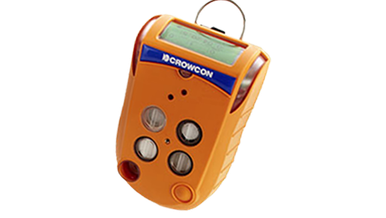
Crowcon Gas-Pro Portable Multi-Gas Detector
Crowcon Gas-Pro: up to 5 gases in one pumped monitor — diffusion, pumped, IR and PID configurations, what each build costs at CPS, and who needs one on site.
$718.64–$3,467.10 configured
See the Gas-ProWhat Is the Crowcon Gas-Pro?
The Gas-Pro is Crowcon's five-gas portable. Its core configuration is the standard four gases every confined-space program runs on — O₂, %LEL, CO, and H₂S — and its defining feature is the fifth sensor bay. Depending on the build, that bay holds:
- An infrared (IR) sensor for flammable gas or carbon dioxide.
- A PID sensor for volatile organic compounds.
- A second toxic sensor — the CPS configurations pair gases like chlorine, ammonia, ozone, sulfur dioxide, nitric oxide, nitrogen dioxide, and chlorine dioxide with the core set.
| Specification | Crowcon Gas-Pro |
|---|---|
| Size | 43 × 130 × 84 mm (1.7 × 5.1 × 3.3 in) |
| Weight | 309 g (4-gas) · 333 g (5-gas) · 340 g / 362 g pumped |
| Battery | Rechargeable Li-ion — over 14 hours (13 hours pumped); typical charge 7.5 hours |
| Alarms | Audible over 95 dB, dual red/blue LEDs, vibrating |
| Display | Top-mount, dual-colour backlight |
| Data logging | 125 hours at 10-second intervals (45,000 logs) |
| Event logging | 1,000 events — alarms, calibration, bump tests, on/off, TWA |
| Operating temperature | −20 °C to +55 °C (−4 °F to +131 °F) |
| Ingress protection | Independently tested to IP65 and IP67 |
| Approvals | ATEX and IECEx (Ex d ia IIC T4 Gb), UL Class 1 Division 1 Groups A, B, C, D, INMETRO, MED |
Who Is the Gas-Pro For?
Three buyers, mainly. Confined-space crews who need one instrument that does the pumped pre-entry test and then goes in on the entrant's chest. Plant and chemical operators whose hazard list runs past the standard four — a chlorine or ammonia risk, solvent vapors, CO₂ accumulation — and who need the fifth channel to be a real sensor, not a second instrument. And fleet managers standardizing on one platform: the Gas-Pro logs 125 hours of readings and 1,000 events, carries bump and calibration reminders, and shows its compliance state on Crowcon's +ve Safety indicator, a tri-colour status light covering bump test, calibration, over-range, and recent alarms that a supervisor can read from across the room.
If your work is the standard four gases, worn all shift, every shift, a dedicated personal 4-gas monitor is smaller and cheaper — that's the Crowcon T4's job, and we'll say so again in the limits section below. The Gas-Pro earns its size when the fifth gas or the pump is the point.
The Sensor Lineup — and Why Each Option Exists
The standard four
Oxygen (0–25% vol), flammable gas (0–100% LEL), carbon monoxide (0–500 ppm in the standard build, with 0–2,000 ppm and hydrogen-filtered versions), and hydrogen sulfide (0–100 ppm). Every Gas-Pro configuration CPS sells includes O₂ and %LEL; the toxic channels are where the builds diverge.
Why an infrared flammable sensor?
A catalytic (pellistor) LEL sensor burns gas on a bead, which means it needs oxygen to work and can be poisoned by silicones and other contaminants. An IR sensor measures gas by light absorption at two wavelengths, so it works in low-oxygen and inert atmospheres where a pellistor reads nothing, it cannot be poisoned, and Crowcon rates it fail-safe with a long lifespan and very low maintenance. The same IR technology reads CO₂ (0–5% vol) — the fifth channel on many brewery, winery, and food-and-beverage builds. The trade is price: IR builds sit at the top of the Gas-Pro range.
Why a PID?
Because exposure hazards live at concentrations an LEL sensor cannot see. A PID ionizes vapor molecules with a 10.6 eV ultraviolet lamp and reads volatile organic compounds in ppm — the scale where solvent exposure limits sit. Crowcon points the Gas-Pro PID squarely at chemical plants and tank work involving solvents, and at aviation wing-tank entry. The blind spot runs the other way: a 10.6 eV PID cannot detect methane at all, so a PID never replaces the LEL channel — it complements it. We work that comparison in full in PID vs. LEL for VOC Detection. One ownership note: the PID lamp is a consumable part — Crowcon sells a cleaning kit and the replacement PID-A1 sensor — so budget lamp care into a PID build's running costs.
The dual-toxic and specialty builds
Several CPS configurations pair two toxics — a dual CO + H₂S channel alongside O₂, IR flammable, and PID — or dedicate the fifth channel to a single aggressive gas: Cl₂, NH₃, O₃, SO₂, NO, NO₂, or ClO₂. These are the builds for water and wastewater treatment (chlorine, ozone, chlorine dioxide), cold storage and fertilizer (ammonia), and combustion-adjacent work (NO, NO₂, SO₂).
Pumped or Diffusion? The Flow Plate Decides
Most pumped monitors are a separate SKU decision: buy the pumped version or the diffusion version. The Gas-Pro's pump is internal and optional in use — clip on the pumped flow plate and the pump activates; take it off and the unit is a diffusion monitor. One instrument does the pre-entry draw and then rides in on the entrant.
That matters because the two modes answer different questions. Diffusion is the right mode for a worn personal monitor: no pump power, no flow path to block, the sensor reads the air at the wearer's chest. Pumped sampling is how you test a space nobody has entered yet — and the only defensible way to clear a confined space before entry. Our Pumped vs. Diffusion comparison works through when each mode wins; the Gas-Pro's answer is that you don't have to pick a side at purchase time. The battery cost of the pump is modest: over 14 hours diffusion, 13 hours pumped.
The Gas-Pro in Confined-Space Work
Confined-space entry is the Gas-Pro's design brief — Crowcon built specific features for it:
- Pre-entry checks from outside. With the flow plate on, the attendant draws a sample from the space before anyone enters — oxygen first, then flammables, then toxics, at every level of the space.
- A pre-entry check function that is recorded in the event log, so the check is traceable afterward — proof it was carried out before entry, not a claim that it was.
- +ve Safety indication. The tri-colour status light shows bump, calibration, over-range, and recent-alarm state visibly to the attendant and supervisor, not just the wearer.
What counts as a confined space, and when a space becomes permit-required, decides whether this workflow is mandatory or just smart — we lay out OSHA's three tests and four permit triggers in What Is a Confined Space?
Configurations and Prices at CPS
CPS sells 22 standard Gas-Pro configurations at list price. They fall into four families:
| Family | What it is | List price |
|---|---|---|
| GPA — 4-gas diffusion | O₂/CO/H₂S/CH₄, no flow plate | $831.60–$870.45 |
| GPB — 4-gas diffusion with flow plate | The same four gases, flow plate included | $864.15–$901.95 |
| GPC — pumped | 3-gas (LEL/O₂/CO or LEL/O₂/H₂S) and 4-gas pumped builds with flow plate, including a hydrogen-filtered CO version for steel-plant work | $922.95–$1,390.20 |
| GPF — 5-gas IR + PID | Five-gas builds pairing an IR flammable channel and PID with a named fifth toxic (Cl₂, NH₃, O₃, SO₂, NO, NO₂, ClO₂, dual CO+H₂S, and CO/H₂S range variants) | $1,795.50–$3,467.10 |
Two honest notes on that table. First, the spread from $831.60 to $3,467.10 is sensor technology, not trim: a PID sensor and an IR sensor each cost more than the electrochemical cells in a diffusion 4-gas unit, and the GPF builds carry both. Second, these 22 are the standard configurations — Crowcon's factory configurator offers 1,800+ Gas-Pro gas combinations, and CPS can order configured builds on request. See the Crowcon Gas-Pro listing for the live configuration list.
The Honest Limits
- It is not a personal-monitor featherweight. At 309–362 g and 130 mm tall, the Gas-Pro is noticeably bigger on a chest than a 4-gas personal unit like the T4. If nobody on your crew needs a fifth gas or a pump, that size buys you nothing.
- The pump costs an hour. 13 hours pumped against over 14 diffusion is a fair trade, but on multi-shift entries the charging plan (7.5-hour typical charge) needs thinking through.
- PID ownership is real ownership. The lamp needs cleaning and eventual replacement, high humidity and lamp fouling shift PID readings, and a PID reading is total ionizable vapor — it does not name the compound.
- IR can't see hydrogen. Infrared flammable sensors don't respond to hydrogen; if H₂ is your flammable risk, the catalytic builds are the right ones. Ask us before you spec the IR channel for a hydrogen application.
Calibration and Bump Testing
Five channels means five chances to drift, and the Gas-Pro is built to be tested as a system: bump and calibration reminders on the instrument, a 1,000-event log that records calibrations and bump tests alongside alarms, and Crowcon's Q-Test station for automated bump and calibration checks on the bench. CPS calibrates every channel on the Gas-Pro — including PID span checks on isobutylene and IR channel verification — and a calibration certificate is the document that makes the event log's story hold up after an incident.
Frequently Asked Questions
How many gases can the Crowcon Gas-Pro detect? Up to five at once. Every configuration carries oxygen and a flammable channel; the CPS range adds carbon monoxide and hydrogen sulfide for the standard four, and the fifth channel can be an infrared flammable or CO₂ sensor, a PID for VOCs, or a specialty toxic such as chlorine, ammonia, ozone, sulfur dioxide, nitric oxide, nitrogen dioxide, or chlorine dioxide.
What does the Crowcon Gas-Pro cost? At CPS, $831.60 to $3,467.10 at list, depending on configuration. The 4-gas diffusion builds are $831.60–$901.95, pumped 3- and 4-gas builds are $922.95–$1,390.20, and the 5-gas infrared + PID builds run $1,795.50–$3,467.10. The spread is sensor technology: PID and IR sensors cost substantially more than electrochemical cells.
Is the Crowcon Gas-Pro pumped or diffusion? Both. The pump is internal and activates when the pumped flow plate is clipped on; remove the flow plate and the same unit works as a diffusion monitor. That is the Gas-Pro's central design decision — one instrument for the pre-entry pumped test and for wear inside the space.
Can the Gas-Pro detect VOCs? Yes — the GPF configurations carry a PID sensor with a 10.6 eV lamp that reads volatile organic compounds in ppm (0–1,000 ppm on Crowcon's datasheet). That is the exposure scale where solvent limits live. A PID cannot detect methane, so VOC builds keep a separate flammable channel — IR on the CPS GPF configurations.
Why choose the infrared sensor over a catalytic LEL sensor? Three reasons: an IR sensor works in low-oxygen and inert atmospheres where a catalytic sensor cannot burn gas; it cannot be poisoned by silicones and similar contaminants; and it is fail-safe with a long lifespan and low maintenance, per Crowcon. The counterweights are price — IR builds sit at the top of the range — and hydrogen, which IR flammable sensors cannot detect.
How long does the Gas-Pro battery last? Over 14 hours on a charge in diffusion use, and 13 hours with the pump running, from a rechargeable lithium-ion pack. A typical full charge takes 7.5 hours. Those are Crowcon's published figures for a CH₄/O₂/H₂S/CO configuration; heavy alarm time shortens any detector's day.
Is the Crowcon Gas-Pro intrinsically safe? Yes. It carries ATEX and IECEx certification (Ex d ia IIC T4 Gb), UL approval for Class 1, Division 1, Groups A, B, C, and D hazardous locations, plus INMETRO and MED (marine) approvals. The CPS configurations are the North American UL versions.
Can the Gas-Pro be used for confined-space pre-entry testing? Yes — that is its design brief. With the flow plate fitted, the internal pump draws a sample from the unentered space; Crowcon's pre-entry check function records the check in the event log, and the +ve Safety indicator shows the instrument's bump, calibration, and alarm status to the attendant before anyone goes in.
What fifth gases can the Gas-Pro measure? In the CPS range: chlorine (Cl₂), ammonia (NH₃), ozone (O₃), sulfur dioxide (SO₂), nitric oxide (NO), nitrogen dioxide (NO₂), and chlorine dioxide (ClO₂), plus dual CO + H₂S and extended-range CO and H₂S variants — each paired with oxygen, an IR flammable channel, and a PID. Crowcon's factory configurator covers 1,800+ combinations beyond the standard list.
How is the Gas-Pro calibrated? With calibration gas across every installed channel — a PID channel spans on isobutylene, the flammable channel on its target gas — after a fresh-air zero. Crowcon's Q-Test station automates bump tests and calibration on the bench, and the instrument logs both in its 1,000-event memory. CPS calibrates every channel on the Gas-Pro and issues the certificate; see our calibration services page for ship-in and on-site options.
The Bottom Line
The Gas-Pro is the monitor for the buyer whose hazard list outgrew a 4-gas personal unit: a fifth gas that matters, a pre-entry test that has to happen before entry, or VOCs that only a PID can see. Its flow-plate pump makes one instrument cover both halves of confined-space work, and its logging and status indication make the compliance story provable afterward. If your work is the standard four gases and nothing else, buy the smaller monitor and save the money — if it isn't, this is the Crowcon built for you.
Not sure which Gas-Pro configuration matches your hazard list? Call 865-900-8844 or reach us through Contact Us. CPS Calibrations · 109 S. Front Street, Rockwood, TN 37854 · Calibration Gas · Calibration Services
CPS Calibrations · 109 S. Front Street, Rockwood, TN 37854 · Calibration Gas · Calibration Services · Contact Us
Need a calibration you can file?
In-house calibration at CPS in Rockwood, Tennessee — $55 for single-gas instruments, $90 for 4- and 5-gas — every channel, as-found and as-left data, full certificate.
See Calibration Servicesor call 865-900-8844
Recent Posts
-

What Is Remote Monitoring for Fixed Gas Detection?
Remote monitoring for fixed gas detection means a fixed system's live readings, trends, and alarm hi …Nov 23rd 2026 -

What Are the Key Differences Between the GX-6000 and GX-6100?
The RKI GX-6100 is the current replacement for the discontinued GX-6000: both are pumped 6-gas monit …Nov 22nd 2026 -

How to Read a PID Correction Factor Chart
To read a PID correction factor chart, find your vapor’s row, take the factor under your own lamp en …Nov 21st 2026