
Crowcon IR Plus: Infrared Methane Detection With SIL 2-Capable Builds
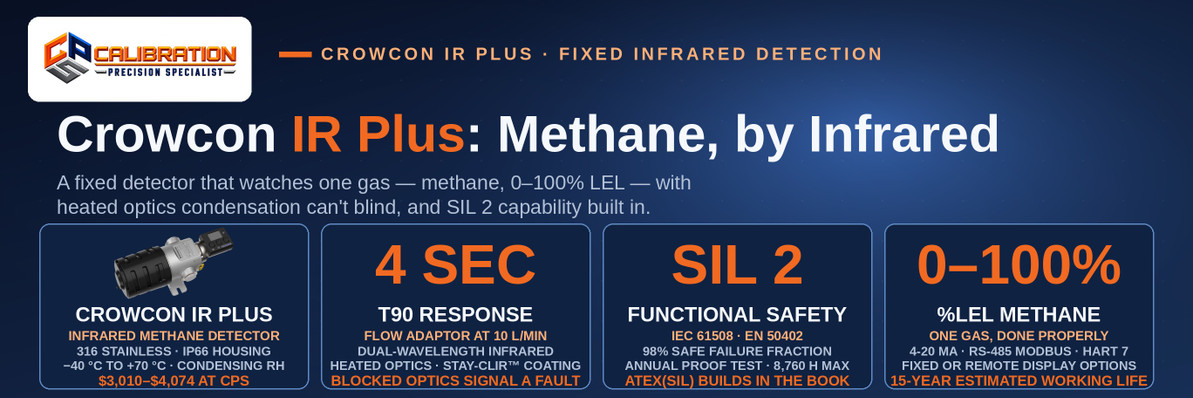
The Crowcon IR Plus is a fixed infrared gas detector that measures methane from 0 to 100% LEL in a 316 stainless steel, IP66 housing, using dual-wavelength infrared optics with an intelligent heater and a hydrophobic STAY-CLIR coating so condensation cannot blind it. Crowcon's manual gives it a T90 response of 4 seconds under flow-adaptor test conditions, rates it for −40 °C to +70 °C in 0–100% condensing humidity, and publishes functional safety data at SIL capability SIL 2 to IEC 61508 and EN 50402. CPS sells the IR Plus in 23 ATEX-certified configurations at $3,010–$4,074, configured by cable-entry thread (M20 or 3/4" NPT), output (4-20 mA sink, HART-sink, or source, with RS-485 Modbus standard), and display — including builds Crowcon's price book codes ATEX(SIL).
Fixed methane detection is usually bought one of two ways: a general-purpose infrared detector configured for whichever gas is on site, or a catalytic pellistor that needs oxygen to work and can be poisoned into silence. The IR Plus is a third answer — an infrared detector dedicated to methane, with heated optics for wet, condensing locations and published functional-safety data for plants that run safety instrumented systems. Here is how it works, what CPS's 23 configurations actually change, how it differs from Crowcon's broader IRmax, and where its limits sit.
What the IR Plus Is
The IR Plus is a flameproof (Ex d) point detector for Zone 1 and Zone 2 hazardous areas, built for continuous monitoring of methane around compressors, gas storage and distribution, offshore and marine installations, and process plants — the places methane is produced, moved, or burned. Crowcon builds the body from 316 stainless steel, seals it to IP66, and gives it an estimated working life of 15 years, assuming an annual proof test. It draws less than 5.5 W from a 12–30 VDC supply, so it drops onto the same 24 V loops as the rest of a fixed system, and up to 32 detectors can share an RS-485 Modbus network.
Unlike a pellistor, the infrared sensor has no catalyst to poison, does not need oxygen in the sample to measure, and is not damaged by the high gas concentrations that can burn out a catalytic bead. Unlike a cheaper semiconductor sensor, it measures one thing specifically — infrared absorption at methane's wavelengths — so humidity swings and background vapors don't move the reading.
How the Infrared Measurement Works
Hydrocarbon gases absorb infrared light at characteristic wavelengths. The IR Plus shines infrared through a compact diffusion gas chamber and measures absorption at a wavelength methane absorbs, against a second reference wavelength it does not. The difference between the two channels is the gas concentration; dirt or aging that affects both channels equally cancels out. That dual-wavelength design is why the reading stays stable for years instead of drifting the way catalytic sensors do.
The weak point of any optical detector is the optics themselves: condensation on a window or mirror scatters the beam and, in lesser designs, faults or blinds the detector. Crowcon attacks that directly — the IR Plus name for it is "intelligent heated optics." An intelligent heater holds the optical components above the dew point, and the optics carry a hydrophobic STAY-CLIR coating to shed moisture. Crowcon rates the detector for 0–100% relative humidity, condensing — the rating that matters in compressor houses, wastewater plants, and offshore air. If the optical path does become obscured anyway, the detector says so rather than guessing: at 75–90% obscuration it drives a 2 mA warning signal, and at 90% or more it drops to a fault output of 1.0 mA or less. Blocked optics announce themselves; they never read as clean air.
The weatherproof cap is shaped using flow modelling so gas reaches the chamber quickly — and so test gas can be applied for calibration and proof tests without fitting a separate test cap.
Specifications That Matter
| Specification | IR Plus (per Crowcon's manual) |
|---|---|
| Gas (CPS configurations) | Methane (CH₄) |
| Range | 0–100% LEL |
| Response time | T90 4 seconds (flow adaptor, 10 l/min); 27 seconds at 1 l/min |
| Sensor principle | Dual-wavelength infrared, intelligent heated optics, STAY-CLIR hydrophobic coating |
| Enclosure | 316 stainless steel, 194 × 119 × 94.2 mm, 4.1 kg (4.5 kg with fixed display) |
| Ingress protection | IP66 |
| Operating temperature | −40 °C to +70 °C (−40 °F to 158 °F) |
| Humidity | 0–100% RH, condensing |
| Outputs | 3-wire 4-20 mA (sink or source), RS-485 Modbus standard, HART 7 optional |
| Fault signalling | <3.6 mA or >21 mA; 2 mA obscuration warning |
| Power | 12–30 VDC, <5.5 W |
| Certification (CPS builds) | ATEX II 2 G/D Ex db IIC T4/T6 — ATEX only, no UL/CSA build |
| Functional safety | SIL capability SIL 2 (IEC 61508, EN 50402); SFF 98%; annual proof test |
| Estimated working life | 15 years (assumes annual proof test) |
Crowcon also performance-certifies the detector to IEC EN 60079-29-1. One installation note from the manual worth knowing before you mount one: the detector must be mounted horizontally (±15°), and with the heaters enabled it needs a 2-hour warm-up before it is fully in specification.
The 23 Configurations, in Plain Terms
Every IR Plus CPS sells measures the same gas over the same range in the same housing. The $3,010–$4,074 spread comes from three choices:
- Cable-entry thread — M20 or 3/4" NPT. Pick the one that matches the conduit and glands your site already uses; the 3/4" NPT option matters on North American-style installs even though the certification is European.
- Certification block — standard ATEX, or the builds Crowcon's book codes ATEX(SIL): the configurations ordered for functional-safety service, matching the SIL 2 capability data published in Crowcon's manual.
- Output and display — the analogue output is configured as 4-20 mA sink, HART over sink, or source; RS-485 Modbus is standard on the platform. A display is the big price step: a fitted display adds roughly $805–$924 depending on build, and an IS barrier module build supports a remote display mounted away from the detector. A display fitted at the factory cannot be retrofitted later — detectors supplied without one are certified differently — so decide during specification, not after installation.
Base builds without a display start at $3,010. The top of the range, $4,074, is a HART build with the display package fitted.
IR Plus vs. IRmax: Which Infrared Detector?
Crowcon sells two fixed infrared detector families, and they split the work cleanly. The Crowcon IRmax is the generalist: CPS's book carries 216 IRmax configurations across 27 flammable gases — propane, butane, LPG, solvent vapours and more, all at 0–100% LEL — from $2,591. The IR Plus is the specialist: methane only, in a heated-optics package built for condensing environments, with the display and IS-barrier options and the SIL-coded builds.
Choose the IRmax when the hazard list runs past methane, or when the budget has to cover a lot of points. Choose the IR Plus when the hazard is methane specifically, the location is wet or condensing, the detector feeds a safety instrumented function, or a local/remote display matters. Neither one sees hydrogen — no infrared detector can — so a hydrogen hazard needs a different sensor technology entirely. And if the real question is whether a fixed point detector is the right geometry at all, our comparison of open-path vs. point gas detectors works through that decision.
A Note on IREX, Crowcon's Other Infrared Detector
Older Crowcon installations may still run IREX, the company's "pellistor exchange" infrared detector: a dual-wavelength IR head designed to mimic a pellistor's mV Wheatstone bridge signal, so a legacy pellistor control panel could be upgraded to infrared sensing — for methane, butane, propane and other hydrocarbons — without replacing the controller or the cabling, running from as little as 2.9 Vdc. It was a clever bridge product. In Crowcon's current FY27 price book, though, IREX survives only as spare parts and accessories — mirror kits, sunshades and covers, several shared with the IRmax — and no complete IREX units are listed. CPS does not sell new IREX detectors; sites retiring them land on the IRmax or the IR Plus, depending on the gas list.
The Honest Limits
- Methane only, in CPS trim. The IR Plus platform is a hydrocarbon detector, but every configuration in Crowcon's current book that CPS scoped is methane. For propane, butane or vapours, that's the IRmax's job.
- ATEX only. All 23 builds carry ATEX certification; there is no UL or CSA variant in the book. If your authority having jurisdiction requires a North American listing, say so before ordering — this is not the detector for that paperwork.
- Infrared cannot see hydrogen. Crowcon's manual is blunt: the IR Plus will not detect hydrogen, ammonia or carbon dioxide. Hydrogen service needs a catalytic, electrochemical or MPS-type sensor.
- The 4-second T90 is a test-condition figure. It is measured with a flow adaptor at 10 l/min. At 1 l/min the same manual lists 27 seconds, and in still air a diffusion detector's real-world response depends on gas reaching the chamber. Fast — but mount it where the gas actually goes.
- SIL is a system property. The manual's SIL 2 capability data (98% safe failure fraction, PFDavg 3.79 × 10⁻⁵) supports using the detector inside a SIL 2 safety instrumented function — it does not make any loop "SIL 2" by itself. The detector, the logic solver, the final element and the annual proof test all count. Our post on what SIL means for gas detection explains the levels in plain terms.
Calibration, Proof Testing, and CPS
An infrared detector drifts far less than a catalytic sensor, but it is not a fit-and-forget device. Crowcon's maintenance routine is a zero check in clean air and a span calibration with methane test gas — applied under the weatherproof cap, no test cap needed — and, for functional-safety service, a documented proof test at least once a year: inspect the gas path and wiring, calibrate on zero and span gas, ramp-test the 4-20 mA output, and power-cycle the unit. The 15-year working-life figure assumes that annual proof test happens.
CPS Calibrations supplies, installs and services fixed gas detection — if you're speccing IR Plus points as part of a system, our fixed system installation page covers how we handle turnkey work, and our calibration services cover the ongoing proof-test and calibration programme that keeps a SIL loop's paperwork honest. Call us at 865-900-8844 or visit us at 109 S. Front Street, Rockwood, TN 37854 — we'll help you work out whether the hazard in front of you is an IR Plus point, an IRmax point, or something else entirely.
Frequently Asked Questions
What gas does the Crowcon IR Plus detect?
In the configurations CPS sells, methane (CH₄) only, measured from 0 to 100% LEL by dual-wavelength infrared absorption. Every one of the 23 builds in Crowcon's current price book is a methane build; sites that need propane, butane, LPG or solvent vapours should look at Crowcon's IRmax instead.
How much does a Crowcon IR Plus cost?
CPS prices the IR Plus from $3,010 to $4,074 depending on configuration. The variables are the cable-entry thread (M20 or 3/4" NPT), the output (4-20 mA sink, HART-sink or source), the certification block (standard ATEX or the ATEX(SIL) builds), and the display — a fitted display adds roughly $805–$924 over the equivalent blind build.
Is the Crowcon IR Plus SIL 2 certified?
Crowcon's IR Plus manual publishes the functional safety data with SIL capability listed as SIL 2, assessed to IEC 61508 and EN 50402 — a 98% safe failure fraction, 98% diagnostic coverage, and a proof test interval of at most 8,760 hours (one year). In Crowcon's price book, the builds intended for that service are coded ATEX(SIL). SIL applies to the whole safety loop, not the detector alone, but the IR Plus brings certified capability data to it.
How fast is the IR Plus?
Crowcon specifies a T90 response time of 4 seconds with a flow adaptor at 10 l/min, and 27 seconds at 1 l/min. In still air, real-world response depends on how quickly gas reaches the diffusion chamber, which is why placement — high, for lighter-than-air methane — matters as much as the headline figure.
Does the IR Plus work in condensing humidity?
Yes — that is what it is built for. The optics are intelligently heated and carry a hydrophobic STAY-CLIR coating, and Crowcon rates the detector for 0–100% relative humidity, condensing, across a −40 °C to +70 °C operating range. If the optics ever do become obscured, the detector signals a warning at 2 mA rather than silently under-reading.
Can the IR Plus detect hydrogen?
No. Crowcon's manual states plainly that the IR Plus will not detect hydrogen, ammonia or carbon dioxide — hydrogen does not absorb infrared at the measured wavelengths. Hydrogen hazards need a catalytic, electrochemical or molecular-property (MPS) sensor instead.
What outputs does the IR Plus have?
A 3-wire 4-20 mA output configured as sink or source, updated once per second, with RS-485 Modbus as standard and HART 7 as an option. Faults are signalled at less than 3.6 mA or more than 21 mA. Up to 32 detectors can share one Modbus network.
Is the IR Plus UL or CSA approved?
No — not in the configurations CPS sells. All 23 builds in Crowcon's current book are ATEX certified (Ex db IIC T4/T6, Zone 1 and 2), and no UL or CSA variant exists in the book. If your site or insurer requires a North American listing, tell us before ordering so we can point you at a detector that carries one.
What is the difference between the IR Plus and the IRmax?
Breadth versus focus. The IRmax covers 27 flammable gases in 216 CPS configurations from $2,591 — the general-purpose infrared detector. The IR Plus covers methane only, and spends its money on heated optics for condensing environments, display and remote-display options, and builds coded for functional-safety service. Pick by your gas list first, then by environment.
How long does an IR Plus last, and what maintenance does it need?
Crowcon estimates a 15-year working life, assuming an annual proof test. Routine care is a zero and span calibration with methane gas — applied under the weatherproof cap, no test cap required — plus cleaning or, if damaged, replacing the mirror, after which the detector must be re-zeroed and recalibrated. There is no sensor element to swap out on a 2–3 year cycle the way a pellistor demands.
The Bottom Line
The IR Plus is what you buy when the hazard is specifically methane, the location is wet, hot, cold or condensing, and the detector may have to stand up inside a functional-safety case. Heated dual-wavelength optics, a 4-second T90 under test conditions, IP66 stainless construction, Modbus and HART options, and published SIL 2 capability data — at $3,010–$4,074 in CPS trim, with ATEX-only certification as the one paperwork limit to plan around. If your gas list is longer than methane, start with the IRmax; if it is exactly methane, start here. Call CPS Calibrations at 865-900-8844 and we'll spec the build — thread, output, display and certification block — against your panel and your hazardous-area paperwork.
Need a calibration you can file?
In-house calibration at CPS in Rockwood, Tennessee — $55 for single-gas instruments, $90 for 4- and 5-gas — every channel, as-found and as-left data, full certificate.
See Calibration Servicesor call 865-900-8844
Recent Posts
-
Can You Add a Pump to a SENKO SGT-P or MGT?
Yes — SENKO's SP-Pump101 external sampling pump ($330, part AAA006000) fits the SGT, SGT-P, and MGT, …Nov 12th 2026 -

What Refrigerant Detection Does a Grocery Store Need?
A grocery store needs refrigerant detection in three places: low-mounted carbon dioxide (R-744) sens …Nov 11th 2026 -

What Is LEL and UEL? The Explosive Range, Gas by Gas
The LEL is the lowest concentration of a gas in air that can explode, and the UEL is the highest: me …Nov 10th 2026