
Crowcon IRmax: The Infrared Fixed Detector for Flammable Gas
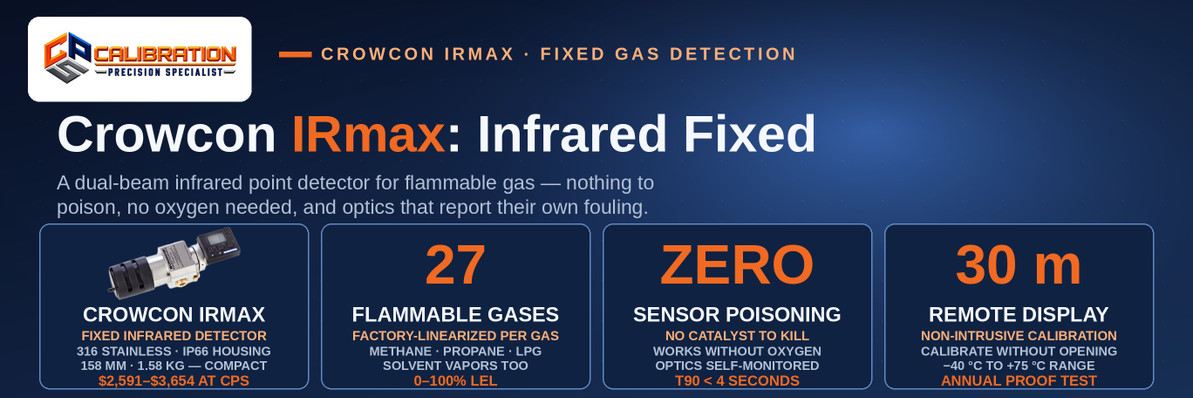
The Crowcon IRmax is a fixed point gas detector that measures flammable gas with a dual-beam infrared sensor instead of a catalytic bead — so it cannot be poisoned by silicones or H₂S, it does not need oxygen in the air to make a reading, and its optics monitor themselves, signalling a warning at 75% obscuration and a fault before they go blind. It responds in under 4 seconds (T90), runs from −40 °C to +75 °C in a 316 stainless steel IP66 housing, and Crowcon linearizes it for the specific gas it will watch — CPS configures it for 27 flammable gases and vapors at 0–100% LEL, at list prices from $2,591 to $3,654. One fact to know before anything else: every IRmax is ATEX and IECEx certified, and there is no UL version — this detector is built to the European certification system, full stop.
An IRmax is what you spec when the flammable-gas point has to keep telling the truth for years in a place that eats ordinary sensors — a compressor station, a tank farm, a loading rack, the cold end of a plant where a pellistor's bead ages fast and nobody wants to climb to it monthly. Here is how the infrared principle works, why it changes the cost of owning the point, how CPS's 216 configurations are put together, and where the IRmax is honestly the wrong tool.
What the IRmax Is
The IRmax is Crowcon's compact fixed detector for hydrocarbon gases and vapors, built around a dual-beam infrared sensor in a 316 stainless steel enclosure just 158 × 75 × 57 mm (6.2 × 2.9 × 2.3 in) and 1.58 kg (3.5 lb) — small and light for an infrared point detector, which matters on crowded pipe racks and retrofit brackets. It is certified for Zone 1 and 2 (and dust Zone 21 and 22) hazardous areas under ATEX and IECEx, carries an IEC 61508 SIL 2 functional-safety rating, and meets the EN 60079-29-1 performance standard for flammable-gas detectors.
Output is the industry-standard 4-20 mA, source or sink, so the IRmax drops into virtually any control system, gas panel, or PLC. Options add RS-485 Modbus (up to 32 detectors multi-dropped on one addressable network, over distances up to 1 km) or HART 7 communications superimposed on the 4-20 mA line. It runs on 12–30 Vdc and consumes less than 1 W — Crowcon puts it at typically 75–90% lower power than conventional infrared detectors, because there are no heated optics to feed. On a large system, that means smaller power supplies, smaller battery backup, and longer cable runs.
The Infrared Principle, Explained
### What a pellistor does — and how it dies
A catalytic (pellistor) sensor burns a tiny amount of the target gas on a heated bead and measures the heat. Three weaknesses come with that design. It needs oxygen to burn anything — in an inerted or oxygen-depleted atmosphere, a pellistor under-reads or stops responding even though flammable gas is present. It reads most accurately the one gas it was calibrated on; other gases need correction factors. And its catalyst can be poisoned — silicones, lead compounds, and heavy H₂S exposure permanently destroy sensitivity, and as our guide to sensor poisoning explains, the failure is silent: the detector looks healthy and reads clean air until a bump test or calibration catches it.
### What infrared does instead
Hydrocarbon molecules absorb infrared light at characteristic wavelengths. The IRmax shines infrared through a sample chamber on two beams — one at a wavelength the gas absorbs, one reference wavelength it does not — and infers gas concentration from how much light the gas took out of the measuring beam. Nothing is burned, nothing is consumed, and no chemistry happens on a catalyst:
- No poisoning. There is no catalyst for silicones or H₂S to attack. The exposures that kill pellistors are non-events for an IR sensor, which is the single biggest reason infrared wins the total-cost argument below.
- No oxygen required. Absorption works in nitrogen-blanketed, inerted, or oxygen-depleted atmospheres where a catalytic sensor cannot be trusted — tank interiors, inerted process areas, and enclosed spaces being purged.
- Fail-safe by design. The detector continuously monitors how much light is getting through. Dirt, condensation, or an obstruction raises the obscuration level, and the IRmax reports it on the 4-20 mA loop: 2 mA signals a dirty-optics warning (at 75% obscuration, configurable), and 0 mA signals a detector fault (at 90%). A failing pellistor drifts toward reading zero gas; a fogging IR detector announces itself before it can lie to you.
- No heated optics. Conventional IR detectors heat their windows and mirrors to stop condensation faults. Crowcon instead treats the optical components with a hydrophobic coating it calls STAY-CLIR, which prevents condensation faults without heater power — that is where the sub-1 W consumption comes from.
The trade for all this is focus: the IRmax is factory-linearized for one target gas. Its published accuracy is ±2% of reading and zero drift is at most ±2% of full scale per year — figures a pellistor cannot match over time — but the detector is a specialist, set up for methane, or propane, or hexane vapor, not a generalist that guesses at mixtures.
Infrared vs. Pellistor: The Ownership Math
The IRmax costs more than a catalytic fixed detector on the purchase order. The comparison that matters is over the detector's working life:
| Catalytic (pellistor) fixed detector | Crowcon IRmax (infrared) | |
|---|---|---|
| Sensor life | The bead is a consumable — sensitivity fades, and poisoning can end it without warning | No sensor element to consume or poison |
| Poisoning risk | Silicones, lead, high H₂S permanently kill sensitivity, silently | Immune — no catalyst |
| Oxygen needed? | Yes — under-reads in low-oxygen or inerted atmospheres | No — absorption works in inert atmospheres |
| Failure behaviour | Fails toward a false "clean air" reading | Announces dirty optics at 2 mA, faults at 0 mA |
| Calibration burden | Frequent calibration to catch drift and dying beads | Crowcon specifies an annual proof-test interval; zero drift ≤ ±2% FSD/year |
| Power | Modest | Under 1 W — smaller PSUs and battery backup across a system |
| Up-front price | Lower | Higher — CPS list $2,591–$3,654 configured |
Every poisoned bead is a sensor replacement, a site visit, and — the part nobody prices — the interval during which the point was blind and didn't say so. Stretch the calibration burden to an annual proof test, delete the replacement-sensor line, and the IRmax's premium is usually recovered in the first maintenance cycle or two at any site where access is expensive or the atmosphere is hard on catalysts.
Configurations and Prices at CPS
CPS sells the IRmax as one product configured four ways, across 216 complete units at list prices from $2,591 to $3,654:
- Gas (27 choices). Methane, propane, butane, LPG, pentane, hexane, heptane, octane, ethane, ethylene, propylene, butene, butadiene, cyclohexane, petrol vapour, and solvent vapors including acetone, ethanol, methanol, toluene, xylene, THF, and ethyl acetate — every one ranged 0–100% LEL, with methane also available in 0–20% and 0–50% LEL ranges for applications that alarm early.
- Cable entry thread. M20 or ½" NPT gland entry — pick the one your conduit system uses.
- Output. 4-20 mA in source or sink wiring; RS-485 Modbus versions of either; or HART versions of either, for plants that manage devices with HART communicators or asset software.
- Display. No display (the lowest-cost build, read at the panel); a display fitted to the detector; display plus HART; an IS barrier module build, which pairs with Crowcon's hand-held intrinsically safe calibrator; or a display-ready build you can add the display to later.
Tell us the gas, the thread standard on site, what the signal lands on, and whether anyone needs to read the detector at the detector, and the configuration picks itself.
Displays, Remote Checking, and Calibration Without Opening
Fixed detectors tend to live where people shouldn't linger — high on columns, inside enclosures, out on pipe bridges. Crowcon's display strategy for the IRmax is built around not going up there:
- Fitted IR Display. A 4-digit backlit LCD mounted on the detector shows gas level, obscuration level, supply voltage, and signal current, with red (gas), amber (fault), and green (healthy) status LEDs. Zero, calibration, and output-trim functions sit behind a password, and the display's buttons can be deactivated so the detector can't be casually adjusted.
- Remote IR Display. The same display can be mounted up to 30 metres (about 100 feet) from the detector and cabled back to it — at eye level, outside the nasty area — while the detector stays at the leak source. Checking, interrogating, and calibrating happen from the display.
- Calibration without opening, and without direct access. With a display fitted or remote, calibration is non-intrusive: nothing on the detector is opened in the hazardous area. Crowcon's weatherproof cap design also lets test gas be applied for checking and calibration without a special calibration cap and without requiring direct access to the detector itself — the remote gassing arrangement exists precisely for detectors that would otherwise need scaffolding or a cherry picker.
- Hand-held I.S. calibrator. Detectors built with the IS barrier module can be checked and calibrated with Crowcon's intrinsically safe hand-held calibrator — one unit serves a whole fleet of barrier-equipped IRmax detectors.
Put together: the detector goes where the gas will be, the readings and the calibration happen where the people are, and the enclosure stays sealed.
Specifications
| Crowcon IRmax | |
|---|---|
| Sensor | Dual-beam infrared, factory-linearized per gas |
| Gases / range | 27 flammable gases & vapors, 0–100% LEL (methane also 0–20% / 0–50% LEL) |
| Response | T90 < 4 seconds |
| Accuracy / drift | ±2% of reading · zero drift ≤ ±2% FSD per year |
| Enclosure | 316 stainless steel, IP66 |
| Size / weight | 158 × 75 × 57 mm (6.2 × 2.9 × 2.3 in) / 1.58 kg (3.5 lb) |
| Power | 12–30 Vdc, < 1 W |
| Outputs | 4-20 mA source or sink · 2 mA dirty-optics warning · 0 mA fault · optional RS-485 Modbus · optional HART 7 |
| Operating range | −40 °C to +75 °C (−40 °F to +167 °F) · 0–100% RH non-condensing |
| Approvals | ATEX & IECEx: Ex II 2 GD Exd IIC T6 Gb / T4 · dust Ex tb IIIC T135 °C Db · Zone 1 & 2, Zone 21 & 22 · SIL 2 (IEC 61508) · EN 60079-29-1 |
| Display options | None · fitted IR Display · remote IR Display (up to 30 m) · IS barrier module for hand-held I.S. calibrator |
| Cable entry | One M20 or ½" NPT gland entry |
The Honest Limits
- ATEX only — there is no UL version. Every IRmax in Crowcon's book is ATEX/IECEx certified. If your authority having jurisdiction, your insurer, or your company's own standards require UL- or CSA-listed equipment at that point, the IRmax cannot answer — no matter how good the sensing is. (Some configurations of Crowcon's Xgard line do carry UL/cUL approval; ask and we'll steer you to the listing that satisfies your paperwork.) Where ATEX/IECEx equipment is accepted — much of the world's process industry runs on it — this is a non-issue, but it has to be settled before the purchase order, not at inspection.
- Infrared cannot see hydrogen. Hydrogen has no infrared absorption signature at these wavelengths, and it is not on the IRmax's gas list — full stop. If hydrogen is your flammable risk, you need a catalytic or electrochemical measurement; in Crowcon's fixed line that points to the pellistor versions of the Xgard.
- One gas per detector. Each IRmax is linearized for its target gas. A point watching a mixed-vapor area reads the gas it was set up for; mixed or changing vapors are a conversation about placement and expectations, not a setting.
- It is a flammable detector, not a toxic one. 0–100% LEL tells you how close the atmosphere is to exploding, nothing about ppm-level toxic exposure. Toxic and oxygen points still need their own detectors beside it.
- Optics need a reasonably clean line of sight. The obscuration monitoring warns you long before dirt becomes blindness, and STAY-CLIR handles condensation — but a detector buried in coating overspray or mud still needs a wipe on rounds. The difference is that the IRmax tells you it needs one.
Frequently Asked Questions
What is the Crowcon IRmax? The IRmax is Crowcon's fixed point detector for flammable hydrocarbon gases and vapors. Instead of a catalytic bead, it uses a dual-beam infrared sensor in a compact 316 stainless steel, IP66 housing (158 × 75 × 57 mm, 1.58 kg). It outputs 4-20 mA (with optional RS-485 Modbus or HART 7), is SIL 2 rated, and is certified under ATEX and IECEx for Zone 1 and 2 areas — there is no UL version.
How much does the Crowcon IRmax cost? At CPS, configured IRmax detectors run from $2,591 to $3,654 at list. The price moves with the configuration: the target gas (27 choices), M20 or ½" NPT cable entry, the output (4-20 mA source/sink, RS-485, or HART), and the display option (none, fitted, display + HART, IS barrier, or display-ready). 216 complete configurations exist in Crowcon's book; tell us the gas and where the signal lands and we'll quote the exact build.
What gases can the IRmax detect? Flammable hydrocarbon gases and vapors at 0–100% LEL — 27 of them in the configurations CPS sells: methane, ethane, propane, butane, pentane, hexane, heptane, octane, LPG, ethylene, propylene, butene, butadiene, cyclohexane, petrol vapour, and solvent vapors including acetone, ethanol, methanol, toluene, xylene, THF, and ethyl acetate. Methane is also offered in 0–20% and 0–50% LEL ranges. Each detector is factory-linearized for one target gas. Hydrogen is not detectable by infrared — see below.
Can the IRmax detect hydrogen? No. Hydrogen does not absorb infrared at the wavelengths point IR detectors use, so no infrared detector — the IRmax included — can measure it. For fixed hydrogen detection you need a catalytic pellistor or electrochemical sensor; in Crowcon's fixed range, that means a pellistor-equipped Xgard. It is the most important single check on any IRmax application: if H₂ is on your gas list, the IRmax is the wrong detector for that point.
Can an infrared gas detector sensor be poisoned? No — poisoning is a catalytic-sensor failure. Silicones, lead compounds, and heavy H₂S exposure destroy a pellistor bead's catalyst, permanently and silently. An infrared sensor has no catalyst; it measures light absorption, so those exposures do not degrade it. That immunity is the main reason infrared detectors cost less to own over time despite costing more to buy.
Does the IRmax need oxygen in the air to work? No. A catalytic sensor burns gas on its bead and needs oxygen to do it — in inerted, nitrogen-blanketed, or oxygen-depleted atmospheres it under-reads or stops responding. The IRmax measures infrared absorption, which works at any oxygen level, including none. That makes it the right principle for tank farms, inerted process areas, and enclosed spaces under purge.
Is the Crowcon IRmax UL listed? No. Every IRmax is certified under ATEX and IECEx (Ex II 2 GD Exd IIC, for Zone 1 & 2 and dust Zone 21 & 22), with a SIL 2 functional-safety rating — and Crowcon does not offer a UL or CSA version of this detector. If your site's AHJ or insurer requires a North American listing at that point, choose a different detector for it (some Xgard configurations are UL/cUL approved) — and settle the question before ordering, not at inspection.
How often does the IRmax need calibration? Crowcon specifies an annual proof-test interval, and the design supports it: zero drift is at most ±2% of full scale per year, and the optics continuously self-monitor, signalling a 2 mA dirty-optics warning at 75% obscuration and a 0 mA fault at 90% — before dirt can blind it. That is a very different maintenance burden from a catalytic detector, whose calibration visits double as the only way to catch a dying or poisoned bead. CPS calibrates and services fixed systems and can fold IRmax proof tests into your site's schedule.
Can you calibrate the IRmax without opening it? Yes. With an IR Display fitted — or mounted remotely up to 30 metres away — calibration is non-intrusive: the enclosure is never opened in the hazardous area. Crowcon's weatherproof cap also allows test gas to be applied for checking and calibration without a special calibration cap and without direct access to the detector, and detectors built with the IS barrier module can be calibrated with Crowcon's hand-held intrinsically safe calibrator.
What is the difference between the Crowcon IRmax and the IR Plus? Breadth. The IR Plus is Crowcon's infrared fixed detector built around methane only — CPS configures it in 23 builds at $3,010–$4,074, including SIL-rated variants. The IRmax covers 27 flammable gases and vapors in 216 configurations at $2,591–$3,654, with the wider display and communications option set. If the point is methane and nothing else, compare both; if the gas list is longer, the IRmax is the family you want.
The Bottom Line
The IRmax is the fixed flammable-gas point you install when the cost of a wrong answer is high and the cost of access is higher: an infrared sensor that can't be poisoned, doesn't need oxygen, watches its own optics, answers in under four seconds, and asks for a proof test once a year instead of a standing calibration appointment. It works from −40 °C to +75 °C, sips under a watt, and can be checked and calibrated from up to 30 metres away without opening it. Its limits are just as clear: no hydrogen, one gas per detector, flammables only — and ATEX/IECEx certification with no UL version, which your site either accepts or doesn't. If it accepts it, there is very little in its class that owns cheaper.
Working out an infrared point — or want your existing fixed system's calibration handled? Call 865-900-8844 or reach us through Contact Us. CPS Calibrations · 109 S. Front Street, Rockwood, TN 37854 · Calibration Gas · Calibration Services
CPS Calibrations · 109 S. Front Street, Rockwood, TN 37854
Need a calibration you can file?
In-house calibration at CPS in Rockwood, Tennessee — $55 for single-gas instruments, $90 for 4- and 5-gas — every channel, as-found and as-left data, full certificate.
See Calibration Servicesor call 865-900-8844
Recent Posts
-

Can You Add a Pump to a SENKO SGT-P or MGT?
Yes — SENKO's SP-Pump101 external sampling pump ($330, part AAA006000) fits the SGT, SGT-P, and MGT, …Nov 12th 2026 -

What Refrigerant Detection Does a Grocery Store Need?
A grocery store needs refrigerant detection in three places: low-mounted carbon dioxide (R-744) sens …Nov 11th 2026 -

What Is LEL and UEL? The Explosive Range, Gas by Gas
The LEL is the lowest concentration of a gas in air that can explode, and the UEL is the highest: me …Nov 10th 2026