
Crowcon L-Tek P100: Methane Detection From a Distance — How It Works and What It Costs
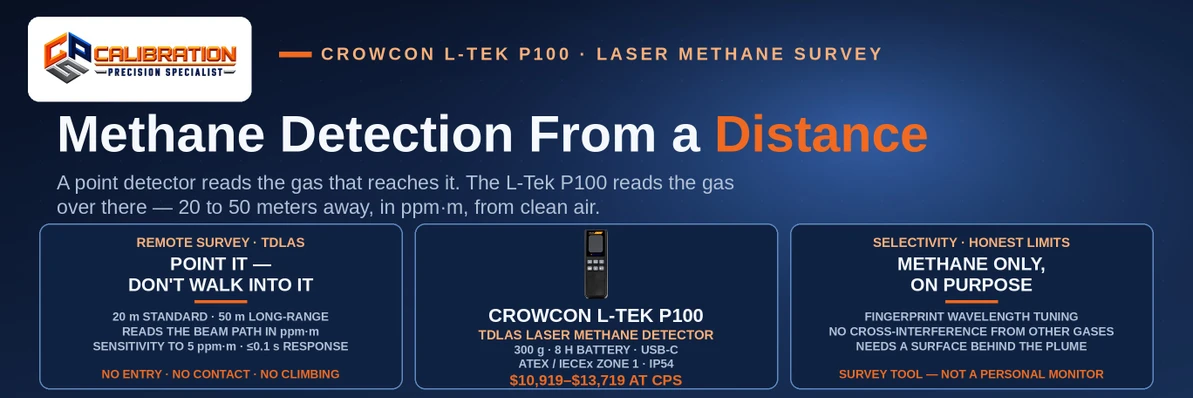
The Crowcon L-Tek P100 is a handheld laser methane detector that measures methane from outside the leak: aim it at a valve, a wellhead, or an elevated pipe run from 20 m away — 50 m on the long-range version — and its TDLAS (tunable diode laser absorption spectroscopy) beam reports the methane along its path in ppm·m, with sensitivity down to 5 ppm·m and a response of 0.1 seconds or less. It detects methane and only methane, which is exactly what makes it a leak-survey instrument rather than a personal safety monitor. At CPS, the 20 m LT-CH4-20 lists at $10,919 and the 50 m LT-CH4-50 at $12,319, with extended-warranty configurations running to $13,719.
Every other detector in your fleet shares one limitation: it can only measure gas that physically reaches its sensor. A point detector reads the air at the point where it sits — which means finding a leak the conventional way involves walking the leak. Along the pipe rack, up the ladder, across the landfill cell, into whatever is escaping. The L-Tek P100 inverts that. The operator stands in clean air, aims a laser at the suspect equipment, and gets a methane reading for the space in between. This post covers what the instrument is, how laser absorption detection actually works, where it earns its five-figure price, and — just as important — the three things it cannot do.
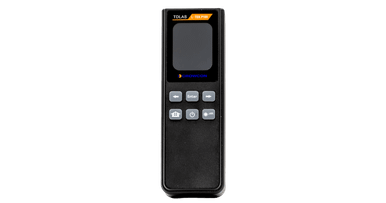
Crowcon L-Tek P100 Laser Methane Detector
Crowcon L-Tek P100: a laser methane detector that finds leaks from 20–50 m away, in ppm·m, without entering the gas. How TDLAS works, limits, CPS pricing.
$10,919–$13,719 configured
See the L-Tek P100 LaserThe Problem: Leak Survey Means Walking Into the Leak
Methane work is full of places you would rather not stand: elevated pipe runs and risers, fenced or locked wellheads and compressor skids, landfill wellfields and biogas collection lines, pressure-regulating stations, tank roofs. The gas itself is often above you, behind a barrier, or in an area that hasn't been cleared for entry. A diffusion monitor samples the air around the person carrying it; a pumped monitor extends that reach by the length of a hose — tens of feet, worked level by level. Both are the right tools for protecting people and testing spaces. Neither is built for rapidly surveying a large outdoor facility for leaks.
That survey job is what remote detection exists for, and it's the job CPS customers describe when they ask about this class of instrument — the same methane-heavy work covered in our guide to landfill and biogas gas monitoring, where the collection field is wide, the wellheads are spread out, and most of the gas you're hunting is in the open air, not in a vessel.
How Does TDLAS Laser Methane Detection Work?
The P100's sensing principle is TDLAS — Tunable Diode Laser Absorption Spectroscopy. The instrument emits a laser tuned to a specific infrared wavelength that methane absorbs — Crowcon calls it methane's "fingerprint" wavelength. The beam travels to whatever surface lies beyond the target — a wall, the ground, the equipment itself — and reflects back to a receiver in the unit. Methane anywhere along that path absorbs some of the light at that wavelength; the more absorption, the more methane the beam passed through. Because the wavelength is chosen for methane's absorption line, other gases in the same air don't absorb it — the reading is methane-specific, with no cross-interference from the CO, H₂S, or solvent vapors that complicate point-sensor readings.
That path measurement is why the unit of measure looks unfamiliar: ppm·m — parts per million multiplied by metres. The P100 doesn't read the concentration at one point; it reads the total methane along the beam, so the same plume gives a bigger number when the beam crosses more of it. The math is simple and worth internalizing:
- 50 ppm of methane spread across a 10 m beam path reads 500 ppm·m.
- A tight, concentrated leak close to the unit can read the same as a weak, diffuse cloud far away — which is why surveyors work toward the source, watching the number climb as the plume narrows.
- The full measuring range is 0–99,999 ppm·m, with sensitivity down to 5 ppm·m — enough to pick up small leaks at survey distance, not just major releases.
Two lasers are involved. The detection laser is Class 1 — eye-safe. A separate visible indicating laser (Class 3R) shows where you're aiming, which matters when the target is a flange 40 m away. Response is fast in a way point sensors can't match: 0.1 seconds or less (adjustable), so a walking survey isn't a stop-and-wait exercise — you sweep the beam across equipment and watch the display. Readings log to internal memory (1,000 records) with time stamps, downloadable over the included USB cable for survey reports.
Where Does a Remote Methane Detector Earn Its Keep?
Crowcon positions the P100 for methane inspection across the petroleum, chemical, mining, and city-gas industries, and the use pattern is consistent: anywhere the measurement point is hard, slow, or unsafe to reach on foot.
- Gas distribution and city-gas survey — checking risers, meter sets, valves, and above-ground pipework from street or ground level instead of ladders and lifts.
- Oil and gas facilities — wellheads, compressor stations, tank batteries, and process pipework, including fenced areas you can read through the fence line without opening a gate.
- Elevated and hard-to-reach points — pipe racks, roof lines, and overhead runs that a pumped probe can't reach and a climber shouldn't have to.
- Landfill and biogas work — wellheads, collection headers, and flare lines spread across a large site, where the survey is a route, not a single point.
- First look at a suspect area — before anyone enters a space or approaches equipment, a beam from clean air tells you whether methane is present and roughly how much.
In each case the value is the same: the survey that used to take a crew, a ladder, and a permit now starts with one person standing in a safe spot, and the points that were simply never checked — because reaching them cost too much — get checked.
L-Tek P100 vs. Point Detectors, Open-Path, and Gas Cameras
Remote detection invites comparison with three other technologies, and the honest answer is that it replaces none of them outright.
Point detectors — the personal monitors and fixed heads in the rest of your program — measure the concentration at a location: a worker's breathing zone, a point beside a compressor. They alarm, they protect specific people and places, and they are the only layer that does. The P100 measures along a path, finds leaks, and quantifies them in ppm·m — but it watches no one's breathing zone and raises no area alarm. Our comparison of open-path vs. point gas detectors works through that point-versus-path distinction in detail; the P100 is best understood as the handheld, go-anywhere member of the path family, where a fixed open-path system is a beam bolted across one fence line, running continuously.
Gas-imaging (thermal/OGI) cameras visualize gas clouds as an image — powerful for seeing plume shape and direction, and priced well above the P100. But a camera's image is qualitative: it shows that something is there, across a range of hydrocarbon gases, and depends on temperature contrast between gas and background. Crowcon draws the contrast directly in its US datasheet: the laser approach "ensures accurate leak measurement and eliminates false alarms, unlike IR camera technologies." The P100 returns a number — methane only, in ppm·m — rather than a picture. (What thermal cameras can and can't do for gas work is covered in Can a thermal imaging camera see a gas leak?)
Ultrasonic leak detectors hear pressurized leaks rather than measuring gas at all — complementary on high-pressure systems, but they quantify nothing and need the leak to be making noise.
Configurations and Pricing at CPS
CPS carries the L-Tek P100 in the two detection ranges Crowcon offers, each with the choice of standard warranty or factory extended-warranty coverage:
| Configuration | Detection distance | List price |
|---|---|---|
| LT-CH4-20 | 20 m | $10,919 |
| LT-CH4-20/EW2 (2-yr warranty) | 20 m | $11,759 |
| LT-CH4-20/EW3 (3-yr warranty) | 20 m | $12,599 |
| LT-CH4-50 | 50 m | $12,319 |
| LT-CH4-50/EW2 (2-yr warranty) | 50 m | $13,019 |
| LT-CH4-50/EW3 (3-yr warranty) | 50 m | $13,719 |
The 50 m version costs $1,400 more than the 20 m in base form — cheap reach if your surveys involve tank farms, wide well pads, or tall structures, unnecessary if your work is meter sets and station pipework at arm's length plus a ladder's worth of distance. In the box, per Crowcon's manual: the instrument, a carry case, a carry strap, a USB-C charging cable, and the manual. See the L-Tek P100 listing for configuration details.
The Honest Limits
- Methane only. The laser is tuned to methane's absorption line. It will register natural gas and biogas because both are mostly methane — but it cannot detect propane as propane, and it is blind to hydrogen sulfide, carbon monoxide, oxygen deficiency, and every other hazard in your program. It is a one-gas instrument by physics, not by cost-cutting.
- It needs line of sight and a backdrop. The beam must cross the plume and land on a surface — wall, ground, equipment — to reflect back. Aimed into open sky, there is no return signal and no reading. Occluded equipment and the far side of vessels stay unsurveyed until you move.
- ppm·m is a path total, not a point concentration. The P100 tells you methane is present along the beam and how much in aggregate; it does not tell you the %LEL at a specific point, and it is not the instrument you clear an entry or a hot-work permit with. Confirm and quantify point readings with the point detectors already in your program.
- It is a survey tool, not a personal monitor. Nothing about it watches the air around the operator. The person aiming it still wears their personal detector — the P100's whole safety case is that it lets them do the survey from somewhere safer, not that it protects them while they do it.
Specifications at a Glance
| Target gas | Methane (CH₄) only |
| Principle | TDLAS — tunable diode laser absorption spectroscopy |
| Measuring range | 0–99,999 ppm·m |
| Sensitivity | 5 ppm·m |
| Detection distance | 20 m (LT-CH4-20) · 50 m (LT-CH4-50) |
| Response time | ≤0.1 s (adjustable) |
| Display | OLED |
| Data storage | 1,000 records, time-stamped, USB download |
| Weight | 300 g |
| Size | 138 × 49 × 36 mm |
| Battery | 8 hours, USB-C charging (lithium) |
| Ingress protection | IP54 |
| Operating range | −20 °C to +50 °C · 98% RH non-condensing |
| Certifications | ATEX / IECEx II 2 G Ex ib op is IIB T4 Gb (Zone 1) |
| Lasers | Class 1 detection (eye-safe) · Class 3R indicating |
Calibration and Service: The Part That's Missing on Purpose
Owners of point detectors will notice what's absent from this post: bump tests, span gas, sensor replacement schedules. That's the TDLAS architecture, not an omission. The laser never contacts the gas, so there is no sensor to poison, drift against a cylinder, or consume — Crowcon rates the P100 long-term calibration-free and describes the design as easy-maintenance with no need for frequent calibration. There is no calibration-gas line item in this instrument's cost of ownership.
What remains is verification and service: if a unit is dropped, damaged, or its readings come into question, the check is a factory-level service evaluation rather than a field span adjustment. CPS handles that intake the same way we handle the rest of a detection fleet — and the point detectors the P100 works alongside still need their regular bump tests and calibrations, which is what our calibration services exist for. Budget honestly: the laser deletes the consumables column for survey work; it doesn't delete the service column for the fleet.
Frequently Asked Questions
What is the Crowcon L-Tek P100? A handheld laser methane detector. Using TDLAS — tunable diode laser absorption spectroscopy — it measures methane remotely: aim it at equipment from up to 20 m away (50 m on the long-range version) and it reports the methane along the beam in ppm·m, down to 5 ppm·m, with a response of 0.1 seconds or less. It weighs 300 g, runs 8 hours on a USB-C-charged lithium battery, and is ATEX/IECEx certified for Zone 1 hazardous areas.
How far away can the L-Tek P100 detect methane? It depends on the version: the LT-CH4-20 measures at up to 20 m, and the LT-CH4-50 at up to 50 m. Those are Crowcon's rated detection distances for the two configurations CPS sells — $10,919 and $12,319 respectively in base form. The beam needs a surface beyond the gas (ground, wall, equipment) to reflect from, so practical surveying means positioning for a backdrop, not just a clear view of the pipe.
What does ppm·m mean on a laser methane detector? Parts per million multiplied by metres — the total methane along the laser's path, rather than the concentration at one point. 50 ppm of methane across a 10 m beam path reads 500 ppm·m; a concentrated small leak and a diffuse large cloud can produce similar totals. Surveyors use that deliberately: walk toward the source and the reading climbs as the path through the plume shortens and concentrates, which is how a path measurement becomes a leak location.
Can the L-Tek P100 detect gases other than methane? No. The laser is tuned to methane's specific infrared absorption wavelength — its fingerprint — so other gases don't register. Natural gas and biogas read correctly because they are mostly methane, but the instrument cannot detect propane, hydrogen sulfide, carbon monoxide, or any other gas, and it says nothing about oxygen levels. That single-gas selectivity is also its strength: no cross-interference and no false alarms from other gases in the same air.
Does the L-Tek P100 replace a personal gas monitor? No. The P100 is a survey instrument: it finds and sizes methane leaks from a distance. It does not monitor the air around the person holding it, does not alarm to protect a wearer, and can't clear a confined space or a hot-work job. The operator doing a survey still wears a personal point detector; the P100's contribution is letting the survey happen from clean air instead of from inside the plume.
Why does the L-Tek P100 cost so much more than a regular methane detector? A point detector is a sensor in a case; the P100 is a stabilized laser optical system — a tunable diode laser, receiver optics, and the processing to turn reflected light into a ppm·m measurement at 50 m, certified intrinsically safe for Zone 1. The price ($10,919–$13,719) buys capability no point detector has at any price: measuring gas you are not standing in. The ownership math runs the other way, too — no calibration gas, no replacement sensors, and no sensor poisoning over its life, because the sensing element never touches the gas.
Does the L-Tek P100 need calibration? No routine calibration. Crowcon rates the P100 long-term calibration-free: the non-contact TDLAS measurement has no sensor to drift against span gas or be poisoned by exposure, and there is no bump-test routine. If a unit is damaged or its readings are ever in doubt, verification is a factory-level service check rather than a field adjustment — talk to CPS and we'll handle the service intake.
What does the laser need to measure against? A reflective backdrop. The beam has to pass through the suspect area and strike a surface — the ground, a wall, a vessel, the equipment itself — that reflects it back to the instrument. Pointed into open sky, there's no return and no measurement. In practice that shapes survey technique: choose angles with a backdrop, and reposition to cover equipment whose far side has nothing behind it.
Is the L-Tek P100 safe to use in classified areas? Yes — it's certified for them. The P100 carries ATEX and IECEx certification as II 2 G Ex ib op is IIB T4 Gb, which is intrinsically safe equipment for Zone 1 gas atmospheres, across an ambient range of −20 °C to +50 °C. The detection laser is Class 1 (eye-safe); the visible aiming laser is Class 3R, so standard laser discipline applies — don't stare into the beam or aim it at faces. The housing is IP54.
How much does the Crowcon L-Tek P100 cost? At CPS: the 20 m LT-CH4-20 is $10,919 and the 50 m LT-CH4-50 is $12,319. Factory extended-warranty versions run higher — $11,759 (2-year) and $12,599 (3-year) for the 20 m, and $13,019 (2-year) and $13,719 (3-year) for the 50 m — for a full range of $10,919 to $13,719 depending on range and warranty. Those are list prices; the instrument, carry case, strap, and USB-C charging cable are included per Crowcon's packing list.
The Bottom Line
The L-Tek P100 answers a question no point detector can: how much methane is in the air over there? — asked from over here, in clean air, in a tenth of a second. For gas distribution survey, oil and gas facilities, landfill and biogas fields, and every elevated, fenced, or not-yet-cleared measurement point in between, that turns leak survey from an entry job into a walk-by job. It does one gas, along one line of sight, in path totals rather than point concentrations — and it sits on top of a point-detection program, never instead of one. If your crews spend their hours walking to the gas, this is the instrument that lets them stop.
Surveying methane across a site — or speccing a remote-detection layer for your program? Call 865-900-8844 or reach us through Contact Us. The L-Tek P100 listing carries both ranges and the warranty configurations, and our calibration services keep the point detectors it works alongside proven and documented.
CPS Calibrations · 109 S. Front Street, Rockwood, TN 37854 · Calibration Gas · Calibration Services · Contact Us
Need a calibration you can file?
In-house calibration at CPS in Rockwood, Tennessee — $55 for single-gas instruments, $90 for 4- and 5-gas — every channel, as-found and as-left data, full certificate.
See Calibration Servicesor call 865-900-8844
Recent Posts
-

What Is Remote Monitoring for Fixed Gas Detection?
Remote monitoring for fixed gas detection means a fixed system's live readings, trends, and alarm hi …Nov 23rd 2026 -

What Are the Key Differences Between the GX-6000 and GX-6100?
The RKI GX-6100 is the current replacement for the discontinued GX-6000: both are pumped 6-gas monit …Nov 22nd 2026 -

How to Read a PID Correction Factor Chart
To read a PID correction factor chart, find your vapor’s row, take the factor under your own lamp en …Nov 21st 2026