
Crowcon Q-Test: Fast Bump Tests and Calibrations for Gas-Pro
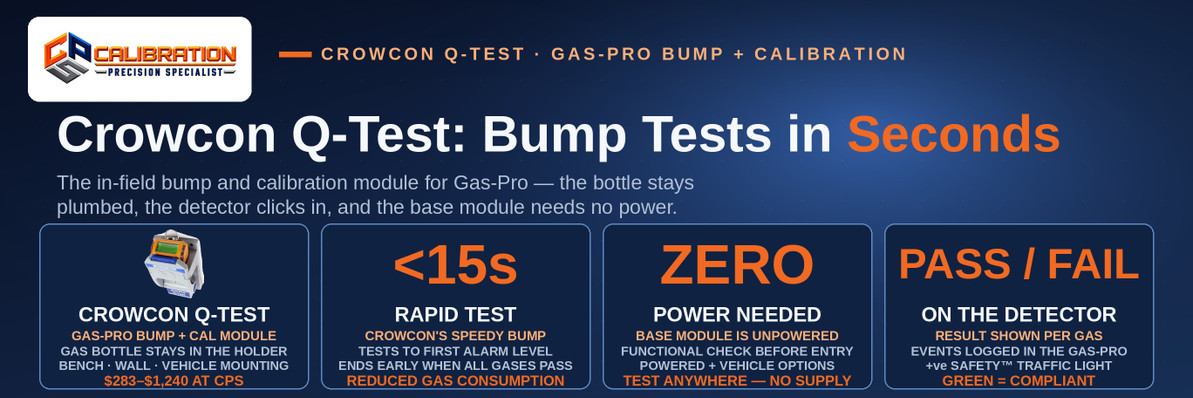
The Crowcon Q-Test is an in-field bump test and calibration module for the Crowcon Gas-Pro multi-gas detector: the calibration gas cylinder stays mounted in the module's holder with its regulator fitted, the Gas-Pro clicks in, and a speedy bump test runs in under 15 seconds by Crowcon's rating — with no power supply needed on the base module, so crews can complete their functional check immediately before entry, anywhere. If a channel fails the bump, a Gas-Pro configured for it can calibrate right there in the module. Q-Test configurations run $283 to $1,240 at CPS list, depending on the power and regulator options fitted.
A bump test is the cheapest insurance in gas detection, and the one most often skipped — because the manual version means finding the bottle, fitting a regulator, connecting tubing, and doing it again tomorrow for every detector in the fleet. Q-Test exists to delete that friction for Gas-Pro users: the gas lives on the module, the test is a dock-and-select routine, and the result is shown per gas on the detector's own display and stored in its event log. This spotlight walks through why the daily bump matters, exactly how a Q-Test test runs, the difference between speedy and smart bump, the power and regulator configurations and what they cost, and — plainly — which Crowcon detectors Q-Test does and does not serve.
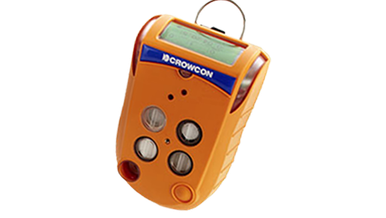
Crowcon Gas-Pro Portable Multi-Gas Detector
Crowcon Q-Test: the in-field bump test and calibration module for Gas-Pro — speedy bump in under 15 seconds, no power needed, CPS list prices $283–$1,240.
$718.64–$3,467.10 configured
See the Gas-ProWhy Does Bump Testing Exist at All?
A bump test is a functional check: a known gas is passed over the sensors to prove the detector responds, reaches its first alarm level, and sounds its audible, visual, and vibrating alarms. It answers one question — will this instrument warn its wearer today? — and it is not the same thing as a calibration, which adjusts the instrument's readings against the gas. We work through the distinction in Bump Test vs. Calibration and the step-by-step manual method in How Do You Bump Test a Gas Detector?
The daily rhythm is not superstition. Crowcon's Gas-Pro manual notes that under the ATEX directive, portable apparatus sensing flammable gases should have a functional check with gas before each day of use, and the Gas-Pro itself enforces the habit: sensors can be assigned to a "Daily" bump group, and the instrument shows a gas-test-due warning at start-up when the interval from the last successful bump has expired. The failure mode a bump test catches is the dangerous one — a blocked filter, a poisoned or dead sensor, a sounder that no longer sounds — on an instrument that powers up and looks perfectly healthy. A detector that has never been bumped is an assumption, not a protection.
What Is the Crowcon Q-Test?
Q-Test is Crowcon's in-field gas test and calibration module for the Gas-Pro — in Crowcon's words, a "quick and simple in-field gas test and calibration solution" that provides "off-site testing for remote locations where power is not always available or practical," reducing "set-up, training requirements and space needed." It is a mechanical module, not a computerised docking station: the intelligence lives in the Gas-Pro, and Q-Test's job is to hold the detector and deliver the gas the same way, every time.
Three design decisions define it:
- The gas stays plumbed. The cylinder sits in the module's holder with the chosen regulator fitted. There is no bottle-and-regulator assembly to build before each test — you turn the gas on when the detector asks for it.
- The detector clicks in. Seating the Gas-Pro in the module (with its home screen displayed) brings up the Bump/Pump screen automatically on Bump/Pump-configured units — the module is recognised, not menu-hunted.
- The base module needs no power. Crowcon's Gas-Pro datasheet puts it directly: "The Q-Test requires no power and is therefore ideally suited to remote users. Crews can now complete their functional check immediately prior to entry ensuring they are compliant." Powered variants exist for charging and vehicle mounting — covered below — but testing itself never depends on a supply.
How a Q-Test Bump Test Runs, Step by Step
- Dock the Gas-Pro. Place the instrument in the Q-Test module. On a Bump/Pump-configured Gas-Pro, the Bump/Pump screen appears.
- Select Bump. The screen shows "Gas on."
- Turn the gas on. The bottle is already in the holder with its regulator fitted — this is a valve, not a setup.
- Read the result. A time bar runs at the base of the display; the screen then shows, gas by gas, whether each tested channel passed or failed (channels not being tested display a marker instead). The test ends early if every tested gas passes before the preset time runs out.
- Undock and go. The result is written to the Gas-Pro's event log — bump tests and calibrations are logged events, in an event memory of at least 1,000 events.
Speedy bump vs. smart bump
Q-Test runs whichever bump the Gas-Pro is configured for, and the two are different tests:
- Speedy bump tests the detector to its first alarm level. Gas is presented for a set time (it varies by sensor type); the test passes if the detector goes into alarm — with the user verifying the sounder, LEDs, and vibrator actually fired. Crowcon's Q-Test literature rates the rapid test at under 15 seconds, and the reduced gas consumption that comes with a short, controlled application is the running-cost point of the module.
- Smart bump tests accuracy, not just response: the detector must indicate within pre-set limits of the applied gas level inside a time window based on the sensor's response time. Its parameters are configurable in Crowcon's Portables Pro software. One exception, from the manual: smart bump is not available for the PID sensor — a PID channel gets a speedy bump.
When a bump fails: calibration after bump fail
A failed bump in a manual workflow usually means the detector goes in a pile for the calibration bench. In Q-Test, a Gas-Pro configured via Portables Pro to allow it performs a calibration after bump fail immediately: leave the instrument in the module with the gas on, and the calibration runs, storing the new values to the instrument's memory and advancing its calibration date by the configured interval. Two honest qualifications from Crowcon's manual: the calibration is only valid if it is run with calibration-quality gas (so a speedy/smart bump intended to feed this function must use that gas), and if the calibration itself fails, that points to a more serious sensor problem — the instrument needs service, not another attempt.
Power and Mounting: Four Ways to Run a Q-Test
The FY27 range splits Q-Test into four power families, and the choice is about where the module lives:
- Unpowered — the base module. No supply, no charging; it tests wherever it is carried and is the remote-crew and pre-entry option.
- Power ready — the module wired ready for power, for installations that will add it.
- Mains powered (MR) — a permanently powered home for the monitors: powered Q-Test gives detectors a fixed base, and the Gas-Pro charges while it sits there.
- Vehicle power — built to mount in a vehicle and run from a standard in-vehicle power socket, so the module is the truck's test point and the Gas-Pro charges on the move.
Mounting follows the same logic: fixing points allow bench or wall mounting, and the vehicle-power version turns a cab or crew truck into the bump-test station. The datasheet's summary is the honest one — multiple mounting options and a cylinder holder ensure the Gas-Pro "is ready to protect workers when needed."
Gas Supply: The Regulator Is the Configuration
Every Q-Test configuration in the book feeds gas at 0.5 LPM through one of four regulator choices, and this choice — not the module — is most of the price spread:
- No regulator (ZZ) — the module alone, for buyers who already own a suitable 0.5 LPM regulator.
- On/off regulator (R1) — the standard fixed-flow option.
- Trigger regulator (R2) — gas flows on demand of the trigger, the economical choice for high test counts.
- Reactive-gas on/off regulator (R3) — the regulator for reactive gas mixtures; it is the expensive line in every power family, and the reason the range top sits where it does.
What Q-Test does not change: it consumes the same calibration gas any Gas-Pro bump or calibration uses, matched to the instrument's configuration — apply the wrong mix and the test fails, correctly. Gas is not included with the module; CPS stocks the quad mixes and single gases the Gas-Pro tests on in our calibration gas range.
Records, Pass/Fail, and the +ve Safety Light
Q-Test gives a clear verdict but keeps no records of its own — deliberately. The pass/fail result is shown per gas on the Gas-Pro's display at the end of the test, and the durable record lives in the detector: bump tests and calibrations are stored in the Gas-Pro's event log alongside alarms and on/off events, downloadable later through Crowcon's software. For a working crew, that is the right place for it — the evidence travels with the instrument.
The supervisor's view is the +ve Safety indicator, Gas-Pro's front-mounted tri-colour LED, which confirms detector status before deployment, in the field, or on return:
- Green flash — the detector is compliant with the site or user requirements set in its configuration.
- Amber double flash — operational, but requires attention: one or more configured flags has been triggered.
- Red constant — not within the specified criteria for use. Do not deploy it.
Bump and calibration currency are part of what those configured flags watch, so a detector that passed its Q-Test bump this morning shows green for the reason a supervisor cares about. What Q-Test does not do is fleet reporting — exception reports, certificates, and central data capture are the job of Crowcon's I-Test station and I-Test Manager software. Q-Test is the test point in the field; I-Test is the records system at base. Fleets that need both usually need both.
The T4 Question, Answered Straight
Q-Test is a Gas-Pro module. It is worth saying plainly, because the two detectors are stablemates: Crowcon's manual describes Q-Test in the Gas-Pro's gas-testing chapter, the Gas-Pro datasheet presents it as the Gas-Pro's no-power test option, and every Q-Test configuration in Crowcon's current price book is a Gas-Pro configuration.
The Crowcon T4 is not left without options — they are just different ones. Every T4 ships with a calibration/bump test plate for manual bump tests and calibrations through the instrument's menu, and Crowcon's automated station for the T4 is the I-Test, the wall- or desk-mounted system that tests T4 and Gas-Pro fleets with full data capture. If your fleet is T4s, I-Test — not Q-Test — is the station built for it; if your fleet is Gas-Pros working away from base, Q-Test is the answer to a different problem.
Configurations and Prices at CPS
CPS lists Q-Test in the four power families, each with the four regulator choices — sixteen standard configurations, priced at list from Crowcon's FY27 book:
| Power family | No regulator | On/off reg | Trigger reg | Reactive-gas reg |
|---|---|---|---|---|
| Unpowered | $283 | $564 | $681 | $1,100 |
| Power ready | $372 | $653 | $770 | $1,189 |
| Mains powered | $423 | $704 | $821 | $1,240 |
| Vehicle power | $423 | $704 | $821 | $1,240 |
Read the table by its logic: moving across a row buys gas-handling (the reactive-gas regulator alone adds over $800 to the unpowered module, because reactive mixtures destroy ordinary regulator internals); moving down a column buys infrastructure (power, then charging, then vehicle mounting). The $283 starting point is real but bare — a module with no regulator and no power is the right buy only for a crew that already owns the regulator and works off-grid. See the Crowcon Gas-Pro listing for the detector Q-Test serves.
The Honest Limits
- Gas-Pro only. Q-Test does not test T4s, Gasman, Tetra 3, or any other brand — those instruments still need their plates, their own stations, or manual calibration. A mixed-brand fleet does not consolidate onto Q-Test.
- It keeps no records. The verdict lives on the detector's display and in its event log. If your compliance program needs central reporting and printed certificates, that is I-Test's job, not Q-Test's.
- Field calibration is not a service. Calibration-after-bump-fail restores a drifted instrument in the field and advances its calibration date by the configured interval — the Gas-Pro manual is clear that new-sensor calibration and servicing belong to a trained technician with the PC software, and Crowcon recommends regular service and calibration every six months in the absence of other evidence. Q-Test keeps a fleet honest day to day; it does not replace the bench.
- The PID channel bumps speedy-only, and smart bump's pass limits are only as good as the configuration set in Portables Pro — a station cannot fix a badly configured test.
- Reactive gases cost reactive money. If your Gas-Pro build carries channels that need reactive calibration mixtures, budget the R3 regulator rows, not the headline $283.
Calibration Services at CPS
A Q-Test module keeps Gas-Pro bump tests happening where the work is. Everything behind it — the calibration gas itself, the six-month service calibrations, sensor replacement, and instruments from every other brand on your site — is what our bench is for. CPS calibrates every channel on the instruments we sell and service, in-house in Rockwood or on-site by written quote, with the certificate that makes your event logs hold up after an incident.
Frequently Asked Questions
What is the Crowcon Q-Test?
Q-Test is Crowcon's in-field bump test and calibration module for the Gas-Pro multi-gas detector. The calibration gas cylinder sits in the module's holder with its regulator fitted, the Gas-Pro clicks into the module, and the detector runs its speedy or smart bump test — and, if configured, a calibration after a failed bump — without the bottle-and-regulator setup a manual test needs before every use.
How long does a bump test take in the Q-Test?
Crowcon's Q-Test literature rates the rapid test at under 15 seconds. The module runs the Gas-Pro's speedy bump (a test to the first alarm level) or smart bump (a response-accuracy test), and the instrument ends the test early once every tested gas has passed. Docking, selecting Bump, and turning the gas on are the only steps around it.
Does the Crowcon Q-Test work with the T4?
No. Q-Test is built for the Gas-Pro — every configuration in Crowcon's price book is a Gas-Pro configuration, and Crowcon's manuals describe Q-Test only in the Gas-Pro's gas-testing system. The T4 bump tests with its included calibration/bump plate, and Crowcon's automated station for T4 fleets is the I-Test, which also serves the Gas-Pro with full data capture.
Does the Q-Test need a power supply?
The base module does not — Crowcon designed it for remote locations where power is not available or practical, and the detector does the testing work. Powered configurations exist for a different reason: power-ready, mains-powered, and vehicle-power versions give the module a permanent home and charge the Gas-Pro while it sits in it, with the vehicle version running from a standard in-vehicle power socket.
Can the Q-Test calibrate a Gas-Pro, or only bump test it?
Both. Alongside speedy and smart bump tests, a Gas-Pro configured in Portables Pro can run a calibration automatically after a failed bump — leave the instrument in the module with the gas on and the calibration completes, storing the new values in the instrument's memory. That calibration must use calibration-quality gas, and a failed calibration indicates a sensor problem that needs service.
What gas does the Q-Test use?
The same calibration gas the Gas-Pro is configured to test with — typically the quad mix matching its sensors — supplied from a cylinder held in the module. Q-Test configurations feed at 0.5 LPM through an on/off, trigger, or reactive-gas regulator, or you can buy the module with no regulator and use your own. Gas is not included with the module.
What does the Crowcon Q-Test cost?
At CPS, $283 to $1,240 at list. The unpowered module with no regulator is $283; adding the standard on/off regulator makes it $564, and the reactive-gas regulator takes it to $1,100. Powered families run $372–$1,240 depending on regulator: mains-powered and vehicle-power versions top the range at $1,240 with the reactive-gas regulator fitted.
Does the Q-Test store bump test records?
Not itself — Q-Test has no memory or reporting software. The pass/fail result is shown per gas on the Gas-Pro's display, and the bump test or calibration is recorded in the Gas-Pro's event log (at least 1,000 events), where it can be downloaded later. Centralised records, exception reporting, and certificates are what Crowcon's I-Test and I-Test Manager are for.
What is the difference between Q-Test and I-Test?
Q-Test is the in-field test point: a simple module, no power required, gas plumbed and ready, built for crews testing Gas-Pro detectors at remote sites and immediately before entry. I-Test is the managed station: a powered wall- or desk-mounted system that automatically tests Gas-Pro and T4 detectors, captures the data, updates configurations, and produces reports and certificates through I-Test Manager. Field speed versus fleet records.
What happens if a Gas-Pro fails its bump test in the Q-Test?
First, the detector shows the failure per gas on its display — a failed speedy bump means the channel did not reach its first alarm level. If the instrument is configured for calibration after bump fail, it calibrates immediately in the module. If the calibration also fails, Crowcon's manual is explicit: that indicates a more serious sensor issue, and the instrument should be serviced rather than returned to work.
The Bottom Line
Q-Test is not a docking station and doesn't pretend to be one. It is the simplest possible answer to the daily bump test for Gas-Pro crews: gas plumbed, detector clicked in, a verdict in seconds, no power, no setup, no excuse — at the plant, at the gate, or in the truck. Its limits are equally clear: Gas-Pro only, records that live in the detector rather than a database, and field calibrations that support — never replace — proper service. For a Gas-Pro fleet that works away from a bench, it is the difference between a bump-test policy on paper and one that happens.
Not sure whether Q-Test, I-Test, or a manual kit fits your fleet? Call 865-900-8844 or reach us through Contact Us. CPS Calibrations · 109 S. Front Street, Rockwood, TN 37854 · Calibration Gas · Calibration Services
CPS Calibrations · 109 S. Front Street, Rockwood, TN 37854 · Calibration Gas · Calibration Services · Contact Us
Need a calibration you can file?
In-house calibration at CPS in Rockwood, Tennessee — $55 for single-gas instruments, $90 for 4- and 5-gas — every channel, as-found and as-left data, full certificate.
See Calibration Servicesor call 865-900-8844
Recent Posts
-

Can You Add a Pump to a SENKO SGT-P or MGT?
Yes — SENKO's SP-Pump101 external sampling pump ($330, part AAA006000) fits the SGT, SGT-P, and MGT, …Nov 12th 2026 -

What Refrigerant Detection Does a Grocery Store Need?
A grocery store needs refrigerant detection in three places: low-mounted carbon dioxide (R-744) sens …Nov 11th 2026 -

What Is LEL and UEL? The Explosive Range, Gas by Gas
The LEL is the lowest concentration of a gas in air that can explode, and the UEL is the highest: me …Nov 10th 2026