
Crowcon UnoIQ: Single-Gas Detection on the IQ Platform
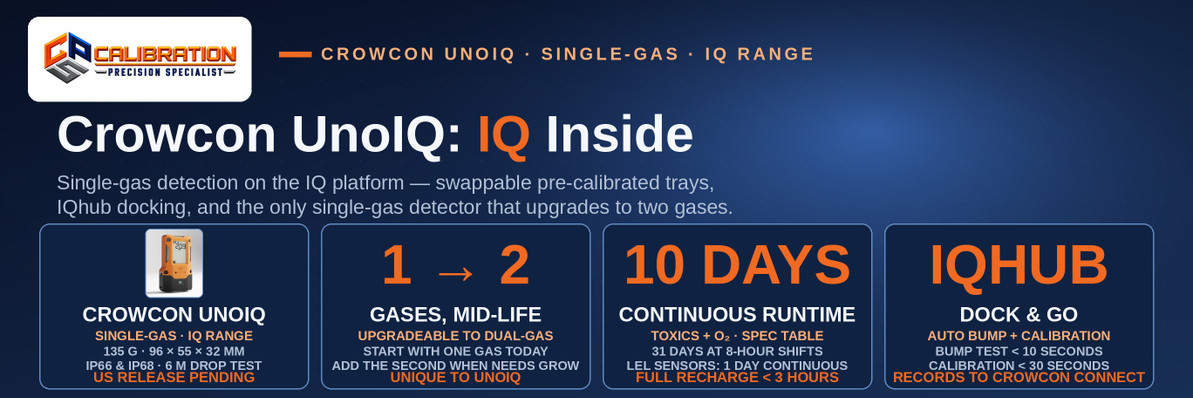
The Crowcon UnoIQ is the single-gas member of Crowcon's IQ range: a 135 g rechargeable personal detector, rated IP66 and IP68, whose sensor lives in a swappable pre-calibrated tray — and which Crowcon says is the only single-gas detector that can be upgraded to dual-gas detection mid-life. It docks with the IQhub station for automatic bump tests under 10 seconds and calibrations under 30 seconds, carries NFC with optional Bluetooth for Crowcon Connect, and its datasheet rates a toxic-gas or oxygen version at 10 days of continuous runtime per charge. One status note up front, because it shapes everything below: UnoIQ is not on sale in the US yet. Every US configuration in Crowcon's current price book is marked "Not Released," so there is no US price to print — CPS will list the UnoIQ the moment Crowcon releases US configurations.
Single-gas detection is the oldest, simplest job in portable gas detection: one named hazard, one worker, one small detector clipped to a collar. The instruments that do it have historically come in two flavors — sealed disposables you activate and throw away at end of life, and serviceable units that are essentially a one-channel version of a bigger monitor. Both share a limitation: the detector you buy is the detector you're stuck with. The gas is fixed, and on most models the sensor is fixed too.
The UnoIQ is Crowcon's attempt to rebuild that category on a platform. It shares its architecture with the two-gas DuoIQ and the DetectiveIQ area monitor: modular sensor trays, the IQhub dock, Crowcon Connect reporting, and one-button operation. This spotlight covers what the UnoIQ is, what its specification table actually says — including one place where it disagrees with Crowcon's own launch headlines — and exactly where US availability stands.
What Is the Crowcon UnoIQ?
The UnoIQ launched in September 2025 as the entry point to Crowcon's IQ range. The hardware, from Crowcon's official datasheet and product page:
- Size and weight: 96 × 55 × 32 mm with the standard sensor tray (106 mm tall with the deep tray), and 135 g. Under 10 cm tall — it rides on a collar or chest strap and disappears.
- Ruggedness: IP66 and IP68 sealing and a 6-metre drop test in Crowcon's specification. Rained on, hosed down, dropped on concrete — the spec says it takes all three.
- Alarms and display: Visual, vibrating, and 95 dB audible alarms (at 10 cm) with low/high, TWA, and STEL alarm types, on a backlit segment display. One button runs the instrument — the same control philosophy as the rest of the IQ range.
- Response: T90 under 10 seconds, sensor dependent.
- Logging: Up to 500 event logs on board, so alarm and bump history survives until it is docked, downloaded, or pushed to Crowcon Connect.
- Operating range: −20 °C to +55 °C, 0–95% RH.
- Down-facing sensors: Like every IQ device, the UnoIQ faces its sensor downward — Crowcon's design answer to dust, debris, and water collecting on the sensor face and causing false alarms.
- Warranty: 2 years, with sensor warranty separate.
That is personal-monitor hardware with nothing exotic about it — deliberately. The interesting decisions are the tray, the battery table, and the platform it plugs into.
The Gases: One Tray, One Gas
A UnoIQ watches one gas at a time, but the platform's gas list is wider than most single-gas lineups — because the sensor technology underneath varies by gas. Crowcon's datasheet lists four sensor technologies for the UnoIQ — electrochemical, infrared (IR), pellistor (catalytic), and long-life oxygen — and these ranges:
- Oxygen (O₂): 0–25% vol
- Carbon monoxide (CO): 0–250 ppm
- Hydrogen sulfide (H₂S): 0–100 ppm
- Methane: 0–100% LEL (plus inert-atmosphere methane and LPG versions)
- Butane: 0–100% LEL
- Ammonia (NH₃): 0–100 ppm and 0–1,000 ppm
- Sulfur dioxide (SO₂): 0–20 ppm
- Nitrogen dioxide (NO₂): 0–20 ppm
- Chlorine (Cl₂): 0–10 ppm
- Ozone (O₃): 0–1 ppm
- Hydrogen (H₂): 0–40,000 ppm
- Carbon dioxide (CO₂): 0–2% vol (non-intrinsically-safe version)
- Jet fuel vapor: 0–10,000 ppm
The US configurations Crowcon has defined so far — in its current FY27 price book — cover CO, H₂S, O₂, methane %LEL, ammonia (1,000 ppm), chlorine, hydrogen, and sulfur dioxide, in Bluetooth/USB-C builds. Every one of them is marked "Not Released," which is why this post has no prices section. When Crowcon releases them, CPS lists the UnoIQ at list like the rest of the Crowcon line, and this spotlight gets its numbers.
Sensor Trays — and the Upgrade No Other Single-Gas Detector Offers
The UnoIQ's defining decision is the same one that defines the IQ range: the sensor does not live in the instrument — it lives in a pre-calibrated, swappable tray. On a conventional single-gas detector, a failed or expired sensor means opening the unit, a bench repair, or a trip back to the manufacturer. On the UnoIQ, the tray swaps in the field without manufacturer intervention, the instrument recognizes what's installed, and the detector goes back on a collar. The plug-and-play design also means the tray — not the whole detector — is how you retarget the instrument at a different gas.
Then there is the claim Crowcon makes in the datasheet itself, in its own words: the UnoIQ is "the only single-gas detector that can be upgraded to support two gases mid-life." Read that carefully, because it changes the buying logic. A site that needs CO coverage today and expects an H₂S hazard when a new process comes online normally buys a single-gas unit now and a two-gas unit later, and the first purchase is stranded. The UnoIQ's platform answer is: start with one gas, and when the second hazard arrives, upgrade the same device into dual-gas detection — the territory of its sibling, the DuoIQ. Whether a given fleet should start at UnoIQ or buy DuoIQ outright is a real question (the DuoIQ post works through the pairings), but a single-gas detector with a growth path is new.
Two honest qualifications, carried over from how the platform works. First, the flexibility lives inside the IQ ecosystem: trays are IQ parts, not universal sensors. Second, a pre-calibrated tray is not a calibration exemption — the detector still gets bump-tested before use and calibrated on schedule. The tray makes sensor service a two-minute job; it does not shorten a single interval.
Battery Life: Read the Spec Table, Not the Launch Copy
This is the section where we apply the same rule we applied to the DuoIQ: the datasheet's specification table is the source of truth, not the launch marketing.
Crowcon's IQ launch material quotes the UnoIQ at up to 65 days of continuous battery life, with "just four charges in two years" under normal use. Crowcon's own UnoIQ datasheet specification table says something more specific — and, for one sensor family, very different:
- Toxic-gas and oxygen sensors: 10 days continuous — 31 days on 8-hour shift cycles.
- Infrared (LEL) sensors: 1 day continuous — 4 days on shift cycles.
- Pellistor (LEL) sensors: 1 day continuous — 3 days on shift cycles.
- Recharge: 0–80% in 2 hours; full charge in under 3 hours.
Both stories can be traced to the shift-cycle arithmetic — a toxic-gas UnoIQ charged monthly is a genuinely low-maintenance device, and on shift cycles the "rarely charge it" pitch is fair. But the specification table is what a safety manager should plan around, and the table's real message is the split: a toxic or O₂ UnoIQ runs for weeks of shifts per charge, while a flammable-gas UnoIQ is a between-shift charging instrument, for the same reason every LEL pairing is — IR and pellistor sensors draw power that electrochemical sensors don't. If your gas is CO, H₂S, or O₂, battery life mostly stops being a maintenance item. If your gas is methane %LEL, plan the charger into the routine from day one.
The IQ Platform: IQhub, Crowcon Connect, NFC and Bluetooth
A single-gas fleet is usually the largest fleet a site owns, which makes it the fleet whose paperwork rots first: dozens of bump tests, calibrations, and alarm events, historically tracked on clipboards or not at all. The IQ platform is Crowcon's connected answer, and the UnoIQ plugs into all of it:
- IQhub is the docking station: drop the UnoIQ in and it runs an automatic bump test in under 10 seconds and a full calibration in under 30 seconds, then syncs the results onward. Manual bump tests and calibrations through the device and PC software remain available for sites without a hub.
- Crowcon Connect is the cloud dashboard behind the hub: real-time alarms, compliance dashboards, location tracking, device configurations, and reporting across the fleet. Crowcon includes Connect free for the first 12 months with an IQ purchase.
- NFC and the Companion App: every UnoIQ carries NFC for tap-to-pair identity, worker assignment, and setup. Bluetooth is an optional extra — and it is the piece required for live data and configuration through the Crowcon Connect App, so fleets that want live streaming should specify the Bluetooth build (the US configurations Crowcon has defined are Bluetooth builds).
For a fleet of single-gas detectors, the dock-and-go routine is the actual product: the worker drops the detector on the hub at shift start, the bump test passes in seconds, the compliance record exists, and nobody kept a logbook. That is the workflow that keeps a big single-gas fleet from quietly decaying into untested detectors.
UnoIQ, Disposable, or Conventional Single-Gas?
- Choose the UnoIQ (once it's released) when the hazard is one named gas, the fleet is big enough that bump/cal paperwork is a real burden, or the job may grow a second gas — the mid-life dual-gas upgrade and the IQhub routine are what you're buying over a plain detector.
- Choose a disposable when the need is simple, fixed, and price-driven: a sealed disposable single-gas monitor you activate, wear for its rated life, and replace is still the lowest-admin answer for a lone CO, H₂S, or O₂ hazard — no charging, no calibration, no dock. What it will never do is change gases, change sensors, or report to a dashboard.
- Choose a conventional serviceable single-gas — like Crowcon's Gasman — when you need one dedicated gas today, in a unit you can buy now, with interchangeable sensor modules across a very wide gas list. The Gasman is the proven workhorse; the UnoIQ is the connected platform play, once US units land.
The Honest Limits
- You can't buy one in the US yet. Every US UnoIQ configuration in Crowcon's current FY27 price book is marked "Not Released," and Crowcon has not given CPS a US release date we can publish. This post exists so the platform is understood before it lands — not to take orders for it.
- US certification is part of the wait. Crowcon's datasheet lists ATEX and IECEx intrinsic-safety approvals in place, and the CSA US Class I, Division 1 approval marked *pending*. Until that clears and US configurations release, there is no US-saleable UnoIQ — full stop.
- One gas at a time. Until you take the dual-gas upgrade, a UnoIQ watches exactly one gas. A second hazard is not a setting — it's the upgrade, or a second instrument.
- No pump, no remote sampling. The datasheet's sampling entry is "None" — diffusion only. The UnoIQ reads the air at the wearer's collar; it cannot draw a sample from a space before entry, and it is not a pre-entry testing tool.
- LEL versions live on the charger. One day of continuous runtime for IR and pellistor builds means overnight charging is part of the routine. Sites that won't enforce it should expect dead detectors.
- Bluetooth is a specification choice. NFC is on every unit; Bluetooth is optional, and it's the option the Connect App's live data needs. Decide before ordering, not after.
US Availability: Where Things Stand
Plainly: Crowcon launched the IQ range in September 2025, the UnoIQ is documented, specified, and sold in other markets, and Crowcon's current FY27 price book defines the US configurations — Bluetooth, USB-C, in CSA and non-hazardous variants for eight gases. Every one is marked "Not Released." CPS is a Crowcon distributor; we stock the T4, T4x, Gas-Pro, Gasman, Clip SGD, Tetra 3, DuoIQ, and L-Tek P100 lines, and we will list the UnoIQ at list price as soon as Crowcon releases the US configurations. If you're planning a single-gas fleet refresh and the UnoIQ's tray-and-upgrade model fits it, call us — we'd rather help you time a purchase around the release than sell you the wrong detector today.
Calibration: We Calibrate Every Channel
One channel or four, the rule doesn't change: bump-test before use, calibrate on schedule, keep the records. When the UnoIQ reaches the US, it will offer the two clean routes the IQ range provides — IQhub's sub-30-second automatic calibration for fleets, or manual calibration through the device — and CPS will back both: our in-house lab handles calibration and service for the lines we sell, and for gas detection our commitment is simple: we calibrate every channel the instrument carries. Pre-calibrated trays shorten sensor service; they don't shorten the calibration interval, and we won't pretend otherwise.
Frequently Asked Questions
What is the Crowcon UnoIQ?
The UnoIQ is Crowcon's single-gas personal detector in the IQ range, launched in September 2025. It is a rechargeable, 135 g detector (96 × 55 × 32 mm) rated IP66 and IP68 with a 6-metre drop test, one-button operation, a backlit segment display, and up to 500 event logs. Its sensor sits in a swappable pre-calibrated tray, it docks with the IQhub station, and it connects to Crowcon Connect by NFC, with Bluetooth optional.
When can I buy a UnoIQ in the US?
Not yet — and we won't invent a date. Every US UnoIQ configuration in Crowcon's current FY27 price book is marked "Not Released," and the datasheet lists the CSA US approval as pending, so there is currently no US-saleable version and no US price. CPS is a Crowcon distributor and will list the UnoIQ at list price as soon as Crowcon releases US configurations. Call 865-900-8844 if you're planning a fleet purchase and want to time it around the release.
What gases can the UnoIQ detect?
One at a time, from Crowcon's datasheet list: oxygen 0–25% vol, CO 0–250 ppm, H₂S 0–100 ppm, methane and butane 0–100% LEL, ammonia 0–100 and 0–1,000 ppm, SO₂ 0–20 ppm, NO₂ 0–20 ppm, chlorine 0–10 ppm, ozone 0–1 ppm, hydrogen 0–40,000 ppm, CO₂ 0–2% vol (non-IS version), and jet fuel vapor 0–10,000 ppm — using electrochemical, infrared, pellistor, and long-life oxygen sensors. The US configurations defined so far cover CO, H₂S, O₂, methane LEL, ammonia 1,000 ppm, chlorine, hydrogen, and SO₂.
Can the UnoIQ really be upgraded to detect two gases?
Yes — that is Crowcon's headline claim for the platform, stated in its own datasheet: the UnoIQ is "the only single-gas detector that can be upgraded to support two gases mid-life." The upgrade moves the device into dual-gas detection on the same hardware, the territory of its sibling the DuoIQ. It exists for sites whose hazard assessment grows a second gas after the initial purchase.
How long does the UnoIQ battery last?
By Crowcon's datasheet specification table, it depends on the sensor. Toxic-gas and oxygen versions run 10 days continuous — 31 days on 8-hour shift cycles. Infrared and pellistor flammable-gas versions run 1 day continuous (3–4 days on shift cycles). A full recharge takes under 3 hours. Note that Crowcon's launch marketing quotes longer figures (up to 65 days continuous); the specification table is the conservative source, and it's the one to plan charging around.
Is the Crowcon UnoIQ intrinsically safe?
Internationally, yes: the datasheet lists ATEX Ex II 1G Ex ia IIC T4 Ga and IECEx Ex ia da IIC T4 Ga intrinsic-safety approvals, in an IP66/IP68 housing. For the US, the CSA Class I, Division 1, Groups A, B, C, D T4 approval is listed in the same datasheet as *pending* — one of the reasons US configurations are not yet released. We will update this answer the moment that status changes.
Does the UnoIQ need an IQhub?
No. IQhub is Crowcon's docking station for the IQ range — it runs an automatic bump test in under 10 seconds and a calibration in under 30 seconds and pushes records to Crowcon Connect — but the UnoIQ also supports manual bump tests and calibrations through the device and PC software. The hub earns its keep on fleets, where dock-and-go turns daily compliance into a habit instead of a logbook.
UnoIQ or a disposable single-gas detector — which is better?
Different tools. A disposable is sealed and maintenance-free: activate it, wear it for its rated life (typically two years), replace it — the lowest-administration answer for a fixed lone hazard, and available today. The UnoIQ is rechargeable and serviceable, with swappable sensor trays, docking, and fleet reporting — built for sites that run many single-gas detectors and want records and flexibility. It is also, for now, not released in the US, so a job that needs coverage this month needs the disposable or a conventional serviceable unit.
Does the UnoIQ have Bluetooth?
NFC is standard on every UnoIQ — it handles tap-to-pair identity, worker assignment, and setup with the Companion App. Bluetooth is an optional configuration, and it is required for live data and configuration through the Crowcon Connect App. The US configurations Crowcon has defined in its price book are Bluetooth builds, so US buyers should expect it — once those configurations release.
Who will calibrate the UnoIQ?
Either IQhub — automatic calibration in under 30 seconds with records pushed to Crowcon Connect — or a manual calibration through the device and PC software. Once the UnoIQ is listed in the US, CPS will also calibrate and service it through our in-house lab, like the other Crowcon lines we sell. Whichever route you use, the bump-test-before-use rule applies every day, pre-calibrated tray or not.
The Bottom Line
The UnoIQ is the IQ platform's answer to the largest, least-loved fleet most sites own: the single-gas detectors. It takes the category's fixed, sealed, one-gas-forever design and replaces it with a 135 g rechargeable instrument whose sensor swaps in the field, whose bump tests and calibrations run themselves on a dock in seconds, whose records land in a compliance dashboard — and which, uniquely, can grow into a two-gas detector mid-life instead of being stranded by a changing hazard assessment. The two things to hold alongside the promise: read the battery story from the specification table (weeks for toxics and oxygen, a day for flammable sensors), and know that US availability is genuinely pending — configurations defined, marked "Not Released," certification in progress. When Crowcon releases it here, CPS will have it listed, priced at list, and ready to calibrate.
Planning a single-gas fleet and want to know whether to wait for the UnoIQ or buy what's proven today? Call 865-900-8844 or reach us through Contact Us. CPS Calibrations · 109 S. Front Street, Rockwood, TN 37854.
CPS Calibrations · 109 S. Front Street, Rockwood, TN 37854 · Calibration Gas · Calibration Services · Contact Us
Need a calibration you can file?
In-house calibration at CPS in Rockwood, Tennessee — $55 for single-gas instruments, $90 for 4- and 5-gas — every channel, as-found and as-left data, full certificate.
See Calibration Servicesor call 865-900-8844
Recent Posts
-

Can You Add a Pump to a SENKO SGT-P or MGT?
Yes — SENKO's SP-Pump101 external sampling pump ($330, part AAA006000) fits the SGT, SGT-P, and MGT, …Nov 12th 2026 -

What Refrigerant Detection Does a Grocery Store Need?
A grocery store needs refrigerant detection in three places: low-mounted carbon dioxide (R-744) sens …Nov 11th 2026 -

What Is LEL and UEL? The Explosive Range, Gas by Gas
The LEL is the lowest concentration of a gas in air that can explode, and the UEL is the highest: me …Nov 10th 2026