
Your Detector Failed Calibration: What Happens Next?
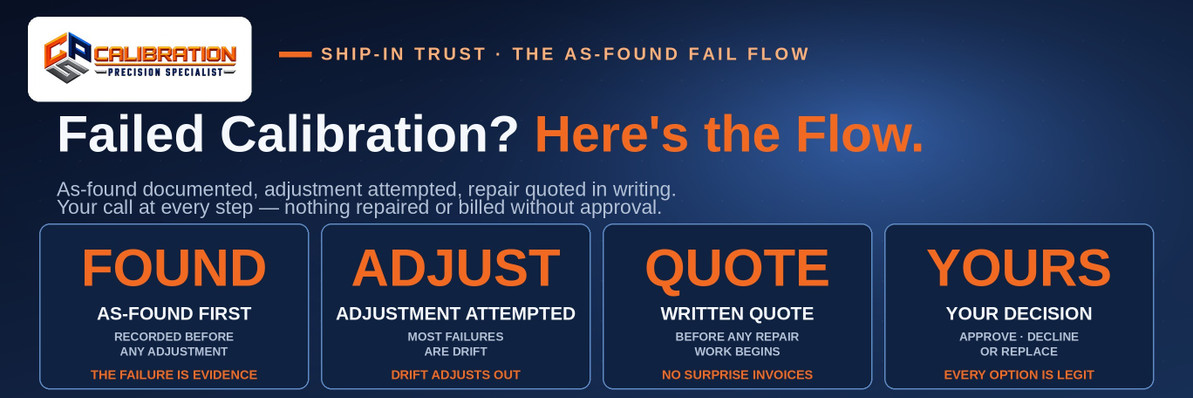
When a gas detector fails calibration at CPS, four things happen in order: the failure is documented as-found — what each channel actually read against known gas before anyone adjusted anything — an adjustment is attempted, because most failures are drift and drift adjusts out; any channel that still will not come in is diagnosed down to the sensor or the hardware behind it; and anything beyond calibration is quoted to you in writing before any work happens, so the repair decision is yours, made with the real figure in hand. Nothing is repaired on the back of a calibration booking, and nothing you did not approve is billed. If you decline, the instrument returns as-is with its as-found record — which is itself a document your safety file needs.
'Failed calibration' is the phrase nobody wants on a certificate, and it means less — and more — than it sounds like. Less, because a failed as-found is often just drift that an adjustment corrects in the same visit. More, because when it is not drift, the as-found record is the single most useful document in the instrument's file: it proves what the meter was telling its wearer, and it is the baseline every repair decision gets made from.
This post walks the exact flow a failed instrument follows on the CPS bench, step by step, including the points where you decide and the points where you pay nothing. It pairs with two documents in this series: what's on a CPS calibration certificate — including what a failed one shows — and what happens to your instrument when you ship it to CPS, the chain of custody from the dock to the bench and back.
Step One and Two: The Failure Is Documented, Then Adjustment Is Attempted
Step one: the as-found is recorded before anything is touched. The instrument is checked in against its serial number and exposed to documented calibration gas exactly as it arrived. Whatever each channel reads is written down. That ordering is the whole discipline: an as-found taken after an adjustment is not an as-found, it is a story. The recorded failure tells you which channels failed, by how much, and in which direction — low, which hides gas, or high, which cries wolf — and that record exists whether the instrument is ultimately repaired, retired, or returned untouched.
Step two: adjustment is attempted. Most as-found failures are drift — sensors move with age, exposure, and storage, and moving back is literally what calibration is. The bench adjusts each failed channel and re-tests it. A channel that adjusts back into specification and holds is a pass with a documented history: the certificate shows the as-found failure and the as-left pass side by side, which is not an embarrassment — it is proof the calibration did its job, and it flags that channel to watch at the next interval. Only a channel that will not adjust in, will not hold, or responds sluggishly or unstably moves to step three.
Step Three and Four: Diagnosis, Then a Written Quote — Your Call
Step three: the failure is diagnosed, not guessed at. A channel that will not calibrate has a short list of honest causes: a spent sensor that has used up its life, a poisoned or contaminated sensor, a physical problem behind the sensor — pump, filter, or sample path on a pumped instrument — or, least commonly, a board-level fault. The sensor health check distinguishes them, because the remedies and the prices are completely different: a sensor swap is routine work, while a board failure on an old instrument is a repair-versus-replace conversation. You are told which one you are in, in plain terms.
Step four: anything beyond calibration is quoted in writing before any work. The quote names the work and the figure. Then you choose, and every option is legitimate:
- Approve it. The instrument is repaired, then calibrated, and returns with a certificate showing the original as-found failure and the post-repair as-left pass — a complete, honest record.
- Decline it. The instrument returns as-is, with its as-found record. No repair is performed and none is billed. The record still serves you: it documents that the instrument was verified, found failed, and removed from service on a decision — which is what an auditor wants to see.
- Replace it instead. Sometimes the quote makes the decision for you — if the repair figure approaches what a new instrument costs, replacement is the honest call, and having the written quote is what lets you make it with numbers instead of guesses.
What never happens: a repair appearing on an invoice that you first hear about when the box comes back. The calibration rate you booked — $55 for a single-gas instrument, $90 for a 4- or 5-gas instrument, in-house — is the only figure that runs without a fresh approval from you.
What a Failed Calibration Means for Your Records
A failed instrument is not a paperwork problem to hide; it is a paperwork asset if it is handled in the open. The as-found record shows the instrument was on a real calibration program — meters that are never verified never 'fail,' they just quietly protect nobody. The instrument's record in the CPS Calibration Program keeps the failure, the quote, and your decision together by serial number, so the fleet history shows a managed event rather than a gap.
Two practical duties follow any failure, whichever option you choose. First, the instrument is out of service until it passes — a documented fail that goes back into a worker's pocket undoes the entire point of the record. Second, ask the question the as-found raises: if this channel had drifted that far, what was it reading during its last weeks of use? You cannot rewrite past exposure decisions, but a bad as-found is a legitimate reason to shorten the next interval or add bump discipline — and it is far better learned from a certificate than from an incident report.
Frequently Asked Questions
What does 'failed calibration' actually mean?
It means that when the instrument was exposed to documented calibration gas exactly as it arrived — the as-found test — one or more channels read outside the accepted tolerance, and the reading was recorded before any adjustment. It does not automatically mean the instrument is broken or finished. Most as-found failures are drift, and drift is what adjustment exists to correct. A failure only becomes a repair question when a channel will not adjust back into specification, will not hold, or responds abnormally during the attempt.
Will you repair my detector without asking me?
No. Anything beyond calibration is quoted in writing for your approval before work begins — that is a standing rule, not a courtesy. Approve the quote and the instrument is repaired and then calibrated. Decline it and the instrument returns as-is with its as-found record, and no repair is performed or billed. The only figure that runs on a booking alone is the calibration itself: $55 for a single-gas instrument or $90 for a 4- or 5-gas instrument, in-house at our Rockwood, Tennessee shop.
My detector failed — is it safe to keep using until the repair is decided?
No. A documented fail means the instrument's readings cannot be trusted, and an untrusted detector is worse than none because it certifies bad air as good. The instrument stays out of service until it passes a calibration — repaired and recalibrated, or replaced. The as-found record documents exactly why it was pulled, which is the correct paperwork posture: verified, found failed, removed from service on a recorded decision.
What are the usual causes of a failed calibration?
The honest short list: sensor drift with age and exposure (the most common, and usually adjustable), a spent sensor at the end of its life, a poisoned or contaminated sensor after a bad exposure, a sample-path problem on a pumped instrument — weak pump or clogged filter starving the sensors — and, least often, a board-level fault. The diagnosis matters because the remedies differ completely in cost: adjustment is part of calibration, a sensor swap is routine, and a board failure is a repair-versus-replace conversation. You are told which cause you are in before any quote is written.
What shows on the certificate when a detector fails?
The as-found readings, channel by channel — what the instrument actually read against known gas when it arrived — and, where adjustment succeeded, the as-left readings beside them. If a channel could not be brought in and you decline repair, the record stands as an as-found failure document. Our breakdown of the document itself is what's on a CPS calibration certificate. There is one certificate tier at CPS; a failed instrument gets the same full breakdown as a passing one, because the failure is exactly when the documentation matters most.
How much will the repair cost?
There is no honest generic figure, and this post will not invent one — a sensor swap, a pump problem, and a board fault are different work at different prices. What is guaranteed is the sequence: diagnosis first, then a written quote naming the work and the figure, then your decision. You will never learn a repair price from an invoice after the fact. If the quote approaches the cost of a new instrument, replacement becomes the honest option, and the quote is what lets you compare the two with real numbers.
Does a failed calibration affect the instrument's history?
Yes — correctly. The instrument's record in the CPS Calibration Program keeps the as-found failure, the diagnosis, the quote, and your decision together under its serial number. That is a feature, not a stain: a fleet history that shows a failure found, documented, and acted on is what a functioning calibration program looks like to an auditor. A history with no failures in it, across a whole fleet and many years, is the one that raises questions.
Can a detector that failed be calibrated again after repair?
Yes — that is the normal path. Once the approved repair is complete, the instrument is calibrated as configured and must pass on its as-left readings before it returns to service. The certificate then tells the complete story in one document: the original as-found failure, and the post-repair as-left pass. The instrument goes back into the field with a current, honest calibration — and its next due date is tracked in the CPS Calibration Program like any other instrument's.
Should I bump test more often after a failure?
It is a reasonable response, and the as-found numbers tell you why: a channel that drifted far between calibrations was giving wrong readings for some part of that interval, and bump testing before use is the check that catches a dead or unresponsive sensor between calibrations. A bump test does not measure accuracy — only calibration does that — but as a daily go/no-go screen it shortens the window in which a failed channel can hide. Some fleets also shorten the calibration interval after a bad as-found; that decision is yours, and the record supports making it.
How long does the failed-calibration flow take?
Call 865-900-8844 and we will confirm the current turnaround for the bench queue. We do not publish a fixed turnaround, because a failed instrument's timeline honestly includes you: diagnosis and the written quote move at bench speed, but the repair itself waits on your approval of that quote, and on parts if a sensor must be ordered. A straightforward drift failure that adjusts out, by contrast, moves with the regular queue. Transit time in both directions is the carrier's.
The Bottom Line
A failed calibration is not a dead end or a blank check — it is a documented flow with your hand on the valve: as-found recorded first, adjustment attempted, the real cause diagnosed, and any repair quoted in writing for your approval before a wrench turns. Approve, decline, or replace — each is a legitimate decision, and each leaves your safety file stronger than an instrument that was never verified at all.
Detector failed, or due to find out? Start the ship-in calibration and repair request, or call CPS Calibrations at 865-900-8844. Ship-in address: 109 S. Front Street, Rockwood, TN 37854.
--- CPS Calibrations · 109 S. Front Street, Rockwood, TN 37854 · What's on a CPS Calibration Certificate · What Happens to Your Instrument at CPS · Calibration Services
Ready to mail in your detector?
Start the ship-in request, pack the meter, and we handle the rest — every channel calibrated as configured, full certificate returned with it.
Start Your Ship-In Requestor call 865-900-8844
Recent Posts
-

What Is Remote Monitoring for Fixed Gas Detection?
Remote monitoring for fixed gas detection means a fixed system's live readings, trends, and alarm hi …Nov 23rd 2026 -

What Are the Key Differences Between the GX-6000 and GX-6100?
The RKI GX-6100 is the current replacement for the discontinued GX-6000: both are pumped 6-gas monit …Nov 22nd 2026 -

How to Read a PID Correction Factor Chart
To read a PID correction factor chart, find your vapor’s row, take the factor under your own lamp en …Nov 21st 2026