
What Happens to Your Instrument When You Ship It to CPS
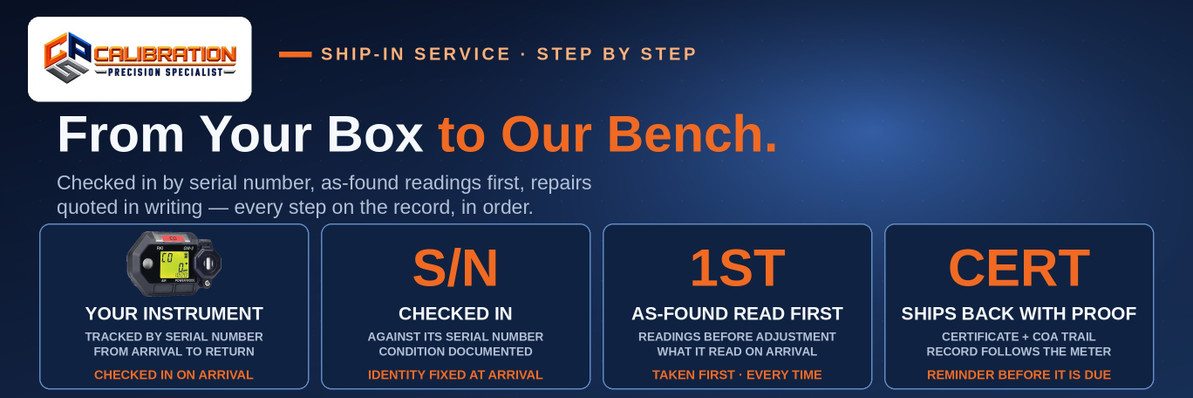
When you ship an instrument to CPS Calibrations, this happens, in order: it is checked in against its serial number with documentation on its record; on the bench, its as-found readings are recorded before anything is adjusted; we calibrate every channel it carries at the published in-house rate — $55 for a single-gas instrument, $90 for a 4- or 5-gas instrument; anything beyond calibration is quoted in writing before work, never simply done; and the instrument ships back (return shipping is the customer's cost) with a full certificate showing as-found and as-left data and a Certificate of Analysis link for each calibration gas bottle used, while its record — history and next due date — follows the instrument in the CPS Calibration Program. No step is a mystery, and no step happens off the record.
Mailing an instrument is an act of trust with a specific dollar figure attached — for a lot of readers it is a $1,500 meter, boxed up and handed to a carrier, bound for a company in Tennessee they found on the internet. The way to earn that trust is not reassurance; it is a published process specific enough to be checked. This post is that process, step by step, including the parts a less careful shop would leave vague: what happens the hour the box arrives, what is written down before anyone adjusts anything, and the exact point at which your money is and is not committed. If you arrived here from no gas detector calibration near you? Ship it to CPS, this is the detail behind that post's promise; the general service overview is how mail-in gas detector calibration works.
Step 1 — Arrival and Check-In Against the Serial Number
Your tracking number is your receipt for the trip; check-in is our receipt for the arrival. When the box reaches CPS Calibrations, 109 S. Front Street, Rockwood, TN 37854, the instrument is checked in against its serial number — the same serial number you noted inside the box — and that serial number becomes the thread everything else hangs on: the work order, the bench record, the certificate, and the program history all belong to that number, not to a pile position or a shelf guess. Check-in is documented on the instrument's record, including check-in photos taken as part of our internal service documentation, so the instrument's condition and identity at arrival are a matter of record from the first hour. In a mixed shipment — several instruments, several models, maybe several locations' meters in one box — each instrument is checked in individually, by its own serial number, so nothing is calibrated, certified, or returned under another unit's identity.
Step 2 — On the Bench: As-Found First, Before Anything Is Adjusted
The first bench act is not an adjustment. It is a reading. Before anything on the instrument is changed, we record its as-found readings — what each channel was actually reporting against known calibration gas when it arrived. That record is the most honest document in the whole transaction: it tells you whether the meter you had been trusting was reading true, drifting, or worse, and it can never be reconstructed after the fact, which is why it is taken first, every time. Then we calibrate every channel the instrument carries — adjusting each one against documented gas — and record the as-left readings that the instrument leaves with. If the instrument calibrates back into specification on every channel, the story is complete: as-found, as-left, done at the flat in-house rate.
Step 3 — If It Needs More Than Calibration, the Quote Comes Before the Work
Sometimes the as-found readings or the bench check show a problem calibration cannot fix: a sensor spent or failing, damage, a part at the end of its life. At that point the process stops and the paperwork starts. The repair — what it needs, what it costs — is quoted in writing before any work is done, and the decision is entirely yours. Approve it, and the instrument is repaired and then calibrated, with the quote as the agreed figure. Decline it, and the instrument is returned as-is, with its as-found record: dated, factual documentation of where the instrument stands, which is itself the evidence a repair-or-replace decision should rest on. What never happens is the middle path some shops take — repairing first and presenting the calibration customer with a combined bill. A calibration booking authorizes a calibration. Everything beyond it waits for your signature on a quote.
Step 4 — The Certificate: What the Numbers Were, and the Gas Behind Them
Every instrument returns with the CPS certificate — one tier, the full breakdown, the same whether the instrument is a single-gas clip or a five-gas flagship. It carries the as-found and as-left readings for every channel, and it carries the gas trail: when a calibration gas bottle enters service at CPS, the supplier QR code on it is scanned and its Certificate of Analysis link is stored on the bottle's record, and the certificate includes a clickable CoA link for each bottle used on your instrument — so the numbers on the page trace back to documented gas, not to a shop's say-so. What is on the certificate, element by element, has its own post: what's on a CPS calibration certificate. The certificate is the document your safety file, your auditor, or your insurer reads; it is written for them as much as for you.
Step 5 — The Trip Home, and the Record That Stays
The instrument ships back to you with its certificate; return shipping is the customer's cost, arranged when the service is booked — the published $55 and $90 in-house rates are the calibration service itself, with freight kept visible rather than buried in the rate. Keep the return tracking the same way you kept the outbound: it closes the loop that check-in opened. And while the instrument travels home, its record does not travel at all — it stays, and grows. In the CPS Calibration Program, that serial number now carries this calibration: the certificate, the history, and the next due date, filed behind your one fleet history link with per-location views alongside every other instrument we calibrate for you. Before the next due date arrives, a reminder email does. There is no contract and no monthly fee; the record is part of the calibration, and it is what makes the second shipment easier than the first — we already know the instrument, and so does its file.
Frequently Asked Questions
How do I know CPS received my instrument?
Two records meet. Yours is the carrier's tracking, which shows delivery to Rockwood; ours is check-in — the instrument is checked in against its serial number when it arrives, documented on its record, and the work order, bench record, and certificate all run under that serial number from that point. If tracking shows delivered and you want confirmation of check-in, call 865-900-8844 with the serial number and we can tell you exactly where the instrument stands in the process.
Is my instrument photographed or documented when it arrives?
Yes — as part of check-in. Instruments are checked in against serial number with documentation on the instrument's record, including check-in photos taken as part of our internal service documentation in the calibration system. That documentation fixes the instrument's identity and condition at arrival, before bench work begins. It is an internal service record — it is not printed on the calibration certificate, which carries the calibration data itself: as-found and as-left readings and the calibration gas's Certificate of Analysis links.
What exactly is recorded before my instrument is adjusted?
Its as-found readings: what every channel the instrument carries was actually reporting against known calibration gas when it arrived, before any adjustment is made. That sequence — read first, adjust second — is the whole point. The as-found data shows how the instrument you had been relying on was truly performing, it can never be recreated after adjustment, and it appears on your certificate alongside the as-left readings recorded after calibration, channel by channel.
Will CPS repair my instrument without asking me?
No. A calibration booking authorizes a calibration — nothing more. If the bench finds the instrument needs a sensor, a part, or a repair, that work is quoted in writing before it is done, with the decision yours. Approve the quote and the work proceeds at the quoted figure; decline it and the instrument is returned as-is with its as-found record. There is no path in our process where a repair happens first and is billed after.
What comes back in the box with my instrument?
The instrument, calibrated, and its certificate. The certificate shows the as-found readings from arrival and the as-left readings after calibration for every channel the instrument carries, plus a clickable Certificate of Analysis link for each calibration gas bottle used on it — the CoA link stored from the supplier QR code scanned when that bottle entered service at CPS. Return shipping is the customer's cost, arranged when the service is booked. The instrument's record — this calibration, its history, and its next due date — stays in the CPS Calibration Program under its serial number.
What does the calibration itself cost?
The published in-house rates: $55 for a single-gas instrument and $90 for a 4- or 5-gas instrument. Those are bench rates for calibration performed in-house at our Rockwood shop — they apply whether the instrument arrives by mail or in person, and they never apply to on-site work, which is quoted in writing for the job. Shipping is separate in both directions, and any repair beyond calibration is quoted in writing before work. The figure you commit to is known before it is spent.
How long does the whole ship-in process take?
Turnaround is confirmed when you book the service — call 865-900-8844 before you ship — because it depends on the current bench queue and on what your instrument needs. A straightforward calibration moves with the queue; an instrument that needs a repair waits on your decision on the written quote and on parts. Transit time in both directions belongs to the carrier you choose. We do not publish a fixed turnaround, because a number we cannot keep for every instrument would make this post's process less trustworthy, not more.
What if my instrument is damaged or lost in transit?
That risk lives with the shipping leg, which is yours to control: choose the carrier, service level, and any declared-value or insurance options that fit what the instrument is worth, pack it padded like the precision instrument it is, and keep the tracking number. CPS's side of the chain is documented from the moment of arrival — check-in against serial number, with the instrument's condition documented on its record — and return shipping is trackable the same way. What we will not do is bury transit promises in a calibration rate; the honest arrangement is careful packing, tracking on both legs, and a documented hand-off at each end.
Does my instrument's record stay with CPS after it ships back?
Yes — that is the point of the CPS Calibration Program. The calibration is filed under the instrument's serial number: its certificate and history build up visit by visit behind your one fleet history link with per-location views, and due-date reminder emails arrive before the next calibration comes due. There is no contract and no monthly fee. The record follows the instrument, not the shipment — so the second time you send it in, its file already knows it.
What should I put in the box when I ship my instrument?
The instrument, its charger if it uses one, and a note inside the box with your company name, a contact name and phone number, and the instrument's serial number — the number it will be checked in against. Do not send calibration gas cylinders: CPS calibrates with its own documented gas, whose Certificates of Analysis are what end up linked on your certificate. Pack the instrument padded and secure for a two-way trip, and keep your tracking number until check-in is confirmed.
The Bottom Line
Shipping an instrument to CPS is not a leap of faith; it is a sequence you can audit: check-in against serial number, as-found readings recorded before adjustment, every channel calibrated at a published in-house rate — $55 single-gas, $90 for 4- and 5-gas — repairs quoted in writing before work, and a return with a full certificate and the calibration gas's CoA trail, while the record follows the instrument into its next due date. That is what happens to your instrument, all of it, in writing, before you tape the box.
Ready when you are: call CPS Calibrations at 865-900-8844 to book the service, then ship your instrument to 109 S. Front Street, Rockwood, TN 37854.
CPS Calibrations · 109 S. Front Street, Rockwood, TN 37854 · What's on a CPS Calibration Certificate · How Mail-In Gas Detector Calibration Works · No Gas Detector Calibration Near You? Ship It to CPS
Ready to mail yours in?
Start the ship-in request, pack the meter, and we handle the rest — every channel calibrated as configured, full certificate returned with it.
Start Your Ship-In Requestor call 865-900-8844
Recent Posts
-

What Is Remote Monitoring for Fixed Gas Detection?
Remote monitoring for fixed gas detection means a fixed system's live readings, trends, and alarm hi …Nov 23rd 2026 -

What Are the Key Differences Between the GX-6000 and GX-6100?
The RKI GX-6100 is the current replacement for the discontinued GX-6000: both are pumped 6-gas monit …Nov 22nd 2026 -

How to Read a PID Correction Factor Chart
To read a PID correction factor chart, find your vapor’s row, take the factor under your own lamp en …Nov 21st 2026