
No Gas Detector Calibration Near You? Ship It to CPS
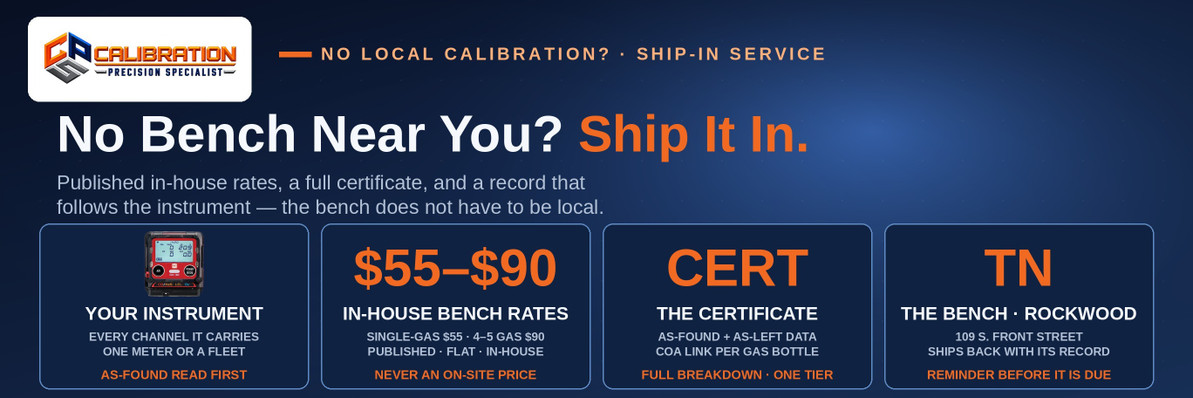
If there is no gas detector calibration near you, ship the instrument to CPS Calibrations in Rockwood, Tennessee: our in-house calibration rate is $55 for a single-gas instrument and $90 for a 4- or 5-gas instrument, we calibrate every channel the instrument carries and record as-found readings before any adjustment, and it returns with a certificate showing as-found and as-left data and a Certificate of Analysis link for each calibration gas bottle used — with its record and next due date kept in the CPS Calibration Program. One instrument or a whole fleet, the bench does not have to be local to be yours.
"No gas detector calibration near me" is not a niche search. It is what the safety manager at a two-crew plant, the chief of a small department, and the owner of a four-truck contracting company all type when a due date lands and the map comes up empty — or worse, when the only "local" result is a counter that takes the meter, mails it somewhere unnamed, and hands back a sticker and an invoice weeks later. If that is your situation, this post is the direct answer: the somewhere can be us, the rate is published, and the paperwork is the strongest part of the deal. The full process is laid out in how mail-in gas detector calibration works; this post is for the moment before that, when you are still deciding whether shipping a meter across the country is a real option. It is.
Why "Near You" Is the Wrong Test for a Calibration Bench
Calibration quality does not come from proximity. It comes from three things a bench either does or does not do: recording what the instrument was reading when it arrived (the as-found readings, before anyone touches an adjustment), calibrating with gas whose documentation traces to a Certificate of Analysis, and returning a record you can hand to an auditor, an insurer, or your own safety file without apology. A bench two states away that does all three beats a counter ten minutes away that does none of them — and the counter ten minutes away is very often shipping your instrument to a bench anyway, adding a middleman, a markup, and a week, while telling you none of it. Shipping it yourself to CPS Calibrations at 109 S. Front Street, Rockwood, TN 37854 removes the middleman and replaces "trust us" with published rates and a certificate standard you can read before you spend a dollar.
What It Costs: Published In-House Rates, No Guessing
The rate card is short enough to print here in full: $55 for a single-gas instrument, $90 for a 4- or 5-gas instrument. Those are our in-house bench rates — the price of calibration performed at our bench in Rockwood, whether the instrument arrives by mail or is carried through the door. Two boundaries, stated plainly because they matter. First, these are in-house rates only: they never apply to on-site work, which is quoted in writing for the job. Second, they are the service rate: you ship the instrument to us at your cost, return shipping is the customer's cost, and if an instrument turns out to need a sensor or a repair beyond calibration, that work is quoted in writing before it is done — you approve it or the instrument comes back as-is with its as-found record. The number you commit to is known before it is spent, from anywhere in the country. Details and booking start at calibration services or by phone at 865-900-8844.
One Instrument or a Whole Fleet — Both Ship the Same Way
The smallest version of this problem is one meter: a single-gas detector on one truck, due next month, with nobody within driving distance who calibrates it. Ship that one meter; the $55 in-house rate and the full certificate apply exactly the same. The larger version is a fleet — a plant, a utility crew, a department — with a rack of 4-gas meters coming due together. Ship them in one box or in rotations: every instrument is checked in against its own serial number, calibrated channel by channel, and returned with its own certificate, while the fleet's history collects behind one fleet history link with per-location views in the CPS Calibration Program. Rotating shipments keep calibrated meters on site while the rest are on the bench, and because each instrument's record is kept by serial number, a mixed shipment never turns into mixed-up paperwork. There is no contract and no monthly fee for the program — the record, the per-location views, and the due-date reminder emails come with the calibration.
What Comes Back in the Box
The instrument, calibrated — and the proof. Every CPS calibration returns one certificate tier, the full breakdown: as-found and as-left readings for every channel the instrument carries, not a pass/fail sticker. The gas behind the numbers is documented as well: when a calibration gas bottle enters service at CPS, the supplier QR code on it is scanned and its Certificate of Analysis link is stored on the bottle's record, and your certificate carries a clickable CoA link for each bottle used on your instrument. So the file you keep shows what the meter read when it arrived, what it read when it left, and the documented gas both readings were set against. What happens to the instrument at each step between your box and ours — check-in against its serial number, the bench flow, the repair-quote rule — is walked through in what happens to your instrument when you ship it to CPS.
How to Start
Call 865-900-8844 first. We confirm your instrument is one our bench covers — service coverage is broader than the brands we sell, so ask even if you bought the meter somewhere else — confirm the in-house rate, and confirm the current bench turnaround before anything leaves your shelf. Then pack the instrument and its charger if it has one (never calibration gas cylinders — we calibrate with our own documented gas), put your company name, a contact, and the serial number inside the box, and ship it to Rockwood. The packing details that protect sensors in transit are covered step by step in how to ship a gas detector for calibration. Keep your tracking number until the instrument is checked in here.
Frequently Asked Questions
There is no gas detector calibration near me. What are my options?
Ship the instrument to a bench that publishes its rates and its certificate standard. At CPS Calibrations in Rockwood, Tennessee, mail-in calibration is $55 in-house for a single-gas instrument and $90 in-house for a 4- or 5-gas instrument. We calibrate every channel the instrument carries, record as-found readings before adjustment, and return it with a full certificate and a record in the CPS Calibration Program. Call 865-900-8844 to confirm your model and the current turnaround before you ship.
How much does it cost to ship a gas detector to CPS for calibration?
The calibration itself is the published in-house rate: $55 for a single-gas instrument, $90 for a 4- or 5-gas instrument. Shipping is separate — sending the instrument to Rockwood is your cost, and return shipping is the customer's cost, arranged when the service is booked. Those $55 and $90 figures are in-house bench rates only; they never apply to on-site work, which is quoted in writing. If the instrument needs a sensor or repair, that is quoted in writing for your approval before any work is done.
Can I ship just one instrument, or is mail-in only for fleets?
One instrument is fine — a single meter gets the same flat in-house rate, the same full certificate with as-found and as-left data, and the same program record as a fleet shipment. Fleets simply scale the same process: each instrument is checked in against its own serial number, gets its own certificate, and the fleet's history collects behind one link with per-location views. There is no minimum shipment size.
Can I ship my whole fleet at once?
Yes, and many customers rotate instead: send part of the fleet while calibrated units stay in service, then swap. Either way, every instrument is tracked by serial number from check-in to return, each returns with its own certificate, and the CPS Calibration Program keeps the whole fleet's history — every instrument, every date — behind one link. Call 865-900-8844 to plan a rotation around your due dates.
Who pays for shipping when I mail in a gas detector?
You do, in both directions. The published $55 and $90 in-house rates are the calibration service itself, kept flat rather than padded with an averaged freight charge. You choose the carrier and speed that fit your downtime when you ship to CPS Calibrations, 109 S. Front Street, Rockwood, TN 37854, and return shipping is the customer's cost, arranged when the service is booked. Keep your tracking number until the instrument is checked in against its serial number here.
How long will I be without my gas detector?
For the honest answer, call before you ship: turnaround is confirmed when the service is booked, because it depends on the current bench queue and on what the instrument turns out to need — a straightforward calibration moves with the queue, while an instrument needing a sensor or repair waits on your written approval of the quote and on parts. Transit time in both directions is the carrier's. We do not publish a turnaround number we cannot keep for every instrument, every week.
What certificate do I get with a shipped-in calibration?
A full certificate — the only tier CPS issues. It shows the as-found readings recorded when your instrument arrived and the as-left readings after calibration, for every channel the instrument carries. It also carries the gas trail: a clickable Certificate of Analysis link for each calibration gas bottle used on your instrument, stored from the supplier QR code scanned when that bottle entered service at CPS. It is built to be filed for an auditor, an insurer, or your own safety records.
What if my detector needs a sensor or a repair, not just calibration?
You find out from the as-found readings and the bench check, and you decide from a written quote. Calibration that succeeds is billed at the flat in-house rate. Work beyond calibration — a sensor, a part, a repair — is quoted in writing before it is done. Approve it and the instrument is repaired and calibrated; decline it and the instrument is returned as-is with its as-found record, which is itself a dated, factual basis for a repair-or-replace decision. Nothing is repaired first and billed later.
Will CPS calibrate a brand of detector I bought somewhere else?
In most cases, yes. CPS's service coverage is broader than its sales catalog — the bench calibrates instruments across the brands crews actually run, not only the brands on our shelves, and we calibrate every channel an instrument carries. The fastest way to confirm your specific model is a one-minute call to 865-900-8844, before you spend anything on shipping. If an instrument is genuinely outside what our bench can document properly, we will tell you that up front.
How will I know when my shipped-in detector is due for calibration again?
The CPS Calibration Program keeps the date for you. Every instrument we calibrate has a record by serial number — its calibration history, building visit by visit behind your fleet history link — and due-date reminder emails go out before the next calibration comes due, while there is still time to plan the shipment. There is no contract and no monthly fee; the record and the reminders come with the calibration.
The Bottom Line
"Near you" was never the point — documented is the point. Ship the instrument to CPS Calibrations in Rockwood, Tennessee, and it is bench-calibrated at a published in-house rate — $55 single-gas, $90 for 4- and 5-gas — with as-found and as-left data and the calibration gas's CoA trail on the certificate, and a program record that reminds you before it is due again. One meter or a fleet, rural plant or small department: the bench is a box away.
No local option? Call CPS Calibrations at 865-900-8844 to confirm your instrument and rate, then ship it to 109 S. Front Street, Rockwood, TN 37854.
CPS Calibrations · 109 S. Front Street, Rockwood, TN 37854 · Calibration Services · How Mail-In Gas Detector Calibration Works · What Happens to Your Instrument When You Ship It to CPS
Ready to mail yours in?
Start the ship-in request, pack the meter, and we handle the rest — every channel calibrated as configured, full certificate returned with it.
Start Your Ship-In Requestor call 865-900-8844
Recent Posts
-

What Is Remote Monitoring for Fixed Gas Detection?
Remote monitoring for fixed gas detection means a fixed system's live readings, trends, and alarm hi …Nov 23rd 2026 -

What Are the Key Differences Between the GX-6000 and GX-6100?
The RKI GX-6100 is the current replacement for the discontinued GX-6000: both are pumped 6-gas monit …Nov 22nd 2026 -

How to Read a PID Correction Factor Chart
To read a PID correction factor chart, find your vapor’s row, take the factor under your own lamp en …Nov 21st 2026