
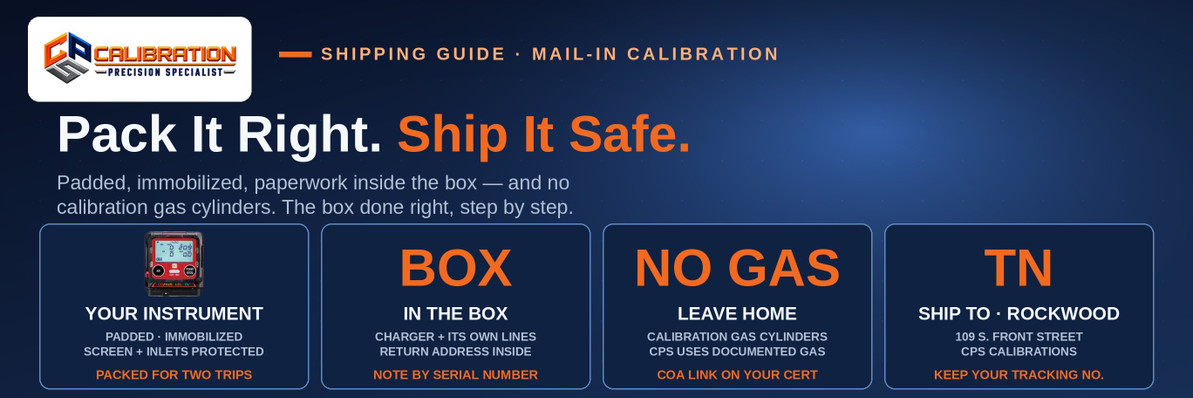
How to Ship a Gas Detector for Calibration
Ship a gas detector for calibration like this: start the service request first — call CPS Calibrations at 865-900-8844 or start at calibration services — then pack the instrument padded and protected with its charger, any pump or sample lines that belong to the instrument, and a note inside the box with your return address and contact, and ship it to CPS Calibrations, 109 S. Front Street, Rockwood, TN 37854. Do not ship calibration gas cylinders with the instrument — CPS calibrates with its own documented gas, so your cylinders stay home.
A gas detector is a precision measuring instrument with sensors that do not love being dropped, crushed, or left rattling loose in a half-empty box. The trip to the bench and the trip home are the two roughest things that will happen to it all year, and both trips are in your hands, not ours. This post is the practical packing and paperwork walk-through that sits alongside the overview of how mail-in gas detector calibration works — that post covers the bench process; this one covers the box.
Start With the Service Request, Not the Tape Gun
- Step 1 — Tell us what is coming before you pack it. Call 865-900-8844 or start from calibration services. We confirm the instrument is one our bench covers — service coverage is broader than the brands we sell, and we calibrate every channel an instrument carries — confirm the in-house rate for it ($55 single-gas, $90 for a 4- or 5-gas instrument, bench rates only), and confirm the expected turnaround against the current bench queue. That two-minute step is what turns a mystery box on our dock into an expected instrument with a name on it.
- Step 2 — Gather what belongs with the instrument. The instrument itself, its charger if it uses one, and — where they belong to the instrument — its pump and sample lines. If a pumped instrument arrives without the lines it normally samples through, say so on the note inside the box, so the bench knows what it is and is not looking at. Accessories that do not travel with the instrument in normal use do not need to make the trip.
- Step 3 — Write the note that goes inside the box. One sheet, inside the box, not just a label on the outside: your company name, a contact name and phone number, your return shipping address, and the instrument's make, model, and serial number. Outer labels fall off and get covered; a note inside the box still identifies the instrument when it is opened on the bench. If anything about the instrument is unusual — a known fault, a sensor you already suspect, a hard due date — write that on the note too.
- Step 4 — Pack it like it has to make the trip twice. Because it does. Wrap the instrument so it cannot shift inside the box, fill the empty space so nothing rattles, and choose a box sturdy enough to survive a conveyor and a stacked truck in both directions. A detector loose in a large box arrives as a repair question instead of a calibration; a detector immobilized in padding arrives as a calibration. Keep chargers and lines from pressing directly against the instrument's screen and sensor inlets.
- Step 5 — Ship it to Rockwood and keep the tracking number. Address: CPS Calibrations, 109 S. Front Street, Rockwood, TN 37854. Your tracking number is your receipt until the instrument is checked in here against its serial number. Shipping to us is your cost; return shipping is also the customer's cost, arranged when the service is booked.
What Should Go in the Box — and What Should Not?
Send: the instrument; its charger; its pump and sample lines where they belong to the instrument; and the inside-the-box note with your return address, contact, and the instrument's serial number. That list is deliberately short.
Do not send calibration gas cylinders. This is a ship-in instruction, plain and simple: CPS bench-calibrates with its own gas, and every bottle used on your instrument is documented — the supplier QR code on each bottle is scanned when the bottle enters service here, its Certificate of Analysis link is stored on the bottle's record, and that link appears on your certificate, as what's on a CPS calibration certificate walks through. Your cylinders do no work on our bench, so they stay home — one less heavy, fragile thing in the box and nothing of yours stranded in Tennessee. The same logic covers anything else the bench does not need: if it is not the instrument, its charger, or its own lines, leave it out and note anything unusual on the sheet inside instead.
What Happens After the Box Arrives?
The instrument is checked in against the serial number on your note, and the bench work starts with the record that matters most: as-found readings — what the instrument was actually reading when it arrived, before any adjustment. We calibrate every channel it carries, record the as-left readings, and the instrument returns with a full certificate showing both, plus the Certificate of Analysis link for each calibration gas bottle used. If the bench finds a spent sensor or damage instead, that work is quoted in writing before it is done — a calibration booking is never a blank check for repairs. Sending more than one instrument, or a whole fleet, has its own playbook: shipping a whole fleet for calibration. And if there is genuinely no good bench near you at all, that is the case the whole service exists for: no gas detector calibration near you? Ship it to CPS.
Frequently Asked Questions
How do I ship a gas detector for calibration?
Start the service request first — call CPS Calibrations at 865-900-8844 or start at the calibration services page — so the rate and the expected turnaround against the current bench queue are confirmed before anything leaves your shelf. Then pack the instrument padded and immobilized, include its charger and any pump or sample lines that belong to it, put a note inside the box with your return address, contact name and phone, and the instrument's serial number, and ship it to CPS Calibrations, 109 S. Front Street, Rockwood, TN 37854, keeping your tracking number until it is checked in.
What should I include in the box with my gas detector?
Four things: the instrument, its charger if it uses one, its pump and sample lines where they belong to the instrument, and a note inside the box — not just on the outside — with your company name, a contact name and phone number, your return shipping address, and the instrument's make, model, and serial number. If the instrument has a known fault or a sensor you already suspect, write that on the note as well, so the bench sees it at check-in.
Should I ship my calibration gas cylinder with the detector?
No. Do not ship calibration gas cylinders with an instrument sent in for calibration. CPS calibrates with its own documented gas: each bottle's Certificate of Analysis link is stored when the bottle enters service here, and that link appears on your calibration certificate for the bottles used on your instrument. Your cylinders do no work on the bench, so they stay home — and the box is lighter and simpler for it.
How should I pack a gas detector so the sensors are not damaged in shipping?
Treat it as the precision instrument it is: wrap it so it cannot shift, fill every empty space in the box so nothing rattles, keep the charger and lines from pressing against the screen and sensor inlets, and use a box sturdy enough to make the trip twice — out to Rockwood and back to you. A detector loose in an oversized box can arrive as a repair question; a detector immobilized in padding arrives as a straightforward calibration.
Do I need to call before I ship my detector in?
Yes — call 865-900-8844 or start from the calibration services page first. The call confirms the instrument is one our bench covers (service coverage is broader than the brands we sell), confirms the in-house rate — $55 single-gas, $90 for a 4- or 5-gas instrument, bench rates only — and confirms the expected turnaround for the current bench queue. It also means the instrument is expected here by serial number instead of arriving as an anonymous box.
What does it cost to ship a detector in for calibration?
The calibration itself is a published flat in-house rate: $55 for a single-gas instrument and $90 for a 4- or 5-gas instrument — the same rates as the Rockwood bench. Shipping is separate in both directions: shipping the instrument to us is your cost, and return shipping is the customer's cost, arranged when the service is booked. If the instrument needs a sensor or a repair beyond calibration, that work is quoted in writing for your approval before it is done.
Will my detector come back with a calibration certificate?
Yes — a full certificate, one tier, not a pass/fail sticker. It shows the as-found readings recorded when the instrument arrived and the as-left readings after calibration, for every channel the instrument carries. It also carries a clickable Certificate of Analysis link for each calibration gas bottle used on your instrument — each bottle's CoA link is stored from the supplier QR code scanned when the bottle entered service at CPS — so the numbers on the certificate trace back to documented gas.
What if my detector needs a repair, not just a calibration?
You find out in writing before any money moves. The as-found readings and the bench check show whether the instrument calibrated back into specification or whether a sensor is spent or something is damaged. Calibration that succeeds is billed at the flat in-house rate; sensors, parts, and repairs are quoted in writing first, and the choice is yours — approve the work, or have the instrument returned as-is with its as-found record as the factual basis for a repair-or-replace decision.
Can I ship more than one detector in the same box?
Yes — multiple instruments can travel together, and fleets do it routinely. List every instrument on the note inside the box by make, model, and serial number, pack each one so it cannot shift or press against the next, and each instrument is still checked in, calibrated, and certificated individually by serial number. For a whole fleet — including staggering instruments in waves so your operation never stops — see the companion post on shipping a whole fleet for calibration.
How will I know when my shipped-in detector is due for calibration again?
Its record is kept in the CPS Calibration Program. Every instrument CPS calibrates has a history by serial number that builds up calibration by calibration, and email due-date reminders reach you before the next calibration comes due, while there is still time to plan the shipment. There is no contract and no monthly fee for the program — the record and the reminders come with the calibration.
The Bottom Line
Shipping a gas detector for calibration is a five-minute packing job done right: service request first, instrument padded and immobilized, charger and its own pump or sample lines in the box, your return address and contact on a note inside the box, and no calibration gas cylinders — those stay home. Do that, and the box that arrives in Rockwood is a calibration, not a question.
Ready to ship an instrument in? Call CPS Calibrations at 865-900-8844 to start the service request, then send it to 109 S. Front Street, Rockwood, TN 37854.
CPS Calibrations · 109 S. Front Street, Rockwood, TN 37854 · Calibration Services · How Mail-In Gas Detector Calibration Works · What's on a CPS Calibration Certificate
Ready to mail yours in?
Start the ship-in request, pack the meter, and we handle the rest — every channel calibrated as configured, full certificate returned with it.
Start Your Ship-In Requestor call 865-900-8844
Recent Posts
-

What Is Remote Monitoring for Fixed Gas Detection?
Remote monitoring for fixed gas detection means a fixed system's live readings, trends, and alarm hi …Nov 23rd 2026 -

What Are the Key Differences Between the GX-6000 and GX-6100?
The RKI GX-6100 is the current replacement for the discontinued GX-6000: both are pumped 6-gas monit …Nov 22nd 2026 -

How to Read a PID Correction Factor Chart
To read a PID correction factor chart, find your vapor’s row, take the factor under your own lamp en …Nov 21st 2026