
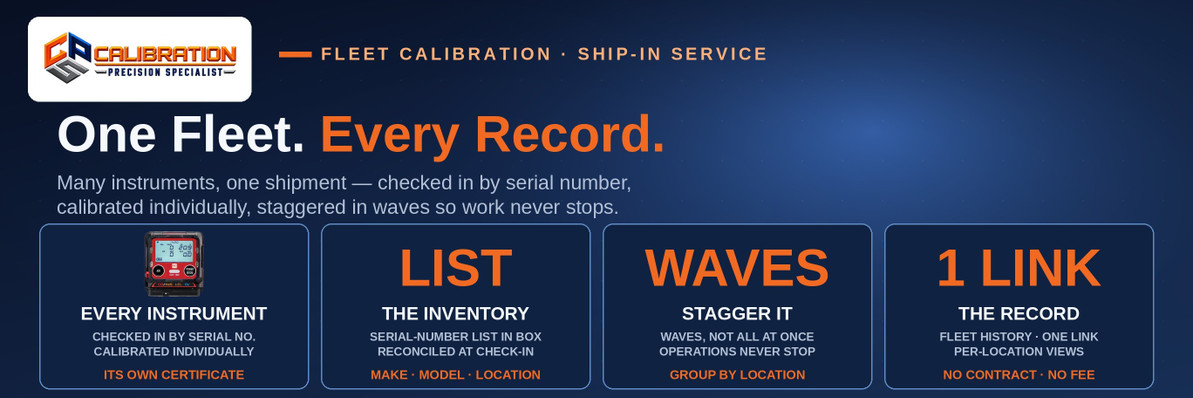
Shipping a Whole Fleet for Calibration
Shipping a whole fleet for calibration works like this: you send many instruments in one shipment to CPS Calibrations, 109 S. Front Street, Rockwood, TN 37854, with an inventory list by serial number inside the box; each instrument is checked in, bench-calibrated, and certificated individually at the published in-house rates — $55 single-gas, $90 for a 4- or 5-gas instrument — and the fleet's record is kept together in the CPS Calibration Program with one fleet history link, per-location views, and one certificate link per instrument. Stagger the fleet in waves and operations never stop while calibration happens.
A fleet is not just a bigger box. It is an inventory problem, a downtime problem, and a records problem arriving on the same pallet — and it fails in predictable ways when it is treated as one instrument multiplied: serial numbers that do not match any list, every unit gone the same week, certificates in a pile nobody can sort by location a year later. This post is the fleet playbook that builds on how mail-in gas detector calibration works and the single-instrument packing guide, how to ship a gas detector for calibration.
How Do You Prepare a Fleet Shipment?
- Step 1 — Build the inventory list by serial number first. Before anything is packed, list every instrument going in the shipment: make, model, serial number, and which location or crew it belongs to. That list goes inside the box, and a copy stays with you. The serial number is the instrument's identity at CPS — check-in, calibration history, and the certificate all key off it — so a fleet shipment lives or dies on the accuracy of this one sheet.
- Step 2 — Book the fleet before it moves. Call 865-900-8844. We confirm the bench covers the instruments on your list — service coverage is broader than the brands we sell, and we calibrate every channel each instrument carries — confirm the in-house rates, and agree the shape of the job: one wave or several, and the expected timing against the current bench queue. A fleet that is expected is a fleet that gets checked in sheet-in-hand, not sorted out from a pile.
- Step 3 — Pack many instruments like many instruments. One box can carry the shipment, but each instrument still gets packed as its own precision device: padded, immobilized, unable to shift against its neighbour, with its charger and any pump or sample lines that belong to it kept with it. Do not send calibration gas cylinders — CPS calibrates with its own documented gas, and the fleet's cylinders stay at your locations.
- Step 4 — Ship to Rockwood and keep the tracking. Address: CPS Calibrations, 109 S. Front Street, Rockwood, TN 37854. Shipping to us is your cost; return shipping is also the customer's cost, arranged when the fleet booking is made.
What Does a Fleet Check-In Look Like?
Instruments are checked in against your inventory list, one by one, by serial number — the list you packed is reconciled with the instruments in the box, so a discrepancy is found on day one, while the box is still open, not at return time. Each instrument then goes through the same bench work as a single shipped-in detector: as-found readings recorded before any adjustment, every channel it carries calibrated, as-left readings recorded after. An instrument that needs a sensor or a repair does not hold the fleet hostage: that work is quoted in writing before it is done, the quote is yours to approve or decline per instrument, and the rest of the fleet keeps moving. Each instrument returns with its own full certificate — as-found and as-left data, plus a clickable Certificate of Analysis link for each calibration gas bottle used on it, from the supplier QR code scanned when each bottle entered service at CPS.
How Does Staggering a Fleet in Waves Work?
Send the fleet in waves sized to your operation: a portion of the instruments travels while the rest stay in service, then the waves swap. No week ever has the whole fleet off site, critical locations keep calibrated instruments on hand throughout, and each wave is small enough to check in, calibrate, and return as a clean unit of work. Waves also smooth the records — due dates that were all stacked on one brutal week spread into a rotation the reminders can actually manage. Which instruments go in which wave is your operational call; the pattern that works is grouping by location or crew, so a location's instruments travel together and its per-location record stays tidy. How the timing of any wave is confirmed — and why no honest single turnaround number exists — is covered in how fast can you get your detector back.
Where Do a Fleet's Records Live Afterwards?
In the CPS Calibration Program: no contract, no monthly fee. Every instrument keeps its own history by serial number, calibration by calibration, and the fleet's history is reachable through one fleet history link with per-location views — so the safety manager sees the whole fleet, a location lead sees only that location's instruments, and every instrument carries one certificate link of its own, as fleet calibration history explains. Email due-date reminders flag each instrument before its next calibration comes due, which is what makes the next fleet cycle a scheduled rotation instead of a scramble.
Frequently Asked Questions
Can I ship my whole fleet in one box for calibration?
Yes — many instruments can travel in one shipment to CPS Calibrations, 109 S. Front Street, Rockwood, TN 37854. Put an inventory list by serial number inside the box, pack each instrument padded and immobilized so it cannot shift against the next, and include each instrument's charger and any pump or sample lines that belong to it. Every instrument is still checked in, calibrated, and certificated individually by serial number — the shared box is logistics, not a bulk shortcut on the bench.
What inventory information should I send with a fleet shipment?
A list of every instrument in the shipment with its make, model, and serial number, and which location or crew it belongs to — one copy inside the box and one kept with you. The serial number is how each instrument is checked in, how its calibration history is kept, and how its certificate is issued, so the list is reconciled against the box at check-in and any mismatch surfaces on day one rather than at return.
How much does it cost to calibrate a whole fleet?
Each instrument is calibrated at the published in-house rates: $55 for a single-gas instrument and $90 for a 4- or 5-gas instrument, bench rates only — the same rates as a single instrument dropped at the Rockwood bench. Shipping in both directions is the customer's cost, arranged when the fleet is booked. If an individual instrument needs a sensor or a repair, that work is quoted in writing for that instrument before it is done; the rest of the fleet is unaffected.
Should I send my whole fleet at once or in waves?
In waves, for almost every operating fleet. Staggering means a portion of the fleet is always in service while the rest is on the bench, no location is ever stripped of calibrated instruments, and each wave checks in and returns as a clean, reconcilable unit of work. Sending everything at once is only sensible for a fleet that can genuinely stand down completely — a seasonal shutdown is the classic case. Group waves by location or crew where you can, so each wave's records stay tidy.
What happens at check-in when a fleet shipment arrives?
Your inventory list is reconciled against the instruments in the box, one by one, by serial number. Each instrument is then bench-calibrated individually: as-found readings recorded before adjustment, every channel it carries calibrated, as-left readings recorded after, and its own full certificate issued. If the list and the box disagree, that is found at check-in while the box is still open — which is exactly why the serial-number list inside the box matters.
What if one instrument in the fleet needs a repair?
It is handled on its own, in writing, without stalling the fleet. The instrument's as-found record shows what it needs, the sensor or repair work is quoted in writing for your approval before it is done, and you decide per instrument: approve it, or have that unit returned as-is with its documentation. The remaining instruments continue through calibration and return on the fleet's normal course.
Does each instrument in a fleet get its own calibration certificate?
Yes — one certificate per instrument, never a fleet summary sheet. Each certificate shows that instrument's as-found and as-left readings for every channel it carries, and carries a clickable Certificate of Analysis link for each calibration gas bottle used on that instrument — each bottle's CoA link is stored from the supplier QR code scanned when the bottle entered service at CPS. In the program, every instrument keeps one certificate link of its own inside the fleet's history.
How are a fleet's calibration records organized afterwards?
In the CPS Calibration Program — no contract, no monthly fee. Each instrument has its own history by serial number, building up calibration by calibration, and the fleet is viewed through one fleet history link with per-location views: the whole fleet for whoever manages it, and just one location's instruments for that location. Email due-date reminders flag instruments before they come due, which turns the next cycle into a planned rotation of waves instead of a rediscovery exercise.
Should I include chargers and sample lines with a fleet shipment?
Include each instrument's charger, and its pump or sample lines where they belong to that instrument, kept with that instrument in the packing. If a pumped instrument's lines do not travel with it, note that on the inventory list so the bench knows at check-in. Do not include calibration gas cylinders — CPS calibrates with its own documented gas, and the fleet's cylinders stay at your locations.
Can CPS calibrate a mixed-brand fleet?
In most cases, yes. CPS's service coverage is broader than the brands it sells — the bench calibrates the mix of brands real fleets actually run, and we calibrate every channel each instrument carries. The fleet booking call at 865-900-8844 is where the list is confirmed instrument by instrument before anything ships, so a model the bench genuinely cannot document properly is identified while it is still on your shelf, not after it has travelled.
The Bottom Line
A fleet calibration succeeds or fails on one sheet of paper and one decision: an accurate inventory list by serial number inside the box, and waves instead of everything at once. Do those two things and a whole fleet gets individual bench calibrations at $55 single-gas and $90 for 4- and 5-gas, individual certificates, and one organized history with per-location views — while your operation never stops.
Ready to move a fleet? Call CPS Calibrations at 865-900-8844 to book the waves, then ship to 109 S. Front Street, Rockwood, TN 37854.
CPS Calibrations · 109 S. Front Street, Rockwood, TN 37854 · Calibration Services · The CPS Calibration Program · Fleet Calibration History
Ready to mail yours in?
Start the ship-in request, pack the meter, and we handle the rest — every channel calibrated as configured, full certificate returned with it.
Start Your Ship-In Requestor call 865-900-8844
Recent Posts
-

What Is Remote Monitoring for Fixed Gas Detection?
Remote monitoring for fixed gas detection means a fixed system's live readings, trends, and alarm hi …Nov 23rd 2026 -

What Are the Key Differences Between the GX-6000 and GX-6100?
The RKI GX-6100 is the current replacement for the discontinued GX-6000: both are pumped 6-gas monit …Nov 22nd 2026 -

How to Read a PID Correction Factor Chart
To read a PID correction factor chart, find your vapor’s row, take the factor under your own lamp en …Nov 21st 2026