
How Fast Can You Get Your Detector Back? Turnaround, Honestly
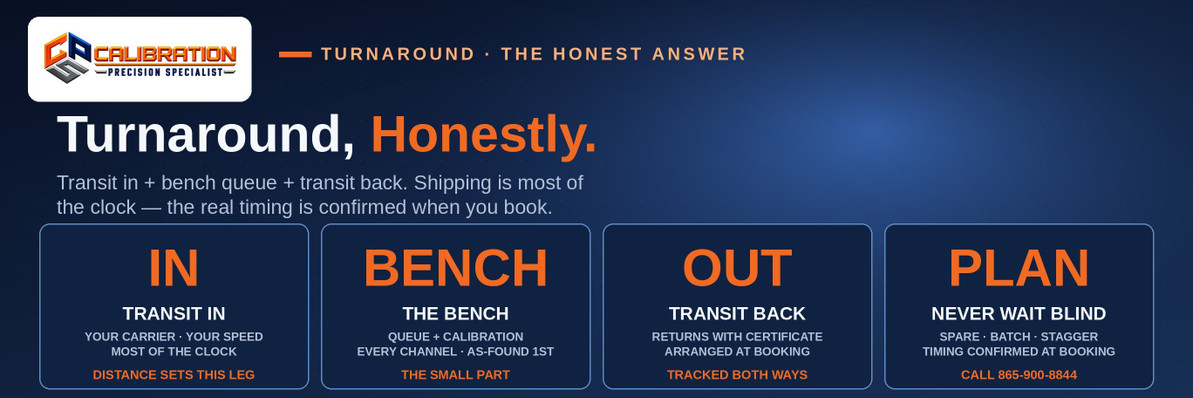
Honestly: there is no honest single number, and any calibration shop that publishes one without asking about your instrument is guessing with your downtime. The total time your detector is gone is transit in, plus the bench queue and bench time in Rockwood, plus transit back — and the bench work is the small part of that clock, while shipping in both directions is most of it. The real timing for your instrument is confirmed when you book, against the current bench queue, at 865-900-8844.
Most turnaround claims in this industry are written to win the click, not to survive your calendar. A number printed on a website cannot know how far your instrument has to travel, what the bench queue looks like this week, or whether your detector arrives needing only a calibration or also a sensor. So this post does the less flashy, more useful thing: it takes the clock apart piece by piece, shows you which parts you control, and lays out how crews who cannot afford downtime plan around the whole cycle — starting with the overview of how mail-in gas detector calibration works.
What Actually Makes Up the Total Time?
Leg one — transit in. Your instrument travelling to CPS Calibrations, 109 S. Front Street, Rockwood, TN 37854. This leg is set by distance and by the carrier service you choose when you ship, and it is entirely in your hands: the sender picks the speed. Packing and paperwork that slow this leg down are covered in how to ship a gas detector for calibration.
Leg two — the bench queue and the bench work. Once the instrument is checked in against its serial number, it joins the bench queue, and we calibrate every channel it carries — recording as-found readings before any adjustment, then as-left readings after. The calibration itself is the small part of your total time away. What can extend this leg is not the calibration; it is discovery. If a sensor is spent or something is damaged, that work is quoted in writing before it is done, and the clock then includes your approval and the part — honestly, because the alternative is work you never agreed to.
Leg three — transit back. The instrument travelling home with its certificate. Return shipping is the customer's cost, arranged when the service is booked, and like leg one its speed is a shipping choice, not a bench promise.
Add the three legs and you have the only turnaround figure that means anything: yours, for this instrument, this week. That is why timing is confirmed at booking — a two-minute call to 865-900-8844 gets you the current bench queue and an honest total, instead of a printed number that was never about your detector.
Why Won't CPS Just Publish a Turnaround Number?
Because the honest variables move. The bench queue is fuller some weeks than others. Instruments arrive from across the country, so transit — most of the clock — is different for a crew in Tennessee and a crew three time zones away. And a share of instruments that arrive for calibration turn out to need a sensor or a repair, which no one can schedule before the as-found readings exist. Publishing one number anyway would mean quietly choosing which customers to mislead. We would rather be the shop that tells you the components, confirms the real timing when you book, and lets you plan around facts. If a faster promise matters more than a kept one, plenty of websites will sell you one.
How Do You Never End Up Without an Instrument?
This is the question that actually protects an operation, and it has practical answers that do not depend on any turnaround claim:
Keep one spare. A single spare instrument in rotation means no calibration shipment is ever an emergency. The spare goes out with the crew while the working instrument travels, then becomes the traveller on the next cycle. For a small fleet, one spare is the cheapest downtime insurance there is.
Batch the non-urgent units. Instruments that come due together but are not all critical on the same day can ship together in one box — one shipment out, one back, one check-in — instead of a drip of single boxes all month. How a multi-instrument shipment is packed and listed is covered in shipping a whole fleet for calibration.
Stagger the fleet in waves. Split the fleet so a wave is on the bench while the rest stay in service, then swap. Operations never stop, no week carries the whole fleet's downtime at once, and each instrument still gets its own check-in, calibration, and certificate by serial number.
Let the reminders start the clock early. The worst turnaround is the one that starts late. CPS Calibration Program members get email calibration due-date reminders before instruments come due — no contract, no monthly fee — so the shipment is planned while there is still slack in the calendar, not discovered during an audit with a crew standing down.
Frequently Asked Questions
How fast can I get my gas detector back after calibration?
There is no single honest number, because the total is three separate legs: transit to Rockwood, the bench queue and bench work, and transit back — and shipping in both directions is most of the clock, while the calibration itself is the small part. Your distance, the carrier service you choose, the current bench queue, and whether the instrument needs more than calibration all move the total. The real timing for your instrument is confirmed when you book at 865-900-8844, against the current bench queue.
Why doesn't CPS publish a standard turnaround time?
Because the variables that set it are real and they move: the bench queue changes week to week, transit time depends on where you are shipping from and the service you choose, and some instruments arrive needing a sensor or a repair that cannot be scheduled before the as-found readings exist. A published number would be a guess dressed as a promise. CPS confirms timing at booking instead, so the figure you plan around is the one for your instrument, this week.
What takes longer — the calibration itself or the shipping?
The shipping, in most cases. The bench work — checking the instrument in by serial number, recording as-found readings, calibrating every channel it carries, and recording as-left readings — is the small part of the total time away. The two transit legs, in and back, are set by your distance from Rockwood, TN and the carrier service chosen, and together they account for most of the days the instrument is gone.
Can I pay extra for faster calibration turnaround?
There is no expedite product to sell you, and this post will not invent one. What genuinely shortens your total time is in your hands: ship with a faster carrier service on the way in, start the booking call early so the instrument enters the bench queue with a name on it, and respond promptly if a written repair quote needs your approval — an instrument waiting on an approval is waiting on the clock, not on the bench. For the current queue and an honest total, call 865-900-8844.
What happens if my detector needs a sensor or a repair — how much time does that add?
It adds the time the honest process takes, and you control part of it. The bench records as-found readings first; if a sensor is spent or something is damaged, the work is quoted in writing before it is done — never folded silently into a calibration. The added time is your decision time on the quote plus the part itself. Approving or declining promptly keeps the instrument moving either way: repaired and calibrated, or returned as-is with its as-found record.
How can I keep working while my detector is being calibrated?
Plan the rotation instead of racing the clock. Keep one spare instrument so a crew is never standing down for a shipment; batch non-urgent instruments into one shipment instead of several; and stagger a fleet in waves, so part of the fleet is always in service while the rest is on the bench. Crews who rotate this way stop experiencing calibration as downtime at all — it becomes a scheduled swap, not an outage.
Does where I live change how long mail-in calibration takes?
Yes — through the transit legs, which are most of the total time. The bench work in Rockwood is the same wherever the instrument came from, but an instrument shipped from across the country spends more days on trucks in both directions than one shipped from inside Tennessee. That is exactly why a single published turnaround cannot be honest for everyone, and why your timing is confirmed at booking with your shipping origin in the conversation.
When should I book if my detector has a hard due date?
As early as the reminder lets you. The CPS Calibration Program sends email due-date reminders before instruments come due — no contract, no monthly fee — precisely so the booking call happens while there is slack: time to choose a carrier speed, time for the bench queue, and time to absorb a repair quote if the instrument needs one. Booking against a due date is a planning exercise; booking after it is an emergency. Call 865-900-8844 while it is still the first kind.
Is on-site calibration faster than mailing my detector in?
It is a different service, not a faster version of this one. On-site calibration brings a technician to instruments and systems that cannot travel, and it is quoted in writing for the job — the published $55 single-gas and $90 4- and 5-gas rates are in-house bench rates and never the price of on-site work, which is scheduled around the site and the scope. For portable instruments that can travel, the honest comparison is total time away plus total cost, and for most crews the bench route plus a sensible rotation wins.
How much does it cost while my detector is away being calibrated?
The calibration itself is a published flat in-house rate — $55 for a single-gas instrument, $90 for a 4- or 5-gas instrument — the same rates as the Rockwood bench. Shipping in both directions is the customer's cost: you choose the carrier service inbound, and return shipping is arranged when the service is booked. If the instrument needs a sensor or repair beyond calibration, that work is quoted in writing for your approval before it is done, so downtime never comes with a surprise invoice attached.
The Bottom Line
The honest turnaround answer is a formula, not a slogan: transit in, plus bench queue and bench time, plus transit back — with shipping as most of the clock and the calibration itself the small part. CPS confirms your instrument's real timing at booking against the current queue, and a spare, a batch, or a staggered fleet means the answer never has to be an emergency.
Want the real number for your instrument this week? Call CPS Calibrations at 865-900-8844 and book it before you pack it.
CPS Calibrations · 109 S. Front Street, Rockwood, TN 37854 · Calibration Services · How Mail-In Gas Detector Calibration Works · Calibration Due-Date Reminders
Ready to mail yours in?
Start the ship-in request, pack the meter, and we handle the rest — every channel calibrated as configured, full certificate returned with it.
Start Your Ship-In Requestor call 865-900-8844
Recent Posts
-

What Is Remote Monitoring for Fixed Gas Detection?
Remote monitoring for fixed gas detection means a fixed system's live readings, trends, and alarm hi …Nov 23rd 2026 -

What Are the Key Differences Between the GX-6000 and GX-6100?
The RKI GX-6100 is the current replacement for the discontinued GX-6000: both are pumped 6-gas monit …Nov 22nd 2026 -

How to Read a PID Correction Factor Chart
To read a PID correction factor chart, find your vapor’s row, take the factor under your own lamp en …Nov 21st 2026