
Gas Safety for Small Distilleries and Moonshine Operations
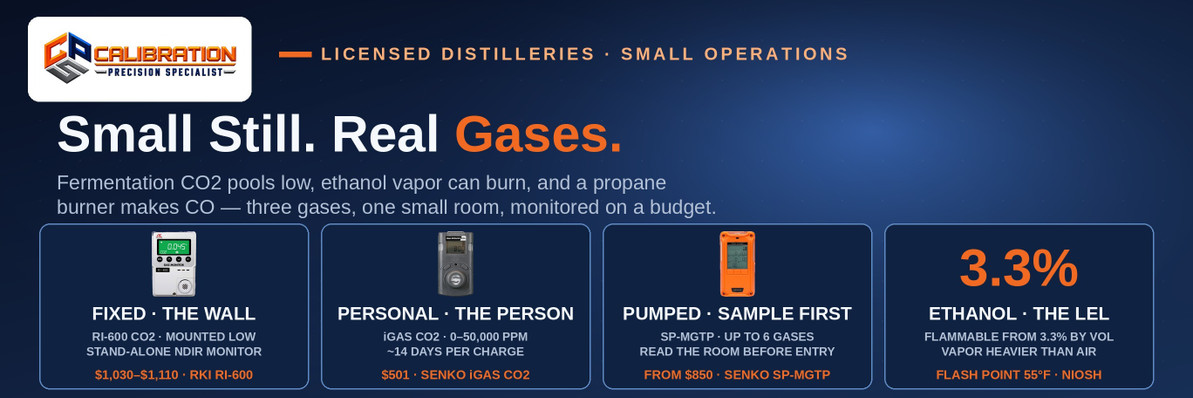
A small licensed distillery needs gas monitoring for three separate hazards in the same small rooms: carbon dioxide from fermentation, which is odorless, about 1.5 times heavier than air, and limited by OSHA to 5,000 ppm; ethanol vapor at the still and in spirit storage, which becomes flammable at 3.3% by volume (its lower explosive limit); and carbon monoxide from fuel-fired burners, limited to 50 ppm. On a small-operator budget that means a stand-alone CO2 monitor mounted low, a personal monitor on the person working the room, and a pumped multi-gas instrument for checking a space before anyone leans into it.
This post is for licensed craft distilleries and small licensed operations — the farm distillery with one still house, the small East Tennessee operation where the same two people tend the fermenters, work the still, and lock up at night. It is a safety-monitoring post only: how the gases behave, where they collect, and what to hang on the wall and clip on a shirt. The larger end of this industry is covered in What gas detection does a distillery need? and CO2 in distilleries; this is the small-room version of the same physics.
Why Does a Small Still House Concentrate the Risk?
Scale is the trap. A big plant spreads its hazards across big, ventilated buildings with dedicated staff. A small operation puts fermentation, the still, spirit storage, and a fuel-fired heat source in one small building — sometimes one room — with low corners, a cellar or pit, and doors that stay shut against the weather. Every gas in this post is heavier than air or odorless or both, so a small, closed, low room is exactly where each one collects.
There is also nobody to notice. In a two-person operation, the person who walks into a bad room is often the only person on site. Gas monitoring is the crew member that never leaves the room — but only if it is the right gas, in the right place, and calibrated.
What Does Fermentation CO2 Do in a Small Building?
Fermentation is a CO2 factory. For scale: fermenting one liter of a 20% sugar wash releases more than 60 liters of CO2 (Virginia Tech Enology's fermentation-gases paper) — multiply that by a fermenter and the room is receiving a continuous pour of a gas nobody can smell. CO2's relative gas density is 1.53, so it does not mix and drift away; it sinks, spreads across the floor, and fills cellars, pits, and low still houses from the bottom up.
The exposure numbers are lower than most small operators guess: OSHA's permissible exposure limit is 5,000 ppm averaged over a shift, NIOSH's 15-minute short-term limit is 30,000 ppm, and 40,000 ppm (4%) is immediately dangerous to life or health. A fermenter headspace and the air just above an active fermentation can run far past those numbers, which is why the rule in every fermentation space is the same: test the air before a head goes over an open vessel, and never treat a low room as safe because the door was open an hour ago — the gas is still pouring in.
Why Is Ethanol Vapor an LEL Problem at the Still and in Storage?
Ethanol is a flammable liquid doing flammable-liquid things at small scale. Its lower explosive limit is 3.3% by volume and its upper limit is 19% (NIOSH Pocket Guide), its flash point is 55°F — below ordinary room temperature — and its vapor is about 1.6 times heavier than air, so vapor escaping at the still, a transfer, or a leaking fitting in spirit storage travels low and pools instead of rising away (OSHA Technical Manual). NIOSH sets ethanol's IDLH at 3,300 ppm precisely because that is 10% of the LEL: the safety margin is meant to be spent long before the air can burn.
That is what a combustible-gas (LEL) channel is for. It reads in percent of the lower explosive limit, so an alarm in %LEL is an alarm with the margin still in hand — a warning at a fraction of the concentration that could ignite, while there is still time to kill ignition sources, ventilate, and find the leak. The places that earn an LEL measurement in a small operation are the still itself, the spirit storage corner, and any low pocket between them.
Where Does Carbon Monoxide Come From in a Distillery?
Not from the wash — from the fire under it. Carbon monoxide is a product of incomplete combustion, and small operations commonly heat with direct-fired, fuel-burning equipment in the same small building as everything else. A burner that is sooting, starved for air, or venting badly pours CO into a room whose doors are shut. CO is colorless and odorless, and OSHA's limit is 50 ppm over a shift — a low ceiling that a sick burner in a small room can cross without a single visible sign.
CO is the channel that turns a personal multi-gas monitor from a fermentation tool into a whole-building tool: the same instrument that checks the fermenter area rides on the person tending the burner.
What Monitoring Fits a Small-Operator Budget?
Three layers, bought in the order the risk demands — and none of them requires a plant-sized fixed system:
- 1. A stand-alone CO2 monitor, mounted low, where fermentation and storage live. The RKI RI-600 is an NDIR CO2 monitor in a wall box with a continuous readout, two preset alarms, relay contacts, and a 4–20 mA output — configured, it runs $1,030–$1,110 depending on range and power. Mount the sensing point low, where CO2 actually pools, and put the alarm where the person on site will hear it.
- 2. A personal CO2 monitor on the person. The SENKO iGas CO2, $501, is a dedicated personal CO2 detector: 0–50,000 ppm NDIR sensing, audible, visual, and vibration alarms, STEL and TWA tracking, and about 14 days per charge. It covers the cellar trip, the fermenter check, and the low room the wall monitor does not watch.
- 3. A pumped multi-gas monitor for sampling before entry. The SENKO SP-MGTP, from $850 depending on configuration, draws a sample through a hose — up to 98 feet of it — so the air in a pit, a vessel area, or a closed storage room can be read from outside it, across the channels the job needs: LEL, CO, oxygen, and CO2 among its configuration options. We calibrate every channel an instrument carries, and that is the honest way to buy one pumped instrument instead of three single-purpose ones.
What this stack deliberately leaves out: a hardwired multi-point fixed system with a controller. Plenty of small licensed operations never need one. If the building grows — more fermenters, a dedicated barrel warehouse, employees working alone in low rooms — that conversation belongs with a site survey, and installed-system work is quoted in writing for the job.
Who Calibrates a Distillery's Monitors?
The same bench that calibrates for plants across East Tennessee. CPS Calibrations, in Rockwood, calibrates gas monitors across the brands small distilleries actually run — not only the brands on our shelves. Published in-house rates are $55 for a single-gas instrument and $90 for a 4- or 5-gas instrument; every calibration returns a certificate with as-found and as-left readings on every channel, and every instrument joins the CPS Calibration Program for due-date reminders — no contract, no monthly fee. Repairs are quoted in writing before any work is done. Start at calibration services or call 865-900-8844.
Frequently Asked Questions
Do small distilleries need a CO2 monitor?
Yes — fermentation produces CO2 continuously, and in a small, closed still house or cellar it pools at floor level past OSHA's 5,000 ppm exposure limit with no odor to warn anyone. A stand-alone CO2 monitor mounted low covers the room, and a personal CO2 monitor covers the person who leaves it. The size of the operation does not change the gas: a two-person licensed distillery fermenting in one small building can build a dangerous low layer faster than a large plant with high ceilings and ventilation.
How much CO2 does fermentation produce?
A lot, relative to a small room. For scale, fermenting one liter of a 20% sugar liquid releases more than 60 liters of CO2 (Virginia Tech Enology). A fermenter holding hundreds of liters therefore pours thousands of liters of CO2 into the building across a fermentation — and because CO2 is about 1.5 times heavier than air, it does not spread evenly and leave; it sinks and accumulates in the lowest air in the building until ventilation removes it.
What is the LEL of ethanol vapor?
Ethanol's lower explosive limit is 3.3% by volume in air, and its upper explosive limit is 19% (NIOSH Pocket Guide). Between those concentrations, ethanol vapor can ignite. NIOSH sets ethanol's IDLH at 3,300 ppm — exactly 10% of the LEL — which is why combustible-gas instruments read in %LEL and alarm at a fraction of the limit: the warning is supposed to arrive while there is still a wide margin before the air can burn.
Why do distilleries monitor for carbon monoxide?
Because of the heat source, not the product. CO is made by incomplete combustion, and small distilleries commonly run fuel-fired burners in the same small building as the still and fermenters. A malfunctioning or poorly vented burner can push a closed room past OSHA's 50 ppm CO limit with no color, no odor, and no smoke to announce it. A CO channel on a personal multi-gas monitor covers the person tending the equipment.
Where should a CO2 monitor be mounted in a still house?
Low — in the air where CO2 actually collects. CO2 is about 1.5 times heavier than air and fills a room from the floor up, so a sensing point at thermostat height reads the last air in the room to go bad. Put the monitor in the fermentation and storage area at low level, and make sure its alarm is audible where the person on site actually works. The same low logic applies to ethanol vapor, which is also heavier than air.
Can one instrument cover CO2, LEL, and CO in a small distillery?
A pumped multi-gas monitor can cover the sampling work across those channels — the SENKO SP-MGTP, from $850, is configurable for up to six gases and draws its sample through a hose, so a pit or closed room can be tested before anyone enters it. What one portable instrument cannot do is watch a room while it is sitting in a charger. That is why the budget stack pairs it with a stand-alone wall monitor for the fermentation room and treats the portable as the go-and-check tool.
How much does gas detection for a small distillery cost?
At CPS list prices, the core stack is: a personal SENKO iGas CO2 at $501; a fixed RKI RI-600 stand-alone CO2 monitor at $1,030–$1,110 configured; and a pumped SENKO SP-MGTP multi-gas monitor from $850, priced by the gases selected. Calibration is the recurring cost — $55 in-house for a single-gas instrument and $90 for a 4- or 5-gas instrument at CPS published rates. A small operation can start with the personal monitor and the wall monitor and add the pumped instrument when vessel or pit work enters the routine.
How often do distillery gas monitors need calibration?
On the interval the manufacturer specifies for that instrument — there is no distillery-specific universal number, and anyone who names one without naming the manual is guessing. The failure mode is silent drift: a CO2 or LEL sensor reading low makes every alarm late. Keep each instrument on a written schedule with a certificate per calibration; CPS keeps the record and sends the due-date reminder for every instrument it calibrates, at no contract or monthly fee.
Is it safe to lean over an open fermenter to check it?
Not on a nose and a guess. The air at and inside a fermenter headspace can run far past CO2's 40,000 ppm IDLH during active fermentation, and CO2 gives no odor warning before it incapacitates. Sample first: draw the air through a pumped instrument from outside the vessel, ventilate, and only then work over it — with a personal monitor on, so the air at your breathing zone is being measured while you work, not before you started.
Does CPS calibrate monitors for distilleries outside Tennessee?
Yes — by mail. CPS calibrates gas monitors shipped to its Rockwood, Tennessee bench from anywhere in the country, at the published in-house rates ($55 single-gas, $90 for 4- and 5-gas instruments), and returns each instrument with a certificate showing as-found and as-left readings on every channel it measures. East Tennessee operations can also drop off in person at 109 S. Front Street, Rockwood, TN 37854, or call 865-900-8844 to talk through what a small operation actually needs before buying anything.
The Bottom Line
A small distillery's gas problem is a small-room problem: fermentation CO2 pooling low past 5,000 ppm, ethanol vapor that can burn from 3.3%, and burner CO with a 50 ppm ceiling — all in one closed building, often with one person in it. A low-mounted stand-alone CO2 monitor, a personal monitor on the person, and a pumped multi-gas instrument for sampling before entry cover it on a small-operator budget — as long as every channel is calibrated.
Licensed distillery or small operation in East Tennessee? Call CPS Calibrations at 865-900-8844 — tell us the rooms you have and we'll size the monitoring to the building, not to a catalog.
CPS Calibrations · 109 S. Front Street, Rockwood, TN 37854 · Calibration Services · The CPS Calibration Program · CO2 in Distilleries
Need a calibration you can file?
In-house calibration at CPS in Rockwood, Tennessee — $55 for single-gas instruments, $90 for 4- and 5-gas — every channel, as-found and as-left data, full certificate.
See Calibration Servicesor call 865-900-8844
Recent Posts
-

What Is Remote Monitoring for Fixed Gas Detection?
Remote monitoring for fixed gas detection means a fixed system's live readings, trends, and alarm hi …Nov 23rd 2026 -

What Are the Key Differences Between the GX-6000 and GX-6100?
The RKI GX-6100 is the current replacement for the discontinued GX-6000: both are pumped 6-gas monit …Nov 22nd 2026 -

How to Read a PID Correction Factor Chart
To read a PID correction factor chart, find your vapor’s row, take the factor under your own lamp en …Nov 21st 2026