
H2S and Reduced Sulfur in Pulp Mills: The Smell That Stops Warning You
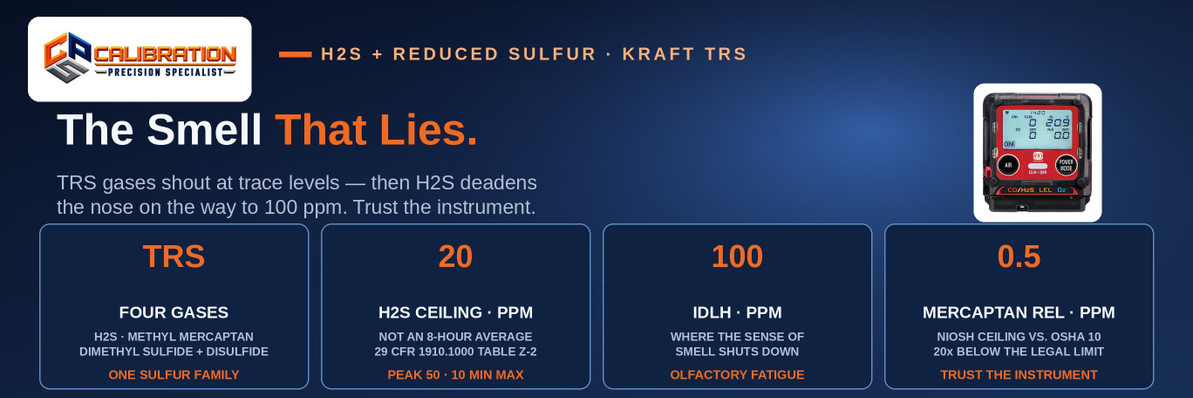
In a kraft pulp mill, the reduced-sulfur gases — hydrogen sulfide, methyl mercaptan, dimethyl sulfide, and dimethyl disulfide, together called TRS — announce themselves by smell at trace concentrations, but hydrogen sulfide deadens the sense of smell as exposure climbs, so a fading rotten-egg odor can mean the air is getting worse, not better. H2S is governed by a 20 ppm OSHA ceiling (not an average) with a 100 ppm IDLH, and methyl mercaptan by a 10 ppm OSHA ceiling against a 0.5 ppm NIOSH recommendation — limits that only instruments, never noses, can enforce.
This is the sulfur deep dive behind the mill hub post, what gas detection does a pulp and paper mill need? — the four gases, the olfactory-fatigue mechanism, where they collect, and the monitoring discipline that replaces the oldest sensor on site: the human nose.
What Is TRS in a Kraft Pulp Mill?
Total reduced sulfur: the family of sulfur gases the kraft cooking and recovery cycle produces and leaks. Four members matter:
- Hydrogen sulfide (H2S) — rotten-egg gas; the acutely toxic member and the one the detection program is built around.
- Methyl mercaptan (methanethiol) — cabbage-and-garlic odor; toxic in its own right, with its own tight limits below.
- Dimethyl sulfide and dimethyl disulfide — the remaining reduced-sulfur compounds; major contributors to the kraft signature odor that carries off site.
They are generated wherever kraft liquor is cooked, washed, evaporated, burned, and regenerated: digesters and brown-stock washers, evaporators and recovery boiler areas, smelt and recausticizing operations, and — away from the process line — pulp storage and wastewater treatment, where sulfur-bearing material sitting without oxygen keeps making H2S biologically.
Why Does the Smell Stop Warning You?
Because H2S attacks the warning system itself. At low concentrations the rotten-egg odor is unmistakable — the gases are detectable by smell at levels far below any exposure limit, which trains everyone on site to treat the nose as an instrument. But sustained or high exposure to hydrogen sulfide deadens the olfactory nerves: the smell fades or disappears entirely, a documented effect called olfactory fatigue. The worker reads "the smell went away" as "the gas cleared" at exactly the moment concentrations may be at their worst — up toward the 100 ppm IDLH, the concentration NIOSH classifies as immediately dangerous to life or health.
OSHA's guidance on H2S is blunt on this point: do not rely on your sense of smell to indicate the presence of hydrogen sulfide or to warn of its concentration. Mercaptans add a quieter version of the same lesson — ATSDR's guidance on methyl mercaptan states plainly that its odor does not provide adequate warning of hazard. The mill smell is real information at the fence line; at the point of exposure, it is a sensor that fails in the dangerous direction.
What Are the Exposure Limits for H2S and Methyl Mercaptan?
Verified against OSHA and NIOSH:
Hydrogen sulfide (general industry, 29 CFR 1910.1000 Table Z-2):
- OSHA: 20 ppm ceiling — never to be exceeded — with a single permitted peak of 50 ppm for up to 10 minutes once per shift, only if no other measurable exposure occurs.
- NIOSH REL: 10 ppm ceiling over 10 minutes.
- ACGIH TLV: 1 ppm TWA, 5 ppm STEL.
- IDLH: 100 ppm.
Note the structure: H2S is one of the few common gases OSHA regulates with a ceiling instead of an 8-hour average, because its hazard is acute — what matters is the peak you breathe, not the shift average. Detector alarms therefore belong at ceiling logic, not averaging logic.
Methyl mercaptan:
- OSHA PEL: 10 ppm ceiling.
- NIOSH REL: 0.5 ppm ceiling — twenty times lower than the enforceable number, and the clearest illustration in the mill of why many programs set their working alarms at the recommended limit rather than the legal one.
- IDLH: 150 ppm.
For dimethyl sulfide and dimethyl disulfide, this post states no exposure numbers: they are monitored in mill practice as part of TRS and odor management, and any site that needs occupational limits for them should pull the current values from the NIOSH Pocket Guide and its own industrial hygiene review rather than from a blog post — including this one.
Where Do Reduced Sulfur Gases Collect in a Mill?
Two patterns. Process points — the recovery boiler area, smelt handling, recausticizing, digester and washer vents and seals, evaporator areas — release TRS where liquor and gas paths open for operation or maintenance; line breaks and seal failures turn routine areas into exposure points. Low anaerobic points — wastewater basins, sludge and sewer structures, pulp storage chests and pits, sumps — generate H2S continuously and collect it: H2S is heavier than air and settles into the same low, still volumes the distillery CO2 story tells, which is why mill pits and wastewater structures are confined-space H2S work, tested before entry and monitored during it.
The personal-monitor discipline is identical to the one oil and gas crews run on the same gas and the same limits — see H2S in oil and gas: personal monitors.
What Monitors Does a Mill H2S Program Need?
Fixed H2S points at the collection areas — recovery floor, recaust, wastewater structures, sumps — alarmed at ceiling logic. Personal H2S coverage on every worker in those areas: a dedicated single-gas H2S instrument such as the maintainable SENKO SGT-P line ($172–$578 across gases and configurations) for workers whose only toxic exposure is H2S, or the H2S channel of a 4-gas monitor — the RKI GX-3R at $590–$690 — for everyone who also needs LEL, O2, and CO. And underneath both: calibration. Sulfur service is hard on electrochemical sensors, and a poisoned or drifted H2S channel fails in the same direction as the nose — quiet when it matters. We calibrate every channel through calibration services, in-house in Rockwood, Tennessee, or shipped in from the mill.
Frequently Asked Questions
What is TRS in a pulp mill?
Total reduced sulfur — the kraft process's four reduced sulfur gases: hydrogen sulfide, methyl mercaptan, dimethyl sulfide, and dimethyl disulfide. They are produced across cooking, washing, evaporation, recovery burning, and recausticizing, and again in wastewater and pulp storage. H2S drives the acute-toxicity program; the other three drive much of the characteristic kraft odor and carry their own limits where set.
Why can't you rely on smell to detect H2S?
Because hydrogen sulfide deadens the sense of smell. Low concentrations smell unmistakably of rotten eggs, but continued or high exposure fatigues the olfactory nerves and the odor fades or vanishes — potentially as concentrations approach the 100 ppm IDLH. OSHA explicitly warns against using smell as an H2S indicator. A fading smell is ambiguous data; an instrument reading is not.
What is the OSHA limit for hydrogen sulfide?
For general industry, a 20 ppm ceiling under 29 CFR 1910.1000 Table Z-2: exposure must not exceed 20 ppm, except for one peak up to 50 ppm lasting no more than 10 minutes in a shift with no other measurable exposure. It is a ceiling, not an 8-hour average. NIOSH recommends a 10 ppm ceiling over 10 minutes; ACGIH's TLV is 1 ppm TWA with a 5 ppm STEL; the IDLH is 100 ppm.
What is olfactory fatigue?
The loss of smell sensitivity caused by the exposure itself. With H2S, the olfactory nerves stop reporting the gas after sustained or high exposure, so the worker perceives the rotten-egg odor weakening while the concentration may be steady or rising. It is the mechanism that makes H2S uniquely treacherous among mill gases: the warning property degrades in exactly the conditions where the warning matters most.
What is the exposure limit for methyl mercaptan?
OSHA's PEL is a 10 ppm ceiling. NIOSH's recommended exposure limit is a 0.5 ppm ceiling — one-twentieth of the legal limit. The IDLH is 150 ppm. Methyl mercaptan is a standard component of kraft TRS, released with the other sulfur gases in recovery and recaust areas, and ATSDR guidance states its odor does not provide adequate warning of hazard.
Where is H2S found in a pulp and paper mill?
At recovery boiler and smelt areas, recausticizing operations, digester and brown-stock washer areas, and evaporators — and independently at wastewater treatment basins, sludge and sewer structures, pulp storage, and sumps, where sulfur-bearing material generates H2S without oxygen. Being heavier than air, it collects in the low points: pits, trenches, and vessel bottoms are the confined-space priority.
What does H2S do at 100 ppm?
100 ppm is the NIOSH IDLH — immediately dangerous to life or health: the concentration from which a worker must be able to escape within minutes without irreversible harm, and the level around which the sense of smell is deadened. It is five times OSHA's 20 ppm ceiling. No routine mill work is planned anywhere near it; detection programs exist so that rising concentrations are caught at alarm points far below it.
What gas detector is best for H2S in a pulp mill?
Fixed H2S sensors at the collection areas, plus a personal instrument on the worker: a dedicated single-gas H2S monitor (the maintainable SENKO SGT-P family runs $172–$578 across configurations) where H2S is the only toxic exposure, or a 4-gas monitor with an H2S channel — RKI GX-3R, $590–$690 — where LEL, oxygen, and CO coverage are also needed. The deciding feature is not the badge; it is ceiling-based alarming and a calibration record that proves the channel reads true.
How much does H2S monitoring cost a mill?
Personal instruments run from the SGT-P's $172 floor for a single-gas unit up to $590–$690 for a 4-gas monitor, by configuration. Fixed systems are quoted per site in writing — point count, alarming, and installation scope drive the price. Calibration at CPS is $55 for a single-gas instrument and $90 for a 4- or 5-gas instrument in-house; on-site mill work is quoted in writing and costs more.
How often do H2S sensors need calibration in mill service?
On the manufacturer's interval, with bump tests before use — and mill H2S channels earn extra suspicion, because sulfur service, moisture, and exposure to high peaks all age electrochemical sensors. A sensor that has been repeatedly over-ranged can read low afterward, which is the failure direction that matters. CPS calibrates H2S instruments in-house at 109 S. Front Street, Rockwood, TN, or by ship-in from anywhere, and the CPS Calibration Program tracks fleet due dates so rotation happens on schedule.
The Bottom Line
TRS is four gases with one publicist — the smell — and the smell is a liar at working concentrations: H2S deadens the nose on the way to its 100 ppm IDLH, under a 20 ppm OSHA ceiling that allows no averaging, while methyl mercaptan's recommended ceiling (0.5 ppm) sits twenty times below its legal one (10 ppm). Mills that manage reduced sulfur by instrument — fixed points at the collection areas, personal monitors on the crews, calibration records underneath — are managing it. Mills managing it by nose are guessing.
Reviewing H2S coverage at your mill? Call CPS Calibrations at 865-900-8844 — monitors, fixed systems, and the CPS Calibration Program behind them, from Rockwood, Tennessee.
CPS Calibrations · 109 S. Front Street, Rockwood, TN 37854 · Calibration Services · The CPS Calibration Program
Need a calibration you can file?
In-house calibration at CPS in Rockwood, Tennessee — $55 for single-gas instruments, $90 for 4- and 5-gas — every channel, as-found and as-left data, full certificate.
See Calibration Servicesor call 865-900-8844
Recent Posts
-

What Is Remote Monitoring for Fixed Gas Detection?
Remote monitoring for fixed gas detection means a fixed system's live readings, trends, and alarm hi …Nov 23rd 2026 -

What Are the Key Differences Between the GX-6000 and GX-6100?
The RKI GX-6100 is the current replacement for the discontinued GX-6000: both are pumped 6-gas monit …Nov 22nd 2026 -

How to Read a PID Correction Factor Chart
To read a PID correction factor chart, find your vapor’s row, take the factor under your own lamp en …Nov 21st 2026