
What Gas Detection Does a Pulp and Paper Mill Need?
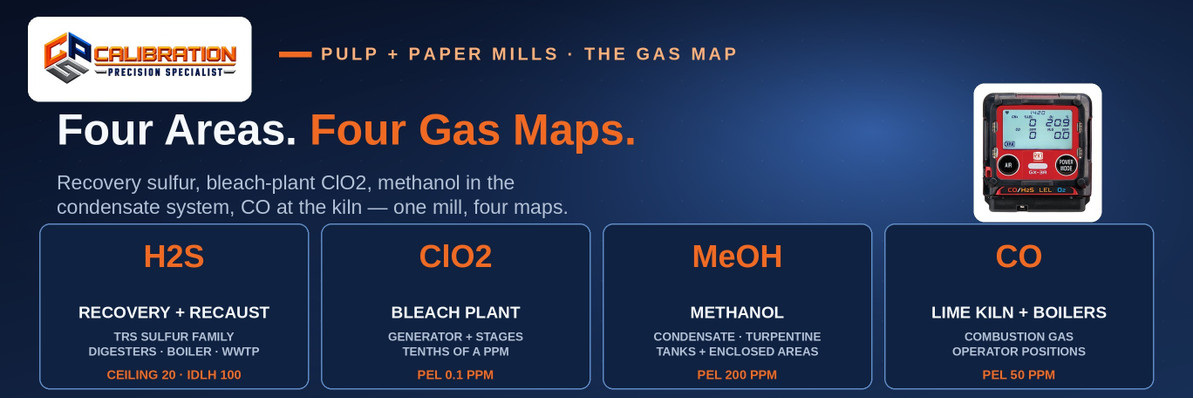
A pulp and paper mill needs hydrogen sulfide and total reduced sulfur (TRS) detection across recovery and recausticizing — H2S carries a 20 ppm OSHA ceiling (50 ppm peak, 10 minutes, once per shift) and a 100 ppm IDLH — chlorine dioxide monitoring in the bleach plant against a PEL of just 0.1 ppm, methanol coverage in recovery and condensate systems (PEL 200 ppm), and carbon monoxide detection at the lime kiln and power boilers (PEL 50 ppm). No single gas defines a mill: the detection program is area-by-area, with fixed points where each gas collects and personal multi-gas monitors on everyone who walks the process.
A kraft mill runs a chemical recovery cycle, a bleach plant, and a combustion island inside one fence — and each one breathes out a different hazard. This post maps the mill area by area, with verified limits for every gas. The sulfur story gets its own deep dive in H2S and reduced sulfur in pulp mills.
What Gases Does the Kraft Recovery Cycle Produce?
Sulfur gases, as a family. The kraft process cooks wood in sodium sulfide liquor and burns the spent liquor in the recovery boiler to regenerate it, and sulfur escapes that cycle at digesters, washers, evaporators, the recovery boiler, smelt handling, and the recausticizing line (causticizers, lime mud handling, the kiln feed end). The escapees are the total reduced sulfur (TRS) group:
- Hydrogen sulfide (H2S) — the toxic driver of the group: OSHA ceiling 20 ppm, NIOSH recommended ceiling 10 ppm for 10 minutes, ACGIH guideline 1 ppm TWA, IDLH 100 ppm.
- Methyl mercaptan — intensely odorous, toxic in its own right (covered with numbers in the TRS deep dive).
- Dimethyl sulfide and dimethyl disulfide — the remaining TRS components, major contributors to the signature kraft odor.
Wastewater treatment and pulp storage add their own H2S generation — anywhere sulfur-bearing liquor or sludge sits anaerobic, H2S is made. The detection consequence: fixed H2S points at the known collection areas, and a personal monitor with an H2S channel as standard issue, not special issue. H2S programs in other industries run on the same limits — see H2S in oil and gas: personal monitors for the personal-monitor side of the discipline.
What Gas Detection Does the Bleach Plant Need?
Chlorine dioxide, measured in tenths of a ppm. ClO2 is generated on site and piped to the bleaching stages, and its exposure numbers are the tightest in the mill: OSHA PEL 0.1 ppm as an 8-hour average, NIOSH REL 0.1 ppm with a 0.3 ppm short-term limit, and a NIOSH Pocket Guide IDLH of 5 ppm. A gas whose legal average is one-tenth of a part per million demands sensors ranged and alarmed for fractions of a ppm — a general-purpose toxic channel set for percent-level work tells you nothing useful here. Fixed ClO2 detection around the generator, storage, and bleach stages, with personal monitoring for the operators and maintenance crews who open that equipment, is the bleach plant layer. (Chlorine itself, where a mill still handles it, is a separate ceiling-limited gas — 1 ppm OSHA ceiling — and gets its own points.)
Where Does Methanol Appear in a Paper Mill?
In the recovery and condensate systems. Methanol is generated in pulping and concentrates in foul condensate, turpentine recovery, and stripper systems — and it follows that liquid into tanks, sewers, and enclosed handling areas as a vapor. Its numbers: OSHA PEL 200 ppm TWA, NIOSH REL 200 ppm with a 250 ppm short-term limit and a skin notation (methanol absorbs through skin), IDLH 6,000 ppm. Methanol is also flammable, so tank and condensate areas pair toxic monitoring with the %LEL thinking used anywhere vapors collect in enclosed spaces. Methanol rarely gets a headline in mill safety programs — which is exactly why it belongs on the gas map explicitly instead of being discovered during a tank entry.
What About the Lime Kiln and Power Boilers?
Carbon monoxide — the combustion gas. The lime kiln reburns lime mud at high temperature and the power and bark boilers burn fuel around the clock; every one of those flames makes CO when combustion is incomplete, venting is compromised, or startup and upset conditions disturb the burn. OSHA's CO PEL is 50 ppm as an 8-hour average, NIOSH recommends 35 ppm with a 200 ppm ceiling, and the IDLH is 1,200 ppm. Kiln and boiler areas get fixed CO coverage at operator positions and personal CO channels on the crews — CO is one channel of the standard 4-gas monitor, so the personal layer is already in most workers' pockets; the discipline is bump tests and calibration, not new hardware. We calibrate every channel on those instruments through calibration services — in-house in Rockwood, Tennessee, ship-in from anywhere, or on-site at the mill quoted in writing.
What Does the Personal Monitor Layer Look Like in a Mill?
A 4-gas base — LEL, O2, CO, H2S — covers the recovery floor, the kiln line, tank entries, and wastewater in one instrument: the RKI GX-3R runs $590–$690 by configuration. Crews whose work adds a fifth toxic gas step up to a 5-gas instrument like the RKI GX-3R Pro ($1,005–$1,575 by configuration) from the portable multi-gas monitor range — the extra channel is fitted to the area's gas list, which is why the area map above comes before the purchase order. Fixed systems tie the whole map together: CPS designs and installs them through fixed system installation, placing points where each gas actually collects — low for H2S at sumps and pits, breathing-zone for ClO2 at the bleach stages, operator positions at the kiln.
Frequently Asked Questions
What gas detection does a pulp and paper mill need?
Area-by-area coverage: H2S and TRS detection in digesters, recovery, recausticizing, and wastewater (H2S OSHA ceiling 20 ppm, IDLH 100 ppm); chlorine dioxide monitoring in the bleach plant (PEL 0.1 ppm TWA, STEL 0.3 ppm, IDLH 5 ppm); methanol monitoring in condensate, turpentine, and recovery systems (PEL 200 ppm); carbon monoxide at the lime kiln and boilers (PEL 50 ppm); fixed sensors where each gas collects; and personal multi-gas monitors (LEL/O2/CO/H2S base) on process and maintenance crews.
What is TRS in a pulp mill?
Total reduced sulfur — the kraft process's sulfur gas family: hydrogen sulfide, methyl mercaptan, dimethyl sulfide, and dimethyl disulfide. TRS gases are released at digesters, washers, evaporators, the recovery boiler, recaust areas, and wastewater handling. H2S is the member with the acute toxicity that drives the detection program; the mercaptans and sulfides drive the mill's characteristic odor at extremely low concentrations.
What is the OSHA limit for hydrogen sulfide in a paper mill?
The general-industry limit, 29 CFR 1910.1000 Table Z-2: a 20 ppm ceiling that must not be exceeded, with one narrow exception — a single peak up to 50 ppm for no more than 10 minutes in a shift with no other measurable exposure. NIOSH recommends a stricter 10 ppm ceiling over 10 minutes, ACGIH's guideline is 1 ppm TWA with a 5 ppm STEL, and the IDLH is 100 ppm.
Why does the bleach plant need chlorine dioxide detection?
Because ClO2's limits leave no working margin: OSHA PEL 0.1 ppm as an 8-hour average, NIOSH short-term limit 0.3 ppm, IDLH 5 ppm. Chlorine dioxide is generated on site and used across the bleach stages, so generator, storage, piping, and stage areas need fixed detection ranged for tenths of a ppm, and maintenance on that equipment needs personal monitoring — a sensor ranged for ordinary ppm-level toxics cannot manage a 0.1 ppm limit.
Where is methanol a hazard in a pulp mill?
Methanol forms during pulping and concentrates in foul condensate, turpentine recovery, and stripper systems, then vaporizes in tanks, sewers, and enclosed condensate-handling areas. OSHA's PEL is 200 ppm TWA; NIOSH adds a 250 ppm short-term limit and a skin notation because methanol absorbs through skin; the IDLH is 6,000 ppm. It is the mill gas most often missing from the written gas map.
Does a lime kiln need carbon monoxide detection?
Yes. The kiln — like the power and bark boilers — is a continuous combustion source, and incomplete combustion, venting problems, and startup or upset conditions all produce CO. OSHA's PEL is 50 ppm TWA, NIOSH's REL is 35 ppm with a 200 ppm ceiling, and the IDLH is 1,200 ppm. Fixed CO points at operator positions plus the CO channel on every personal 4-gas monitor cover the area.
What personal gas monitor do paper mill workers carry?
The standard is a 4-gas monitor — %LEL, oxygen, CO, and H2S — such as the RKI GX-3R at $590–$690 depending on configuration. Workers whose areas add a fifth gas carry a 5-gas instrument such as the RKI GX-3R Pro ($1,005–$1,575). Bleach-plant work is the exception that needs its own arrangement: ClO2 at a 0.1 ppm limit requires detection ranged for that gas specifically.
Do pulp mills need fixed gas detectors or just personal monitors?
Both layers, as in most process industries. Fixed detectors watch recovery, recaust, bleach, kiln, and wastewater areas continuously — including unstaffed hours — and can alarm and drive ventilation. Personal monitors protect the individual during entries, line breaks, and maintenance, and they measure the breathing zone, which a wall-mounted sensor cannot. Neither layer substitutes for the other.
What does gas detection cost a pulp and paper mill?
Personal instruments: $590–$690 per 4-gas monitor (RKI GX-3R) and $1,005–$1,575 per 5-gas (GX-3R Pro), by configuration. Fixed systems are quoted per site after a walk-down — sensor count by area, alarm and ventilation tie-ins, and installation scope set the number, and CPS quotes fixed work in writing. Calibration is $55 per single-gas and $90 per 4- or 5-gas instrument in-house; on-site mill calibration is quoted in writing and costs more than bench work.
How often do mill gas detectors need calibration?
On the manufacturer's schedule, with bump testing before use per the mill's program — mill air is hard service: sulfur gases, moisture, and dust all age sensors faster than office air does. CPS calibrates mill fleets in-house at 109 S. Front Street, Rockwood, TN, or by ship-in, and the CPS Calibration Program tracks due dates across the fleet so instruments rotate through on schedule instead of failing in the field.
The Bottom Line
A pulp and paper mill needs a gas map, not a gas: H2S and TRS in recovery and recaust against a 20 ppm ceiling and 100 ppm IDLH, chlorine dioxide in bleaching against a 0.1 ppm PEL, methanol in condensate and recovery at 200 ppm, and CO at the kiln and boilers at 50 ppm — fixed points where each gas collects, personal multi-gas monitors on the crews, and calibration underneath all of it.
Building or auditing a mill gas detection program? Call CPS Calibrations at 865-900-8844 — monitors, fixed systems, and the CPS Calibration Program behind them, from Rockwood, Tennessee.
CPS Calibrations · 109 S. Front Street, Rockwood, TN 37854 · Calibration Services · The CPS Calibration Program
Need a calibration you can file?
In-house calibration at CPS in Rockwood, Tennessee — $55 for single-gas instruments, $90 for 4- and 5-gas — every channel, as-found and as-left data, full certificate.
See Calibration Servicesor call 865-900-8844
Recent Posts
-

What Is Remote Monitoring for Fixed Gas Detection?
Remote monitoring for fixed gas detection means a fixed system's live readings, trends, and alarm hi …Nov 23rd 2026 -

What Are the Key Differences Between the GX-6000 and GX-6100?
The RKI GX-6100 is the current replacement for the discontinued GX-6000: both are pumped 6-gas monit …Nov 22nd 2026 -

How to Read a PID Correction Factor Chart
To read a PID correction factor chart, find your vapor’s row, take the factor under your own lamp en …Nov 21st 2026