
How Much Does a Fixed Gas Detection System Cost?
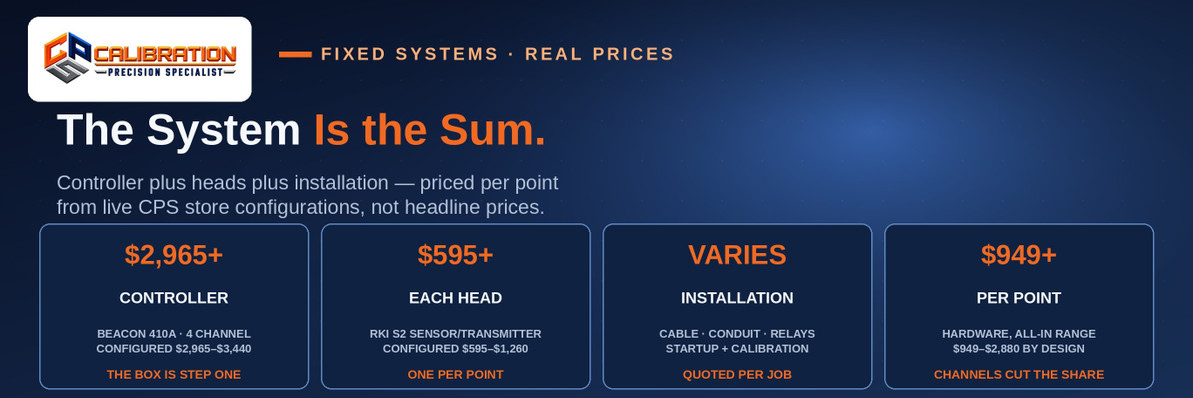
A fixed gas detection system costs $1,325–$1,965 per point in hardware for a stand-alone transmitter point, or $949–$2,880 per point for a controller-and-head system, at verified CPS store prices — a 4-point RKI Beacon 410A system runs $5,345–$8,480 in hardware before installation. Installation labor is the second half of the price, it varies too much by site to quote honestly as a standard rate, and it is priced per job in writing.
There is no single sticker price for a fixed system because a fixed system is not a product — it is a controller, one detector head per point, and the work of wiring them together. This post prices each layer from live store configurations, shows how the per-point cost falls as channels rise, and is explicit about which numbers are verified product prices and which part — installation — can only be quoted against your building. If you are still choosing the architecture, start with how to choose a gas detection controller.
What Are the Three Cost Layers of a Fixed System?
Layer 1 — the controller. The panel that reads every point, sounds the alarm, and drives relays. On the RKI Beacon line, configured prices run from the 1-channel Beacon 110 at $1,340–$1,620 up through the 4-channel Beacon 410A at $2,965–$3,440 and the 8-channel Beacon 800 at $2,835. A 32-channel wirefree system starts with a controller like the OTIS OI-7032 at $4,010 — $125 of controller per point if all 32 channels are used.
Layer 2 — one detector head per point. Every sensing point needs its own head, and heads repeat at every point while the controller is bought once. The RKI S2 Series sensor/transmitter that pairs with Beacon controllers configures at $595–$1,260 depending on gas and range. OTIS explosion-proof heads configure higher, $1,455–$4,216. This layer, not the controller, is usually the largest hardware line on a multi-point system.
Layer 3 — installation. Cable or conduit runs from each head back to the controller, power at the panel, relay wiring to ventilation, shutoffs, strobes, and horns, then startup and calibration of every point. None of that is a product, none of it has a catalog price, and any per-foot or per-point labor figure quoted without seeing the site is invented. What drives it is knowable — distance, explosion-proof conduit and seals, lift work, and how many interlocks the relays must drive — and fixed system installation walks through what the work actually involves.
How Much Does Each System Shape Cost in Hardware?
Verified configured prices from the CPS store (controller + heads; installation excluded):
| System shape | Hardware build-up | Total | Per point |
|---|---|---|---|
| 1 point, stand-alone | RKI M2A-XL transmitter (its own display, relays, alarm — no controller) | $1,325–$1,965 | $1,325–$1,965 |
| 1 point, controller-based | Beacon 110 ($1,340–$1,620) + one S2 head ($595–$1,260) | $1,935–$2,880 | $1,935–$2,880 |
| 4 points | Beacon 410A ($2,965–$3,440) + four S2 heads ($2,380–$5,040) | $5,345–$8,480 | $1,336–$2,120 |
| 8 points | Beacon 800 ($2,835) + eight S2 heads ($4,760–$10,080) | $7,595–$12,915 | $949–$1,614 |
The pattern is the lesson: the controller share per point collapses as channels fill ($1,340+ of controller on a 1-point system, $354 on a full 8-channel Beacon 800, $125 on a full 32-channel OI-7032), while the head cost repeats at full price on every point. A bigger system costs more in total and less per point — and filling a controller you already own is the cheapest expansion there is. The Beacon family is compared channel-by-channel in RKI Beacon controllers: 110, 200, 410A, and 800.
Why Do Headline Prices Understate the Hardware Cost?
Because on configurable fixed equipment, the headline price frequently buys no configuration at all. On our own store, checked against the live variant prices for this post: the Beacon 110's $1,275 headline matches none of its five configurations ($1,340–$1,620), the Beacon 200's $2,500 headline matches none of its configurations ($2,625–$2,780), the Beacon 410A's $2,825 headline matches none of its configurations ($2,965–$3,440), and both M2A-XL housings show headlines below every configured variant. Budget from the configured range for your gas and options — the headline is a starting artifact, not a price. (The Beacon 800 at $2,835 and the OI-7032 at $4,010 are single-price products; their headlines are real.)
What Does Installation Add?
Honestly: it depends on the building, and this post will not put an invented number on it. The drivers, in rough order of impact: how far each head sits from the controller (cable and conduit are priced by the run); whether the area classification demands explosion-proof conduit, seals, and fittings; whether power must be brought to the panel; how much the relays have to do — starting ventilation and shutting down equipment costs more wiring than sounding a horn; and whether heads mount at heights that need a lift. A wirefree system removes the signal-wiring run between head and controller, which is why the OTIS WireFree pattern exists — it does not remove mounting, power decisions, relay work, or startup calibration. Any installer who has walked the site can quote this layer in writing; treat a labor number given without a walk-through as a placeholder, not a quote.
What Does a Fixed System Cost to Keep?
The purchase is year zero. After that: periodic calibration of every point (fixed systems are calibrated where they hang, as service work quoted per job — the $55/$90 in-house rates on this site are for portable instruments brought or shipped to our shop, and they do not apply to fixed points), and sensor replacement as individual heads reach the end of their service life, priced by the head and gas involved. Neither is optional if the readings have to mean something: we calibrate every channel on a system we service, and a point that has never been calibrated is decoration. Portable instruments carry the same lesson in smaller numbers — see how much it costs to own a gas detector for a year.
Frequently Asked Questions
How much does a fixed gas detection system cost?
In hardware, $1,325–$1,965 for a single stand-alone transmitter point, $1,935–$2,880 for a single point on a 1-channel controller, $5,345–$8,480 for a 4-point controller system ($1,336–$2,120 per point), and $7,595–$12,915 for an 8-point system ($949–$1,614 per point) — all at verified CPS store configurations for RKI Beacon controllers and S2 heads. Installation labor is additional, varies by site, and is quoted per job in writing; no honest standard rate exists.
How much does a gas detection controller cost?
Configured, on the RKI Beacon line: the 1-channel Beacon 110 runs $1,340–$1,620, the 2-channel Beacon 200 runs $2,625–$2,780, the 4-channel Beacon 410A runs $2,965–$3,440, and the 8-channel Beacon 800 is $2,835. A 32-channel OTIS OI-7032 wirefree controller is $4,010. Note that the Beacon 110, 200, and 410A headline prices ($1,275, $2,500, $2,825) match no actual configuration — the configured range is the price.
How much does a fixed gas detector head cost?
One head is required per sensing point. The RKI S2 Series sensor/transmitter configures at $595–$1,260 depending on gas and range, and OTIS OI-6000-XP explosion-proof heads configure at $1,455–$4,216. Because heads repeat at every point while the controller is bought once, heads are usually the largest hardware line on a multi-point system.
Why is the installed price higher than the product price?
Because the products are only two of three layers. Installation adds cable or conduit runs from every head to the controller, panel power, relay wiring to ventilation, shutoffs, strobes, and horns, plus startup and calibration of every point. Distance, explosion-proof area requirements, and lift work move that labor substantially from site to site, which is why it is quoted per job after a walk-through rather than listed as a standard rate.
Is a stand-alone transmitter cheaper than a controller system?
For a single point, usually: an RKI M2A-XL stand-alone transmitter — which carries its own display, relays, and alarm — configures at $1,325–$1,965 with no controller to buy, against $1,935–$2,880 for a 1-channel Beacon 110 plus an S2 head. The trade runs the other way as points multiply: at 4–8 points a shared controller drops the per-point hardware cost to $949–$2,120, and only a controller gives you one panel reading every point.
Does wireless fixed gas detection cost less to install?
It removes one real cost — the signal-wiring run between each head and the controller — which is the most distance-sensitive part of a wired install. It does not remove mounting, relay and interlock wiring, or startup calibration, and the hardware itself (a 32-channel OTIS OI-7032 controller at $4,010, plus a head per point) is priced for larger systems. Wireless wins where cable cannot go or would cost more than the radio hardware; it is not automatically the cheaper system.
How much does it cost to add a point to an existing fixed system?
If your controller has a spare channel, the hardware is one head — $595–$1,260 for an RKI S2 — plus the wiring run and startup calibration for that point. That is why the per-point math rewards filling a controller: the panel, power, and alarm infrastructure are already paid for. If the controller is full, the next point also carries a share of a larger or additional controller.
What does installation of a fixed gas detection system include?
Mounting the controller and each head, running cable or conduit between them, bringing power to the panel, wiring relays to the loads they control (ventilation, shutoffs, strobes, horns), and then startup: powering the system, verifying every channel reads, and calibrating every point. A system that is hung but never started up and calibrated is not installed in any sense that protects anyone.
How much does it cost to maintain a fixed gas detection system each year?
Budget for periodic calibration of every point and eventual sensor replacement on individual heads. Fixed-point calibration is service work performed where the system hangs and is quoted per job in writing — the in-house portable rates ($55 single-gas, $90 for 4- and 5-gas instruments) apply to portables brought or shipped to our Rockwood shop, not to fixed points. Sensor replacement is priced by the head and gas; a head that can no longer hold calibration is replaced, not adjusted forever.
How much does it cost to calibrate a gas detector?
For portable instruments at CPS Calibrations, in-house calibration is $55 for a single-gas instrument and $90 for a 4- or 5-gas instrument; ship-in calibration is billed at the same rates. On-site work at your facility — including fixed-system points — is quoted in writing and costs more than bench work. We calibrate every channel on every instrument we service.
The Bottom Line
A fixed gas detection system is three costs, not one: a controller ($1,340–$4,010 configured across 1–32 channels), one head per point ($595–$1,260 for RKI S2; more for explosion-proof OTIS heads), and installation that varies by building and is quoted per job. Hardware lands at $1,325–$1,965 for a stand-alone point and falls to $949–$1,614 per point on a filled 8-channel system — and the headline price on configurable gear is the one number in this post you should never budget from.
Pricing a fixed system for your facility? Call CPS Calibrations at 865-900-8844 — controllers, heads, and the CPS Calibration Program behind them, from Rockwood, Tennessee.
CPS Calibrations · 109 S. Front Street, Rockwood, TN 37854 · Calibration Services · The CPS Calibration Program
Need a calibration you can file?
In-house calibration at CPS in Rockwood, Tennessee — $55 for single-gas instruments, $90 for 4- and 5-gas — every channel, as-found and as-left data, full certificate.
See Calibration Servicesor call 865-900-8844
Recent Posts
-

How Long Do Gas Detector Sensors Last?
Gas detector sensors do not share one lifespan: a traditional galvanic oxygen sensor typically lasts …Nov 16th 2026 -

The 15-Minute Weekly Gas Detection Checklist for Supervisors
A weekly gas detection check takes a supervisor about 15 minutes and covers four things: every instr …Nov 15th 2026 -

Calibration Gas for PID Instruments: Isobutylene and the 100 ppm Standard
A PID is calibrated on 100 ppm isobutylene — not on the gas you are measuring — because the instrume …Nov 14th 2026