
How to Replace the Sensors in an RKI GX-3R
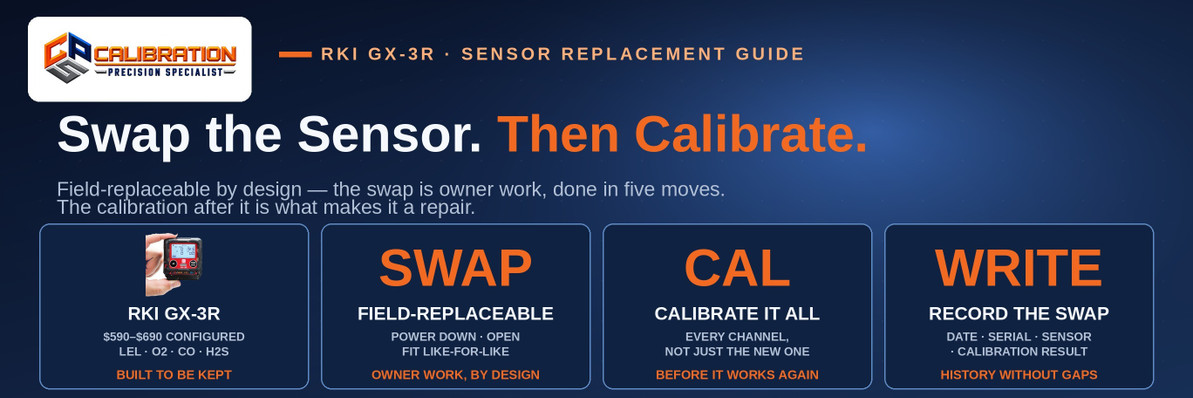
Replacing a sensor in an RKI GX-3R is a designed-for owner job — the GX-3R's sensors are field-replaceable — and it runs in five moves: power the meter down, open the sensor access and remove the spent sensor, fit the correct new sensor for that channel like-for-like, reassemble and let the meter settle, then calibrate every channel as configured before the meter returns to service. That last move is not a finishing touch; a new sensor is uncalibrated by definition, and a GX-3R that goes back on a worker with an uncalibrated channel is wearing a part, not a repair. The meter itself runs $590–$690 configured, which is why the swap economics work: a sensor restores an instrument worth protecting, provided the calibration and the record close the job.
The GX-3R earned its place in fleets by being small, honest, and serviceable — and serviceable is the word this post is about. RKI designs the platform for user calibration with field-replaceable sensors, batteries, and filters, so when a channel reaches the end of its life, the intended path is a swap, not a replacement meter. The card below is the instrument: the RKI GX-3R, monitoring up to four gases — combustible (LEL), oxygen, carbon monoxide, and hydrogen sulfide in its sensor configurations — at $590–$690 configured.
This guide walks the swap at the level the design defines it, then spends its real attention where swaps succeed or fail: getting the correct sensor in, the calibration that must follow, and the record that closes it. Two companions cover the neighboring ground: how to order the right replacement sensor for part identification — this post invents no GX-3R sensor part numbers — and how to calibrate an RKI GX-3R for the calibration procedure itself.
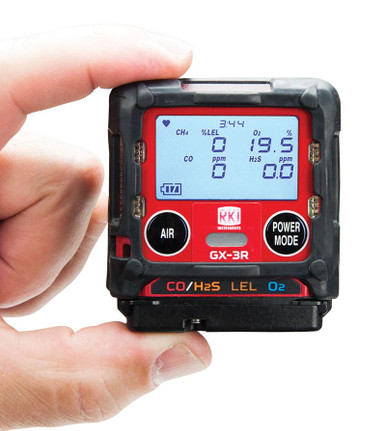
RKI GX-3R 4-Gas Monitor – LEL, O₂, CO & H₂S
Ultra-compact 4-gas personal monitor — field-replaceable sensors, worn in the breathing zone.
$590–$690 configured
See the GX-3RBefore You Touch the Meter: The Right Sensor and a Clean Diagnosis
Two checks come before the cover comes off, and skipping either one wastes the swap. First, is the sensor actually the fault? A channel that failed calibration, responds sluggishly, or will not hold a span is a sensor candidate — but a clogged filter in front of a healthy sensor imitates all three. Look at the cheap explanations first: the filter's condition, any visible contamination or damage at the sensor face, and whether the channel's behavior changed suddenly (suggesting an event or a blockage) or faded over months (suggesting a sensor honestly wearing out). If the diagnosis is genuinely uncertain, that is the bench's job — a sent-in instrument gets an as-found record and a diagnosis before parts money moves, under a written quote.
Second, is the new sensor the right one? GX-3R channels are gas-specific, and configurations vary — including, per the meter's product record, an H₂-compensated carbon monoxide configuration alongside the standard channels. A correct-gas, wrong-configuration sensor fits the socket and fails the mission. Match the replacement to the channel's gas and the meter's configuration using how to order the right replacement sensor, and keep it sealed until it goes in. Stage the calibration gas, in date, before you start: a swap that begins without its calibration staged is planning to be finished 'later,' and later is where uncalibrated meters drift back into service by accident.
The Swap, Step by Step
The GX-3R's design makes the mechanical work straightforward. Work clean, work unhurried, and follow the instrument's own documentation for the access details of your unit:
- 1. Power down and work in clean air. The meter goes off, away from the work area, on a clean surface. Opening a gas detector in the atmosphere it was just measuring invites contamination into exactly the places you are about to expose.
- 2. Open the sensor access as the design directs. The GX-3R's sensors are field-replaceable; the access is made to be used by the owner. Note how the spent sensor sits — orientation and seating — before you disturb it. A phone photo at this step has saved more reassemblies than any diagram.
- 3. Remove the spent sensor and set it aside — permanently. It comes out and it does not go into a drawer 'just in case.' A removed sensor was removed for cause; its next stop is your site's hazardous or e-waste stream, because electrochemical sensors contain electrolyte and electrode materials that do not belong in ordinary trash.
- 4. Fit the new sensor like-for-like. Correct gas, correct configuration, seated fully and oriented as the old one sat. Handle it by its body, not its face — the sensing surface is the instrument now, and fingerprints and pressure are not calibration inputs. If it does not seat willingly, stop: forcing a sensor is how a $590–$690 meter becomes a repair bill, and a reluctant fit usually means the wrong part.
- 5. Reassemble, power up, and let it settle. Close the meter as it was opened, power it on in clean air, and give the new channel time to stabilize before judging anything it says. A fresh sensor's first minutes are settling, not data — the calibration below is where its readings start to mean something.
Done carefully, the mechanical job is minutes. Everything that makes it a repair instead of a parts change happens next.
The Calibration That Must Follow — and the Record That Closes the Job
A new sensor has never met known gas. Its raw output becomes a measurement only when it is spanned against the documented calibration gas for its channel — which is why the swap is not finished until the meter has been calibrated as configured, every channel: the new channel because it is uncalibrated by definition, and the others because opening the meter and disturbing its insides is reason enough to verify the whole instrument before it protects someone again. The procedure itself is taught in full in how to calibrate an RKI GX-3R; this post's contribution is the insistence that it happen, immediately, before the meter returns to a belt — not at the next scheduled round, not after one shift 'to see how it reads.'
Two finishes are honest. In-house: you own the gas, you run the calibration, you record it — date, meter serial number, which channel, which sensor, and the calibration result — so the instrument's history reads continuously through the swap. On the bench: the meter comes to CPS, the calibration is the published $90 in-house rate for a 4-gas instrument, and it returns with the CPS certificate — as-found and as-left data and the calibration gas's CoA trail — with the swap and the calibration recorded together in the CPS Calibration Program. What is not an honest finish is the gap between them: a swapped meter whose calibration lives in somebody's intention. Write the record the day the sensor goes in, whichever bench did the work — months later, that entry is the difference between an instrument with a history and an instrument with a rumor.
Frequently Asked Questions
Can I replace GX-3R sensors myself?
Yes — that is what the instrument is designed for. RKI builds the GX-3R platform with field-replaceable sensors, batteries, and filters, and the swap itself is owner work: power down, open the sensor access, fit the correct new sensor like-for-like, reassemble. The conditions are the ones this post repeats because they decide whether the job counts as a repair: the replacement must be the right sensor for the channel's gas and the meter's configuration, the meter must be calibrated on every channel immediately afterward, and the swap must be recorded in the instrument's history. Skip either condition and you have changed a part, not repaired an instrument.
Do I have to calibrate my GX-3R after replacing a sensor?
Yes — every channel, immediately, before the meter returns to service. The new sensor is uncalibrated by definition: its output means nothing until it is spanned against documented gas. The untouched channels get calibrated too, because the meter was opened and its insides disturbed. The full procedure is how to calibrate an RKI GX-3R. If your shop does not own the gas or does not want the documentation duty, the bench finish is $90 in-house at CPS, with the full certificate — but one of those two finishes has to happen. A swapped-and-uncalibrated meter must not go back on a worker.
How do I know which sensor my GX-3R needs?
By gas and by configuration — both. Each GX-3R channel takes a sensor for its specific gas, and the meter's configurations vary, including an H₂-compensated carbon monoxide configuration noted in the meter's product record alongside the standard LEL, O₂, CO, and H₂S channels. This post deliberately states no GX-3R sensor part numbers; the identification process has its own guide, how to order the right replacement sensor, and it deserves following rather than shortcutting. A sensor that fits the socket but not the configuration is the most expensive kind of wrong part: it installs perfectly and protects incorrectly.
What if the new sensor does not fix the channel?
Then the sensor was not the whole fault — a clogged filter starving the channel, contamination at the sensor face, or a fault deeper in the meter can all survive a sensor swap. Stop swapping parts at it. The bench sequence exists for this case: an as-found record, a diagnosis that separates sensor from sample path from electronics, and a written quote before any further work, so the next dollar goes to the identified cause. If you send the meter in, say what was changed and when — a note in the box with the swap history genuinely shortens the diagnosis, and the meter's record in the calibration program keeps the story attached to its serial number.
How should I dispose of the old GX-3R sensor?
Through your site's hazardous or e-waste stream — electrochemical sensors contain electrolyte and electrode materials and do not belong in ordinary trash. And never keep the removed sensor as a spare. It was removed because it was spent or failing; stored in a drawer, it becomes a future accident, reinstalled months later by someone who never saw its history and has no reason to doubt it. A legitimate spare is a new sensor, sealed, matched to the channel's gas and configuration, stored with the calibration gas that will finish its installation the day it is needed.
How long does a GX-3R sensor replacement take?
The mechanical swap is minutes with the right sensor staged. The honest total adds diagnosis beforehand, settling time after power-up, a full calibration of every channel, and the record entry — the better part of an hour of attended work in-house. The bench route trades that hour for shipping time: call 865-900-8844 for the current queue. A swap rushed past its calibration is not faster; it is unfinished.
Should I replace all the sensors at once while the meter is open?
Only on evidence, not on tidiness. Sensors age independently, and replacing a healthy, documented channel discards working life you paid for. If another channel is already marginal — sluggish, drifting to the edge at calibration — doing it in the same opening is efficient and defensible. Let each channel's record make its own case.
Does replacing the sensors myself affect the GX-3R's warranty position?
Work done as the manufacturer designs it — user-replaceable parts, installed per the instrument's documentation — is the instrument being serviced as intended. Trouble starts outside the design: forcing a fit, fitting a sensor not specified for the channel, or opening parts of the meter that are not owner-accessible. Follow the documentation for your exact unit, fit only the correct sensor, and keep the swap record with the instrument's history. When any of that is in doubt, a two-minute call to 865-900-8844 before the cover comes off beats an argument afterward.
What should I record when I replace a sensor?
Five things, the same day: the date, the meter's serial number, which channel was changed, what sensor went in (its identity, matched to the channel and configuration), and the result of the calibration that followed. That entry is what keeps the instrument's history continuous — without it, the next calibration's as-found readings get interpreted against a sensor nobody knows is new, and an auditor reading the file finds a gap where a chapter should be. Instruments calibrated at CPS carry this record in the CPS Calibration Program by serial number; in-house swaps should land in the same file by the same discipline.
When should I send a GX-3R in instead of swapping the sensor myself?
In four situations: the diagnosis is uncertain — the fault might be the filter, contamination, or something deeper than the sensor; the meter's configuration makes the correct replacement sensor unclear; your shop does not own in-date calibration gas for the meter's channels, so the mandatory calibration cannot be finished in-house; or the instrument's documentation has to satisfy an auditor, where a bench certificate with as-found and as-left data carries weight a log entry does not. The send-in route is the ship-in calibration and repair request — $90 in-house for the calibration finish on a 4-gas meter, repairs quoted in writing if the diagnosis finds more than a sensor.
The Bottom Line
The GX-3R was built to be kept, not replaced: correct sensor in, meter calibrated on every channel, record written, old sensor disposed of — in that order, every time. Do those four things and a sensor swap is the cheapest years of service in gas detection. Skip the calibration or the record, and the same ten minutes of work becomes the reason an instrument's readings cannot be trusted or defended.
Need the bench finish — calibration, certificate, and the swap on the record? See calibration services, or call CPS Calibrations at 865-900-8844. Ship-in address: 109 S. Front Street, Rockwood, TN 37854.
--- CPS Calibrations · 109 S. Front Street, Rockwood, TN 37854 · RKI GX-3R · How to Calibrate an RKI GX-3R · Calibration Services
Need a calibration you can file?
In-house calibration at CPS in Rockwood, Tennessee — $55 for single-gas instruments, $90 for 4- and 5-gas — every channel, as-found and as-left data, full certificate.
See Calibration Servicesor call 865-900-8844
Recent Posts
-

What Is Remote Monitoring for Fixed Gas Detection?
Remote monitoring for fixed gas detection means a fixed system's live readings, trends, and alarm hi …Nov 23rd 2026 -

What Are the Key Differences Between the GX-6000 and GX-6100?
The RKI GX-6100 is the current replacement for the discontinued GX-6000: both are pumped 6-gas monit …Nov 22nd 2026 -

How to Read a PID Correction Factor Chart
To read a PID correction factor chart, find your vapor’s row, take the factor under your own lamp en …Nov 21st 2026