
Methane and Carbon Monoxide: The Two Gases That Run Mine Monitoring
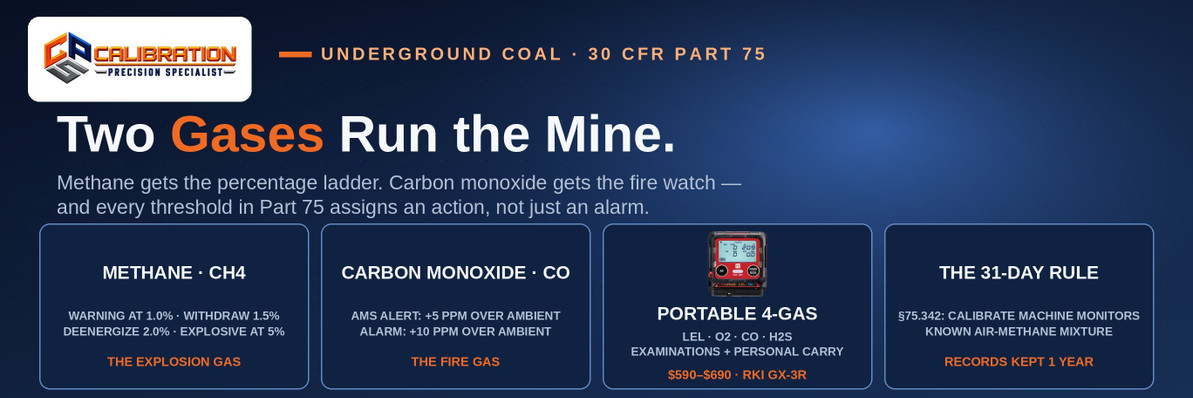
Underground coal monitoring runs on two gases: methane, where 30 CFR 75.323 requires equipment deenergized and ventilation corrected at 1.0 percent in a working place and withdrawal at 1.5 percent — and carbon monoxide, the early-warning fire gas, where an atmospheric monitoring system on a belt entry must alert at 5 ppm above the established ambient level and alarm at 10 ppm above it (30 CFR 75.351). Methane is the explosion gas the ventilation plan is built to dilute; CO is the fire gas the belt sensors are built to catch first.
Ask a mine electrician which two channels matter and you will not get a long list. Other gases appear underground, and oxygen is checked constantly, but the monitoring architecture of an underground coal mine — the machine-mounted monitors, the atmospheric monitoring system (AMS), the belt sensors, the fan signals — is organized around methane and carbon monoxide. One comes out of the coal itself. The other is what coal, belts, and equipment produce when something starts to burn. This post walks the actual numbers in MSHA's Part 75 standards, because in a coal mine the regulation does not describe monitoring in general terms — it assigns a required action to every threshold. For the wider picture of underground coal gas detection, see our companion post on gas detection in underground coal mines.
Why Does Methane Get a Percentage Ladder Instead of a ppm Limit?
Because methane's hazard is explosion, not poisoning. NIOSH classifies methane as a simple asphyxiant — it has no ppm exposure limit of its own — and the OSHA/NIOSH hazard tables put its lower explosive limit at 5.0 percent by volume (upper limit 15.0 percent). Part 75 therefore works in percent, and every rung of the ladder sits well below that 5 percent line: the first action level, 1.0 percent methane, is one-fifth of the explosive limit.
The ladder lives in two sections that work together. Section 75.342 governs the monitors mounted on the machines. Section 75.323 governs what people must do at each concentration, wherever the reading is taken. Tests under §75.323 are made at least 12 inches from the roof, face, ribs, and floor — methane is lighter than air and layers at the roof, so where you hold the instrument is part of the measurement.
What Does §75.342 Require of Machine-Mounted Methane Monitors?
MSHA-approved methane monitors are required on all face cutting machines, continuous miners, longwall face equipment, loading machines, and other mechanized equipment used to extract or load coal within the working place, with sensing devices installed as close to the working face as practicable (on a longwall shearer, one sensor sits at the return-air end of the face and another downwind, as close to the cutting head as practicable). The monitor's duties are automatic:
- At 1.0 percent methane, the monitor must give a warning signal — and the signal device must be visible to a person who can deenergize the electric equipment or shut down the diesel equipment it is mounted on.
- At 2.0 percent methane, the monitor must automatically deenergize the electric equipment (or shut down the diesel equipment) it is mounted on — and it must also deenergize when the monitor is not operating properly. A dead monitor is not a neutral monitor; the standard treats a failed monitor as a stop signal.
- Calibration is a dated, recorded duty: monitors must be calibrated with a known air-methane mixture at least once every 31 days, by persons properly trained in their maintenance, calibration, and permissibility, with a record of every calibration test retained for 1 year at a surface location.
That last bullet is the one this industry lives on. A machine monitor is a legal instrument: its warning and deenergize functions only mean something if the sensor is reading true, which is why the standard names the calibration gas (a known air-methane mixture), the interval (31 days), the person (properly trained), and the record (1 year, on the surface) in the same paragraph.
What Actions Does §75.323 Require at 1.0, 1.5, and 2.0 Percent?
Section 75.323 assigns the human actions, and they differ by where the methane is found:
| Where the methane is | At 1.0% or more | At 1.5% or more |
|---|---|---|
| Working place or intake air course (including a belt air course) | Deenergize electrically powered equipment (except intrinsically safe AMS), shut off other mechanized equipment, adjust ventilation at once to below 1.0%, no other work until below 1.0% | Withdraw everyone except §104(c) persons; disconnect electrically powered equipment at the power source |
| Return air split off a working section | Adjust ventilation at once to reduce the return air below 1.0% | Withdraw, deenergize/disconnect at the source, no other work until the return is below the stated level |
| Bleeder splits and other return air courses | — | Hard limit: methane shall not exceed 2.0% |
Read the shape of it: 1.0 percent is the act-now line — power off the equipment, fix the air. 1.5 percent is the people line — withdraw, and disconnect power at the source rather than at the machine. The 2.0 percent figure is the ceiling for the air courses furthest from the face, and the machine monitors' automatic deenergize point. Nothing in the ladder waits for the explosive limit; the entire structure operates between one-fifth and two-fifths of the 5 percent LEL.
Around those sections sits the plan and the fan. The mine's ventilation system and methane and dust control plan (§75.316) — approved by MSHA, showing the type and location of ventilation equipment and the quantity and velocity of air reaching each working face — is reviewed by the operator and the Secretary at least every 6 months. And because ventilation is the control that keeps methane diluted, §75.312 requires main fans to be examined daily (or watched by a fan monitoring system whose data a trained person reviews daily, with the system tested and the fan examined at least every 7 days), with the automatic fan signal device tested by stopping the fan at least every 31 days.
Why Is Carbon Monoxide the Fire Gas?
Methane announces the coal seam. Carbon monoxide announces a fire — a heating belt, a smoldering pile, overheated equipment — and it does so before smoke is visible and long before flame, because CO is what incomplete combustion produces first. That is why Part 75 puts CO sensors on the two places a fire would start or travel: the belt entries that move air (and product) through the mine, and the electrical installations.
Where a belt air course ventilates working sections, or an AMS watches electrical installations or return splits, §75.351 sets the alert and alarm levels relative to the mine's own air, not to a fixed ppm:
- Alert at 5 ppm CO above the established ambient level for that area.
- Alarm at 10 ppm CO above ambient (where smoke sensors are used instead, alarm at an optical density of 0.022 per meter).
The ambient level itself is established for the mine and approved in the ventilation plan — a belt entry downwind of diesel equipment does not start at the same baseline as an intake, and the standard is written to catch a rise off whatever baseline is normal for that spot. A 5-over-ambient alert is deliberately small: it is meant to move while a heating is still a heating.
Sensor placement on a belt air course is specified just as tightly:
- CO sensors at intervals of not more than 1,000 feet along each belt entry — tightened to 500 feet where air velocity is 50–100 feet per minute, and 350 feet where velocity is under 50 fpm (slow air means slow transport to the next sensor, so the sensors move closer together).
- A sensor not more than 100 feet downwind of each belt drive unit, each tailpiece transfer point, and each belt takeup.
- For electrical installations, at least one CO or smoke sensor downwind and not more than 50 feet from the installation.
- The AMS signals a designated surface location and the affected working sections — a belt reading nobody sees is not monitoring.
One distinction worth keeping straight: these AMS alert/alarm levels are mine monitoring numbers, set over ambient. The general-industry CO exposure limits are a separate frame — OSHA PEL 50 ppm TWA, NIOSH REL 35 ppm TWA with a 200 ppm ceiling, IDLH 1,200 ppm — and a belt AMS alarming at 10 ppm over ambient is doing its job long before any of those exposure numbers are in sight. That is the point of the design.
Where Do Portable Instruments Fit in a Mine's Monitoring?
The fixed and machine-mounted systems above belong to the mine and its approved plan — they are installed, maintained, and calibrated by the mine's own trained people under Part 75. Portable instruments are the layer in between: the certified person's handheld checks, pre-shift and on-shift examinations, and the personal monitor a miner carries into a place the fixed system does not reach. That layer is standard 4-gas equipment — LEL, oxygen, CO, and H₂S:
- The RKI GX-3R, configured at $590–$690, is the diffusion 4-gas most crews already know — the examination and personal-carry instrument.
- The RKI GX-Force, configured at $835–$975, adds a built-in pump for drawing a sample from a high spot, a borehole, or a place nobody should enter to test.
CPS Calibrations' role for mine customers is the bench side of that portable layer, plus supply: we sell the portables and the calibration gas that keeps every channel honest, we calibrate portable instruments at published in-house rates — $55 single-gas, $90 for 4- and 5-gas instruments — and every instrument we service goes into the CPS Calibration Program with a certificate showing as-found and as-left readings and a reminder before the next due date. We calibrate every channel the instrument has. Repairs are quoted in writing before work is done, and any on-site work is quoted in writing for the job — the in-house rates above are bench rates for instruments shipped or carried to Rockwood.
Frequently Asked Questions
What methane level requires action in an underground coal mine?
The first action level is 1.0 percent. Under 30 CFR 75.323, at 1.0 percent or more methane in a working place or intake air course, electrically powered equipment is deenergized (except intrinsically safe monitoring systems), other mechanized equipment is shut off, ventilation is adjusted at once to bring the concentration below 1.0 percent, and no other work is permitted until it is. Machine-mounted monitors under §75.342 must also give a warning signal at 1.0 percent.
When must miners be withdrawn for methane?
At 1.5 percent. When methane reaches 1.5 percent or more in a working place or intake air course, §75.323 requires everyone except the persons referred to in §104(c) of the Mine Act to be withdrawn from the affected area, with electrically powered equipment disconnected at the power source. The same withdrawal-and-deenergize response applies at 1.5 percent in a return air split, and no other work is permitted there until the concentration falls below the stated level.
At what methane level does a machine monitor shut equipment down automatically?
At 2.0 percent. Section 75.342 requires the methane monitor on face equipment — continuous miners, longwall equipment, loading machines, and similar mechanized equipment — to automatically deenergize electric equipment (or shut down diesel equipment) when the concentration at any monitor reaches 2.0 percent, and also when the monitor is not operating properly. The warning signal comes earlier, at 1.0 percent, and must be visible to a person who can deenergize the equipment.
How often must methane monitors be calibrated under MSHA rules?
At least once every 31 days. Section 75.342 requires machine-mounted methane monitors to be calibrated with a known air-methane mixture at least once every 31 days, by persons properly trained in the maintenance, calibration, and permissibility of the monitors. A record of every calibration test must be kept for 1 year at a surface location and made available to MSHA and the miners' representative.
Why does mine monitoring watch carbon monoxide if methane is the explosive gas?
Because CO is the fire gas. Methane comes from the coal seam; carbon monoxide is produced first by incomplete combustion — a heating conveyor belt, smoldering coal, overheated equipment — before there is visible smoke or flame. Part 75 therefore places CO sensors along belt entries and downwind of electrical installations as an early-warning fire detection layer, with atmospheric monitoring systems that alert at 5 ppm over the area's established ambient level and alarm at 10 ppm over ambient under §75.351.
How far apart are CO sensors on a belt entry?
No more than 1,000 feet apart, and closer in slow air. Section 75.351 spacing for belt air courses is 1,000 feet maximum, reduced to 500 feet where air velocity is 50–100 feet per minute and 350 feet where velocity is under 50 feet per minute. A sensor is also required not more than 100 feet downwind of each belt drive unit, tailpiece transfer point, and belt takeup — the mechanical points where a fire is most likely to start.
What does "5 ppm above ambient" mean for a CO alarm?
It means the alarm is a rise, not an absolute number. Every monitored area has an established normal CO background — its ambient level — which is determined by the mine and approved in the ventilation plan. The atmospheric monitoring system alerts when a CO sensor reads 5 ppm above that established ambient and alarms at 10 ppm above it. A small, early rise off baseline is exactly what the system is built to catch, while a heating is still small.
How much methane is in air when it can explode?
Methane burns in air between its lower explosive limit of 5.0 percent by volume and its upper limit of 15.0 percent (OSHA/NIOSH hazard tables). Part 75's action ladder sits far below that range: 1.0 percent — the first action level — is one-fifth of the explosive limit, withdrawal comes at 1.5 percent, and machine monitors deenergize equipment at 2.0 percent. Methane is also a simple asphyxiant, but underground coal regulates it as an explosion hazard measured in percent, not as a ppm exposure.
Who calibrates a mine's machine-mounted methane monitors?
The mine does, under its own program. Section 75.342 calibration must be performed by persons properly trained in the maintenance, calibration, and permissibility of methane monitors, using a known air-methane mixture, at least every 31 days, with records kept on the surface for a year. A calibration shop like CPS supports the mine's wider instrument fleet — bench calibration and repair of portable gas detectors, calibration gas supply, and due-date records — while the Part 75 machine-monitor duty stays with the mine's trained, designated people.
What portable gas detector do mine examiners and miners carry?
Typically a 4-gas portable reading LEL, oxygen, CO, and H₂S — diffusion models for personal carry and examinations, pumped models when a sample has to be drawn from a high spot or an unentered place. At CPS, the RKI GX-3R configured at $590–$690 covers the diffusion role and the pumped RKI GX-Force at $835–$975 covers sample-draw work. In-house calibration at our Rockwood bench is $55 for a single-gas instrument and $90 for 4- and 5-gas instruments, with a certificate and due-date reminder on every unit.
The Bottom Line
Mine monitoring is two gases and a ladder of numbers: methane warns at 1.0 percent, takes equipment power at 1.0–2.0 percent, and takes people out at 1.5 percent — while CO rides the belt entries as the fire alarm, alerting at 5 ppm over ambient. Every one of those numbers only works if the sensor behind it was calibrated on schedule and on the record. CPS Calibrations keeps the portable layer honest — instruments, calibration gas, bench calibration, and records — from Rockwood, Tennessee.
Run a mine instrument fleet in East Tennessee or the coalfields beyond? Call CPS Calibrations at 865-900-8844 — we'll keep the portables calibrated and the records inspector-ready.
CPS Calibrations · 109 S. Front Street, Rockwood, TN 37854 · Calibration Services · The CPS Calibration Program · Gas Detection in Underground Coal Mines
Need a calibration you can file?
In-house calibration at CPS in Rockwood, Tennessee — $55 for single-gas instruments, $90 for 4- and 5-gas — every channel, as-found and as-left data, full certificate.
See Calibration Servicesor call 865-900-8844
Recent Posts
-

What Is Remote Monitoring for Fixed Gas Detection?
Remote monitoring for fixed gas detection means a fixed system's live readings, trends, and alarm hi …Nov 23rd 2026 -

What Are the Key Differences Between the GX-6000 and GX-6100?
The RKI GX-6100 is the current replacement for the discontinued GX-6000: both are pumped 6-gas monit …Nov 22nd 2026 -

How to Read a PID Correction Factor Chart
To read a PID correction factor chart, find your vapor’s row, take the factor under your own lamp en …Nov 21st 2026