
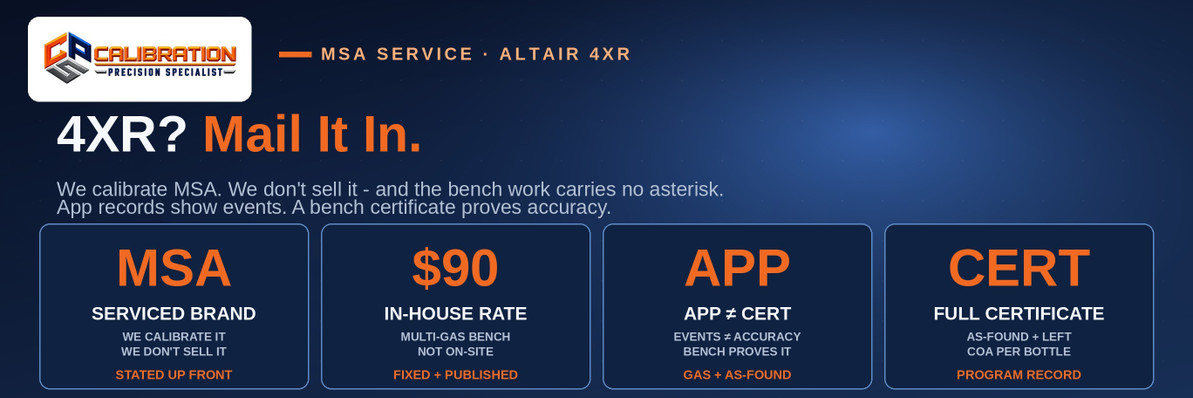
MSA ALTAIR 4XR Calibration Service: Mail In Your Meter
Mail-in calibration for the MSA ALTAIR 4XR costs $90 at CPS Calibrations — the published in-house rate for a 4- or 5-gas instrument — from a shop that calibrates MSA without selling it: every channel is calibrated as configured with as-found readings recorded before any adjustment, a sensor health check on the bench, and the meter returned with a certificate showing as-found and as-left data and a Certificate of Analysis link for each calibration gas bottle used. Ship it to 109 S. Front Street, Rockwood, TN 37854; call 865-900-8844 first to confirm the current turnaround.
Start with the disclosure most service pages bury: CPS Calibrations is not an MSA dealer. You cannot buy a 4XR, its sensors, or its accessories from our store, and this page will not pretend otherwise. What CPS runs is a calibration bench — and a bench's job is gas, sensors, and documentation, which do not care whose name is molded into the case. Our position is stated site-wide in we calibrate brands we don't sell, and the 4XR is one of the most common serviced-brand meters in American industry, so it gets its own service page.
The 4XR is MSA's Bluetooth-connected 4-gas portable: the standard confined-space set (combustible/LEL, oxygen, carbon monoxide, hydrogen sulfide) as configured in your unit, with app-connected records through MSA's ecosystem. That connectivity is genuinely useful for fleet visibility — and it frames this page's honest argument about what an app record is and is not.
What a Bench Calibration Does That an App Record Doesn't
An app ecosystem records what the instrument reports: bump results, calibration events, readings, and status, transmitted over Bluetooth. That is fleet telemetry, and it has real value. What it cannot do is independently verify the instrument against documented gas on a bench, record the as-found error before adjustment, assess sensor health, or produce a calibration certificate whose gas trail — a Certificate of Analysis link for each bottle used — an auditor, insurer, or customer can follow.
That distinction matters when the record is ever questioned. 'The app shows a calibration event' answers when. A bench certificate answers when, with what gas, how far off the meter was when it arrived (as-found), and exactly where it read when it left (as-left), channel by channel. CPS issues that second document for the 4XR at the same $90 rate and with the same one-tier, full-breakdown standard as every meter we calibrate — see calibration services.
What the 4XR Bench Visit Covers
- Every channel as configured — the standard four (LEL, O2, CO, H2S) in your unit's build, each identified from the meter itself and spanned against its documented gas.
- As-found first — readings against known gas recorded before adjustment, so the certificate documents how the meter was actually performing in your field, not just that it passes now.
- Sensor health check — drifted-but-recoverable is distinguished from sluggish, unstable, or spent; if a sensor is failing, any work beyond calibration is a written quote before any work, with the choice yours.
Send the meter and its charger, with a note naming your company, a contact, and the serial number. Do not send calibration gas — the bench works with its own documented gas, and the certificate's CoA links point to those bottles.
What Comes Back — and the Program Behind It
The meter returns calibrated with its certificate, tracked by serial number from check-in to return shipping (return shipping is the customer's cost, arranged at booking). Its record joins the CPS Calibration Program — free and automatic, no contract or monthly fee — so its history accumulates by serial number and a reminder arrives before the next due date, whichever brand the next meter in your fleet happens to be. The general ship-in process for any instrument is in how mail-in gas detector calibration works.
One boundary, honestly: parts and sensor availability for a serviced brand runs through that brand's supply chain, not our shelves. If a 4XR needs a sensor, the written quote will say what it costs and how long the part takes — before you approve anything. Calibration itself needs no parts channel at all, which is why a non-dealer bench can offer it without an asterisk.
Frequently Asked Questions
How much does it cost to calibrate an MSA ALTAIR 4XR?
$90 at CPS Calibrations — the published in-house rate for 4- and 5-gas instruments, for bench work in Rockwood, Tennessee. It never applies to on-site work. Shipping is separate in both directions, and anything beyond calibration is quoted in writing before it is done.
Does CPS sell MSA detectors or sensors?
No. CPS does not sell MSA — there are no MSA products in our store and none are linked from this page. We calibrate MSA instruments as a serviced brand, openly, under the same bench standard as the brands we sell. If you need to buy a 4XR, you need an MSA dealer; if you need yours calibrated and certified, that is this page.
What does the 4XR calibration include?
Every channel calibrated as configured (the standard four — LEL, O2, CO, H2S — in your unit's build), as-found readings recorded before adjustment, as-left readings after, a sensor health check, and a full certificate with a Certificate of Analysis link for each calibration gas bottle used. The meter's record joins the CPS Calibration Program with due-date reminders.
Don't my XCell Connect / app records already prove calibration?
They prove events, not accuracy. App-connected records show that calibration and bump events occurred and what the instrument reported. A bench certificate independently documents the meter against known gas: as-found error before adjustment, as-left readings after, and the CoA trail for the gas used. Auditors and customers asking for a certificate are asking for the second document.
Can you replace a failed sensor in my 4XR?
If a sensor is spent, you will get a written quote before any work — including what the part costs and how long it takes, since serviced-brand parts come through MSA's supply chain rather than our shelves. Approve it and the meter is repaired and calibrated; decline it and the meter returns as-is with its as-found record.
How long will my 4XR be gone?
Call 865-900-8844 before shipping and we will confirm the current bench turnaround. We publish no fixed turnaround — it depends on the week's queue and, if a sensor is needed, on your quote decision and the part. The $90 calibration rate itself is fixed and published.
Where do I ship my ALTAIR 4XR?
CPS Calibrations, 109 S. Front Street, Rockwood, TN 37854 — after calling 865-900-8844 first. Include the meter, its charger, and a note with your company name, a contact, and the meter's serial number. Do not send calibration gas cylinders.
Is a 4-gas 4XR charged at the 4-gas rate even though it has four channels?
Yes — $90 is the published in-house rate for 4- and 5-gas instruments, and the 4XR is squarely in that class. The $55 rate is for single-gas instruments only.
Will my 4XR's history be kept if my fleet is mixed brands?
Yes. The CPS Calibration Program tracks instruments by serial number, not by brand or by where they were bought. A mixed fleet — MSA portables beside brands we sell — accumulates one history per meter, with one reminder rhythm.
Why would a shop calibrate a brand it doesn't sell?
Because calibration is gas, sensors, and documentation — a bench discipline, not a dealership function. Fleets run mixed brands; their calibration records should not have to. Our we-calibrate-brands-we-don't-sell page states the policy, and this page is that policy applied to the 4XR.
The Bottom Line
The 4XR does not need a dealer to be calibrated properly — it needs documented gas, as-found honesty, and a certificate that stands on its own. CPS sells no MSA and calibrates the 4XR anyway, at the published $90 in-house rate, with the full breakdown and CoA trail. Ready to mail your ALTAIR 4XR in? Call 865-900-8844, then ship it to 109 S. Front Street, Rockwood, TN 37854.
Ready to mail in your MSA ALTAIR 4XR?
Start the ship-in request, pack the meter, and we handle the rest — every channel calibrated as configured, full certificate returned with it.
Start Your Ship-In Requestor call 865-900-8844
Recent Posts
-

Which GfG Portable Gas Detector Is Best for You?
The right GfG portable is decided by three questions — how many gases, pumped or diffusion, and PID …Nov 24th 2026 -
What GfG Fixed Gas Detection Systems Are There? Every Transmitter and Controller Explained
GfG’s fixed gas detection line at CPS is 39 products in two layers: 23 transmitters and detection sy …Nov 24th 2026 -
What GfG Portable Gas Detectors Are There? Every Model Explained
GfG’s portable line at CPS is 14 products built around six instruments: the Micro IV single-gas dete …Nov 24th 2026