
OTIS WireFree Controllers: OI-7010, OI-7530, and the OI-9850 Gateway
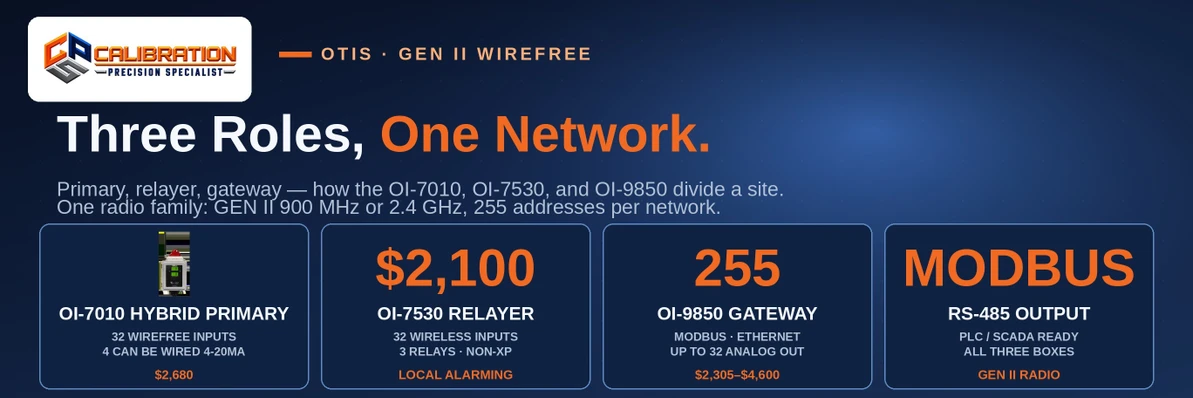
OTIS's GEN II WireFree system divides its controller work three ways: the OI-7010 is a hybrid primary controller for up to 32 WireFree channels — four of which can instead be wired 4-20mA inputs — at $2,680; the OI-7530 is a non-explosion-proof secondary 'relayer' watching up to 32 wireless detectors and tripping three relays, at $2,100; and the OI-9850 is a gateway that collects up to 255 WireFree detectors and hands them to plant systems as Modbus, Ethernet, or up to 32 analog channels, at $2,305–$4,600 configured. Same radio family, three different jobs — and choosing wrong is choosing twice.
Wireless gas detection sells itself on the detector end — no conduit, no trenching, detectors where wire cannot go. The questions that decide whether the system works live at the other end: where do the readings land, what trips when they alarm, and how does any of it reach the PLC? OTIS answers with three boxes that share the GEN II radio (900 MHz or 2.4 GHz, with 255 addresses per network) and split the land-end work by role. CPS already covers the sibling OI-7032 WireFree controller and the OI-6900 WireFree detector heads that feed all three; this guide divides the three controllers themselves: the OI-7010, the OI-7530, and the OI-9850.
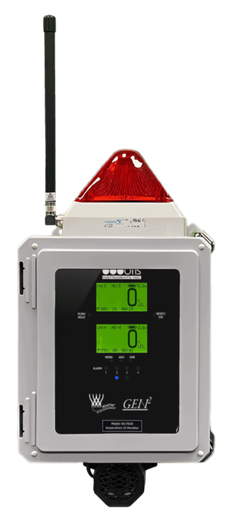
OTIS OI-7010 WireFree 32-Channel Hybrid Controller
Hybrid primary controller — up to 32 WireFree inputs, four of which can be wired 4-20mA.
$2,680
See the OI-7010What Does Each Controller Actually Do?
- OI-7010 — the hybrid primary ($2,680). The system's brain for a mid-size site: up to 32 WireFree sensor inputs, and the hybrid trick — four of those inputs can be wired 4-20mA analog instead — so existing wired loops join the wireless build instead of being ripped out. Four dry-contact alarm relays (replaceable 4A fuses, NO/NC, latching or not) handle local alarming, RS-485 Modbus carries everything onward to the PLC/SCADA, and dual 128×64 graphical LCDs with a five-button interface run setup. It accepts the full GEN II WireFree family plus any wired 4-20mA sensors, third-party transmitters included.
- OI-7530 — the relayer ($2,100). A secondary controller, non-explosion-proof, that adds *local alarming* where the primary is not: it watches up to 32 GEN II WireFree detectors and trips three programmable dry-contact relays, with three individually configurable alarm set points per channel. Sunlight-readable LCD, magnetic non-intrusive switches for setup without opening the box, RS-485 Modbus out. Tank batteries, wellheads, compressor stations — distributed points that need dependable alarming on site, tied back to a central system.
- OI-9850 — the gateway ($2,305–$4,600 configured). The bridge into wired infrastructure at scale: up to 255 WireFree detectors in, and out as RS-232/RS-485 Modbus, Ethernet (an embedded website serves live readings, alarms, and faults to any browser on the network), virtual COM over USB, or — via optional 8-channel output cards — up to 32 channels of 4-20mA for a DCS or PLC that speaks analog. An external N-female RF connector lets the antenna go where the signal is, not where the box is.
How Do the Three Divide a Real Site?
Picture the archetypal GEN II installation — a facility mixing old wired loops, a field of wireless heads, and a control room that wants it all in the plant system. The 9850 is the front door: the whole wireless estate, up to 255 points, enters through it and becomes Modbus/Ethernet/analog data the DCS already understands. The 7010 runs a building or a process area as its primary — 32 channels, its own relays alarming locally, its four wired inputs absorbing the legacy loops in that area. The 7530 sits at the remote satellite — the tank battery miles from the panel — watching its local detectors and tripping its own relays for the beacon, horn, or shutdown that cannot wait for a network round-trip. Networks scale accordingly: GEN II radio supports 52 networks at 900 MHz or 78 at 2.4 GHz, 255 addresses each — addressing is never the constraint; roles are.
Use this when your site is distributed, your wired base is partial, or trenching to every detector is the budget-killer: that is precisely the terrain WireFree exists for. The detectors themselves — the OI-6900 family heads — are covered in their own CPS post, and the installed system is designed, installed, and serviced on site through CPS's fixed system installation work, quoted in writing.
What Does a Complete WireFree Installation Include, Beyond Controllers?
Controllers are the land end; a working quote also counts the air end and the joins. Detector heads — the GEN II WireFree family, covered in CPS's OI-6900 detector heads post — are chosen per gas and per location class, and their count is what sizes the controller roles. Antenna placement decides real-world reliability: the gateway's external N-female RF connector exists so the antenna can be positioned for signal rather than bolted wherever the panel fit, and a site survey before installation is cheaper than a repeater after it. Integration — which of Modbus, Ethernet, or analog outputs the plant will actually consume — should be settled before the gateway's output cards are specified, since they drive its configured price. CPS scopes all three as part of fixed-system design: the controller division in this guide is step two of that conversation, not a shopping list to order blind.
Frequently Asked Questions
How much do the OTIS WireFree controllers cost?
The OI-7010 hybrid primary is $2,680; the OI-7530 relayer is $2,100; the OI-9850 gateway is configured at $2,305–$4,600 across 10 builds — its output-card complement (up to 32 analog channels) drives the position in that range. All three are listed on CPS's store with live configurations.
What is the difference between the OI-7010 and the OI-7530?
Role. The OI-7010 is a primary controller — the system brain — with 32 inputs (four can be wired 4-20mA), four relays, dual displays, and Modbus. The OI-7530 is a secondary relayer: it watches up to 32 wireless detectors and provides local alarming through three relays with three configurable alarm set points per channel, for sites that need alarming where no primary sits. The 7530 is also non-explosion-proof, which decides where it can be mounted.
What does the OI-9850 gateway do that the others don't?
Scale and translation. It collects up to 255 WireFree detectors — against 32 for the others — and converts them into the languages plant systems speak: RS-232/RS-485 Modbus, Ethernet with an embedded live-readings website, or up to 32 channels of 4-20mA via optional output cards. It is how a large wireless estate joins an existing wired DCS or PLC without new wire to every point.
Can WireFree controllers accept wired sensors?
The OI-7010 can: four of its 32 inputs accept wired 4-20mA analog sensors — including third-party transmitters — which is its 'hybrid' designation and the migration path for sites with sound wired loops. The OI-7530 and OI-9850 take WireFree digital inputs; the 9850 can additionally *output* analog channels to wired systems.
What radio does the GEN II WireFree system use?
GEN II WireFree at 900 MHz (52 networks) or 2.4 GHz (78 networks), with 255 addresses per network. All three controllers in this guide share that radio family, as do the OI-6900-series detector heads — one network architecture across primaries, relayers, and gateways.
How many detectors can one WireFree system handle?
Per box: 32 on an OI-7010 or OI-7530, 255 on an OI-9850 gateway. With 255 addresses available per network and dozens of networks per band, system size is set by your architecture — primaries per area, a gateway for the estate — rather than by the radio.
Can I see WireFree readings in a browser?
Through the OI-9850, yes: its Ethernet output serves an embedded website with live readings, alarms, and faults to any browser on the network. The 7010 and 7530 present their readings on their own LCDs and pass data onward by RS-485 Modbus.
Is the OI-7530 explosion proof?
No — it is explicitly a non-explosion-proof controller, which is a mounting specification, not a defect: it belongs in the non-classified locations (or enclosures rated for them) from which it relays alarms for detectors in the field. Site classification decides placement for every controller in the system; that is part of the design work.
What power do these controllers need?
All three run on 12-35 VDC, with the OI-7530 and OI-9850 also accepting 120 VAC and AC supply options across the line (draw at 24 VDC: 275 mA max for the 7010/7530, 800 mA max for the 9850). Operating range is -40 to +70 °C, enclosures are fiberglass with clear windows/lids, and hardware carries a 1-year limited warranty.
Who designs and installs a WireFree system?
CPS designs and installs fixed gas detection, including GEN II WireFree systems — on-site work quoted in writing (the published $55/$90 rates are in-house bench rates for portable instruments, never on-site prices). Bring your detector count and your plant-system target — Modbus, Ethernet, or analog — via the fixed system installation page or 865-900-8844, and the controller roles fall out of the design.
The Bottom Line
Primaries think, relayers alarm, gateways translate: the OI-7010 ($2,680) runs an area with a hybrid wired/wireless input mix, the OI-7530 ($2,100) puts local relays at remote points, and the OI-9850 ($2,305–$4,600) brings up to 255 wireless detectors into the plant system. Spec the roles in that order and the WireFree architecture designs itself.
Planning a wireless system and unsure which boxes your site needs? Call CPS Calibrations at 865-900-8844 with your detector count and control-system target — we will divide the roles with you.
--- CPS Calibrations · 109 S. Front Street, Rockwood, TN 37854 · OTIS OI-7010 · OI-7032 Controller · Fixed System Installation
Need a calibration you can file?
In-house calibration at CPS in Rockwood, Tennessee — $55 for single-gas instruments, $90 for 4- and 5-gas — every channel, as-found and as-left data, full certificate.
See Calibration Servicesor call 865-900-8844
Recent Posts
-

What Is Remote Monitoring for Fixed Gas Detection?
Remote monitoring for fixed gas detection means a fixed system's live readings, trends, and alarm hi …Nov 23rd 2026 -

What Are the Key Differences Between the GX-6000 and GX-6100?
The RKI GX-6100 is the current replacement for the discontinued GX-6000: both are pumped 6-gas monit …Nov 22nd 2026 -

How to Read a PID Correction Factor Chart
To read a PID correction factor chart, find your vapor’s row, take the factor under your own lamp en …Nov 21st 2026