
RAE MultiRAE Calibration Service: Mail In Your Meter
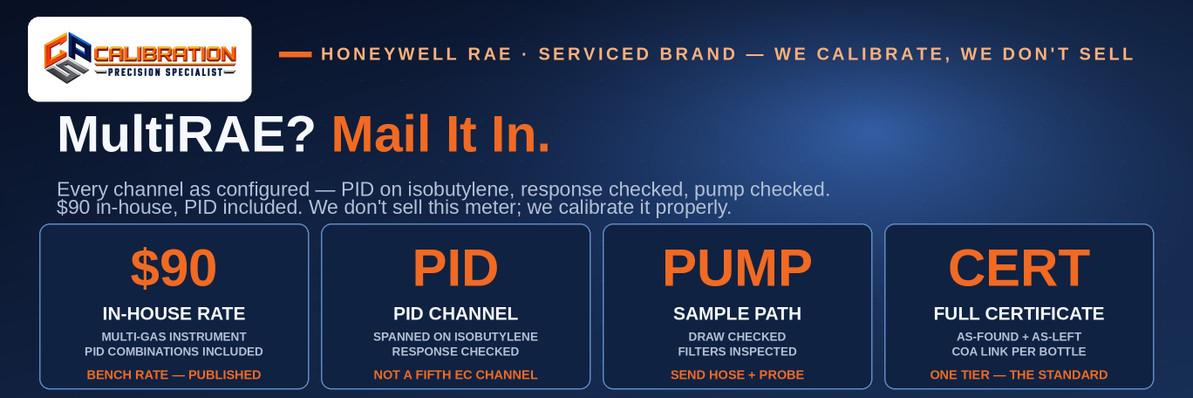
Mail-in calibration for the RAE MultiRAE costs $90 at CPS Calibrations — the published in-house rate for a 4- or 5-gas instrument, PID combinations included — and covers every channel the meter carries as configured, with the PID channel calibrated on isobutylene and its response checked, a draw check and filter inspection on the pumped sample path, as-found readings recorded before any adjustment, a sensor health check, and the meter returned with a certificate showing as-found and as-left data and a Certificate of Analysis link for each calibration gas bottle used. One honest note up front: CPS does not sell RAE instruments — we calibrate them, and this post is only about that service. Ship it to 109 S. Front Street, Rockwood, TN 37854; call 865-900-8844 first to confirm the current turnaround and to note your meter's configuration.
The MultiRAE is a working meter with a split personality: part confined-space multi-gas instrument, part pumped VOC survey tool. That second half is why its calibration cannot be a four-gas span and a handshake. A PID channel spanned on the wrong gas — or not spanned at all — produces a number that looks precise and is not, and the pump that feeds every channel is a wear item whose condition decides what the sensors actually see.
CPS's position on brands like RAE is stated on we calibrate brands we don't sell: the bench calibrates the meter as configured, documents it the same way it documents a brand on our shelves, and never turns a calibration booking into a sales pitch or a blank check. This post is the service page for the MultiRAE: what its calibration covers, why the PID channel gets its own gas and its own check, what the bench checks around the calibration — pump and filters included — and what comes back in the box.
Why Does the PID Channel Change the Calibration?
Because a photoionization detector does not read the standard multi-gas mix at all. A PID is calibrated on isobutylene, the PID reference gas, and its response is then checked against the correction factor for the vapor you actually measure — the factor is what turns an isobutylene-equivalent reading into a reading for your gas. Span a PID on the wrong gas, or skip the response check, and the meter will still display confident numbers that do not mean what the screen says they mean.
So the bench calibrates the MultiRAE as configured: every fitted channel is identified from the meter itself, calibrated against the correct gas for that channel, and reported on the certificate in its own units. The electrochemical and combustible channels span against their documented gases; the PID spans on isobutylene with its response checked. When you call 865-900-8844 before shipping, tell us the configuration — which sensors and which PID are fitted — so the work order names every channel before the meter leaves your dock.
The Pump Check and the Sensor Health Check
A pumped meter is only as honest as its sample path. A weak pump, a cracked hose, or a clogged filter slows the sample, stretches response time, and can starve every sensor in the housing at once — on a multi-channel instrument, one tired filter degrades every reading together. Send the hose and probe you actually sample with, if you use one, and the bench treats the sample path as part of the instrument: the pump's draw is checked and its filters are inspected.
Around the calibration itself sits the sensor health check. Calibration answers whether the meter reads correctly against known gas today; the health check answers whether anything is heading for trouble. A channel that calibrates back into specification behaves differently from one that is sluggish, unstable, or at the edge of its range — and that judgment matters most on the PID, because a specialty channel is the one nobody else on your site can sanity-check. If a sensor is spent or failing, you hear it in a specific form: a written quote before any work, with the choice yours. A calibration booking is never a blank check.
What Comes Back in the Box
Your MultiRAE, calibrated — and its documentation. The certificate is the CPS standard, one tier with the full breakdown: as-found and as-left readings for every channel as configured, and the gas trail behind them — when a calibration gas bottle enters service at CPS, the supplier QR code on it is scanned and its Certificate of Analysis link is stored on the bottle's record, and the certificate carries a clickable CoA link for each bottle used on your meter. The meter is checked in and tracked against its serial number from arrival to return, and its record joins the CPS Calibration Program: its history builds calibration by calibration behind one fleet history link, and a due-date reminder email arrives before the next calibration comes due. No contract, no monthly fee.
Send the meter, its battery and charger, and the hose and probe you use; include a note with your company name, a contact, the meter's serial number, and its sensor configuration. Do not send calibration gas cylinders — we calibrate with our own documented gas. Return shipping is the customer's cost, arranged when the service is booked. The general ship-in process, for any instrument, is in how mail-in gas detector calibration works, and our calibration services page covers the wider bench. You can also start with the ship-in calibration and repair request.
Frequently Asked Questions
How much does it cost to calibrate a RAE MultiRAE?
Ninety dollars at CPS Calibrations. The MultiRAE takes the published in-house rate for 4- and 5-gas instruments — $90, PID combinations included — rather than the $55 single-gas rate. That is a bench rate for calibration performed in-house at our Rockwood, Tennessee shop; it never applies to on-site work, which is quoted in writing. Shipping is separate in both directions, and any sensor or repair work beyond calibration is quoted in writing before it is done.
What does a MultiRAE calibration include?
Calibration of every channel the meter carries as configured, with as-found readings recorded before any adjustment and as-left readings after, the PID channel calibrated on isobutylene with its response checked, a draw check and filter inspection on the pumped sample path, a sensor health check on the bench, and a full certificate showing both sets of readings plus a Certificate of Analysis link for each calibration gas bottle used. The meter's record is entered in the CPS Calibration Program, so its history is kept by serial number and you are reminded before the next due date. There is one certificate tier; the full breakdown is the standard, not an upgrade.
Can you calibrate the PID channel on a MultiRAE?
Yes — and it is calibrated as a PID, not as another electrochemical channel. A photoionization detector is spanned on isobutylene, the PID reference gas, and its response is checked against the correction factor for the vapor being measured. That check is the difference between a PID that displays a number and a PID whose number means what it claims to mean for your vapor.
Does CPS sell RAE detectors?
No — and we say so plainly. CPS does not stock RAE instruments; we calibrate them. Our page we calibrate brands we don't sell explains the policy: a serviced brand gets the same bench discipline, the same certificate, and the same written-quote rule as a brand on our shelves — it just does not get a product card, because there is no CPS product page to link to.
Does the calibration check the MultiRAE's pump?
Yes. On a pumped meter the sample path is part of the measurement: a weak pump or a clogged filter changes what every sensor in the housing actually sees in the field. The bench checks that the pump draws and inspects its filters as part of the visit. Send the hose and probe you sample with, if you use one, so the sample path you carry is the one that leaves checked.
What happens if a sensor on my MultiRAE fails calibration?
The bench finds it and you decide what happens next. The as-found readings and the sensor health check show whether each channel — the PID included — calibrated back into specification or whether a sensor is spent or failing. Anything beyond calibration is quoted in writing for your approval before work begins. Approve the quote and the meter is repaired and calibrated; decline it and the meter returns as-is with its as-found record, which documents exactly where it stands.
Should I send the hose and probe with my MultiRAE?
Yes, if you use one. The combination you carry is the combination that should leave calibrated and checked: send the hose and probe and the bench checks the sample path as part of the visit. Also send the battery and charger your configuration uses, and a note inside the box with your company name, a contact, the meter's serial number, and which sensors are fitted — that configuration note is what lets the bench work order name every channel before the meter arrives. Do not send calibration gas cylinders.
Can I calibrate my MultiRAE myself instead?
You can, if you own the gases and keep the records. The honest trade-off is scope: doing a MultiRAE yourself means owning the documented gas for each fitted toxic and combustible channel plus isobutylene for the PID, checking PID response, maintaining the pump and filters, and keeping as-found and as-left records for every channel. Mailing the meter in means the bench does it with documented gas and returns a certificate with the full breakdown and the gas's CoA trail, with the record kept in the CPS Calibration Program.
Why does the configuration matter when I book?
Because two MultiRAEs side by side on the bench can share little beyond the case: the fitted sensor set and the PID decide which gases the bench needs and which lines appear on the certificate. Telling us the configuration when you call 865-900-8844 lets the work order name every channel before the meter leaves your dock, so nothing fitted is left unverified and nothing un-fitted is billed for. The rate does not change with configuration — $90 in-house, PID combinations included.
How long will my MultiRAE be gone?
Call 865-900-8844 before you ship and we will confirm the current turnaround for the bench queue — and note your meter's configuration on the work order while you are on the call. We do not publish a fixed turnaround, because it honestly depends on the queue that week and on what the meter needs — a straightforward calibration moves with the queue, while a meter waiting on your approval of a sensor quote waits on that decision and on parts. Transit time in both directions is the carrier's. The rate, by contrast, is fixed and published: $90 in-house for the MultiRAE's channels.
The Bottom Line
A MultiRAE is only as calibrated as its least-checked channel — and its PID is the channel a generic calibration never touches. Mail yours to CPS Calibrations and for the published $90 in-house rate you get every channel calibrated as configured — PID on isobutylene, response checked — as-found readings recorded before adjustment, a pump draw check and filter inspection, a sensor health check, a written quote before any repair, and a certificate with as-left data and the calibration gas's CoA trail, plus a program record that reminds you next time. We do not sell this meter. We calibrate it like it was one of ours.
Ready to mail your MultiRAE in? Call CPS Calibrations at 865-900-8844 to confirm the turnaround and note your configuration, then ship it to 109 S. Front Street, Rockwood, TN 37854.
--- CPS Calibrations · 109 S. Front Street, Rockwood, TN 37854 · We Calibrate Brands We Don't Sell · How Mail-In Calibration Works · Calibration Services
Ready to mail in your MultiRAE?
Start the ship-in request, pack the meter, and we handle the rest — every channel calibrated as configured, full certificate returned with it.
Start Your Ship-In Requestor call 865-900-8844
Recent Posts
-

How to Read a PID Correction Factor Chart
To read a PID correction factor chart, find your vapor’s row, take the factor under your own lamp en …Nov 21st 2026 -

PID Lamp Energies: 10.0 vs. 10.6 vs. 11.7 eV — Which Lamp Sees Your Vapor?
A photoionization detector (PID) can only detect a vapor whose ionization energy is below its lamp e …Nov 20th 2026 -

Catalytic Bead vs. Infrared vs. Hydrocarbon Sensors: What Can Each LEL Sensor Detect?
A catalytic bead LEL sensor detects almost any combustible gas — including hydrogen — but it needs o …Nov 19th 2026