
RKI 04 Series Calibration Service: Mail In Your Single-Gas Monitor
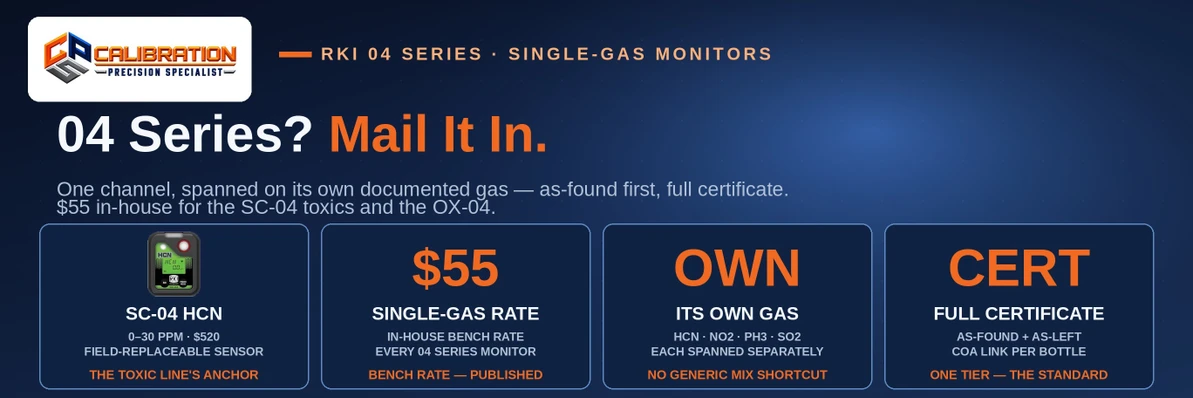
Mail-in calibration for an RKI 04 Series single-gas monitor costs $55 at CPS Calibrations — the published in-house rate for a single-gas instrument — and covers the monitor's one channel spanned on its own documented gas: the SC-04 toxic line (hydrogen cyanide 0–30 ppm, nitrogen dioxide 0–20 ppm, phosphine 0–20 ppm, or sulfur dioxide 0–100 ppm, each $520) or the OX-04 oxygen monitor ($205), with the as-found reading recorded before any adjustment, a sensor health check, and the monitor returned with a certificate showing as-found and as-left data and a Certificate of Analysis link for the calibration gas bottle used. Ship it to 109 S. Front Street, Rockwood, TN 37854; call 865-900-8844 first to confirm the current turnaround.
Single-gas monitors live or die on one channel. There is no second sensor to cross-check, no neighboring reading to make a drifting channel look suspicious — when an SC-04's one toxic sensor moves, the display simply keeps showing a confident, wrong number. That is why the as-found reading matters more on a single-gas monitor than on any other instrument we calibrate: it is the only evidence of what the meter was actually telling its wearer before the bench touched it.
This post is the service page for the RKI 04 Series: the SC-04 toxic monitors and the OX-04, what each one's calibration covers, why each toxic gets its own gas, and what comes back in the box. The card below is the RKI SC-04 hydrogen cyanide monitor — and if you want the hazard behind that gas first, what is hydrogen cyanide is the background read.
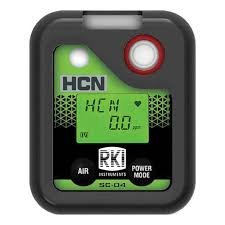
RKI SC-04 Hydrogen Cyanide (HCN) Single Gas Monitor
Compact single-gas HCN monitor, 0–30 ppm — field-replaceable sensor, IP67, diffusion sampling.
$520
See the SC-04 HCNThe 04 Series Line, Gas by Gas
The 04 Series is RKI's single-gas family: compact diffusion monitors, each built around one field-replaceable sensor, with audible, visual, and vibration alarms and an IP67 enclosure. The members CPS sells — and the channels the bench calibrates — are:
- SC-04 hydrogen cyanide (HCN), 0–30 ppm — $520. RKI part 73-0071. The SC-04 pattern in its purest form: diffusion sampling, response T90 within 30 seconds, two AAA alkaline batteries, datalogging, and a 3-year warranty on the instrument record.
- SC-04 nitrogen dioxide (NO₂), 0–20 ppm — $520. The SC-04 NO₂ build, for the diesel-and-combustion corners where NO₂ is the exposure that sneaks up.
- SC-04 phosphine (PH₃), 0–20.00 ppm — $520. The SC-04 PH₃ build, carried where fumigation and semiconductor work put phosphine in the air.
- SC-04 sulfur dioxide (SO₂), 0–100 ppm — $520. The SC-04 SO₂ build, the widest range in the SC-04 toxic line.
- OX-04 oxygen (O₂) — $205. The OX-04 is the family's oxygen member, with a field-replaceable oxygen sensor — the channel that catches both deficient and enriched air.
Each of those channels spans against a different gas, at a different concentration, which is the whole point of the next section: there is no such thing as a generic single-gas calibration.
Why Does Each Toxic Get Its Own Gas?
Because an electrochemical toxic sensor is calibrated against its own gas. An HCN sensor spanned on the wrong gas — or on a multi-gas mix that does not contain HCN at all — has not been calibrated; it has been exposed to gas and sent home. The bench identifies the channel from the monitor itself, spans it against the documented gas for that toxic at its documented concentration, and reports the result on the certificate in its own units and range.
Around the calibration sits the sensor health check. Calibration answers whether the channel reads correctly against known gas today; the health check answers whether the sensor is heading for trouble — sluggish, unstable, or at the edge of its range. On a single-gas monitor that judgment carries extra weight, because the wearer has no second channel to contradict a dying sensor. If the sensor is spent or failing, you hear it in a specific form: a written quote before any work, with the choice yours. A calibration booking is never a blank check.
What Comes Back in the Box
Your 04 Series monitor, calibrated — and its documentation. The certificate is the CPS standard, one tier with the full breakdown: the as-found and as-left readings for its channel, and the gas trail behind them — when a calibration gas bottle enters service at CPS, the supplier QR code on it is scanned and its Certificate of Analysis link is stored on the bottle's record, and the certificate carries a clickable CoA link for the bottle used on your monitor. The monitor is checked in and tracked against its serial number from arrival to return, and its record joins the CPS Calibration Program: its history builds calibration by calibration behind one fleet history link, and a due-date reminder email arrives before the next calibration comes due. No contract, no monthly fee.
Send the monitor (its batteries are standard AAAs — no charger to pack), and include a note with your company name, a contact, and the monitor's serial number. Do not send calibration gas cylinders — we calibrate with our own documented gas. Return shipping is the customer's cost, arranged when the service is booked. The general ship-in process, for any instrument, is in how mail-in gas detector calibration works, and our calibration services page covers the wider bench. You can also start with the ship-in calibration and repair request.
Frequently Asked Questions
How much does it cost to calibrate an RKI 04 Series monitor?
Fifty-five dollars at CPS Calibrations — the published in-house rate for a single-gas instrument. That is a bench rate for calibration performed in-house at our Rockwood, Tennessee shop; it never applies to on-site work, which is quoted in writing. Shipping is separate in both directions, and any sensor or repair work beyond calibration is quoted in writing before it is done.
What does an 04 Series calibration include?
Calibration of the monitor's single channel against its own documented gas, with the as-found reading recorded before any adjustment and the as-left reading after, a sensor health check on the bench, and a full certificate showing both readings plus a Certificate of Analysis link for the calibration gas bottle used. The monitor's record is entered in the CPS Calibration Program, so its history is kept by serial number and you are reminded before the next due date. There is one certificate tier; the full breakdown is the standard, not an upgrade.
Which 04 Series monitors does CPS calibrate?
The whole line we sell: the SC-04 in its four toxic builds — hydrogen cyanide 0–30 ppm, nitrogen dioxide 0–20 ppm, phosphine 0–20 ppm, and sulfur dioxide 0–100 ppm, each $520 — and the OX-04 oxygen monitor at $205. Each is a single-gas instrument, so each takes the $55 single-gas in-house rate. Tell us which gas your monitor carries when you call, and the work order names that channel and its gas before the monitor leaves your dock.
Why can't a multi-gas mix calibrate an SC-04?
Because the standard multi-gas mix does not contain your toxic. A four-gas cylinder carries combustible gas, oxygen, carbon monoxide, and hydrogen sulfide — an SC-04 for hydrogen cyanide, nitrogen dioxide, phosphine, or sulfur dioxide exposed to that mix has had none of its target gas applied to its sensor, so nothing about its reading has been verified. Each SC-04 channel is spanned on its own documented gas at its documented concentration; that is what calibration means for a specialty toxic.
What happens if the sensor in my 04 Series monitor fails calibration?
The bench finds it and you decide what happens next. The as-found reading and the sensor health check show whether the channel calibrated back into specification or whether the sensor is spent or failing. The 04 Series sensors are field-replaceable by design, and anything beyond calibration is quoted in writing for your approval before work begins. Approve the quote and the monitor is repaired and calibrated; decline it and the monitor returns as-is with its as-found record, which documents exactly where it stands.
Is the OX-04 really a single-gas calibration at $55?
Yes. The OX-04 carries one channel — oxygen — so it takes the published $55 single-gas in-house rate, not the multi-gas rate. Oxygen sensors drift with age and exposure, which is why the as-found reading is recorded before adjustment: it is the evidence of how far the channel had moved while it was protecting its wearer. The certificate reports the channel's as-found and as-left readings and links the Certificate of Analysis for the gas used.
Can I calibrate my 04 Series monitor myself instead?
You can — the platform is designed for user calibration, with field-replaceable sensors. The honest trade-off is gas and documentation: doing an SC-04 yourself means owning the correct documented gas for your specific toxic, in date, plus keeping as-found and as-left records an auditor will accept. Most shops own four-gas mix for their multi-gas meters and no HCN, NO₂, PH₃, or SO₂ gas at all — which is exactly the gap a $55 mail-in calibration closes. Mailing it in returns a certificate with the full breakdown and the gas's CoA trail, with the record kept in the CPS Calibration Program.
What should I send with my 04 Series monitor?
Just the monitor and a note inside the box with your company name, a contact, and the monitor's serial number. The 04 Series runs on standard AAA alkaline batteries, so there is no charger to pack. Do not send calibration gas cylinders; CPS calibrates with its own documented gas, and the certificate links to that gas's Certificate of Analysis. If you carry the monitor on a specific clip or boot you want checked, say so when you call.
How long will my 04 Series monitor be gone?
Call 865-900-8844 before you ship and we will confirm the current turnaround for the bench queue. We do not publish a fixed turnaround, because it honestly depends on the queue that week and on what the monitor needs — a straightforward calibration moves with the queue, while a monitor waiting on your approval of a sensor quote waits on that decision and on parts. Transit time in both directions is the carrier's. The rate, by contrast, is fixed and published: $55 in-house for a single-gas 04 Series monitor.
What does a new 04 Series monitor cost, if mine is beyond repair?
The SC-04 toxic builds — hydrogen cyanide, nitrogen dioxide, phosphine, and sulfur dioxide — are $520 each on our store, and the OX-04 oxygen monitor is $205. Most 04 Series monitors that fail calibration need a sensor, not a replacement — the sensors are field-replaceable by design — and because repairs are quoted in writing first, you will have the real repair figure in hand before a repair-or-replace decision has to be made.
The Bottom Line
A single-gas monitor has one channel and no backup — its calibration is the whole safety case. Mail yours to CPS Calibrations and for the published $55 in-house rate you get that channel spanned on its own documented gas, the as-found reading recorded before adjustment, a sensor health check, a written quote before any repair, and a certificate with as-left data and the calibration gas's CoA trail, plus a program record that reminds you next time.
Ready to mail your 04 Series monitor in? Call CPS Calibrations at 865-900-8844 to confirm the turnaround, then ship it to 109 S. Front Street, Rockwood, TN 37854.
--- CPS Calibrations · 109 S. Front Street, Rockwood, TN 37854 · RKI SC-04 HCN · What Is Hydrogen Cyanide? · Calibration Services
Ready to mail in your 04 Series monitor?
Start the ship-in request, pack the meter, and we handle the rest — every channel calibrated as configured, full certificate returned with it.
Start Your Ship-In Requestor call 865-900-8844
Recent Posts
-

What Is Remote Monitoring for Fixed Gas Detection?
Remote monitoring for fixed gas detection means a fixed system's live readings, trends, and alarm hi …Nov 23rd 2026 -

What Are the Key Differences Between the GX-6000 and GX-6100?
The RKI GX-6100 is the current replacement for the discontinued GX-6000: both are pumped 6-gas monit …Nov 22nd 2026 -

How to Read a PID Correction Factor Chart
To read a PID correction factor chart, find your vapor’s row, take the factor under your own lamp en …Nov 21st 2026