
RKI GasWatch 3: The Gas Monitor You Wear Like a Watch
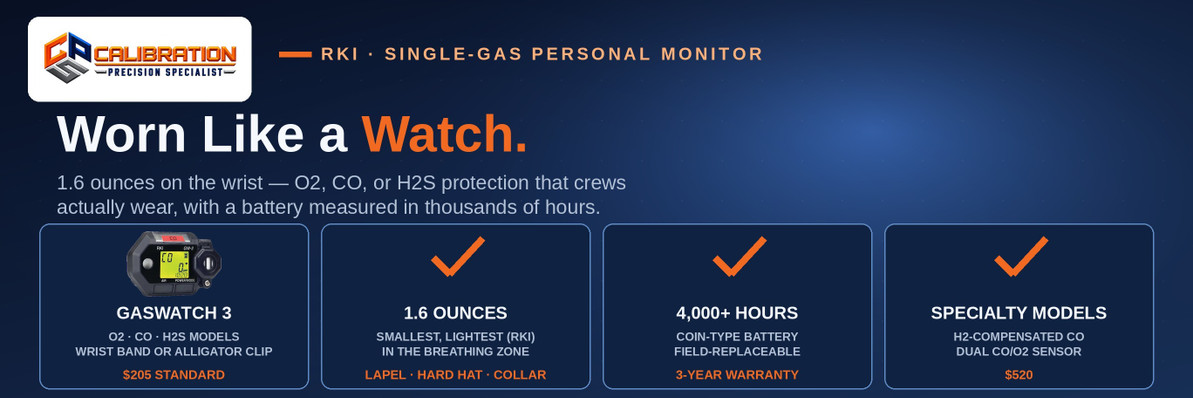
The RKI GasWatch 3 is a single-gas personal monitor that weighs 1.6 ounces and is worn on the wrist like a watch — or clipped to a lapel, hard hat, or collar — in versions for oxygen, carbon monoxide, and hydrogen sulfide. Its field-replaceable coin-type battery runs the standard models for over 4,000 hours of continuous operation, and it carries a 3-year warranty. Standard models are $205 at CPS Calibrations; the hydrogen-compensated CO and dual CO/O2 models are $520.
Personal monitoring has a compliance problem that has nothing to do with sensors: the monitor that gets clipped on under protest, migrates to a belt loop behind the back, and eventually gets 'forgotten' in the gang box protects nobody. The RKI GasWatch 3 is designed against that failure mode. RKI describes it as the world's smallest and lightest single-gas monitor — 1.6 ounces — and its default home is the one piece of safety equipment nobody argues about wearing: a wrist.
RKI GasWatch 3 Single Gas Personal Monitor
The RKI GasWatch 3 (from $205 at CPS) is a 1.6-ounce single-gas personal monitor worn on the wrist like a watch or clipped to a lapel, hard hat, or collar — O2, CO, or H2S, over 4,000 hours on a coin-type battery, 3-year warranty: models, prices, battery life, and its honest limits.
$205–$520 configured
See the GasWatch 3 SingleWhy Does Wearing It Like a Watch Matter?
Two reasons, one ergonomic and one technical. Ergonomically, a watch is worn, not carried: it goes on in the morning with no decision, no clip hunting, no 'where does this hang on this harness.' A monitor that light and that automatic simply has a higher wear rate across a crew, and wear rate is the metric that decides whether a monitoring program is real.
Technically, the wrist keeps the sensor near the breathing zone on most work — and when the job puts the breathing zone somewhere the wrist isn't, the same unit moves: every GasWatch 3 configuration is sold with either a wrist band or an alligator clip, and RKI's own description has it clipped to a lapel, hard hat, or other safety equipment in the breathing zone. The form factor is a choice, made per wearer and per task, not a fixed compromise.
What Gases Does the GasWatch 3 Cover?
| Model | Protects against | Price at CPS |
|---|---|---|
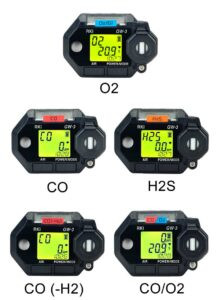
| GW-3 (O2) | Oxygen deficiency — O2, 0–25% vol | $205 |
| GW-3 (CO) | Carbon monoxide — CO, 0–2,000 ppm | $205 |
| GW-3 (H2S) | Hydrogen sulfide — H2S, 0–200 ppm | $205 |
| GW-3 (C-) | Carbon monoxide with hydrogen compensation — for steel mills, refineries, and other hydrogen environments | $520 |
| GW-3 (CX) | Dual sensor: carbon monoxide (0–300 ppm) and oxygen (0–25% vol) together | $520 |
The specialty models deserve their line of explanation. A standard CO sensor can be fooled by hydrogen — it reads some of the hydrogen as carbon monoxide — which in a steel mill or refinery means nuisance alarms that train crews to ignore the instrument. The H2-compensated model exists to keep CO readings honest in hydrogen-rich air. The dual CX model pairs the two gases that most often travel together in complaint calls — CO and oxygen displacement — in the same 1.6-ounce format.
How Does a Coin Battery Run a Gas Monitor for 4,000 Hours?
By being honest about what the instrument does: one sensor, a display, an alarm — no pump, no backlit color screen, no radio. The small, field-replaceable coin-type lithium-ion battery gives the standard GasWatch 3 models over 4,000 hours of continuous operation; the H2-compensated CO model runs up to 2,500 hours and the dual-sensor CX up to 2,000 hours, because both work their sensors harder. In practical terms the battery stops being a shift chore and becomes a maintenance-interval item — and when it does run down, it is replaced in the field, not soldered at a depot. Coupled with the 3-year warranty, RKI positions the GasWatch 3 on low cost of ownership, and the arithmetic is genuinely hard to argue with.
What Can't a GasWatch 3 Do?
The limits are the flip side of the format, and they should be stated as plainly as the features:
- One gas (or two, on the CX). A GasWatch 3 watches the gas it was bought for. It does not measure combustible %LEL at all — a crew entering a space with a flammable-atmosphere question needs a multi-gas monitor with an LEL channel, full stop.
- It is a personal monitor, not an investigation instrument. No pump, no ppm leak search, no sample draw. Finding a leak or clearing a space remotely is other tools' work — the SC-8000 for drawn toxic samples, the pumped detectors in our SENSIT spotlights for leak hunting.
- Small is a choice. Crews who want a big display, a pumped multi-gas, and a docking-station fleet program are shopping a different category — and should. The GasWatch 3 is for the large middle: one known gas, one worker, all shift, no excuses.
Bump Testing and Calibration for Something This Small
Small does not exempt it from the discipline. The product record's own guidance: bump test before each day's use, and calibrate at least every six months — sooner if a bump fails, readings drift, or the unit takes a harsh exposure. CPS calibrates the GasWatch 3 in-house for $55 at the single-gas rate, with as-found and as-left readings on the certificate; see calibration services or call 865-900-8844. Every unit we calibrate joins the CPS Calibration Program, so a fleet of wrist monitors gets the same due-date tracking as the big instruments — which is usually where small-monitor programs quietly fall apart. For the standard a calibration provider should meet, see who can calibrate my gas detector.
Frequently Asked Questions
What is the RKI GasWatch 3?
The RKI GasWatch 3 is a single-gas personal monitor that weighs 1.6 ounces and is worn on the wrist like a watch, or clipped into the breathing zone on a lapel, hard hat, or collar with an alligator clip. RKI describes it as the world's smallest and lightest single-gas monitor. It comes in oxygen, carbon monoxide, and hydrogen sulfide models, plus a hydrogen-compensated CO model and a dual CO/O2 model, with a 3-year warranty.
How much does the RKI GasWatch 3 cost?
At CPS Calibrations the standard GasWatch 3 models — oxygen (0–25% vol), hydrogen sulfide (0–200 ppm), and carbon monoxide (0–2,000 ppm) — are $205 each, with your choice of wrist band or alligator clip. The hydrogen-compensated CO model and the dual CO/O2 model are $520. Every model carries RKI's 3-year warranty.
How long does the GasWatch 3 battery last?
The GasWatch 3 uses a small, field-replaceable, coin-type lithium-ion battery. Standard models run over 4,000 hours of continuous operation; the hydrogen-compensated CO model runs up to 2,500 hours; and the dual-sensor CO/O2 model up to 2,000 hours. Because the battery is field-replaceable, a depleted battery is a quick swap in the field, not a depot repair.
What is the hydrogen-compensated GasWatch 3 for?
Standard CO sensors also respond to hydrogen, so in hydrogen-rich environments — steel mills, refineries, and similar plants — an ordinary CO monitor can over-read and produce nuisance alarms. The GW-3 (C-) compensates for hydrogen so its carbon monoxide reading stays honest where hydrogen is present. It is one of the two $520 specialty models; the standard CO model is $205.
Can the GasWatch 3 replace a 4-gas monitor?
No. The GasWatch 3 measures one gas — or two on the dual CO/O2 model — and has no combustible (%LEL) channel. Where a job requires multi-gas monitoring, especially confined-space entry with a flammable-atmosphere question, a 4-gas monitor is the right instrument. The GasWatch 3 fits the many jobs where the known hazard is a single gas and the priority is a monitor that is actually worn all shift.
How do you wear the GasWatch 3?
Two ways, chosen at order: on a wrist band, like a watch — the configuration it is named for — or on an alligator clip that attaches to a lapel, hard hat, collar, or other safety equipment so the sensor sits in the breathing zone. At 1.6 ounces it is light enough that either way, crews tend to forget it's there, which is precisely the point of the design.
How often does a GasWatch 3 need bump testing and calibration?
Bump test before each day's use, and calibrate at least every six months — sooner if a bump test fails, readings drift, or the instrument is exposed to high gas concentrations or harsh conditions. CPS calibrates the GasWatch 3 in-house for $55 at the single-gas rate, with a certificate showing as-found and as-left readings, and enrollment in the CPS Calibration Program for due-date reminders is free.
What warranty does the GasWatch 3 carry?
The GasWatch 3 carries a 3-year warranty, per RKI's product record. Combined with the field-replaceable coin battery and 2,000–4,000+ hour battery life depending on model, the warranty is a large part of the instrument's low cost of ownership: there is very little on it to wear out, send back, or pay to maintain.
Is the GasWatch 3 good for confined space entry?
It depends on the space's hazards. If the entry program's atmospheric testing covers the gases the GasWatch 3 model measures and no combustible (%LEL) monitoring is required, a wrist-worn unit can serve as the continuous personal monitor during entry. If the space needs the standard four-gas picture — LEL, O2, CO, H2S together — that requires a multi-gas monitor, and the GasWatch 3 does not substitute for it. Match the instrument to the entry permit's stated hazards, not the other way round.
Who can calibrate an RKI GasWatch 3?
CPS Calibrations calibrates the GasWatch 3 in-house at 109 S. Front Street, Rockwood, TN for $55 at the single-gas rate — call 865-900-8844 to book units in. The certificate carries as-found and as-left readings for the channel, and each calibrated unit is enrolled free in the CPS Calibration Program, which tracks its due date and sends a reminder ahead of the next calibration.
The Bottom Line
The GasWatch 3's argument is simple: the monitor that gets worn is the one that works. At 1.6 ounces, on a wrist, with a battery measured in thousands of hours and a 3-year warranty, it removes every practical excuse for a known single-gas hazard to go unwatched. $205 for the standard gases; $520 when hydrogen or a dual CO/O2 picture enters the story.
Outfitting a crew, or adding wrist monitors alongside your multi-gas fleet? Call CPS Calibrations at 865-900-8844 — we sell the GasWatch 3 in every configuration, and we calibrate every channel we sell.
CPS Calibrations · 109 S. Front Street, Rockwood, TN 37854 · Calibration Services · The CPS Calibration Program
Need a calibration you can file?
In-house calibration at CPS in Rockwood, Tennessee — $55 for single-gas instruments, $90 for 4- and 5-gas — every channel, as-found and as-left data, full certificate.
See Calibration Servicesor call 865-900-8844
Recent Posts
-

What Is Remote Monitoring for Fixed Gas Detection?
Remote monitoring for fixed gas detection means a fixed system's live readings, trends, and alarm hi …Nov 23rd 2026 -

What Are the Key Differences Between the GX-6000 and GX-6100?
The RKI GX-6100 is the current replacement for the discontinued GX-6000: both are pumped 6-gas monit …Nov 22nd 2026 -

How to Read a PID Correction Factor Chart
To read a PID correction factor chart, find your vapor’s row, take the factor under your own lamp en …Nov 21st 2026